Civil War Correspondents Memorial Has Become Writer’s Legacy
By Bob Ruegsegger · Originally published October 2020 · pp. 12–13
Civil War newspaper correspondent George Alfred Townsend’s once pretentious mountain estate is now embraced by Gathland State Park at Crampton’s Gap in the South Mountain range near Sharpsburg, Md. At twenty years of age, Townsend was the youngest of the Civil War correspondents. Originally, he wrote for the Philadelphia Inquirer, then for James Gordon Bennett’s New York Herald in 1861. The New York Herald sent the 20-year-old reporter to cover General McClellan’s Peninsula Campaign and Cedar Mountain in 1862. Townsend did not have a high opinion of most of his co-workers at the Herald. He characterized them as “uneducated, flimsy-headed, often middle-aged, misplaced people.” They were, in his view, “not fit to describe a fire.” Townsend used the pseudonym “Gath” in his battlefield reports. His pen name was derived from using his initials “GAT” and adding the letter “H.” When bylines (signatures) were later required by general order, the young correspondent embraced the opportunity to capture public credit for his writing. In August, soon after the Seven Days Battles and the Battle of Cedar Mountain, Townsend left for England, where his articles and lectures championed the Union cause. His lecture tour drew large audiences. Englishmen were interested in what the twenty-one-year-old American had to say. Townsend published his Campaigns of a Non-Combatant in England, in 1863. His descriptions of battlefields and fortifications were accurate, vivid, and detailed. Townsend had flair; he typically set the stage geographically, and enhanced the setting with specifics. When Townsend returned to New York in 1864, he was hired by the New York World to cover the concluding battles of the war; among them the overwhelming Union victory at the Battle of Five Forks, near Petersburg, in April 1865. He gained additional prestige as a noteworthy writer for his reports on the assassination of President Lincoln and the escape and capture of the assassin John Wilkes Booth.
Following the war, George Townsend married Elizabeth Evans Rhodes. He became an independent journalist and remained one for the rest of his life. Townsend preferred writing about what interested him rather than “cranking out” articles. He did not syndicate himself. Gath sold his work directly to a number of individual newspapers and averaged two columns per diem. He maintained a home in Washington, D.C., because of his keen interest in politics. While doing research on the Maryland Campaign, specifically Antietam, he became enamored with the inspiring vista that South Mountain offered. In 1892, he purchased 110 acres around where the Battle of Crampton’s Gap was fought prior to the bloodbath at Antietam. Townsend regarded the mountain site as the perfect place for a retreat to evade the pressures of his life as a journalist/writer in Washington, D.C. “In his own way, he was as famous as Mark Twain. Everybody knew him,” said Dianne Wiebe, author of George Alfred Townsend and Gathland. “While we have his books, novels, and poems – especially poems, they never caught on the way Mark Twain’s [works] did,” she noted. “His best work was in the newspapers – columns.” Townsend was content with his place in the world. Gath, as he called himself, took pride in being one of journalism’s “Young Turks.” He was popular with the public, financially successful, and highly respected by his colleagues. Townsend earned a fortune and spent it on his lavish mountain estate. When he reached his 60’s, Gath began to review his life, assess his accomplishments, and consider his legacy. He was no longer making money. He missed the public acclaim and felt neglected by his friends. His children weren’t interested in preserving his journalistic legacy or inheriting his highland estate. No one had expressed interest in compiling his papers. Townsend began writing his memoirs but died before completing them.
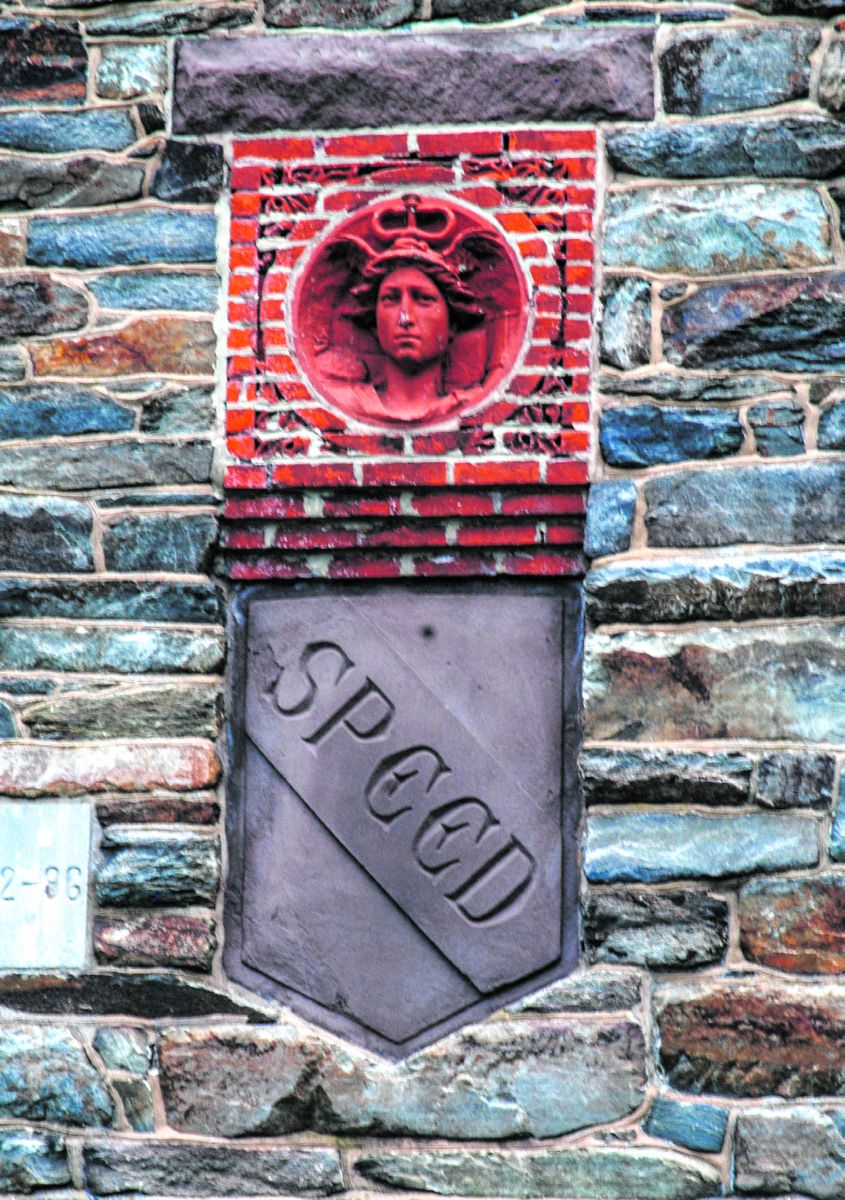
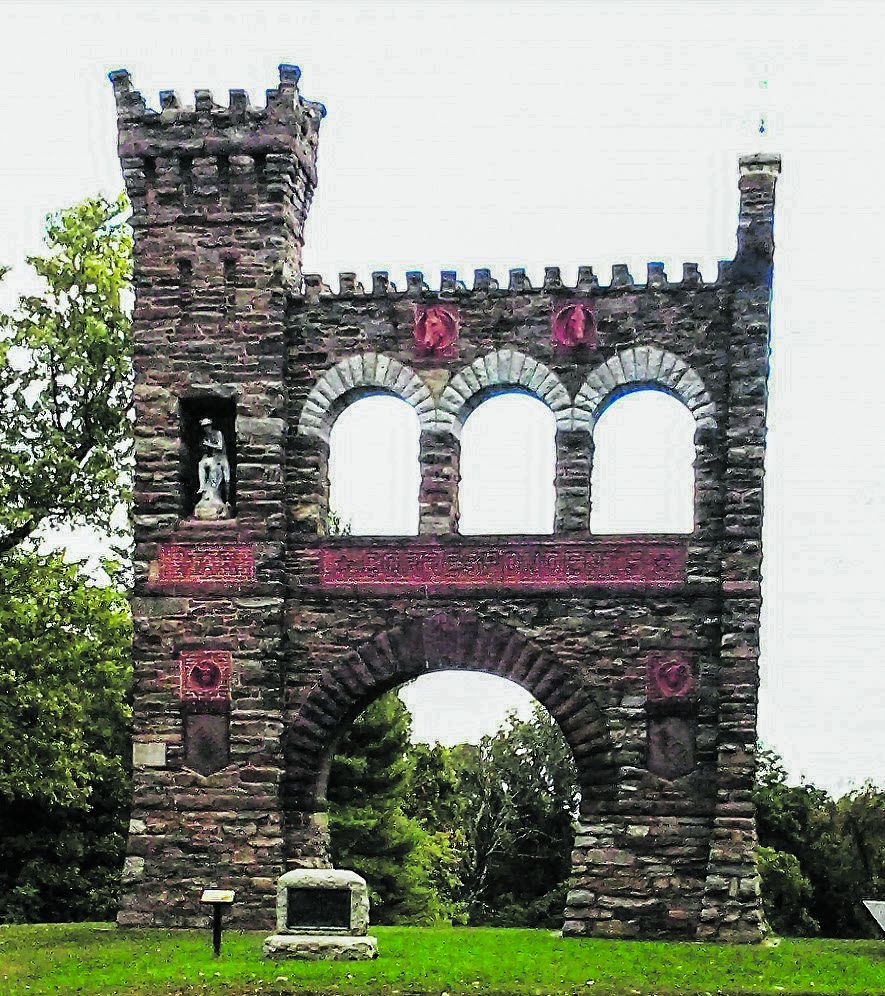
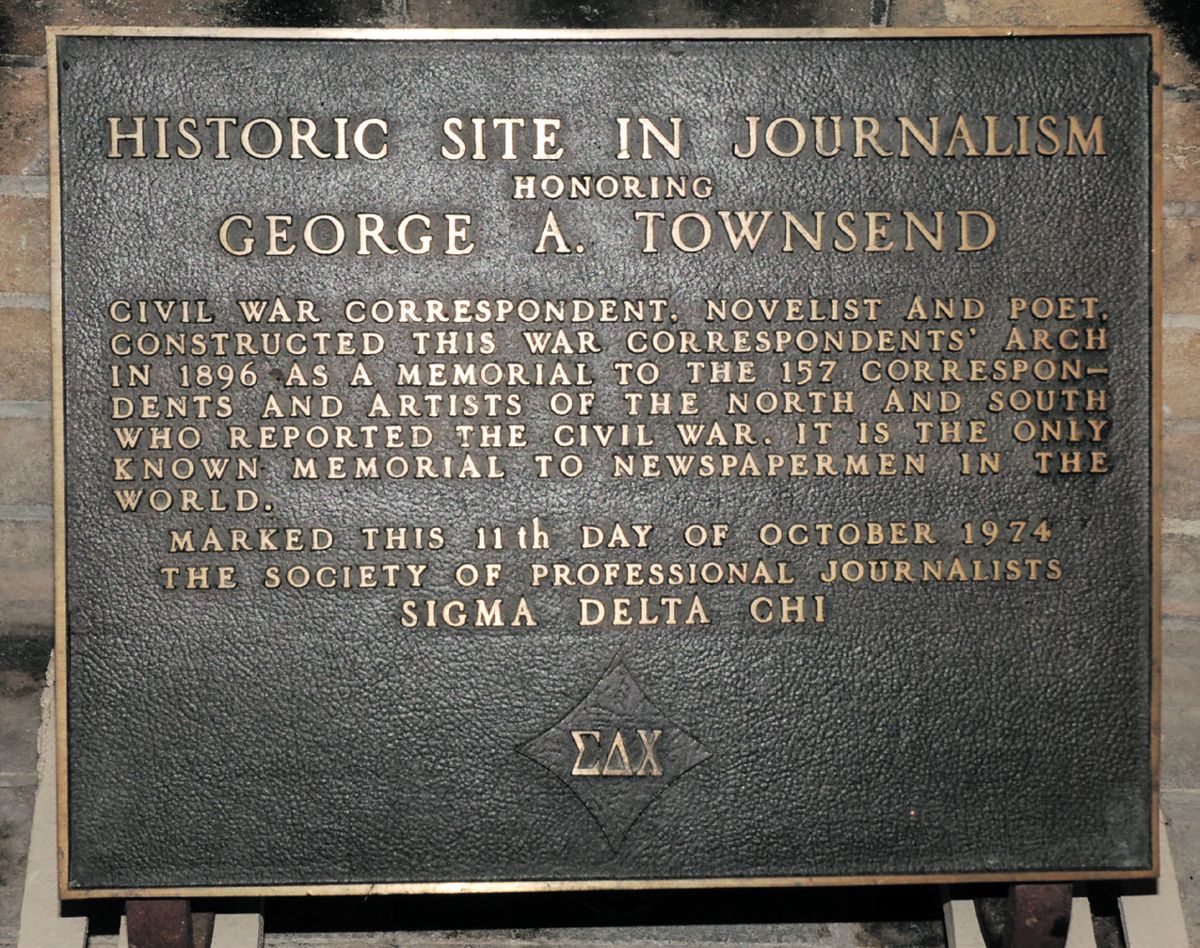
“He was a good, good writer, but his literary work was mediocre,” said Dianne Wiebe. “He was left with this beautiful bunch of buildings. His money was running out,” she noted. “At this age, about 60, his health was fading. His wife was dying and taking a long time to do it.” Seeing Mark Twain’s reputation skyrocket into the 20th century made Townsend recognize that he would probably be forgotten. Gath decided that he had to do something to guarantee that his memory would not fade into oblivion. He may have been old, sick, and broke, but he was determined not to be forgotten. Townsend resolved that he would erect an impressive monument in the form of a huge arch to commemorate the Bohemian Brigade, the corps of war correspondents, writers, and artists assigned by the newspapers to cover the Civil War. “Gath goes out to his wealthy chums and raises $5,000 – which was huge back then,” said Wiebe. “He designed the arch and took it to an architect. It took a year to build it. It was dedicated in 1896,” she said. “That was the last hurrah – the last big thing.” The War Correspondents Memorial Arch, commissioned by Townsend, climbs 50 feet into the sky above South Mountain at Crampton’s Gap. The massive stone structure is 40 feet wide. Today Gath’s memorial arch,
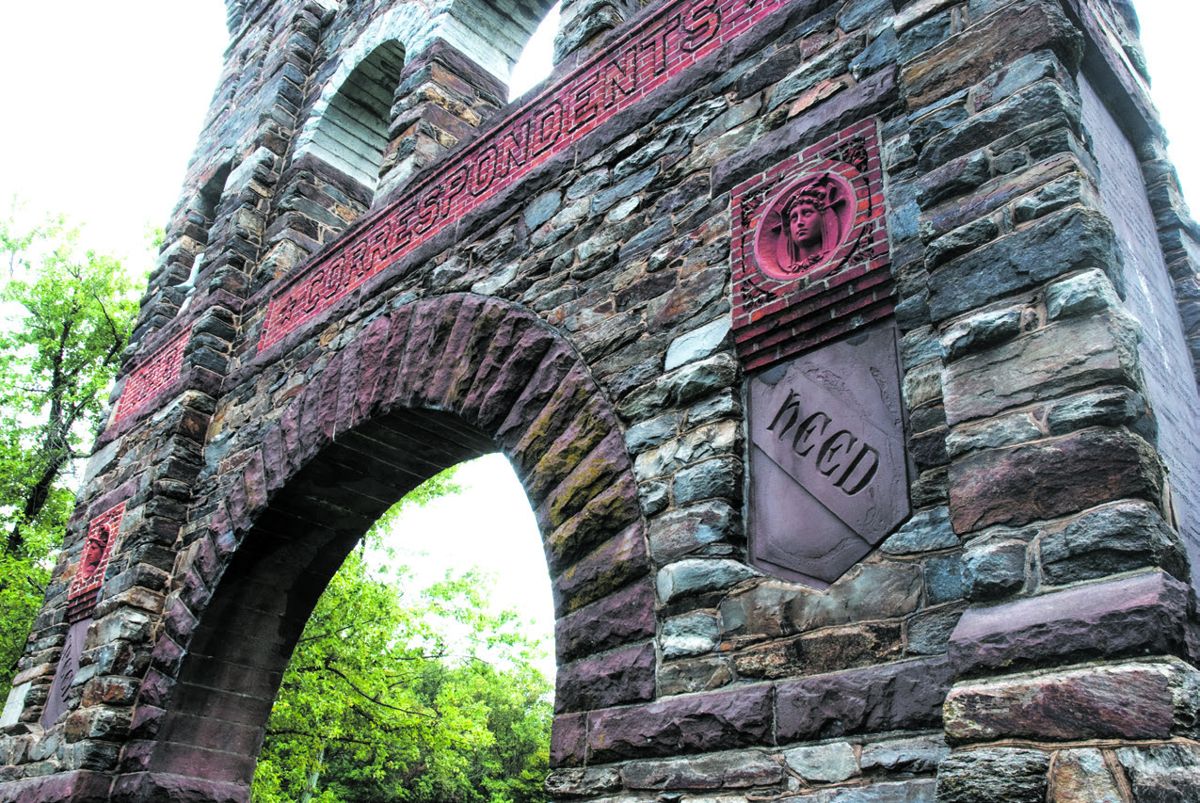
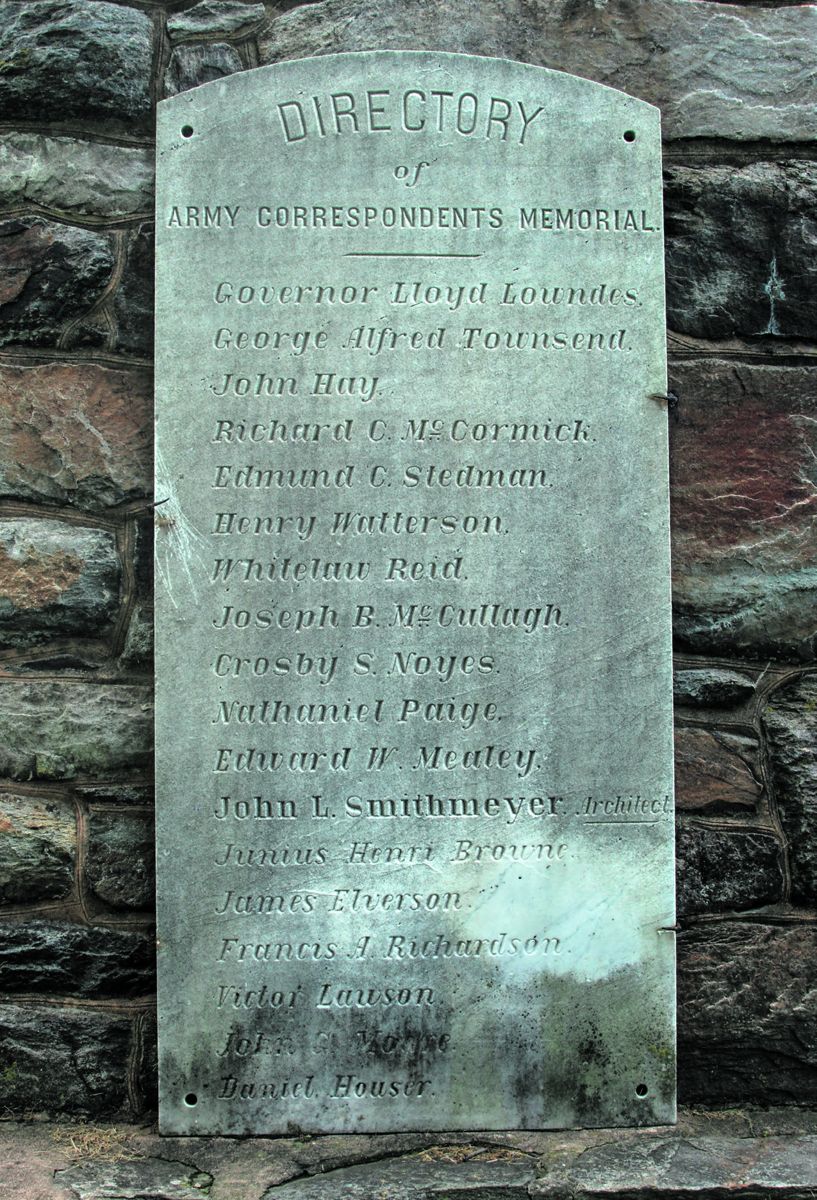
This bobble-head figure depicts George Alfred Townsend who prided himself in being one of the “Young Turks” of journalism during and after the Civil War. a National Historic Landmark, is maintained by the National Park Service. It is located in Maryland’s Gathland State Park. Tablets attached to the memorial were inscribed with the names of 157 correspondents and artists who reported and illustrated nearly every Civil War event over the course of four years. George Alfred Townsend included his own name in the list of war correspondents. Gath did not forget himself. Note: While the grounds and pavilions at Gathland State Park are open to the public, the museums are presently closed due to COVID-19 considerations. The Appalachian National Scenic Trail traverses the park and passes the base of the War Correspondents Memorial Arch. The park is open from 8 a.m. until sunset. Bob Ruegsegger is an American by birth and a Virginian. His assignments frequently take him to historic sites throughout Virginia, the Mid-Atlantic, and the Southeast. His favorite haunts include sites within Virginia’s Historic Triangle—Jamestown, Yorktown, and Williamsburg. Bob served briefly in the U.S. Navy. He is a retired educator and has been an active newspaper journalist for the last twenty years.