
Through The Lens
A Glorious Charge: Armstrong’s Raid – Part 2
By Stephanie Hagiwara · Originally published October 2020 · pp. 22–23
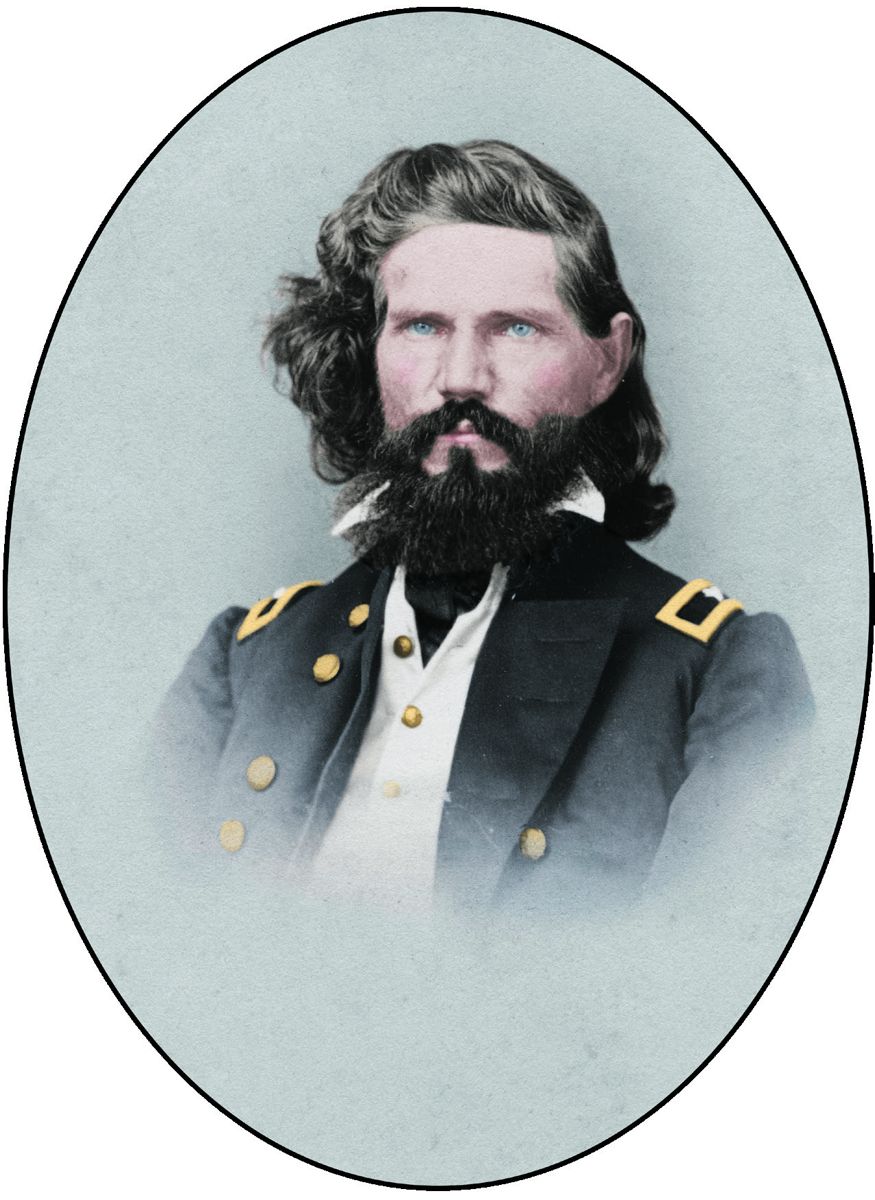
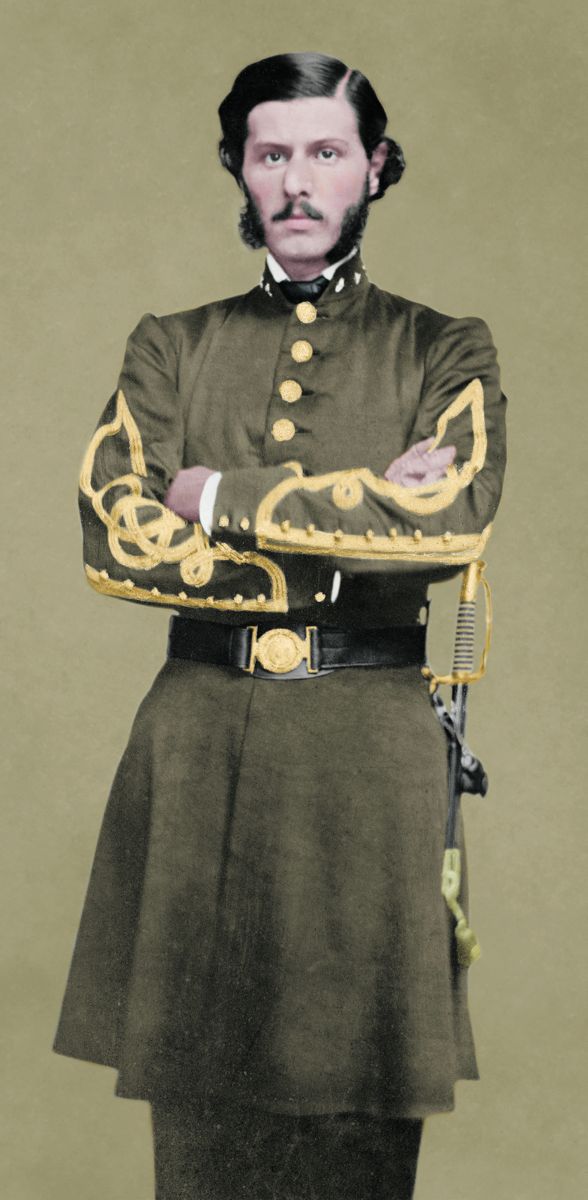
“We captured two pieces of artillery, destroyed a portion of the train, and took 213 prisoners” – C.S. Gen. Francis C. Armstrong On August 30, 1862, C.S. Gen. Francis C. Armstrong’s cavalry fought the Federals near Bolivar, Tenn., as part of his raid into west Tennessee. Both sides believed they won the skirmish and both sides considered the quartermaster depot at Jackson, Tenn., their ultimate objective. Armstrong has the distinction of being the only Confederate general to fight on both sides during the War. In 1835, Armstrong was born in Indian Territory where his father was stationed. In 1854, Armstrong accompanied his stepfather, future military governor of California, Gen. Persifor Smith, to the Territory of New Mexico. His gallantry in battle at Eagle Spring in 1855 earned him a commission. On July 21, 1861, Captain Armstrong led a Federal cavalry unit in the First Battle of Manassas. Armstrong then decided to change sides. He resigned his commission on August 10 and joined the Confederate Army. The Confederates began their raid by cutting up the Mobile and Ohio railroad. Then, on August 31, they turned their attention to the Mississippi Central Railroad, burning the trestle at Toone and cutting telegraph lines. The 45th Ill. pickets rushed down the tracks to warn their brethren at Medon Station. Using “cotton bales which happened to be lying around the station,” the men swiftly built breastworks to defend themselves from the coming onslaught and requested reinforcements from Jackson, about ten miles to the south. Around 3 p.m. Armstrong’s raiders arrived in Medon. It was 150 men vs. approximately 1,200 to 1,500 dismounted cavalry. “The Rebels had gotten off their horses and left them in the woods. They approached the station by running behind trees and the few huts and houses that were scattered around the station; they would jump out and fire and dodge back again.” The cotton bales were proving to be an effective shield. Local resident C.S. Pvt. John Hubbard, 7th Tenn. Cavalry, Company E, recalled that “without artillery we found it impossible to dislodge them. … It did so happen that Company E, in the charge on foot at the old brick church, passed over the same ground where it had been so royally entertained by the people of that vicinity the day it was mustered into service.” Confederate Col. W.H. Jackson ordered Lt. Col., Frank Montgomery, 1st Miss. Cav., to take five companies and charge down Medon’s principal street. Not wishing to “expose the men to certain slaughter,” Montgomery proposed to “reconnoiter the ground … [to] find a better place from which to make the assault.” As he was doing so, Montgomery spotted six companies of the U.S. 7th Mo. in the distance. Instead of fighting, Armstrong chose to retire. On Aug. 31, U.S. Col. Elias S. Dennis was ordered to strike camp at Estenalula, Tenn., and rush to defend Jackson. Dennis previously had served as an Illinois State Senator and a Kansas Territory Marshall. His command consisted of 800 men from the 30th and 20th Ill., a section of two pieces of Gumbart’s artillery, and two companies of cavalry. Marching all day, the men spent the night in Denmark, Tenn. On Sept. 1, the Battle of Britton Lane, Tenn., was fought when both sides discovered their enemy traveling on a short cut off the main road. The Federals spotted the Confederates first. Dennis realized he was outnumbered. He placed his two cannon in the center of the fourteen-foot-wide lane and set up a “defensive position along on a small ridge within a grove of trees, … surrounded on all sides by cornfields.” The raiders were returning to Mississippi and assumed “that there would be no more fighting on this raid.” They were stunned, “when two pieces of artillery let loose two charges of grapeshot into our column at point-blank range.” The Rebels charged to silence the cannon. The Federal infantry drove them back with their fire. The 2nd Mo. drew their sabers and charged. The Federals with their guns fell back 300 yards behind a fence. Again, the men charged, capturing the supply wagons. The 7th Tenn. charged on foot through the cornfield; few reached the fence before falling in a blaze of gunfire. Armstrong needed to capture the guns. He ordered C.S. Col. Wirth Adam’s cavalry to charge. “Adams, mounted on a beautiful cream-colored mare,” led the men “at racing speed … The fire was awful, and under the withering blast the head of our column went down. Those behind … spurred madly forward toward the sound of the guns, only to stumble and fall over their dead and wounded comrades and horses in front until the narrow lane was completely blocked. But the guns were won; … with no ammunition to use them and not strength enough to move them. I can never forget the picture of Col. Adams … as he looked around on his dead and dying men and the few survivors who had lived to follow him through.” The 30th Ill. arrived and covered the Federal retreat. The battle had been raging for four hours. To his men’s surprise, Armstrong did not pursue the enemy. According to Hubbard,
“The whole command was discouraged by the operations of this raid, and thought that, if we had gained anything at all, we had paid dearly for it.” Both sides felt they had won. Dennis earned promotion to general based on his actions at Britton Lane. On his return, Armstrong reported that his men “are ever ready when an opportunity offers to punish the insolent invaders. I am more firmly than ever convinced that the enemy are prepared to evacuate Bolivar
CWN whenever an advance of our army is made.” However, Armstrong’s men would go on to question his abilities as a commander. One of Adam’s men asserted that, “The charge Of the Light Brigade at Balaklava was not more foolish or more glorious than the charge of Col. Wirt Adams’s Regiment of Confederate cavalry up Britton’s lane.” Sources: • Alexander, H. (1962). The
• •
Armstrong Raid Including the Battles of Bolivar, Medon Station and Britton Lane. Tennessee Historical Quarterly, 21(1), 31-46. Black, Robert W. (2004). Cavalry Raids of the Civil War: Stackpole Books. Wyllie, Arthur. (1887). Hancock’s Diary: Or A History of the Second Tennessee Confederate Cavalry: Brandon Printing Company.
• •
•
•
Ford, C. Y., “Fighting With Sabers.” Confederate Veteran (Volume 30, 1922). Montgomery, Frank A. (1901). Reminiscences of A Mississippian in Peace And War: The Robert Clarke Company Press. Adair, John M. (1869). Historical Sketch of the Forty-Fifth Illinois Regiment: Carroll County Gazette Print. Brewer, James D. “Battle of Britton’s Lane”. Big Creek
•
Historical Association O.R. Series I, Volume XVII, Part I, Chap. XXIX Pgs 44 -51
Stephanie Hagiwara is the editor for Civil War in Color.com and Civil War in 3D.com. She also writes a column for History in Full Color. com that covers stories of photographs of historical interest from the 1850’s to the present. Her articles can be found on Facebook, Tumblr and Pinterest.