
Watching Gettysburg
By Carl L. Sell, Jr. · Originally published November 2020 · pp. 50–51
Watching Gettysburg by Carl L. Sell, Jr. Nineteen-year-old George Humerick stood on the northeast corner of the Emmitsburg, Md., town square for three hours on June 30, 1863, and watched Union soldiers march toward Gettysburg, Penn. Seventy-five years later, he stood at the same spot as reenactors marched past toward the battle site. Both the I and XI Corps of the Army of the Potomac passed through Emmitsburg on their way to Gettysburg. The First, led by Major General John Reynolds, camped just north of town. The Eleventh, led by Major General Oliver Howard, camped just south of town with Howard establishing his headquarters in the priest’s quarters at Mount Saint Mary’s College. Early on July 1, the I Corps moved west of Gettysburg to intercept the Confederate Army advancing on the Chambersburg Road.
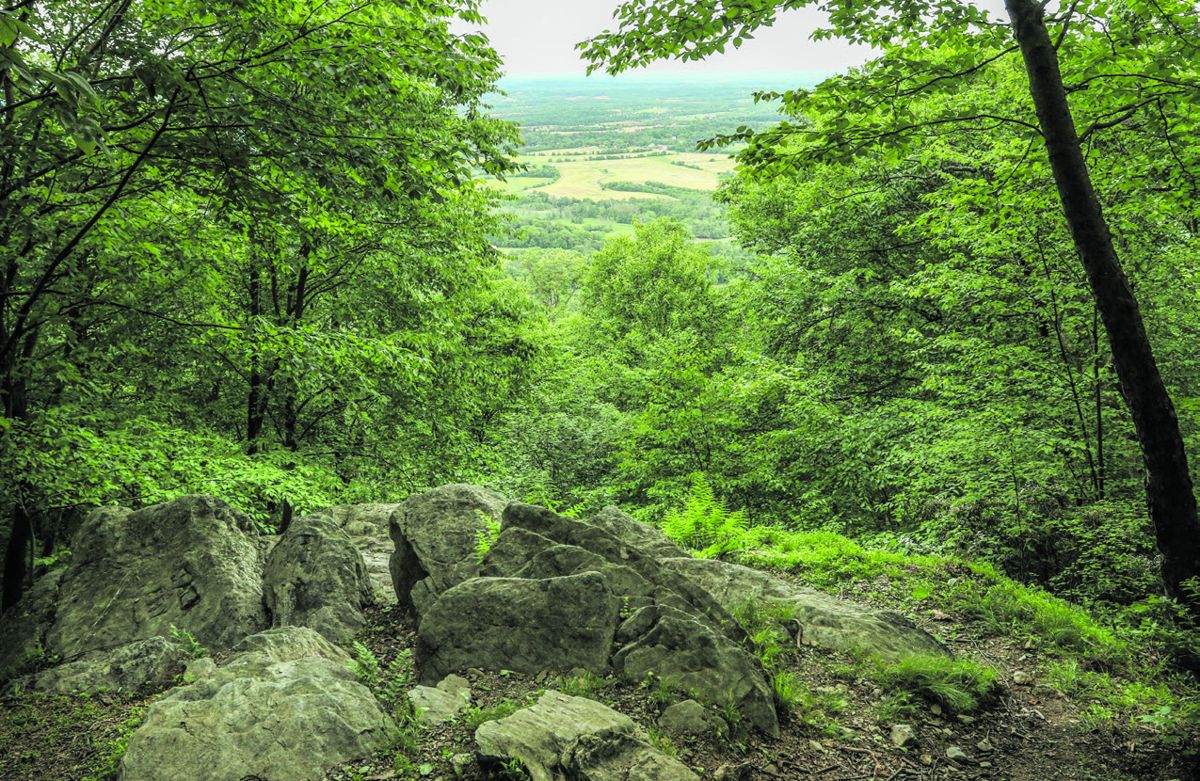
Two current views toward Gettysburg from Indian Overlook above Mount St. Mary’s University. The 1863 battlefield is more than 10 miles away. The climb to the spot in Emmitsburg, Md., is a rough one through woods and over rocks following a trail marked on the trees. It takes more than an hour and a half or more for inexperienced climbers. At age 83, the author had little trouble going up, but won’t talk about the trip back! Fortunately, he was accompanied by younger Civil War enthusiasts Bill Kamenjar and Ben Trittipoe. This is a spot that every Civil War and Gettysburg scholar should visit if they can. Don’t try it alone. Photos by Bill Kamenjar.
The XI moved into position on Cemetery Hill, barely within the town. Reynolds was shot dead as he urged his men forward to meet the Confederate attack. By dark on July 1, the Confederates occupied the town, and the entire Union line had been forced back on Cemetery Hill and Cemetery Ridge. That same morning, Humerick noticed flagging activity at the Union signal station on the mountain overlooking Mount St. Mary’s College. He went up the mountain to Indian Lookout. He learned that the station was in communication via flagging with the cupola at the Lutheran Seminary, overlooking the battlefield twelve miles north of Emmitsburg, and the news wasn’t good. General Reynolds had been killed and the Confederates were pushing the Union soldiers back toward the town. Shortly after that, the Confederates occupied the Seminary, and used it for their observation post. Over the next two days, many people, including staff at Mount Saint Mary’s, witnessed the battle with the use of telescopes, field glasses, and opera glasses. At any one time, almost sixty people would be at the Indian Lookout watching the battle. The view was so clear that those watching could see individual soldiers, officers riding along their lines, cannon, and infantry charges, according to an account signed by “A.J.B.” (apparently A.J. Brown, a student at the college), written shortly after the battle and much later published in the March 25, 1976, Emmitsburg Chronicle. Captain Lemuel B. Norton, Chief Signal Officer, reported that because of the smokiness of the atmosphere on the signal line between
Emmitsburg, Round Top, and general headquarters, the desired result was not obtained until 11 p.m. when the first message was received. He added that those stations were kept open until July 6 and were “eminently useful.” Communication with Gettysburg was accomplished through flagging stations that relayed information to General Meade’s headquarters, keeping in touch with Washington through wire transmission. The army also had a series of wagon trains that included battery operated low voltage telegraph lines connected to steam-powered systems along the railroads. General Meade kept up a constant communications through wire transmission with Washington beginning on July 4, 1863. Meade’s aide, Major
George Humerick General Daniel Butterfield, complained, however, that the operator possessing the cipher left, and General Meade could not send or receive coded messages. During the battle, flagging connected Gettysburg to Washington via stations at South Mountain and
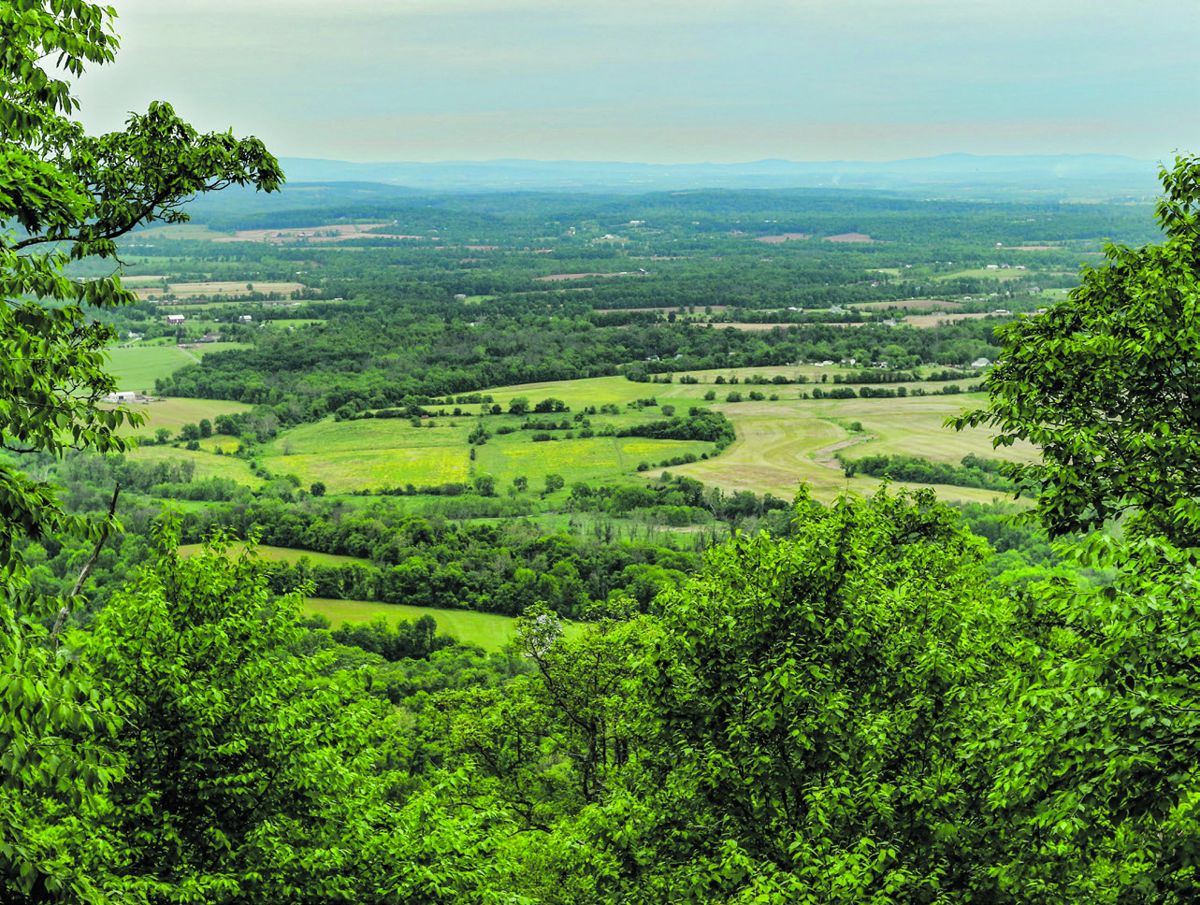
This view was taken from Indian Overlook, just above Mount St. Mary’s University in Emmitsburg, Md., almost 10 miles from the Gettysburg battlefield. The first rise in the topography is Cemetery Ridge with the Peace Light Memorial at the left and the Pennsylvania Memorial farther to the right. The Round Tops cannot be seen because of the foliage. Staff members from the college climbed up the mountain on July 1, 1863, to view the battle with telescopes and opera glasses. A Union flag station brought news from the cupola at the Lutheran Seminary, which pokes through the trees to the right of the Peace Light. Among those who climbed up the mountain that day was young George Humerick, who had cheered the Union troops two days earlier as they passed through Emmitsburg. Humerick lived to be 97 years old and was there for the 75th Anniversary of the three-day battle in 1938. Photo by Bill Kamenjar.
Sugarloaf Mountain in Maryland. The Confederates also had an active signal system at Gettysburg, using the cupola at the Lutheran Seminary after displacing Union signalmen on the first day. Afterward, the Union operated mostly from Round Top. Both sides changed ciphers several times during the war to keep their messages “secret” as they usually were in full view of the enemy. A late-night fire destroyed almost a quarter of Emmitsburg on June 15. A bucket brigade started by townspeople and then continued with college students’ help bring the blaze under control the next morning. Union troops saw the ruins as they approached the town, and thought Confederates had started the fire, much like in Chambersburg during Major General Jeb Stuart’s raid the previous October when government supplies were sacked and warehouses set on fire. They were told the Emmitsburg fire started in one of the town’s stables and had nothing to do with the war. Thousands of troops bivouacked in the fields surrounding the town overnight. According to A.J.B., areas around Emmitsburg sustained little or no damage unless they were reported as belonging to southern sympathizers. On
July 7, 1863, General Meade arrived in Emmitsburg; George Humerick was there to greet him, and shook hands with the victorious general. Meade and the Army of the Potomac moved on toward Frederick on the Old Post Road, crossing the covered bridge at Loy’s Station just two days after Stuart had taken the same route. Many Union prisoners captured by the Confederates around Gettysburg were paroled before the retreat across the Potomac; however, more than 3,000 inexplicably chose captivity and were marched to Staunton, Va., where they boarded trains for Richmond. On July 4, Major General Meade informed Washington that a proposition made by General Lee, under flag of truce, to exchange prisoners had been declined. Union forces buried their dead, and residents of Gettysburg were employed to bury the Confederate dead. Humerick visited the battlefield about ten days later and walked out Confederate Avenue “for hundreds of feet over the bodies of dead horses side by side.” He also said that in the Devil’s Den section, he came upon “the bodies of (a) hundred or more men.” Humerick said people were picking the teeth from the skulls for souvenirs or because they may have been made of gold, he didn’t know which. In any event, he said he picked up a canteen and a cartridge box that he hung over a musket he found, and walked back home to Emmitsburg. Humerick married Anna Jackson on Oct. 27, 1867. They produced 11 children, one of whom, Jackson, had a daughter, Dorothy, the mother of Thomas Seiss of Graceham. Seiss and his wife, Darlene, live in the house where young Belva Anne Elizabeth Cramer pumped water for the horses ridden by Stuart’s cavalrymen on July 5, 1863, (February 2020 Civil War News). George Humerick died Sept. 27, 1940, from complications of a fall that resulted in several broken ribs at age 97. Just two years earlier, he watched Union reenactors march toward Gettysburg for the battle’s seventy-fifth anniversary. His wife, Anna, died in 1927. Thanks to Tom Seiss for providing the information about his great grandfather on his mother’s side. Tom lives in Graceham, Maryland, just outside Thurmont, in an area rich in Civil War history. Carl Sell has written two books about his ancestors who fought for the south at Gettysburg, along with another book about Major General James Ewell Brown Stuart, whose troopers passed Tom Seiss’ now front door on at least two occasions. Sell also has written about a distant Union cousin who was killed by Mosby’s guerillas. In addition, he has written numerous articles for Civil War News.