
The Unfinished Fight
Imported European Muskets for the South
By Craig L. Barry · Originally published November 2020 · p. 7
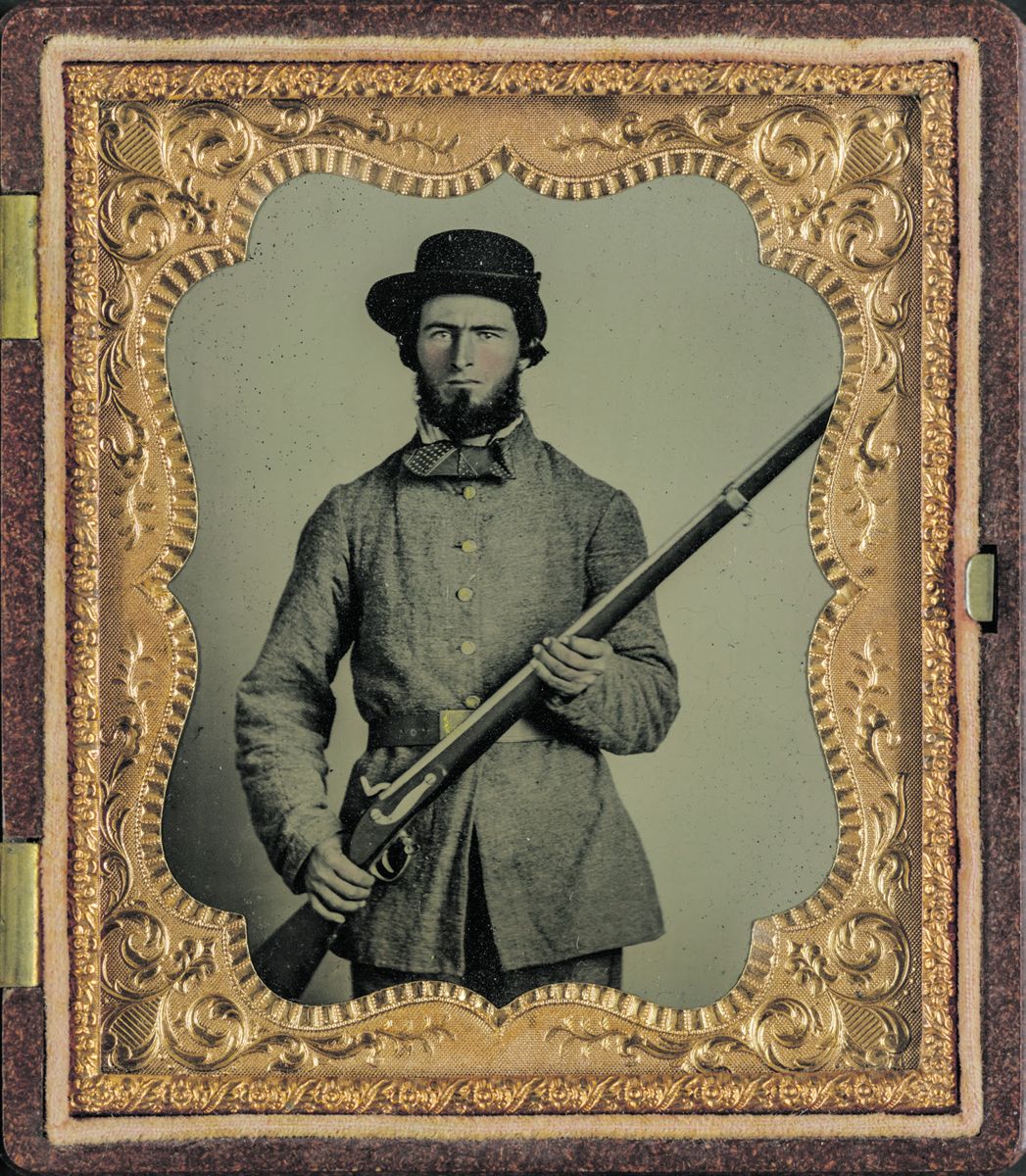
Imported European Muskets for the South The most common smoothbore percussion musket in Confederate hands was most likely a U.S. 1816/22 converted from flint sometime after the Mexican War. The adoption of the percussion lock system beginning in 1842 resulted in the retroactive conversion of some of the Federal stockpile of over 800,000 flint-locks still on hand. However, not all smoothbore muskets used during the Civil War were of U.S. manufacture. In May 1861, Caleb Huse obtained C.S. contracts for the commercial British P53 rifle-muskets but also surplus P39 and P42 percussion cap ‘Brown Bess’ smoothbore muskets. He continued on to Continental Europe and obtained other available surplus muskets from France, Belgium,
Prussia, and Austria. These varied somewhat in bore diameter as well as quality. American gun-makers were not the only ones producing muskets from substandard and condemned parts that were sold into the gun trade. Exact figures of European smoothbore muskets purchased by the Confederacy and run through the Blockade are not known, but Huse claims to have landed 100,000 of the more modern M1854 Austrian (a.k.a. Lorenz) rifle alone. This figure may be exaggerated. Caleb Huse wrote this many years post-bellum and time has a way of muddling certain details. The contract was also higher in cost than the Confederate Ordnance Department had been led to believe. We do not have figures from the Imperial Armory in Vienna like we do from the Birmingham Major Caleb Huse Small Arms Trade (courtesy of John Dent Goodman) so the best we can do is come up with a figure working backwards. As near as can be determined Josiah Gorgas indicated in correspondence to Secretary of War James Seddon that 27,000 Austrian rifles were imported by the end of 1862. Another 23,000 remained in Nassau awaiting shipment. There were probably various European smoothbore muskets included in that figure as well due to the volume of arms buying going on. A further 30,000 Austrian rifles remained in Vienna awaiting payment. If the math is right, that makes around 80,000 Austrian rifles by the end of 1864…then the paper trail goes cold. The number of smoothbore muskets was certainly less than that. By 1864 the Confederacy did not intend to import any more obsolete flintlocks as they already had a supply of those on hand. European smoothbore muskets were more commonly issued and remained in service longer in the Western theater units. The continued use of buck and ball rounds is one reason why the so-called “obsolete” smoothbore muskets were still seeing service on both sides when Robert E. Lee surrendered at Appomattox Courthouse in April 1865. A good source on the extent of smoothbore musket usage during the U.S. Civil War is The Bloody Crucible of Courage by Brent Nosworthy. The author reviewed ammunition requisitions from the last years of the conflict and found that an unexpectedly large number of orders for .69 caliber buck and ball cartridges were being filled right up until the end of the war. If the armies were armed almost totally with .58 caliber rifle-muskets as has often been stated, what use would the .69 caliber buck and ball rounds be and what purpose would the soldiers have for them? Obviously, the buck and ball cartridges were issued because a number of smoothbore muskets were still in the ranks. What did the officers at the time think about the effectiveness of the “new” rifle-muskets in the field? Opinions seem to vary, but after approximately two years studying the effectiveness of both “rifled” and “smoothbore” muskets with troops in battle, Claud E. Fuller noted in The Rifled Musket (Stackpole Publishing, 1959) that one Union officer reported back: “…(Even) with all the defects in the new (rifled) arms, caused by the great curves of their trajectories, an army can not now do without them; it would be placed in a position of inferiority to its adversary (at longer ranges). It would be equally in error to fall into the other extreme, and discard entirely smoothbore arms from our army, a result towards which we have been tending for several years past.” The report concludes by saying, “Battles must be fought and won, as in times past; decisive victories cannot be gained by firing at long ranges; at short ranges the (smoothbore musket with) the buck and ball cartridge is certainly more effective. It is a grave error to adopt for an army rifled (muskets) to the entire exclusion of smoothbore arms.” The historical use of smoothbore muskets throughout the war is a simple reality most historians chose to ignore. Experienced Civil War field officers have been quoted as saying “The (smoothbore) musket with buck and ball is the best arm in the service” and as fellow Civil War News columnist Joe Bilby noted in his May 1993 article for American Rifleman, “buckshot tells at close range.” Craig L. Barry was born in Charlottesville, Va. He holds his BA and Masters degrees from the University of North Carolina (Charlotte). Craig served The Watchdog Civil War Quarterly as Associate Editor and Editor from 2003–2017. The Watchdog published books and columns on 19th-century material and donated all funds from publications to battlefield preservation. He is the author of several books including The Civil War Musket: A Handbook for Historical Accuracy (2006, 2011), The Unfinished Fight: Essays on Confederate Material Culture Vol. I and II (2012, 2013) and four books in the Suppliers to the Confederacy series on English Arms & Accoutrements, Quartermaster stores and other European imports.