
The Graphic War
Fort McHenry
By Salvatore Cilella · Originally published November 2020 · pp. 36–37
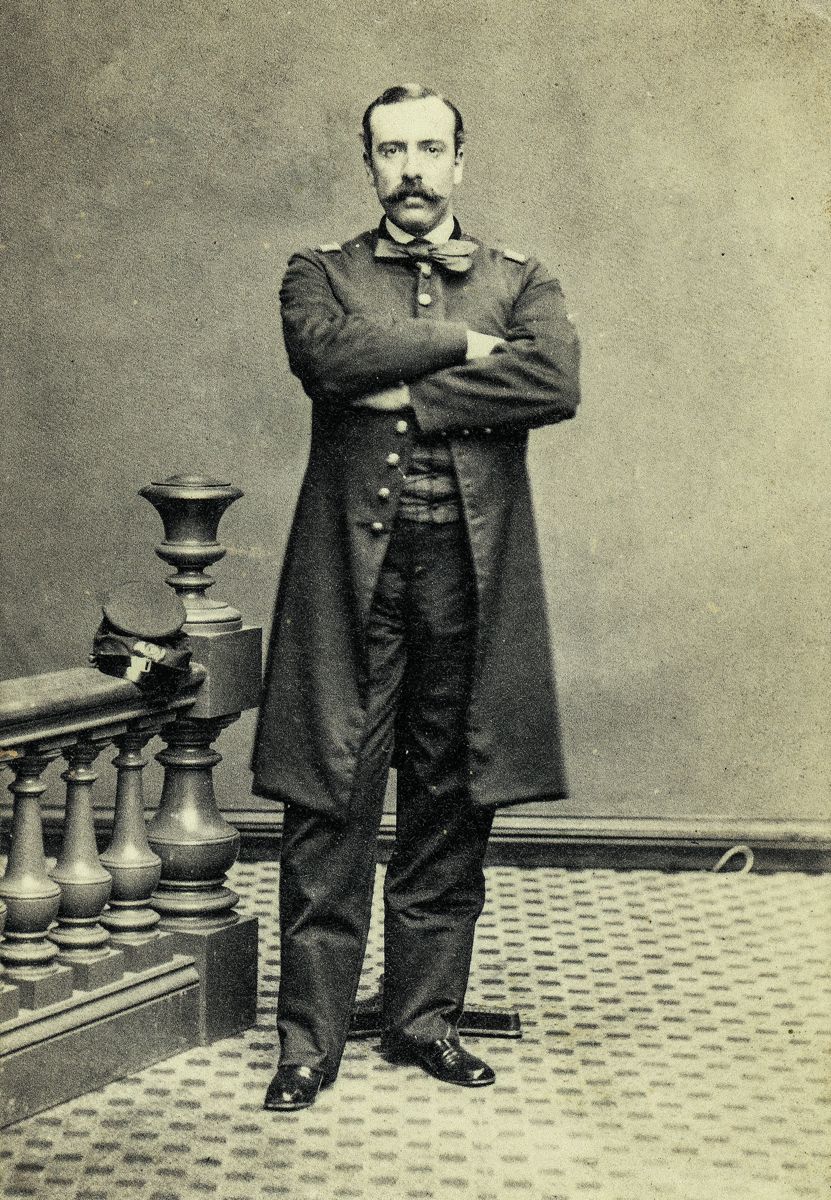
Fort McHenry The Graphic War highlights prints and printmakers from the Civil War discussing their meaning and the print maker or artist’s goals. One of the more interesting, unplumbed areas of Civil War historical research is the participation of many members of companies, battalions, regiments, and brigades in producing artistic renderings in real time. In other words, it appears anecdotally anyway, that tucked into many units was at least one artist willing to spend time at his craft to record his experience and surroundings. We have, in this column over the past few years, highlighted several who have taken stylus in hand and produced a souvenir of his service for his comrades. This month we feature Corporal E. S. Lloyd of the 3rd Battalion of Rifles, Massachusetts Volunteer Militia. Little is known of Lloyd. According to available records, we know he was a resident of Boston when he enlisted as a Corporal in Company D, 3rd Massachusetts Rifles. He served only from May until August, 1861.1 The 3rd Battalion of Rifles, Massachusetts Volunteer Militia, consisted of three companies commanded by Major Charles Devens. They were recruited from central Massachusetts, principally around Worcester. The battalion was ordered to Washington April 20, 1861, and when it reached Annapolis, orders were changed to report to Fort McHenry, Baltimore.
“Meanwhile another company, which had been recently raised in Boston, under the command of Captain Albert Dodd, was … sent to Fort McHenry to join the battalion, arriving at its destination May 15.” The “entire battalion was mustered into the United States service; Captain Dodd’s command became Company ‘D’.”2 It was known also as “Dodd’s Rifles” and, mysteriously, “Dodd’s Carvers.” Because the battalion served only a three-month enlistment, it spent the entire time at Fort McHenry where company D had very little to do with its moniker “Rifles.” It was principally involved with guard and garrison duty and trained on the heavy artillery guns guarding the fort. a designation frequently given to antebellum militia companies trained in the use of rifled muskets, a relatively new innovation at the time, as opposed to smoothbores. Only minor differences in training and tactics differentiated such units from a typical infantry company of the time. During the 1840s, rifle companies were often expected to train and serve as skirmishers in open order, however by the Civil War, United States Army tactical manuals made no distinction between a company of ‘rifles’ and a typical infantry company.”3 In taking occasional patrols down the Chesapeake Bay, the raw recruits “suffered from overwork.” While they never saw combat, the battalion could not escape the number one cause of casualties during the war, disease. When its enlistments ended at 90 days, the battalion was asked to remain an additional two weeks until it could be properly replaced. It was finally mustered out on July 30, 1861. Our artist, Corporal Lloyd had very little time to record the battalion’s time of service. We know he produced at least two views of Fort McHenry while he was stationed there. A third view, executed by Baltimore lithographer, Edward Sachse shows a perspective nearly identical to one of Lloyd’s. The print illustrated here by Lloyd is described by one print expert: “In this early 1861 view there is little to suggest that the war was more than a martial spectacle in
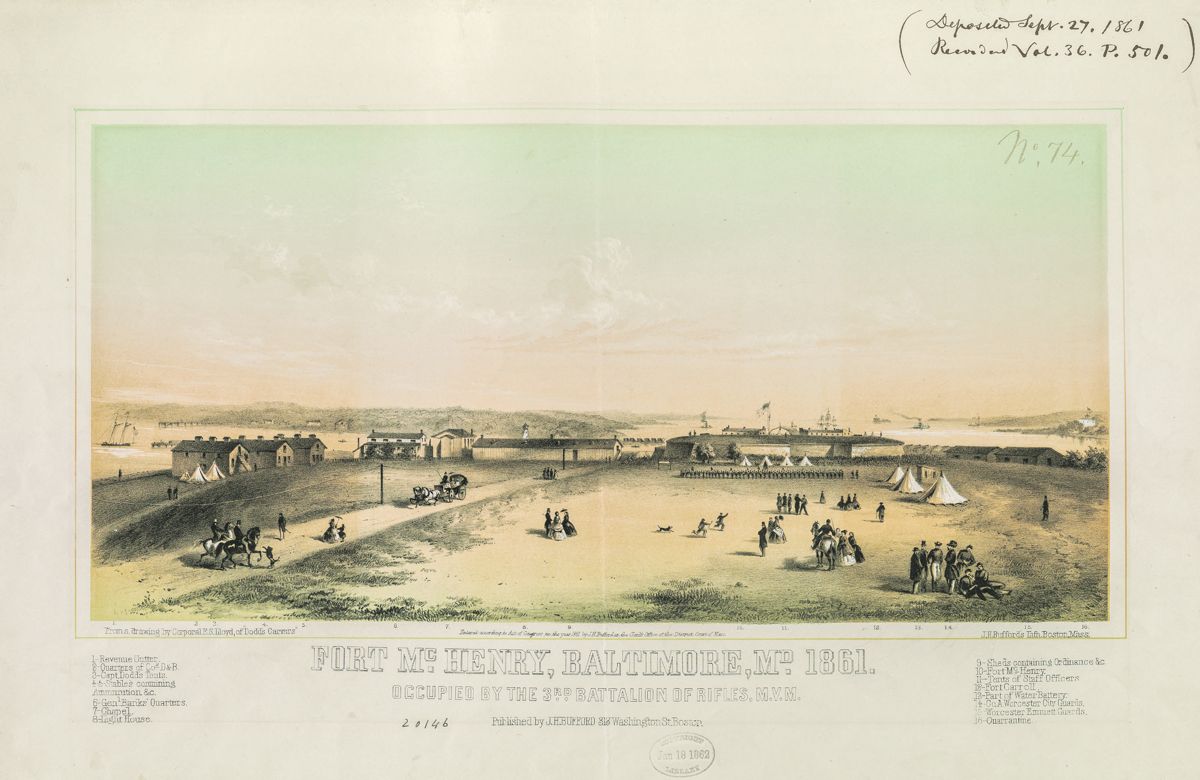
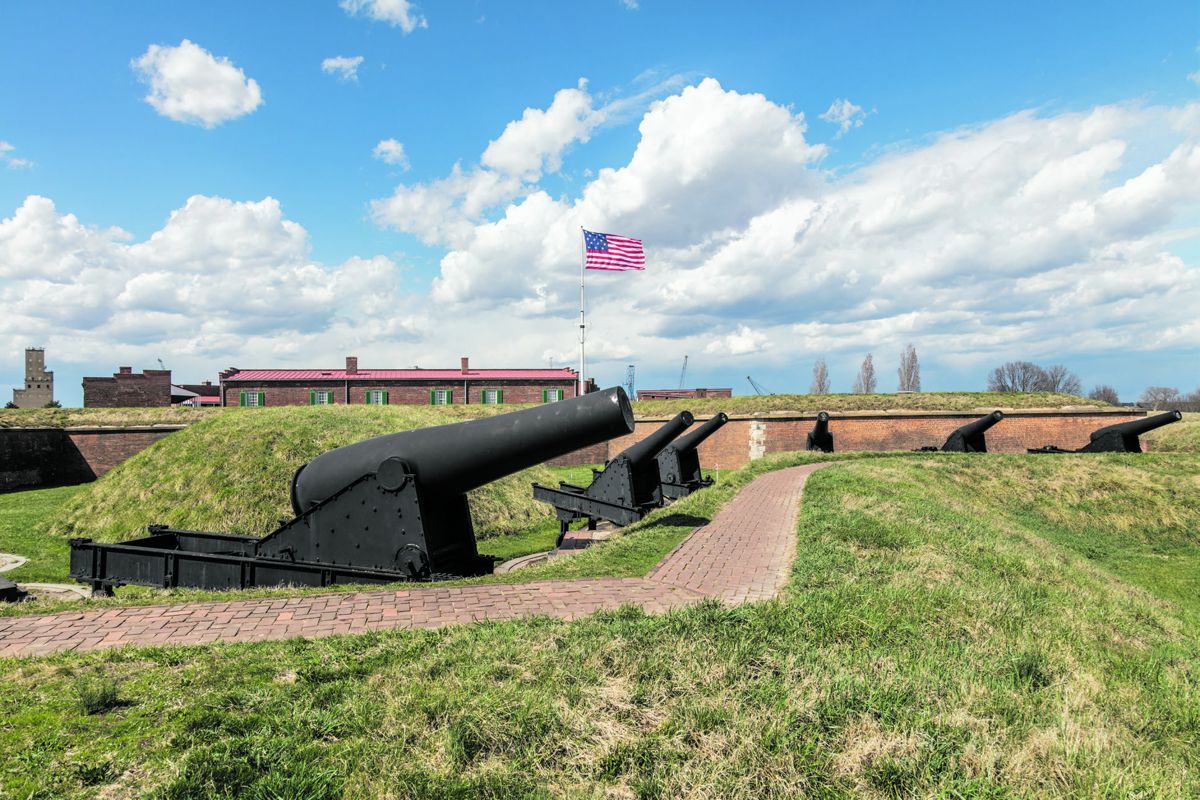
Fort McHenry in 2016. picturesque surroundings as civilian visitors mingle with the troops.”4 The fort was also used to hold Confederate sympathizers and prisoners. This view was published by Boston printer, John Bufford. Lloyd’s other view was printed and published by A. Hoen, Baltimore. The only mystery surrounding this battalion’s short life is the origin of the term “Dodd’s Carvers,” which appears in the title margin of both of his works. Possibly a faithful reader can enlighten us about artist Lloyd and while they are at it, explain what the “carvers” were. Endnotes: 1. Massachusetts Soldiers, Sailors, And Marines In The Civil War. Compiled And Published By The AdjutantGeneral In Accordance With Chapter 475, Acts Of 1899 And Chapter 64, Resolves Of 1930. 8 Volumes, V, 303-315. Lloyd is listed Vol. 5, page 313.
- Ibid., 303. 3. 3rd battalion Massachusetts Rifles. https://military.wikia.org/wiki/3rd_Battalion_ Massachusetts_Rifles 4. Lois B. McCauley, Maryland Historical Prints, 1752 to 1889, Baltimore, Maryland Historical Society, 1975, E60 and E61, 189. After 43 years in the museum field, Salvatore Cilella devotes his time collecting American prints and maps and writing. His last professional position was President and
CEO of the Atlanta History Center. His most recent books are Upton’s Regulars: A History of the 121st New York Volunteers in the Civil War (U. Press Kansas, 2009). His two-volume Correspondence of Major General Emory Upton, (U. of Tennessee Press, 2017), received the 2017–2018 American Civil War Museum’s Founders Award for outstanding editing of primary source materials. His latest book “Till Death Do Us Part,” an edit of Upton’s letters to his wife 1868– 70, was published in May by the Oklahoma University Press.