
Through The Lens
A Race In The Mud Knoxville Campaign – Part I
By Stephanie Hagiwara · Originally published November 2020 · p. 33
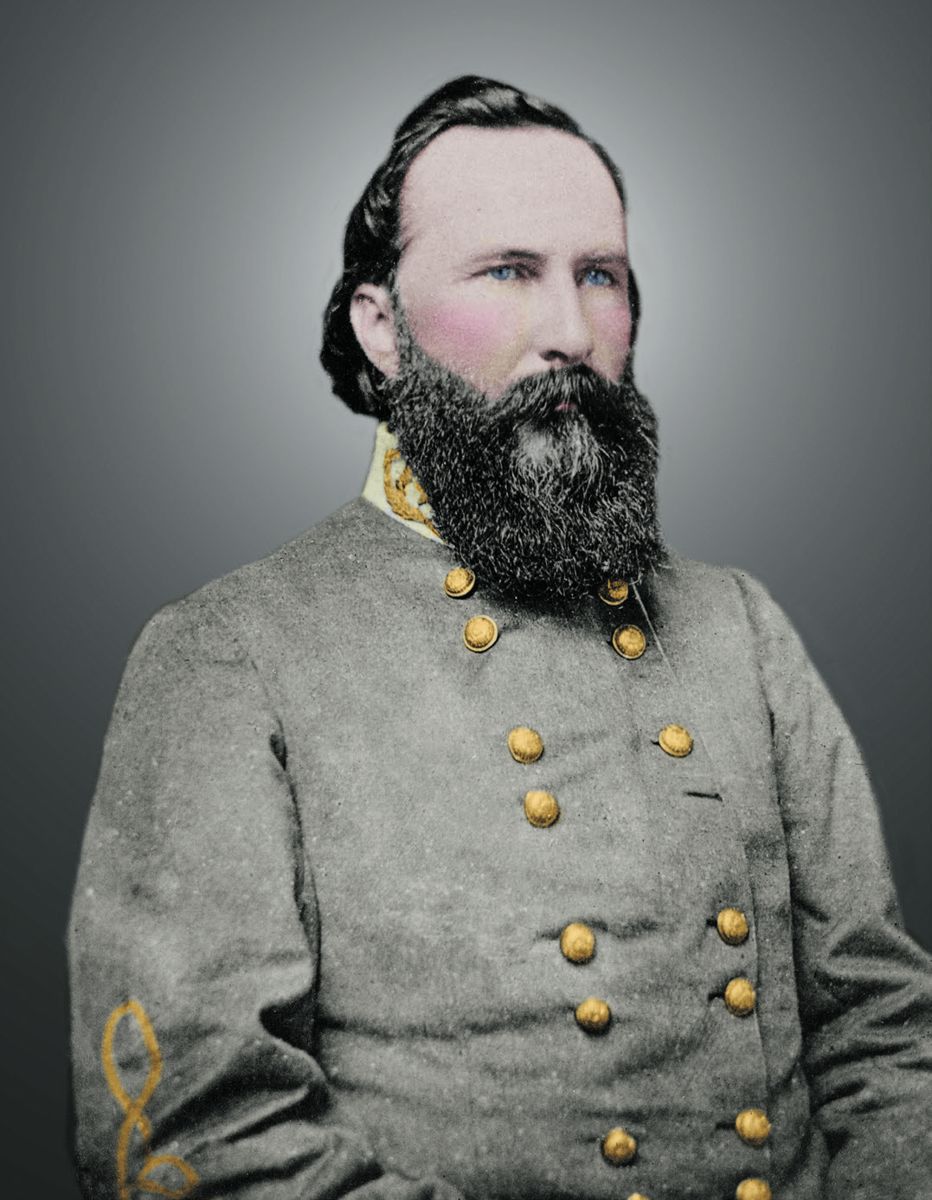
A Race In The Mud Knoxville Campaign – Part I “On several occasions during the war [Jefferson Davis] came to the relief of the Union army by means of his superior military genius.” – U.S. Gen. Ulysses S. Grant On September 20, 1863, Gen. Braxton Bragg won the Battle of Chickamauga, Ga., the largest Confederate victory in the Western Theatre. Instead of using the momentum of victory to fight the Federals, the Confederates turned to resolving conflicts within their own army. Bragg and Gen. James Longstreet did not get along. Furthermore, the promotion of Gen. John Hood created a conflict within the command structure of Longstreet’s army, pitting generals Lafayette McLaws and Micah Jenkins against each other. Longstreet’s request that “any good major-general to be found elsewhere” be given the command was denied. President Jefferson Davis’s solution was to send Longstreet to attack U.S. Gen. Ambrose Burnside’s Army of the Ohio at Knoxville, Tenn. Bragg considered Longstreet’s departure as “a great relief to me.” Longstreet was against his assignment. By splitting the Confederate forces, he argued “We thus expose both to failure, and really take no chance to ourselves of great results.” But orders were orders. On November 5, due to train delays, the army starting walking towards Knoxville. The trains connecting Tennessee to Virginia were in desperate need of maintenance, impacting the Confederate supply chain. According to C.S. Col. Moxley Sorrel, “the cars and railway by which we helped the transportation were almost comical in their inefficiency. The railroad was of heavy grades and the engines light-powered. When a hill was reached the long train would be instantly emptied— platforms, roofs, doors, and windows—of our fellows, like ants out of a hill, who would ease things by trudging up the dirt road and catching on again at the top; and so it went on as far as the railroad would serve us.”
outnumbered the Federals, “as the enemy stood he was ours.” The 36th Mass. Volunteers had held the crossroads to protect the last of the Federal troops and wagons to pass. The men then moved to support Capt. Jacob Roemer’s 34th N.Y. Light Battery with their two 3-inch ordnance rifles on the left of the road and Lt. Benjamin’s Battery E, 2nd Artillery, with four 20-pounder Parrotts on the right. “At noon the rebels came out of the woods just beyond the village, in two lines of battle, with a line of skirmishers in front. The whole field was open to our view. Benjamin and Roemer opened fire at once; and so accurate was their range that the rebel lines were immediately broken, and they fell back into the woods in confusion.” Longstreet decided to send generals Evander Law and George Anderson’s men on a flanking maneuver along a concealed route on the left. Alexander’s guns opened fire. Defective ammunition diminished its impact. Worse, a 20-pdr. Parrott rifle exploded injuring its crew. Law sent to word to Jenkins that he had “obliqued so much to the left as to have gotten out of its line of attack.” Darkness ended the fight. Burnside quietly withdrew the muddy sixteen miles to Knoxville. To the frustration of the Confederates, the opportunity to capture Burnside was lost. Jenkins considered Laws’s mismanagement of the flanking maneuver, “this careless and inexcusable movement lost us the few moments in which success from this point could be attained.” One of Alexander’s artillery officers contended, “If our infantry had been handled with anything like the skill and dash with which the artillery was handled that the greater part of Burnside’s force would have been captured before he got to Knoxville.” On the other hand, Burnside continued to gain Grant the needed time to prepare for the Battle of Missionary Ridge, Tenn.
It took eight days for Longstreet alerted to the pursuit. It was a Sources: and his men to travel the sixty “race” through the mud. “It was • Longstreet, James. From miles to Sweetwater, Tenn. On dark and disagreeable,” recalled Manassas to Appomattox arrival, expected supplies were Pvt. William Todd, 79th N.Y. Memoirs of The Civil War not waiting. The men were on The wagons sank in mud holes in America: J. B. Lippincott short rations, having left “most and the men hauling them out beCompany, 1895 of our clothing and blankets and came so covered “with the splat• Burrage, Henry S. History all of our wagon transportation” tering mud that it was difficult to of the Thirty-Sixth Regiment back in Virginia as it was in the tell them from the surrounding Massachusetts Volunteers, “heated season.” They found soil.” The order came to abandon 1862–1865: Rockwell and themselves with “the enemy in 100 baggage wagons. The 23rd Churchill, 1884. front to be captured, and our Mich. was tasked with “cutting • Sorrel, Gilbert Moxley. friends in rear putting in their pa- the spokes of the wagon wheels, Recollections Of A Confederate per bullets.” cutting up or burning the harness, Staff Officer: The Neale Bragg complained Longstreet tents, officers’ baggage, … while Publishing Company, 1917 was falling behind schedule. barrels of bacon, coffee, and sug• Korn, Jerry, and the Editors of Longstreet reminded him that ar were burst open and distribTime-Life Books. The Fight for “we were dependent upon forag- uted to the men, and what they Chattanooga: Chickamauga to ing for our daily rations for men could not take was destroyed.” Missionary Ridge. Alexandria, and animals.” He felt that “it be- Still the Confederates were able VA: Time-Life Books, 1985. gan to look more like a campaign to retrieve 100,000 rounds of rifle • Wert, Jeffry D. General James against Longstreet than against ammunition, artillery rounds and Longstreet: The Confederacy’s Burnside.” “… all kinds of good things.” Most Controversial Soldier: A In the meantime, Gen. Ulysses On November 16, Burnside Biography: New York: Simon S. Grant inquired if Burnside reached Campbell’s Station first, & Schuster, 1993. could “hold Longstreet in check deploying his men in a “beautiuntil [Gen. William] Sherman ful position” across the narrow Stephanie Hagiwara is the editor gets up, or, by skirmishing and valley. Longstreet’s men arrived for Civil War in Color.com and Civil falling back, can avoid serious fifteen minutes later. McLaws’s War in 3D.com. She also writes a loss to yourself, and gain time.” Division were positioned in weekly column for History in Full Burnside agreed. Forces were the woods to the left of the staColor.com that covers stories of left to strengthen Knoxville’s tion with Jenkins’s on the right. photographs of historical interest defenses as Burnside led 5,000 Gen. Alexander Porter’s 17 canfrom the 1850’s to the present. Her men to Loudon, Tenn., where non were placed behind them in articles can be found on Facebook, the 36th Mass. Volunteers were a meadow. Longstreet knew he Tumblr and Pinterest. busy building their permanent winter camp. On November 15, near Loudon, Longstreet crossed the Tennessee River. The enemy was five miles away. Eight miles further was Lenoir’s Station. If Longstreet arrived first, he could block Burnside’s retreat. But by the time Longstreet reached Lenoir’s Station, Burnside was gone. At 2 a.m., in a pouring rain, Burnside’s men were heading toward the crossroads at Campbell’s Station. A Confederate sympathizer tipped off the Rebels to a short Major Gen. Ambrose Burnside. Colorization © 2013 General James Longstreet. Colorization © 2015 cut to the crossing; civilwarincolor.com, courtesy civilwarincolor.com/ civilwarincolor.com, courtesy civilwarincolor.com/ cwn. Library of Congress. the Federals were cwn. Library of Congress.