
The COVID-19 Economic Impact: a Trade Show Promoter's Perspective
By Mike Kent · Originally published May 2020 · pp. 1–7
If you can keep your head when all about you are losing theirs…” is the opening line of the immortal poem “If” by Rudyard Kipling. Published in 1910 and still relevant today, it is often touted as an inspirational work that provides advice on how one should live their life and gives encouragement to rise above the many adversities we all face at some point in time. As members of the human race, and a much smaller subset consisting of Civil War enthusiasts, National and State Parks, museums, collectors, dealers, seminars, tour companies, sutlers, living history presenters, and reenactors, we might all benefit by taking a few minutes to read and digest “If.” With the outbreak of COVID-19, known as the Coronavirus, in the United States since late February, life has changed to some degree for all of us. Isolation or self-quarantine is prevalent and mandated in some locations. Necessities such as food, water, pharmaceuticals and yes, even toilet paper, are harder to find and in short supply.
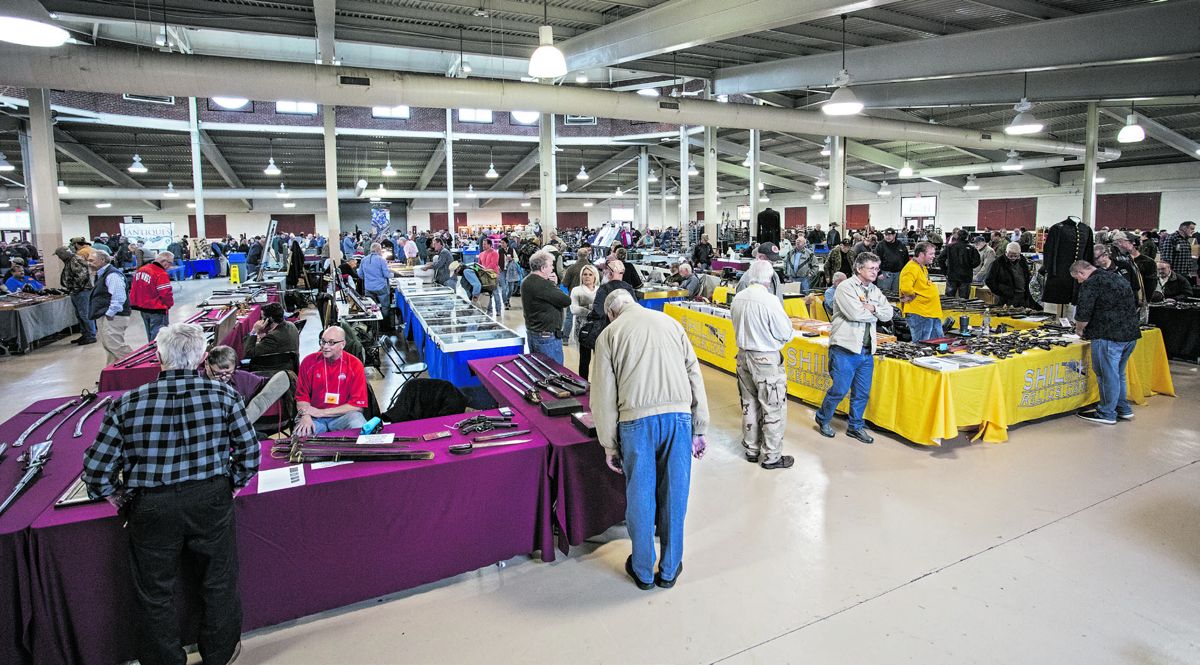
Certain industries are facing massive layoffs, or work from home situations, and no one is sure when the virus may be contained or when life can return to normal. Statistics, predictions, opinions, facts, and lies are inundating us 24 hours a day via TV and social media, often from talking heads, celebrities, and politicians with little or no factual information about the situation. Everyone seems to have an agenda to push during this crisis; few of them offer solutions for the average American. While each of us is obviously concerned with our own situation during this outbreak, it may be helpful if we step back and take a look at how other people and businesses are impacted as well. My recent experience is probably very similar to the many readers who collect, deal, and participate in Civil War events around the country. On March 15, I was notified that my gun show scheduled for Columbia, S.C., on March 21st and 22nd had been cancelled by the state fair board. While financially concerning to me, I couldn’t help but think of the hundred plus vendors who had stocked up on merchandise in preparation for the show only to have no place to sell it for the foreseeable future. It was then that I began to realize the staggering impact an event’s cancellation could have in any industry, especially when you take into consideration the thousands of shows, festivals, sporting events, and gatherings occurring in this country every weekend. To put things in perspective, consider the following list of businesses and individuals who did not receive any income due to the cancellation of my small, 400 table gun show: • The venue I rent for my show. • The event services company that provides tables and chairs. • The off-duty police officers who provide security. • The ATM company that provides banking services. • The concession company • • • • •
•
•
that feeds the vendors and attendees. The individuals employed to sell tickets and inspect firearms. The temp labor company that provides workers who assist vendors moving in and out. The temp laborers themselves. The parking lot attendants. The hotels and restaurants, where I and a large number of vendors, stay and eat for 3 days and nights. The hotel and restaurant staff. The National Restaurant Association recently predicted that restaurants across the country will lose $225 billion in business over the next three months, and that five to seven million service and kitchen jobs could be lost over the same period. The gas station where I fill up and get my coffee every morning along with all the vendors and participants who attend the event. The media outlets that run my ads: radio, TV, billboard companies, digital advertising, and newspapers. • The advertising agency that creates and places my ads. • The city that charges me for a temporary business license. • The state that charges me an admission tax. • The pet sitter who feeds my dog and cats. Now imagine that in each of the situations listed above, there is a business owner, manager, or employee who can diagram a similar chart of affected entities under their control. When analyzed from this perspective the economic toll being taken by the Coronavirus panic can seem overwhelming. The other part of the Coronavirus equation is obviously its health-related impact, which is concerning, but not the magnitude of the bubonic plague that killed an estimated 50 •
million people, 60 per cent of the European population, in the 14th century. To put things in perspective, here are a few statistics on more recent epidemics, courtesy of the CDC (cdc.gov). • The Spanish flu of 1918– 1919 infected an estimated 50 million people worldwide with 675,000 deaths in the U.S. • The SARS outbreak of 2003 infected 8,098 people worldwide with 774 deaths, but none in the U.S. • The Ebola scare of 2014 registered 11,325 deaths worldwide, with only 1 reported death in the U.S. • The H1N1 influenza epidemic of 2009 resulted in an estimated 60 million infections in the U.S., 274,000 hospitalizations, and 12,469 deaths. • Throughout the most recent flu season from October 1,
2019, until March 14, 2020, the CDC estimated between 38 million and 54 million Americans were infected with the flu virus that resulted in between 23,000 and 54,000 deaths. During these past epidemics, including the most recent one just ended, do you remember a national shutdown? Do you remember a stock market crash? Do you remember a president, governor, or mayor telling us we have to self-quarantine and social distance? Of course not; none of those things happened. We simply put on our big boy pants, washed our hands more frequently, didn’t cough on others, stayed away from those who were sick, and used common sense. Guess what? We all survived and will survive Coronavirus as well. Now for the $64,000 question; what can we do in the face of this national catastrophe? The answer is simple: • Stop, don’t panic, and take a deep breath. • Improvise, adapt, and overcome (the unofficial slogan of the United States Marine Corps).
In our lives all of us have faced and overcome adversity whether it be a business failure, the loss of a loved one, or enemy fire in a hot zone overseas. Most of us are now older, wiser, and stronger for having met these challenges and persevered. In times of trouble we tend to just do what we have to do to survive. Americans as a whole, and I think readers of this publication in particular, are emblematic of the can do attitude that has sustained this country since its founding. Rather than wringing our hands and seeking a safe space, we like to address problems head on, taking no prisoners until our goal is accomplished. By this time next year Coronavirus will be a distant memory. In the meantime, continue to fight the good fight, stay safe, and read “If” by Kipling. See you at the next show! Mike Kent is President of MK Shows which produces the Franklin, Dalton, and Richmond Civil War shows as well as numerous gun and knife shows in North and South Carolina. He has promoted over 400 shows during his 30-year career. Mike is a Georgia Tech graduate, holds an MBA from Georgia State University, is a member of the SCV and a NRA Life Member.