
The Graphic War
Our Generals in the Field
By Salvatore Cilella · Originally published May 2020 · p. 26
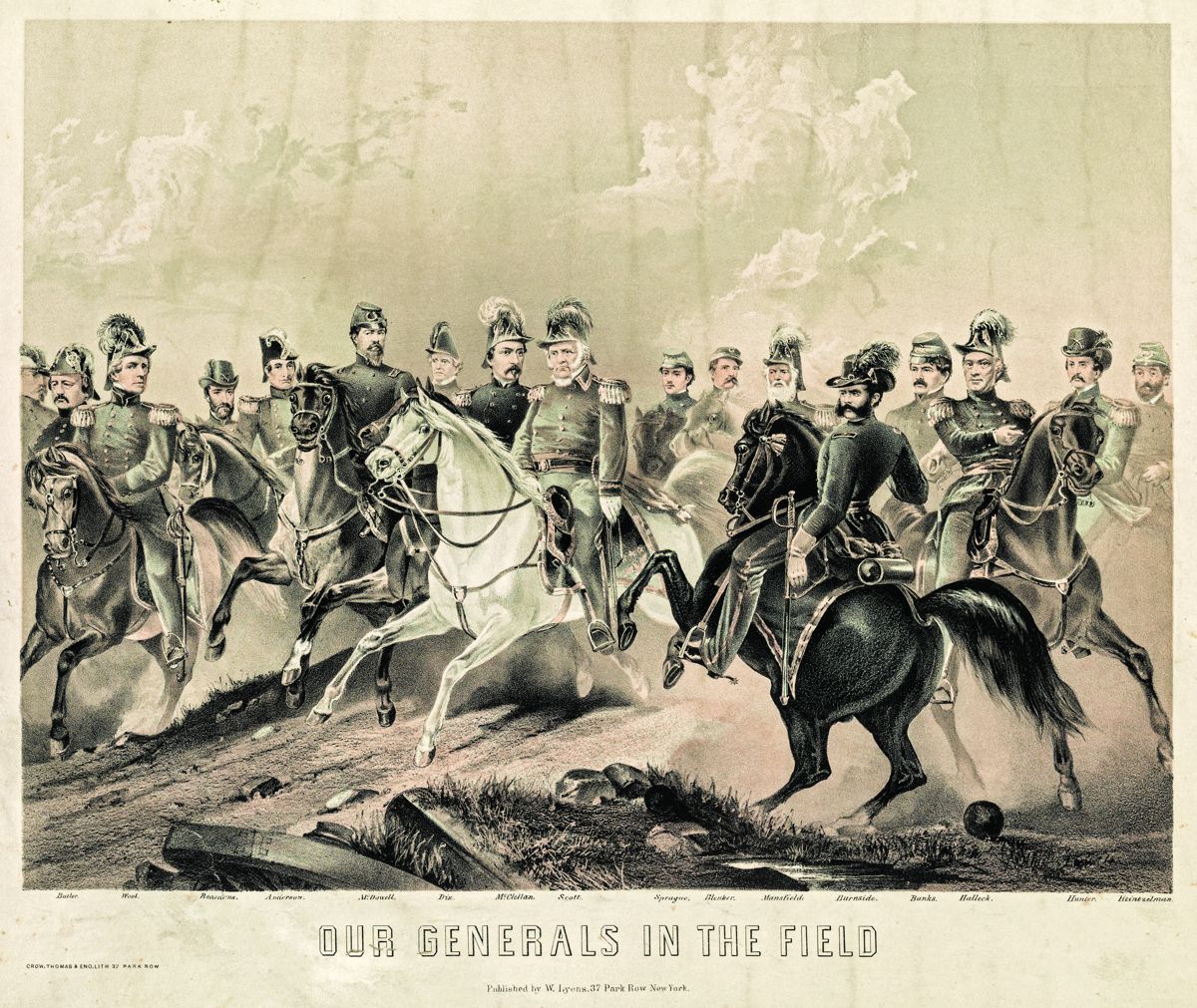
The Graphic War highlights prints and printmakers from the Civil War discussing their meaning and most importantly, the print maker or artist’s goals. Our subject this month is almost amusing. It is an attempt, by relatively obscure New York lithographers Frank Crow, Henry Thomas, and Henry C. Eno to convey Union strength and unity in the face of the Rebellion. Although it was not meant as a caricature or a satirical look at Union leadership in the early days of the war, to modern eyes, its obvious impact is comical and highly inaccurate. But to an anxious public midway through a bloody and tragic war, seeing their anointed generals on vigorous steeds was reassuring if nothing else. The three lithographers did not become partners until 1863, so it is curious that half way through the war, these particular generals would be featured. Like many lithographic partnerships in the mid-19th century, the three quickly moved on to establish new relationships or found their own companies. Crow and Thomas went on to specialize in theater posters. Henry Clay Eno and Thomas worked together from 1862 to 1868. Eno also ran his own firm from 1865 to 1868. This print, published by W. Lyons of 37 Park Row, New York, depicts sixteen Union generals on horseback from left to right: Butler, Wool, Rosecrans, Anderson, McDowell, Dix, McClellan, Scott, Sprague, Blenker, Mansfield, Burnside, Banks, Halleck, and Heintzelman.
It is obviously the first team, fielded at the war’s inception. Center stage is General Winfield Scott on a magnificent white charger, sitting as though he is lashed to the saddle to remain upright. Immediately to the right [Scott’s left] is Ambrose Burnside on a rearing black steed; the general depicted is nothing close to real life. Farther right is another “desk jockey” Henry Halleck. Just to the left [Scott’s right] of Scott is McClellan. Fewer than half “the first team” made names for themselves, many sinking into obscurity. Conspicuous by their absence are Grant, Sherman, Thomas, and Sheridan who were just coming into their own as leaders in suppressing the rebellion. Only on rare occasions were naval heroes such as Foote and Farragut represented. Butler, Rosecrans, Burnside, Anderson, McDowell, and Sprague managed to survive the war and the responsibility of command to various degrees. Wool, like Halleck, Dix, and Scott proved willing but too old for command responsibilities. Banks, Blenker, and Heintzelman, all proved incapable and not up to the task of successful leadership. Mansfield died from his wounds at Antietam.1 For his part, Henry Eno produced other timely lithographs including real time views of Atlanta during Sherman’s occupation. Unfortunately, the Atlanta views are rare. The Atlanta History Center has a few; it appears that the Library of Congress does not. He produced city views, scenic views, and sheet music covers.2 Henry Eno came from a wealthy New York family headed by Amos Richards Eno, realtor and philanthropist. When Eno senior passed away in 1898, his estate was estimated between $20 and $40 million. When Amos Francis Eno, Henry’s brother, died in 1915, he donated his vast collection of books and city views of Manhattan to the New York Public Library. A local print dealer called Eno’s collection “one of the few really great collections.”3 Ironically, Henry, the print producer, died the year before (1914) at age 73 and was not the beneficiary of his brother’s (the print collector’s) largesse.
Endnotes: 1.
See Ezra J. Warner, Generals is Blue: Lives of the Union Commanders. Baton Rouge: LSU Press, 1964. Jay T. Last. The Color Explosion: Nineteenth-Century American Lithography. Santa Ana: Hillcrest Press, 2005, 178, 183, 233. The New York Times, October 29 and 30, 1915.
After 43 years in the museum field, Salvatore Cilella now spends his time collecting American prints and maps and writing. His last professional position was President and CEO of the Atlanta History Center. His most recent books are Upton’s Regulars: A History of the 121st New York Volunteers in the Civil War (U. Press Kansas, 2009). His two-volume Correspondence of Major General Emory Upton, (U. of Tennessee Press, 2017), is the recipient of the 2017-2018 American Civil War Museum’s Founders Award for outstanding editing of primary source materials. His latest book is an edit of Upton’s letters to his wife 1868-70, recently published by the Oklahoma University Press.