
The Graphic War
Winter Camp: 37th Massachusetts
By Salvatore Cilella · Originally published March 2020 · pp. 24–25
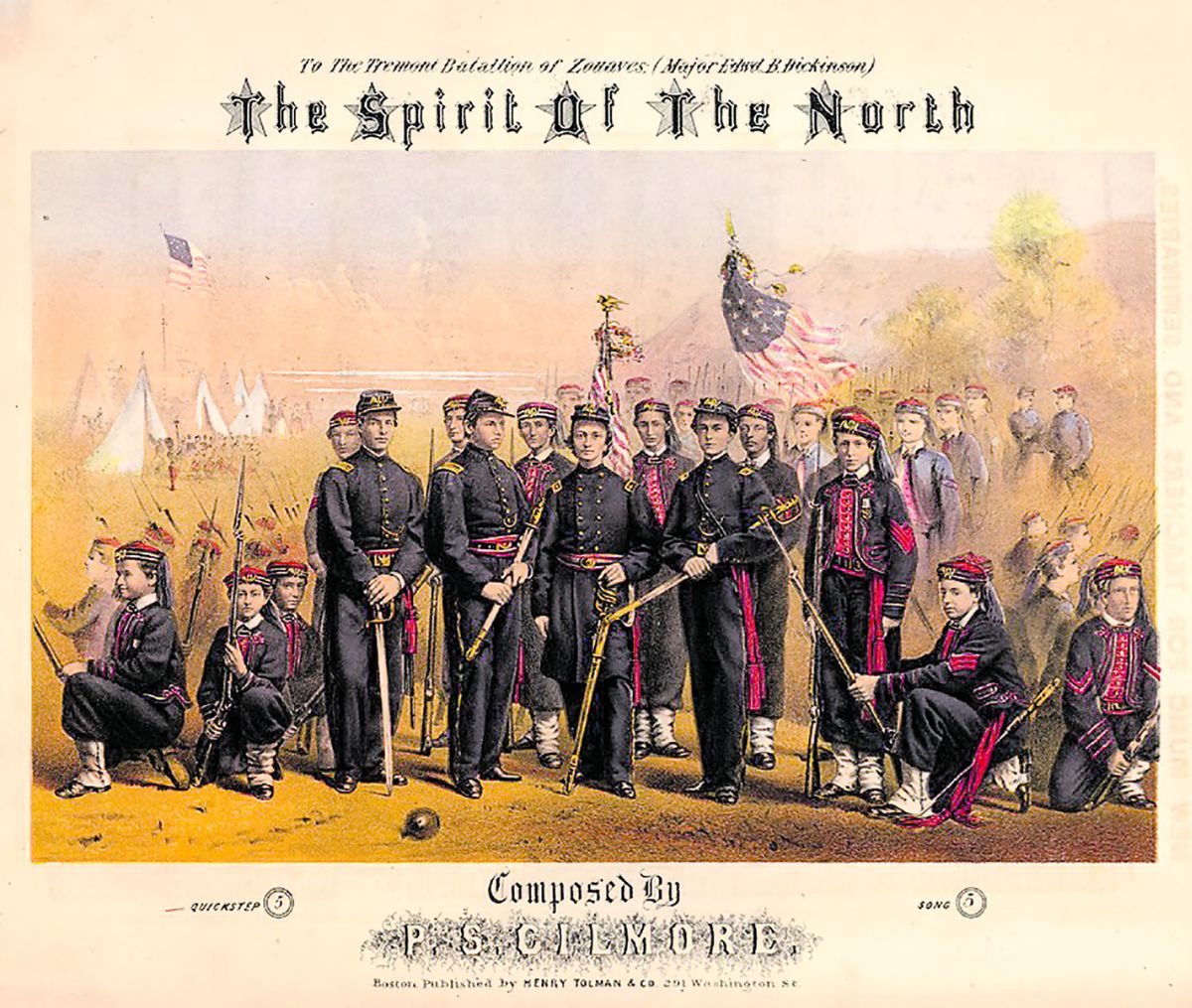
The Graphic War highlights prints and printmakers from the Civil War discussing their meaning and most importantly, the print maker or artist’s goals. The 37th Massachusetts Volunteer Infantry had a gallant wartime record. It was recruited by its eventual commander, Major Oliver Edwards. It formed under Lincoln’s call for 300,000 more men in the summer of 1862. The regiment consisted mainly of recruits from the western counties of Massachusetts. Three companies adopted Zouave uniforms calling themselves the “Tremont
Battalion of Zouaves.” The regiment lost 261 men during its three-year service. It saw action at Fredericksburg, Gettysburg, the Siege of Petersburg, and the Appomattox campaign. In early August 1863, the 37th went to New York City to enforce the new draft law and quell the draft riots that immobilized the city. It re-joined the VI Corps and participated at Rappahannock Station, November 7, 1863. Following the victory at Rappahannock Station, General Meade was eager to engage Lee’s army at Mine Run. Meade’s plans were aborted when General Gouvernor Warren informed him that the attack would be devastating to his troops. Reluctantly, he cancelled the attack. Lee had positioned his hardened veterans behind new earthworks making any assault on them suicidal. With that, both commanders decided it was time to go into winter camp. Lee settled his army below the Rapidan River. Six miles below Rappahannock Station, the Union army occupied an area in the vicinity of Brandy Station. The VI Corps, with the 37th Massachusetts settled into the same camp at Brandy
Station it had occupied after Rappahannock Station before the Mine Run Campaign. Describing the camp, the historian for the 37th Massachusetts wrote: “the location was scarcely an ideal one for a camp, the situation being exposed and wood having to be brought a long distance. But the days wore away with their dull routine, the chills of early winter sharpened the air more and more cold, heavy rains made the day and night alike uncomfortable.”1 Once returned from the cold, miserable Mine Run Campaign, it appeared that winter quarters rumors were becoming a reality; the 37th began preparations to move. “The site for a new camp was selected and the men set to work upon it, patterning it closely after ‘Camp Edwards,’ the famous habitation of the previous winter.”2 As the Army of the Potomac and the Army of Northern Virginia calmly retreated to their winter quarters, the New York Times told its readers that the Federals were “probably in (their) old quarters at Brandy Station, on the line of the Orange and Alexandria Railroad” calling it a “retrograde movement.” The paper opined that Meade’s strategy was to prevent Lee “from sending reinforcements to
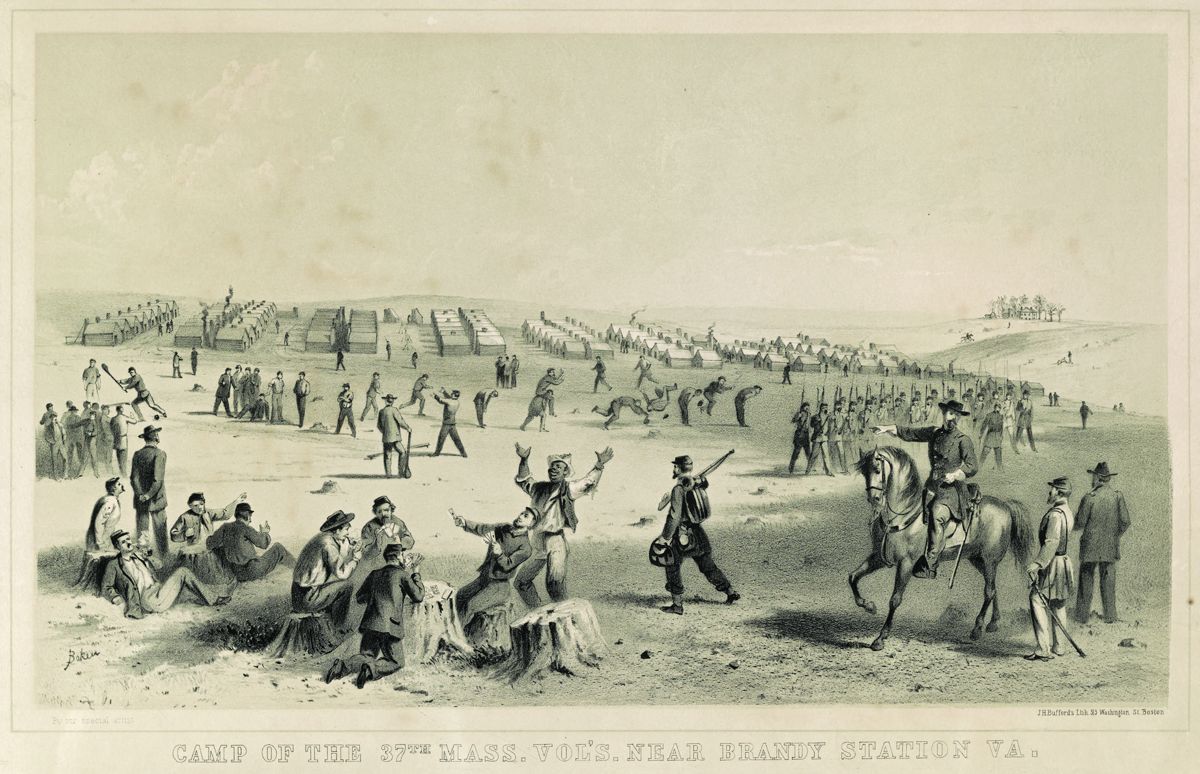
Longstreet in Tennessee.” With a straight face, the paper reported that the movement was a success “and it is now hinted quietly that the army will settle down into winter quarters on the line of the Rappahannock.”3 The title margin of Bufford’s lithograph showing the 37th Massachusetts camp reveals that it was executed by our “special artist.” Signed in the plate is “Baker,” Bufford’s principal and draftsman and illustrator of sheet music, Joseph E. Baker. In 1860, Baker produced a portrait of Lincoln, which “was widely circulated” enabling him to build “a solid reputation as a portraitist.” During the war he drew political cartoons, war scenes, and portraits of military officers. Although his principal work was with Bufford, Baker worked for other Boston firms producing playbills and advertisements. He remained active until 1888.4 Lithographic historian and collector Harry Peters noted that Bufford employed many talented artists giving a mention to “J. E. Baker.” Noted in earlier columns in this space was the information that Winslow Homer was one of John Bufford’s apprentices before he achieved his fame.5 Bufford was responsible for countless views of the Civil War. His body of work rivaled Currier and Ives and was more artistically appealing. Additionally, he worked with other lithographers such as John Bachelder who also stressed quality and accuracy over Currier’s penchant for immediacy. Endnotes:
James L. Bowen, History of the Thirty-Seventh Regiment, Mass. Volunteers in the Civil War of 1861–1865 : With a Comprehensive Sketch of the Doings of Massachusetts as a State, and of the Principal Campaigns of the War. Holyoke. C. W. Bryan, & Co., 1884, 235. See also Mason Whiting Tyler, Recollections of the Civil War. Columbus, O.: Badgley Publishing Company, 2011, 84-85. Ibid., 243. The New York Times, December 2, 1863. https://www.artprice.com/artist/223175/joseph-e-baker/biography. See also David Tatham, American Antiquarian Society, “John Henry Bufford,” 47-73. https://www.americanantiquarian.org/proceedings/44517581.pdf. Harry Peters. America On Stone: The Other Printmakers to the American People. New York: Doubleday & Co., 1931, 118-119.
After 43 years in the museum field, Salvatore Cilella now spends his time collecting American prints and maps and writing. His last professional position was President and CEO of the Atlanta History Center. His most recent books are Upton’s Regulars: A History of the 121st New York Volunteers in the Civil War (U. Press Kansas, 2009). His two-volume Correspondence of Major General Emory Upton, (U. of Tennessee Press, 2017), is the recipient of the 2017–2018 American Civil War Museum’s Founders Award for outstanding editing of primary source materials. He is currently editing a manuscript of Upton’s letters to his wife 1868-70, slated for publication by the Oklahoma University Press early 2020.
Tremont Zouaves, (song sheet) also by Bufford.
(Public Domain)
Camp of the 37th Mass. Vol’s. near Brandy Station, Va. / Bakers; J.H. Bufford’s lith., Boston.