
This And That
Soldiering On
By Gould Hagler · Originally published March 2020 · pp. 30–31
On occasion the postman has brought me interesting things sent by my cousin Billy. Once the mailbox contained a book telling the story of a collateral ancestor of ours. Benjamin Church was a prominent citizen of Boston at the time of the Revolution. He served on the Committee of Safety with some men wellknown to American history and admired by us all. Uncle Ben, however, was a mole, a spy for General Gage. He was not tried (the reasons are complex) but exiled. The ship carrying him to the Caribbean was lost at sea. Another of Billy’s uncles (just his, this time, not mine)
participated in another revolution: Ferdinand Burdell served in the Confederate army. After the war Ferdinand composed a brief account of his military service, a three-page, handwritten document, a copy of which Billy mailed to me. Ferdinand enlisted as a private, fought at Sharpsburg, then later joined the engineers. As Sherman was approaching Savannah in late 1864, Ferdinand was in charge of a crew building a lunette for mounting an artillery piece. The work was not finished and the gun was never mounted. “About daybreak of Dec. 21 1864 a Cavalryman came riding up to the work at a frantic rate,”
Ferdinand wrote, “& informed me that Hardee’s army had abandoned the City that night, & I must rush my Party to the Pontoon Bridge….” A close call for Ferdinand and his men, but they did get out of Savannah before Sherman got in. On the last page of the account this sentence caught my attention: “My party was placed under the direction of James M. Couper – Lieut. Engineers & sent to Abbeville SC to establish a line for a Military Rail Road from that point to Washington Ga.” This was sometime after January 8, 1865. That’s right. In January 1865
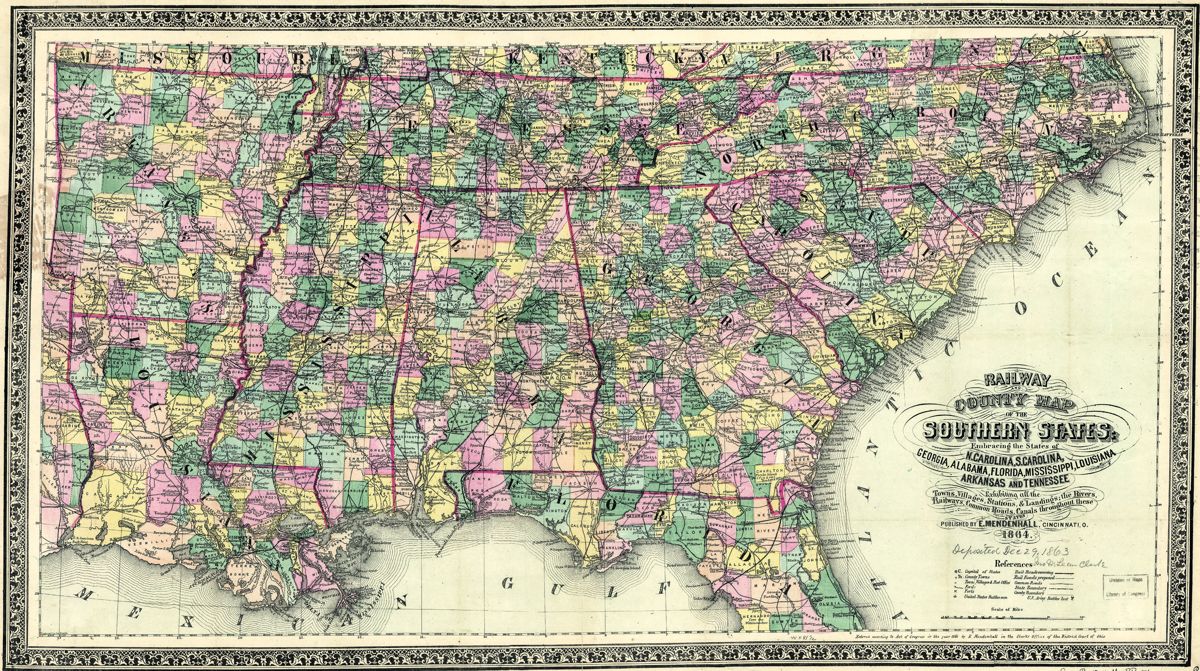
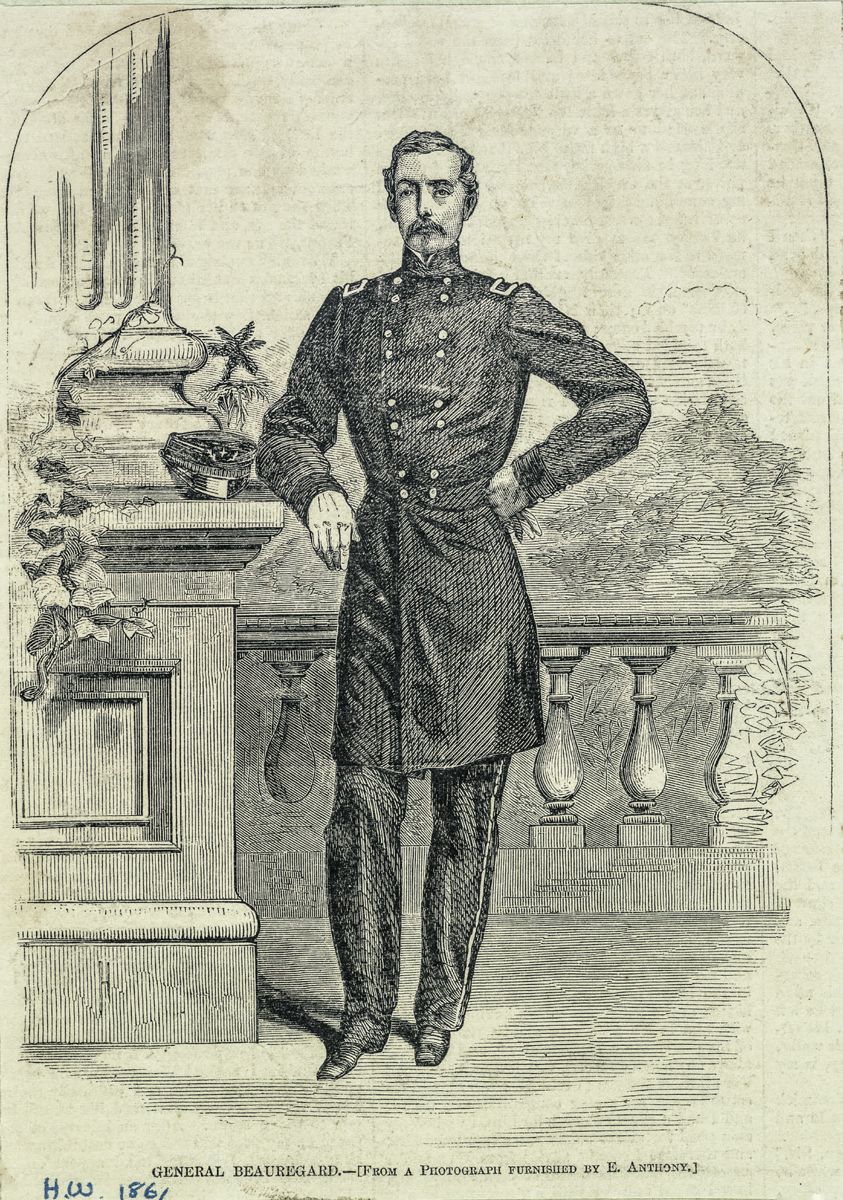
there was a plan—or at least a hope—for a 50-mile railroad between these two towns. Ferdinand wrote that “the work was very soon abandoned.” He went on to other engineering tasks in the Carolinas. But let’s get back to that railroad. I perused the correspondence between General P.G.T. Beauregard and other officers in early 1865, when Beauregard was commanding the Military Division of the West. The records do confirm the existence of such a plan or hope. What were these officers thinking? An assessment of the military situation, an examination of the map, and orders related to the movement of men and supplies may tell us. Sherman was finishing his R&R in Savannah. His next specific objective, Charleston, or Augusta, or Columbia, was, of course, unknown to the Confederates; however, whatever his exact route, he would disrupt communications between the Western Theater and the east. Uncle Ferdinand’s hoped-for railroad was part of an effort to get men and supplies around Sherman’s path of destruction, to get aid to Lee, and to put an army between Sherman and Grant. The records provide insights about the Confederates’ struggle to carry on the fight.
Fixing existing rail lines was essential. The Official Records contain orders and other communications pertaining to repairs necessitated by enemy destruction and by the extra-ordinary wear and tear to which the rails had been subjected during 45 months of war. The railroad from West Point, Ga., to Atlanta was one critical line. Another was the Georgia Railroad between Atlanta and Augusta, 150 miles to the east. Orders were made to repair the branch line running north from the Georgia Railroad to Washington, Ga. In February Beauregard warned that rolling stock on the line north of Columbia would have to be destroyed unless the gauge of the Charlotte-to-Danville line was widened. The Confederacy was near the end of its tether. Where would it find the resources necessary to make these repairs? Iron could be impressed from some rail lines for the repair of others, but we know what happens when we rob Peter to pay Paul. Someone suggested pulling up iron from two branch lines in Georgia to use on the main lines. Beauregard objected. “It is impracticable at present to order the removal of the iron from the Mayfield and Washington Branch Roads. They have become lines of communication of the first importance. Washington and Abbeville may become our future base of supply for the army in Virginia,” wrote Col. George Brent on February 6, speaking for his boss in a telegram to the Confederate army’s chief engineer. The Washington-to-Abbeville line wasn’t the only new project suggested. On January 28, Beauregard sent a message to Adj. Gen. Samuel Cooper saying that it was “essential to military operations that the railroad from Milledgeville to Mayfield be speedily finished.” This line would connect the central part of the state to the Georgia Railroad. Cooper quickly squelched this notion, telling Beauregard to focus instead on the repairs to the West Point Railroad. In March Beauregard ordered the impressment of labor for widening the gauge of a North Carolina track. A heavy hand was needed to garner the resources for these projects. On January 24 Beauregard authorized Capt. L.P. Grant to “impress for temporary use the necessary transportation to repair Georgia Railroad.” On February 10 Beauregard authorized a Mr. W.M. Hight “to call upon the citizens adjacent to the Washington Branch, Georgia Railroad, for such lumber, wagons, and labor as they are willing to contribute for the repairs of the road, and for all of which the Government will pay a just compensation.” The message to Hight went on to state that “Capt. L.P. Grant…has been requested to furnish you iron, spikes, &tc., sufficient to place the road…in thorough repair.” Railroad or no railroad, the men and supplies had to be transported. A message from Beauregard to Maj. Norman Smith on February 4 ordered a heavy-handed approach tempered with tact. The major was instructed to impress
“wagons and teams to run between Washington, Ga., and Abbeville, S.C….” The order called for 120 wagons and 480 mules and specified the numbers to be obtained from each of five counties along the line. Such action, the order read, “is at all times harsh and calculated to irritate and annoy….” Smith was therefore told to “select for this duty your best officers and instruct them to proceed with all possible delicacy….” The effectiveness of delicacy under the circumstances is not known, but we can guess. The citizens were to be paid with Confederate IOUs. Let’s not forget, there is a river between Washington and Abbeville. On February 20 Beauregard ordered construction of a pontoon bridge over the Savannah. The pontoon train was en route, but flooring and sleepers would have to be made from material available at the crossing creating more annoyance and irritation, perhaps, for the locals. On February 17 Beauregard was in Columbia, but leaving that very morning as Sherman approached. He sent a message to his assistant adjutant general in Augusta, advising that forces being gathered to stymie Sherman’s progress would concentrate in Chesterville [now Chester], a stop on the railroad between the South Carolina capital and Charlotte. Beauregard specified three possible routes* to Chesterville. Moving from the first option to the third, the proposed routes bypass Columbia by wider and wider margins, to the north and west, a path shifting as necessary to get around Sherman and unite with a force in his path. So, as the war entered its final weeks, the Confederates were seeking ways to get supplies to Lee and concentrate against Sherman. We read orders about building one new railroad and repairing existing ones. Pontoon bridges were built. Lines of march were specified. Rations were ordered for points along the routes. The books narrating the events of April and May had not yet been written. The men issuing these orders did not know what we know, but they surely understood their situation to be dire. What were they thinking? They must have been thinking that they were duty-bound to soldier on. The government in Richmond continued to function and was giving direction to the military leaders. Telegraph lines and couriers conveyed orders. Men were under arms, men who would follow orders and be led. Railroad trains were yet limping along the worn and shaky tracks to move men and supplies. There were still resources that could be marshalled, furnished by citizens with wagons and mules, citizens irritated and annoyed, but compliant with orders of impressment. The commanders still had hope, they carried on. Beauregard sometimes displayed an attitude that went beyond hope and entered the realm of fantasy. On February 3 he asked for re-enforcements from Virginia, with which he “would defeat, if not destroy Sherman’s army.” Later that month he wrote about crushing Sherman, concentrating against Grant, and then marching to Washington “to dictate a peace.” That was Bory. Others were more realistic and, for that matter, not all the men were soldiering on. On February 4 an officer in Augusta, ordered to take his command of guards to the Savannah River crossing upstream, was told not only to protect the pontoon bridge but also to “arrest stragglers and deserters from the armies in South Carolina and Virginia.” When the plan for the Abbeville-to-Washington railroad was dropped, Ferdinand Burdell soldiered on to Newberry, S.C., where the engineers threw a pontoon bridge across the Broad River, used by troops on their way to North Carolina and the battle at Bentonville. After this work, he rushed to Hillsboro, N.C., to survey roads leading to Virginia, “the Evident object being to make a clear way for Lee & [Johnston’s] army to connect.” When he wrote his post-war account Ferdinand knew what we know now. By early 1865, he wrote, “we were about crushed out by the strength of overwhelming numbers and resources of war.” In April he encountered some of Lee’s paroled men as they returned home. “They told us that ‘the war was over & to make for home’ – which we were not slow in doing.” Ferdinand returned home to Augusta, where he and the others of his party surrendered and were paroled. “Thus Ended my bitter experience of 4 long weary years,” he wrote, “wrecked on the Shores of Defeat.”
*Route 1: Augusta, Edgefield, Newberry, and Chesterville. Route 2: Augusta, Edgefield, Ninety-six Depot, Huntsville, Unionville, and Chesterville. Route 3: Washington, Abbeville, Laurensville, Unionville, and Chesterville. (See map for the significance of this detail.) Sources: All the correspondence referenced is found in the Official Records, Ser. 1, Vol. 47, Pt. 2, Sec. 2.
Gould Hagler is a retired lobbyist living in Dunwoody, Ga. He is a past president of the Atlanta Civil War Round Table and the author of Georgia’s Confederate Monuments: In Honor of a Fallen Nation, published by Mercer University Press in 2014. Hagler speaks frequently on this topic and others related to different aspects of the Civil War and has been a regular contributor to CWN since 2016. He can be reached at [email protected].