
Myth: Thousands of enslaved and free African American soldiers fought for the Confederacy
By John M. Coski · Originally published March 2020 · pp. 1–4
This column is a slightly-updated reprint of a short blog post written for the American Civil War Museum’s website in 2017. For several decades, the question of whether or not there were “Black Confederates” has been one of the most controversial issues in the study of Civil War history. The disagreement arises in part from rival ideological positions, but also traces to different definitions of key terms, especially “soldier.”
There is no question that tens of thousands of enslaved and free African Americans served with Confederate armies as body servants, laborers, teamsters, hospital workers, and cooks, but were these men “soldiers” in any real sense of the word? Partisans of the “Black Confederate” viewpoint answer in the affirmative, comparing the roles black men played in the Confederate army with analogous job descriptions of modern American soldiers, the labor battalions in the World Wars, especially those who were drafted and thus “forced” into service, and even the menial labor that U.S. Colored Troops units performed during the Civil War. Were African American laborers in the Confederate army formally enlisted in the army, equipped with uniforms, arms, and accoutrements, and paid for their own work, as were African Americans in the U.S. Army? No. Their status was that of enslaved or marginally free laborers serving in capacities in a military setting analogous to their roles in civilian life. Referring to such men as “soldiers” ignores a fundamental distinction between forced labor and military service; historian Kevin Levin coined a useful term for them: “camp slaves.” That said, even before the last months of the Civil War, there were African Americans in Confederate armies who met some of the customary criteria to be called soldiers. Beginning in 1862, the Confederate army
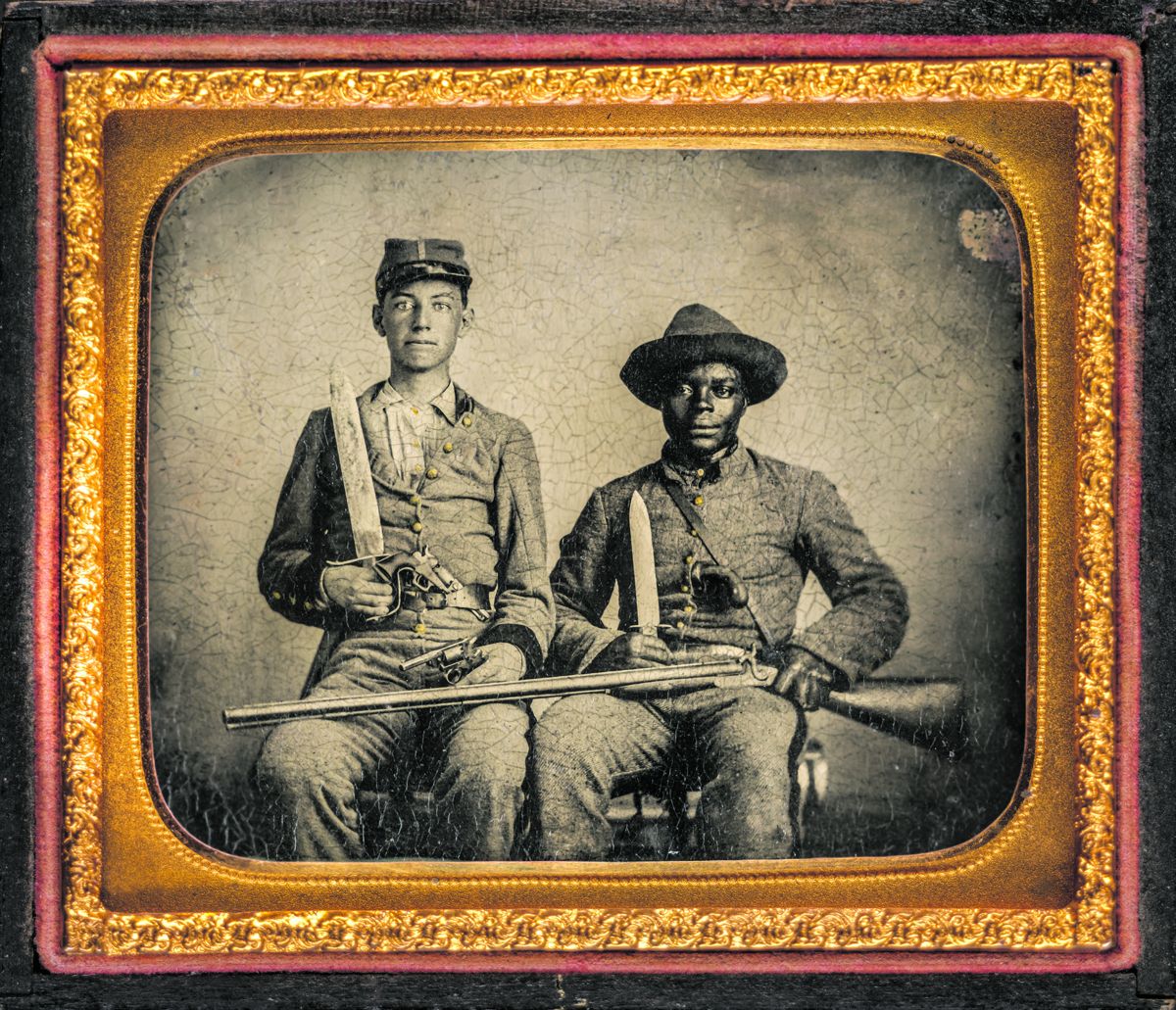
Andrew Martin Chandler (1844–1920), Company F, 44th Mississippi Infantry and family slave Silas Chandler (1837–1919) posed for this iconic 1861 photograph both wearing homespun Confederate shell jackets holding Bowie knives, Colt revolver stuck in Andrew’s belt and pepperbox pistol stuck in Silas’ jacket, double barrel shotgun rests across their lap. The Chandlers had 37 slaves when the war began, and when 17 year old Andrew went to war, 24 year old Silas accompanied him. When Andrew was badly wounded in the leg at the Battle of Chickamauga Sept. 20, 1863, army surgeon decided his leg must be amputated, but Silas according to various accounts would not allow it and was able to get Andrew home to Mississippi, with the local doctor treated his wound less drastically and his leg was saved though he never had full use of it again. At this point Silas was sent off to accompany another Chandler brother Benjamin in the 9th Mississippi Cavalry, Benjamin Chandler (1846–1909) had just turned 17 and Silas was now 27 when they left for Georgia, to join Wheeler’s Cavalry early in 1864. Silas would be with Benjamin as an escort for President Jefferson Davis fleeing Richmond Virginia, to Georgia, in June 1865. The Chandlers all returned home to Palo Alto, Miss., after the war. Silas returned to his wife and would have 12 children, of which only five survived to adulthood. Silas was granted pension as “indigent servant” of a soldier in 1916, over 1,700 other African American slaves who accompanied their masters would receive similar Mississippi State pensions.
formally enlisted hundreds of cooks and musicians; those men were paid, but almost certainly not armed or uniformed. In March 1865, the Confederate Congress passed a law providing for the formal enlistment of African-American soldiers. When the Confederate army implemented the law it required masters to recognize slaves’ freedom before they could enlist. Not surprisingly, recruitment was slow. Possibly a few hundred men enlisted before Appomattox. Some of those men drilled on Richmond’s Capitol Square shortly before the Confederates evacuated the city, and apparently some traveled with Lee’s army and were involved in the Appomattox Campaign. In the six months preceding passage of the March 1865 act, soldiers, civilians, newspaper editors, and public servants debated the proposal to arm the slaves. A few
Confederate military units published circulars favoring the proposal, but other units opposed it, and many predicted privately that white Confederate troops would never consent to it. Significantly, in the course of that long and thorough debate about what would happen if the Confederacy used black troops, no one cited actual examples of
African Americans fighting for the Confederacy in the first three years of the war. The use of the conditional tense throughout the debates constitutes the most persuasive evidence that there was no critical mass of “Black Confederates” participating as soldiers in the War. Evidence that Prof. Ervin L. Jordan, Jr., amassed for his landmark study,
Black Confederates and AfroYankees in Civil War Virginia (1995), suggests that individual African Americans serving with Confederate armies occasionally participated in battle. Whether they did so for self-defense, loyalty to a master or friend, or commitment to the Confederacy is not clear. Although many scholars contend that no people would ever willingly fight to perpetuate their own enslavement, Jordan argues that an un-measurable minority of men were “zealots of the wrong,” and that students of history should try to understand those men, even if we disapprove of their decisions. In contrast to Jordan’s scholarly critical analysis, the argument supporting “Black Confederates”
is typically related to the modern debate about slavery and Confederate heritage. According to this argument, if large numbers of African Americans fought for the Confederacy, then their descendants should embrace, not condemn, the Confederacy, the Confederate flag, and Confederate monuments. The modern promotion of “Black Confederates” echoes the early 20th-century white southern embrace of “faithful slaves” who served the Confederacy. Southern states, beginning with Virginia in the 1880s, but most after 1900, awarded pensions to blacks who served with Confederate forces, and a handful of former body servants and cooks attended Confederate veteran reunions.
Prominent Confederate veteran Judge George L. Christian in 1913 hinted at the likely motive for such actions when he memorialized the service of Alexander Kean, who served with the Richmond Howitzers artillery. Christian hoped that the account of Kean’s service “might stimulate some of the colored people of this day to emulate the life and character of this faithful and devoted member of their race.” As historians continue to mine records for evidence for and against the existence of “Black Confederates,” we know that no significant numbers of enslaved or free African-American men served in the Confederate Army as soldiers, as defined by commonly accepted criteria. Certainly their numbers and their military service was nothing to compare with the 200,000 AfricanAmerican men who served in the U.S. Colored Troops.
For Further Reading:
Bruce Levine, Confederate Emancipation: Southern Plans to Free and Arm Slaves during the Civil War Video of Bruce Levine lecturing on the book: https://www.youtube.com/ watch?v=VjBwCSZC-20 Robert Durden, The Gray and the Black: The Confederate Debate on Emancipation Ervin Jordan, Black Confederates and Afro-Yankees in Civil War Virginia Kevin M. Levin, Searching for Black Confederates: The Civil War’s Most Persistent Myth. Chapel Hill: University of North Carolina Press, 2019.
John M. Coski is historian at the American Civil War Museum in Richmond.