
Through The Lens
A Dramatic Leap The Battle of Glorieta Pass – Part 1
By Stephanie Hagiwara · Originally published March 2020 · p. 22
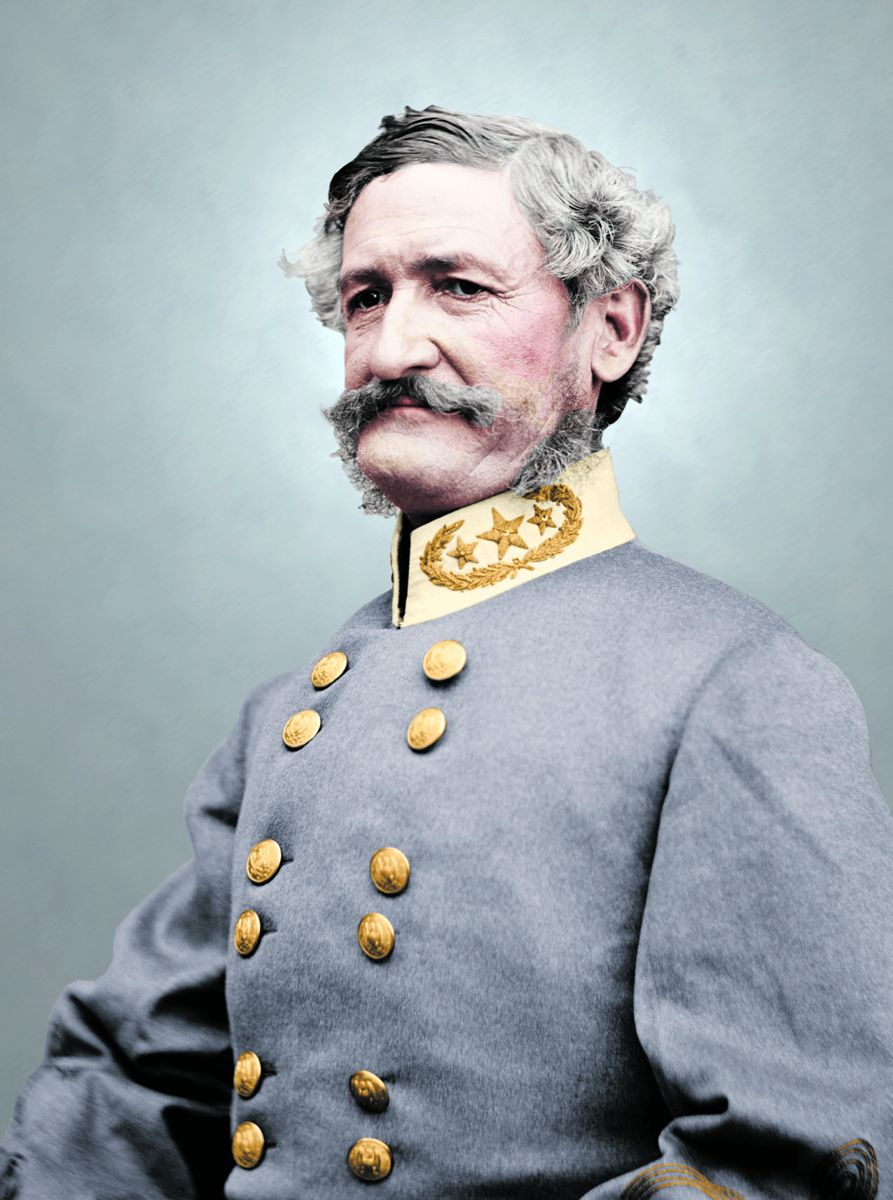
“Boys, I’m the worst enemy you have” – C.S. Gen. Henry Sibley, departing from Ft. Union After the 1846–1848 MexicanAmerican War, the United States stretched from sea to shining sea. The Confederates considered it only equitable that their new country should do so as well. C.S. Gen. Henry Hopkins Sibley would lead the effort. Sibley had invented the Sibley tent, widely used by both sides and the Sibley stove, to heat tents the Army used through the early years of World War II. Louisiana native Sibley resigned while actively serving in New Mexico. He went to C.S.A. President Jefferson Davis in Richmond, Va., to pitch his idea to capture the New Mexico Territory. He knew many of the area’s defenders had either resigned to join the Confederacy or were sent to fight in the East. After 14 years of being Americans, the native Hispanic population wasn’t particularly loyal to the Federal government. Sibley would raise troops in Texas, live off the land until he easily captured Federal supplies, seize the rich mines in Colorado Territory, march westward through Salt Lake City, across the mountains, and “On to San Francisco.” Sibley overlooked that two previous years of drought had dried up year around water holes in the barren landscape. The Federals had consolidated their position at Fort Union and Fort Craig near Santa Fe, N.M., to defend supplies and movement along the transcontinental Santa Fe Trail. The residents primarily wanted a government that protected them from the Indians, conducted business through the border state of Missouri, and hated Texans. Everyone feared the Apaches. The Apaches made their living with raiding parties, viewed the departure of the soldiers as a victory, and created a three-sided war by attacking everyone. On Feb. 21, 1862, the Confederates won the Battle of Valverde, but their goal of being resupplied was thwarted by the Federals removing stores on retreat and clearing provisions out of both Albuquerque and Santa Fe, N.M. Additionally, the gold miners from Pikes Peak, Colo. Territory heeded the call for reinforcements. Under U.S. Col. John P. Slough, the Colorado Volunteers marched over 400 miles in 14 days to reach Fort Union. On March 22, Slough sent U.S. Maj. John Chivington to Santa Fe to capture the approximately 100 rebels reported there. Chivington, an ordained minister from a military family, had a reputation for “cleaning up frontier towns in the name of the Lord. Once in Platte County, Mo., when threatened with tarring and feathering if he continued to preach, he stormed to the pulpit and, laying two pistols beside the open Bible, proclaimed, ‘By the grace of God and these two revolvers I am going to preach here today!’ The “Fighting Parson” turned down a chaplaincy for a fighting command. The Santa Fe Trail between Fort Union and Santa Fe traveled through 11miles of valleys, canyons, creeks, wooded ridges, and cultivated fields collectively known as La Glorieta Pass, in the Sangre de Cristo Mountains. The Battle of Glorieta Pass was fought on March 26–28, 1862. During the early hours of March 26, both sides sent men searching through the dark to find their adversary. U.S. Lt. George Nelson and 20 men following the Santa Fe Trail back to their camp came across their opponent’s four mounted pickets. In the early morning light, C.S. Lt. John McIntyre, mistaking the group for their brethren, asked if they were being relieved. “Yes, we came to relieve you of your arms,” replied Nelson. The Federals “cocked our rifles and drew them to our faces.” Nelson ordered them to surrender and the rebels complied. Back at camp, the waking Federals were surprised to recognize a deserter and a person from Colorado among the captives. More to the point, Chivington learned the whereabouts of his foe. About 2 p.m. Chivington’s three infantry 1st Colo. companies and one that had been mounted, went with a detachment of the 1st and 3rd Cavalry regiments and reached Apache Canyon. A report that the enemy was spotted a mile ahead spread through troops. The excited recruits rushed forward “dropping knapsacks, canteens, and overcoats,” for their first taste of battle. Due to the cold, the Confederates had not slept well. Unaware of capture of their pickets, Maj. Charles L. Pyron with his 2nd Texas Mounted Rifles battalion and Maj. John Shropshire’s four companies of the 5th Texas and two 6-pdr. cannon were getting a slow start to the day. Ahead of the main column, 30 men with the 6-pdr. guns just reached the upper portion of Apache Canyon when the Federals were spotted. The cannon were fired, disrupting the Union advance. Chivington ordered his men to take cover amongst the trees on the high ground and to charge the guns if they were limbered. Outnumbered, the guns were limbered for a retreat to Shropshire’s camp in the lower canyon when Pvt. Adolphus Norman noticed a loose gun carriage wheel. Interpreting the repair as the gun taking a firing position, the Federals dove for cover. It gave the Texans time to escape. The bluecoats mounted but no one gave the order to charge. Instead they stood around like “stoughton bottles.” The artillery flew past as Shropshire’s men rushed forward. About 1 ½ miles from the initial encounter, Pyron conveyed calm as he placed his men and artillery in the road. Shropshire’s men were positioned on the “steep, rocky hillock” on the left flank; the right flank took their places on the canyon’s southern side. According to one Federal, it looked like the “bastion of a fort.” Chivington placed his men on the wooded hillsides. The cavalry was to charge if the opposing line faltered. The horsemen of Company F, 1st Colo. followed the infantry over the Galisteo Creek bridge. The Confederates turned their artillery fire at this “… new threat and the veteran regulars were thrown into confusion by the projectiles screaming over their heads and bursting at their rear.” The regulars regrouped behind some rocks leaving Company F on the bridge. The Confederate artillery advanced but was unable to withstand the fire from the hillside and retreated. Covington expected his cavalry to charge, but when the cavalry didn’t receive the order, both sides regrouped farther down the canyon. This time Chivington planned a cavalry charge to break the Confederate center while the infantry flanked the line. About 4 p.m., Chivington gave the order for Company F to charge the perceived retreating Confederate artillery. The horseman charged four across down the trail, unable to spread out due to the terrain. The Texans poured lead on the oncoming horseman. Around the bend they rode to face the Confederate center. The Rebels broke, taking their two cannon with them. The horsemen jumped a little gully or rode through it after the Texans. The fighting continued until nightfall. Some Confederates “…forgot that one of them was equal to five of us and insisted on surrendering.” Both sides pulled back and sent for reinforcements to continue the fight. Nevertheless, the myth of Company F, galloping in “columns of twos” down the Santa Fe Trail and leaping over a burning eighteen-foot bridge to continue the fight with the Texans is the enduring image of the battle. •
•
Sources:
Alberts, Don E. The battle of Glorieta: Union victory in the West. Texas A&M University Press, 2000 Edrington, Thomas S. and Taylor, John. The battle of Glorieta Pass: a Gettysburg in the West, March 26-28, 1862. University of New Mexico Press, 2000
Stephanie Hagiwara is the editor for Civil War in Color.com and Civil War in 3D.com. She also writes a column for History in Full Color. com that covers stories of photographs of historical interest from the 1850’s to the present. Her articles can be found on Facebook, Tumblr and Pinterest.
General Henry Hopkins Sibley, Commander, Army of New Mexico, Colorization © 2020 civilwarincolor.com courtesy civilwarincolor.com/cwn.