
1st Georgia, Oglethorpe Light Infantry Presentation Sword
By Shannon Pritchard · Originally published March 2020 · pp. 15–16
Thirty-three year old Methodist preacher, James Osgood Andrew Clarke, enlisted in the Georgia Volunteers, on March 16, 1861, as Captain of the Oglethorpe Light Infantry. He had previous military experience serving in the Mexican War. The 1st Georgia Volunteers, CS (Ramsey’s) was formed at Camp Oglethorpe, Macon, Ga., in April 1861, with the Oglethorpe Light Infantry as Company D. Clarke was signing documents as a lieutenant colonel as early as April 30,
The ornately cast brass mount is inset with an engraved silver scene depicting mankind confidently climbing the hill of adversity, while carrying a flag that is engraved with “Excelsior” which means, ever upward.
1861, although the record showing his official promotion date is missing. The men were raised in Macon, Newnan, Perry, Augusta, Sandersville, Atlanta, Bainbridge, Quitman, Dahlonega, and Columbus. The regiment went to Pensacola, Fla., then north to Virginia. The War Department sent the First to western (now West) Virginia and the Shenandoah Valley where they served under R.S. Garnett and H.R. Jackson, then was attached to General D.S. Donelson’s
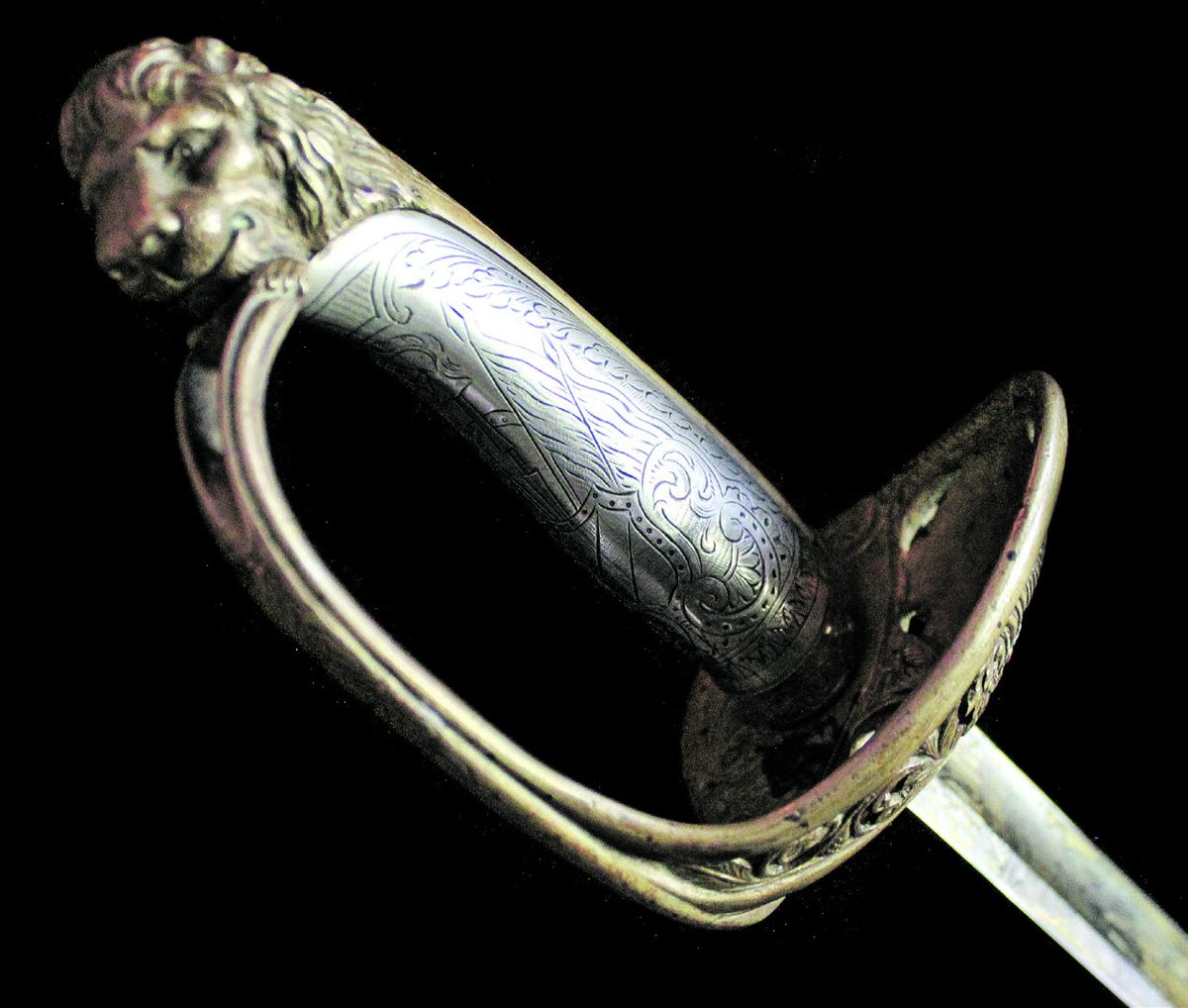
The scabbard’s lower mount has a silver inset engraved with Lady Liberty, holding a liberty cap on a spear. This was a patriotic motif that all of the era recognized. The brass, cast drag is little less ornate than the mounts themselves. Lieutenant and Drill Master at a Georgia Camp of Instruction. He was already serving, but his official appointment date was July 29, 1862. He continued in that position through 1863 at the least; due to the dearth of records, his discharge date cannot be determined, but I assume that he served through the remainder of the War. Colonel Clarke had a remarkable career in the ministry after the War, and I found hundreds, if not thousands, of newspaper accounts mentioning him and referring to him as a professor, minister, and doctor. He went to his reward on Sept. 4, 1894; his earthly remains are buried in Magnolia Cemetery, Augusta, Richmond County, Ga. The “Captain’s” ornate sword was presented to him by the men of the Oglethorpe Light Infantry in June 1861. It was manufactured by Horstmann & Sons, Philadelphia. The sword and its scabbard are ornately decorated with solid silver, engraved patriotic Georgia motifs, and an engraved silver grip. The blade is deeply etched with more patriotic motifs that are brought out in strong relief with a gold overlay on the recesses.
Brigade during Lee’s Cheat Mountain Campaign. They met with an initial success in a minor skirmish at Laurel Hill, but then were involved in a disastrous retreat and the rear guard fights at Kalers Ford and Corricks Ford, during which six companies were cut off and became lost in the rugged Alleghenies, starving to the point of contemplating cannibalism. The First fought well in the Confederate victory at Greenbriar River. Subsequently, they were sent to the Shenandoah Valley and served under General Thomas J. “Stonewall” Jackson. The regiment suffered horribly dealing with the winter ice and snow as they followed Jackson on marches to Bath, Hancock, and Romney. After being left isolated in winter quarters at Romney, the Georgians came near to mutiny. When one of his men assaulted General Taliaferro, charges were preferred against Colonel Clarke, causing him to resign in November 1861. He, and soon the regiment, returned to Macon and were mustered out of service. Most members joined other commands and went back to Virginia. Clarke reentered service as a
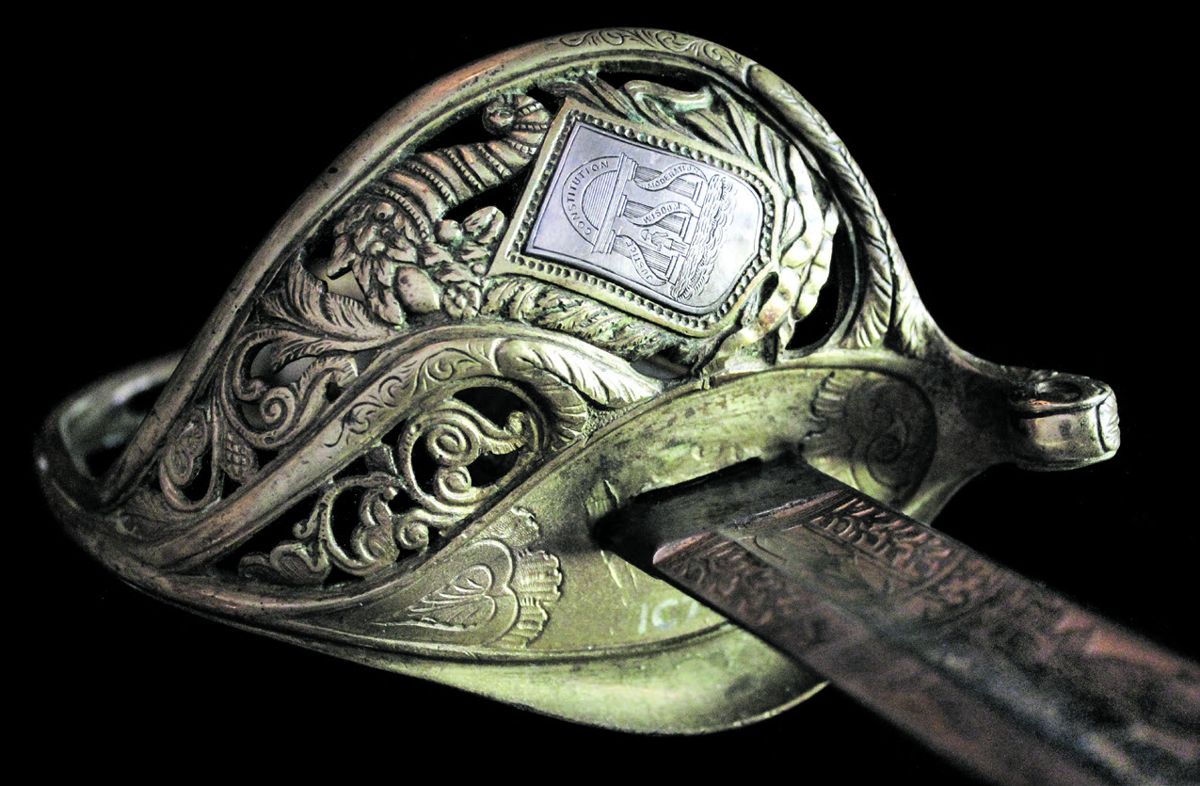
The Georgia state seal, the constitution, resting on the pillars of justice, wisdom and moderation. The laurel bordered presentation panel is engraved “Oglethorpe Infantry to James O Clarke Captain Commanding, June 1861.
The panoply of arms is etched in deep relief, and brought out in stunning clarity with a gilt background.
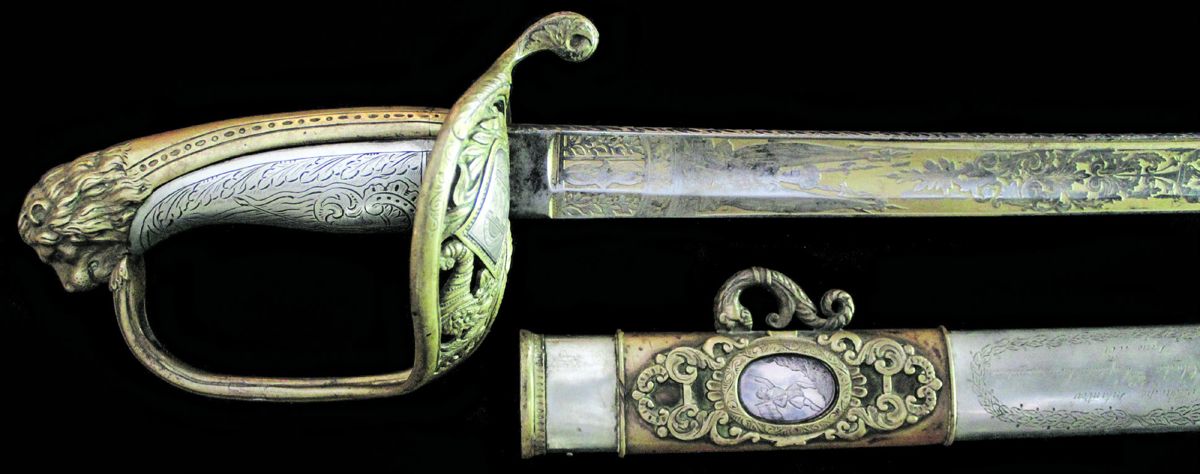
Another blade etching featuring a roman soldier; after etching the panel was chased to add detail.
The sword and its scabbard are in near new condition, still glowing with their original beauty.
Shannon Pritchard has authored numerous articles relating to the authentication, care and conservation of Confederate antiques, including several cover articles and is the author of the definitive work on Confederate collectibles, the widely acclaimed Collecting the Confederacy, Artifacts and Antiques from the War Between the States, and is co-author of Confederate Faces in Color.
Still another beautifully etched and chased panoply of arms.