
The Graphic War
The Volunteers in Defence (sic) of the Government Against Usurpation
By Salvatore Cilella · Originally published June 2020 · p. 26
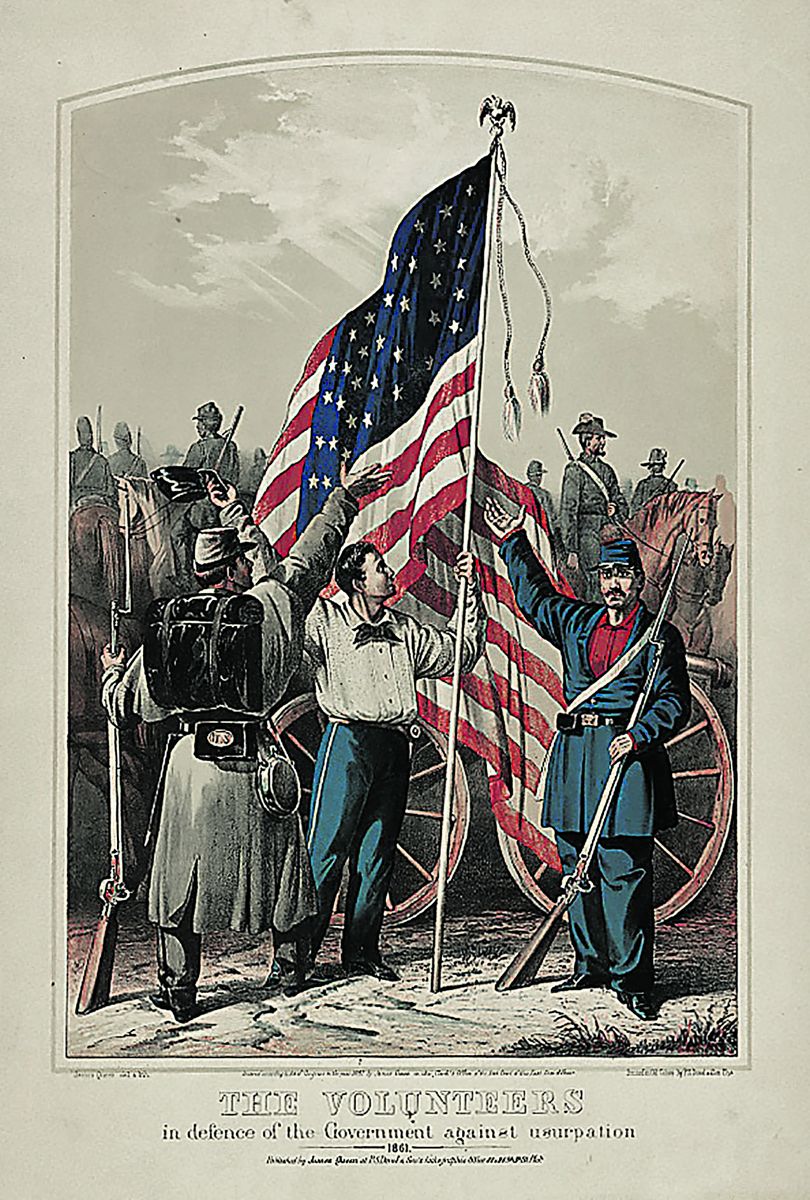
The Graphic War highlights prints and printmakers from the Civil War discussing their meaning and most importantly, the print maker or artist’s goals. Allegorical devices have been used by artists for centuries. Ancient coins “became the most important source used by (Renaissance) painters for the depiction of such abstract virtues as Liberality or Clemency or Charity, and the language of allegorical art was radically and permanently altered.”1 During the American Revolution and throughout the early days of the American Republic, allegorical figures abounded. We wrote recently in this column about the use of George Washington’s image by both south and north as an allegorical representation of the cause for either side. Less obvious representations of freedom and liberty were employed by the colonists to convey their cause. The liberty tree, not the first symbol one would consider, was used on early prints, paintings, and flags. The liberty cap and the liberty pole were borrowed from the continent. Bostonians preferred the liberty tree; New Yorkers, the liberty cap.2 In the 19th century most Americans came to accept the concepts of freedom and liberty as symbolized by a woman. The figure of “Armed Liberty” eventually adorned the federal capital building in 1863.When war broke out, both sides adopted flags as symbols of their allegiance. While the Confederate flag underwent several iterations, with the fall of Fort Sumter, the
Union rallied around the national emblem of the stars and stripes. In his 1861 lithograph entitled “The Volunteers in Defence (sic) of the Government Against Usurpation,” the artist James Fuller Queen (1821–1886) replaced liberty trees, liberty caps, and armed goddesses with three soldiers and the American Flag. One holds the flag staff with his hat off, gazing upward at the stars and stripes while the other two raise their right hands toward it. The latter two, one of whom is gazing toward the viewer, seem to be saying: “Look on this, the symbol of our nation and eventually our sacrifice to preserve it.” In the background are mounted soldiers behind an artillery piece. So quickly did the flag become a symbol of Union unity, that Currier and Ives presented a “flag/volunteer” print to the public five weeks after Fort Sumter fell.3 The date of “Volunteers” is 1861 and the ironic note of this patriotic lithograph by Philadelphia printer, P. S. Duval is that the volunteer on the right is uniformed in blue, the man on the left in gray. The background soldiers are also dressed in gray and wear early issue Hardee hats. It wasn’t until well into the war when uniforms became, well, more uniform. Was this an attempt by the artist and printer to convey the notion that both sides should honor the flag and cease hostilities? The lithographer, Peter Duval (1804–1886) was no stranger to military subjects. A native of France and recent immigrant to America, he became a prominent printer of his day. Teaming up William Massey Huddy (1807– 1846), the two produced, published, and illustrated The United
States Military Magazine (1839– 1842).4 It was Huddy who conceived of a publication extolling the virtues of the state militia and the Philadelphia Volunteer Corps. In this print from the Library of Congress’ collection, Duval continued the tradition of the volunteer as an important cog in the war effort. James Queen, the artist of this allegory, worked extensively with Duval. As one historian notes, Duval was Queen’s “most steady and consistent employer.” In fact, Duval thought that Queen was “one of the best lithographic artists in the country.”5 The two produced many military oriented prints during the war, including several renditions of the volunteer refreshment saloons in the city, the Civil War’s predecessors to the USO canteens of World War II. Here, in this print, Duval and Queen pay tribute to the volunteer so necessary to the administration’s prosecution of the war against “Usurpation.” Endnotes: 1.
Francis Haskell. History and Its Images: Art and the Interpretation of the Past. New Haven: Yale University Press, 1993. 21. David Hackett Fischer. Liberty and Freedom. Oxford: Oxford University Press. 2005. 1-49. Harold Holzer, Mark E. Neely, Jr.
The Union Image: Popular Prints of the Civil War North, Chapel Hill: The University of North Carolina Press, 2000, 6. Erika Piola, ed. Philadelphia on Stone: Commercial Lithography in Philadelphia, 1828–1878. University Park: The Pennsylvania State University Press, 2012. 133-134. Ibid., 85. See Piola, ed. Sara W. Duke, Chapter Three, “James Queen, Chronicler of Philadelphia, 79-95 and Sarah J. Weatherwax, Chapter Four, “Peter S. Duval, Philadelphia’s Leading Lithographer,” 97-117.
After 43 years in the museum field, Salvatore Cilella devotes his time collecting American prints and maps and writing. His last professional position was President and CEO of the Atlanta History Center. His most recent books are Upton’s Regulars: A History of the 121st New York Volunteers in the Civil War (U. Press Kansas, 2009). His two-volume Correspondence of Major General Emory Upton, (U. of Tennessee Press, 2017), is the recipient of the 2017–2018 American Civil War Museum’s Founders Award for outstanding editing of primary source materials. His latest book is Till Death Do Us Part, an edit of Upton’s letters to his wife 1868–70, published this spring by the Oklahoma University Press.