
‘The Gunboat Commodore’ – US Flag Officer Andrew Hull Foote
By Joan Wenner, J.D. · Originally published June 2020 · pp. 12–13
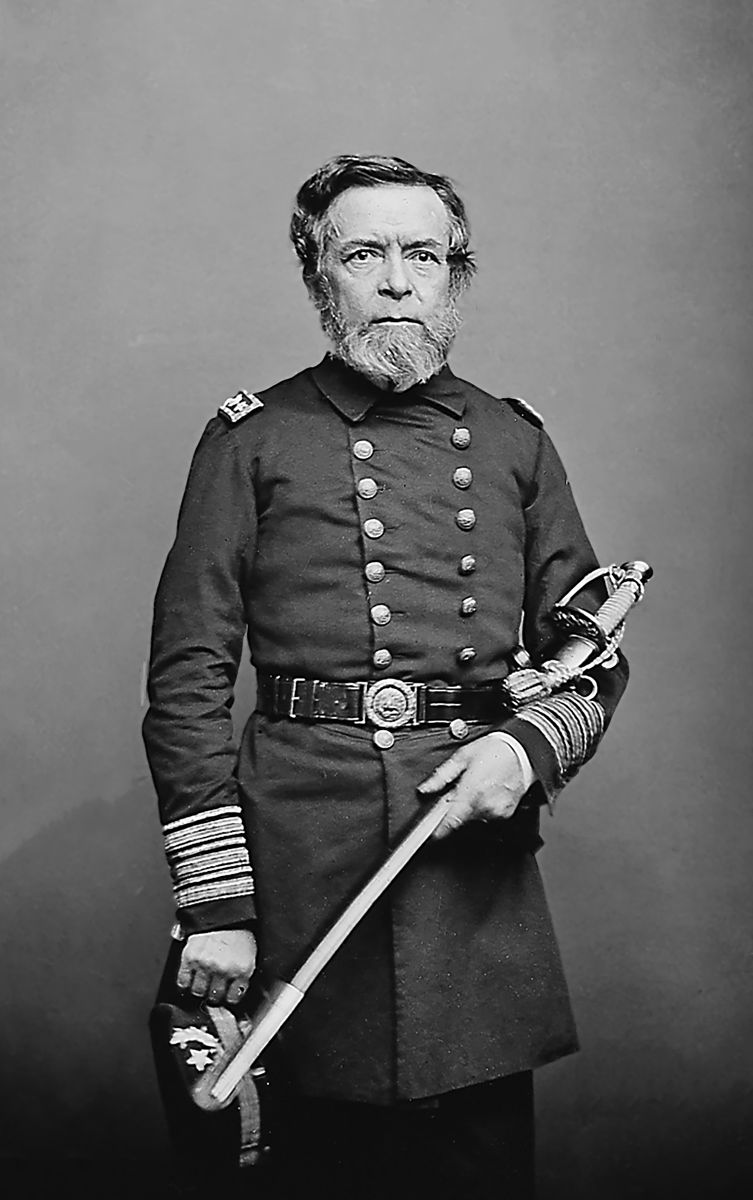
“He had a megaphone and he kept popping in and out of the pilothouse on St. Louis, shouting instructions to his captains.” St. Louis was struck 59 times, drifted downstream out of action, pilot killed. Foote wounded in leg and arm. Fort Donelson was going to be an Army fight after all. by Joan Wenner, J.D.
Who Was Andrew Hull Foote? From an Ohio State University (OSU.edu e-history) summary, he was from New Haven and for a time attended West Point at the age of 16, but left before he completed his first year to serve as a midshipman aboard a U.S. Navy vessel. Prior to commanding a fleet of ironclads helping Grant, he was overseas on naval service including China, Africa, and the South Pacific; he also saw action while on anti-slave trader patrol. When the Civil War began he was in New York on ‘mundane duty’ as chief of the Brooklyn Navy Yard. Then in August 1861, and described as ‘brilliant in command,’ Foote was placed in charge of naval defense on the upper Mississippi River where his duties included building and manning the ships he led into action at Forts Henry and Donelson, and Island Number Ten. It’s been written that Gideon Welles managed to create the doctrine of ‘unified command’ by accident; his thinking being that Mississippi River operations were purely to be the responsibility of the army, but when Foote took command of naval operations along the western rivers, Welles advised him, and those who succeeded him, that these naval operations were to be under the War Department but under control of the army. Foot and arm wounds from Donelson forced the ‘gunboat commodore’ to a shore position. In Washington during June 1862, he was promoted from commodore to rear admiral, given the thanks of Congress, and tasked as Chief of the Bureau of Equipment and Recruiting. After a year he was able to wrangle a seagoing appointment as commander of the South Atlantic Blockading Squadron but would die in June 1863 before take command.
Lead-up to Fort Henry Prior to the firing on Fort Sumter on April 12, 1861, there were discussions more than a month earlier by Secretary of
State Seward with Lord Lyons, British Minister to Washington, concerning the effect of a possible blockade of Southern state ports on England’s cotton-fueled sector of its economy. Lincoln’s April 19, 1861, issuing of the Proclamation Against Southern Ports complicated matters, as it was Britain’s view that, under the 1856 Treaty of Paris, the United Kingdom was legally obligated to acknowledge the Southern Confederacy as a de facto sovereign state. When the Federals won at Logan’s Cross Roads, Washington confirmed a soft spot in the Confederate line farther west where the Cumberland and Tennessee Rivers came north across the Kentucky-Tennessee border. Secretary of War Halleck and Grant selected “the rugged sailor who represented the salt-water sailor on the rivers of the Middle West, Flag Officer Andrew Foote,” for assistance. Halleck was skeptical of the “strange auxiliaries called gunboats” but Fort Henry would be captured as Foote found the Confederates defenses sorely lacking and, since the river was in flood, basically steamed right into it. After the fort surrendered to the Navy, Foote would say, “I made a bold dash at Fort Henry to inspire terror & it succeeded.” Commodore Foote, said a newspaper reporter, believed in swift action at close quarters. Bruce Catton in his volume two, Terrible Swift Sword, noted that the Federals had gained one of the easiest and most significant victories of the entire war. Foote quickly sent three unarmed ‘black monsters with slanting sides’ up the river to spread alarm throughout the upper South.
Fort Donelson According to Catton, Flag Officer Foote was also said to have had misgivings about attacking Fort Donelson, but that fortification also fell although not as easily as Fort Henry.
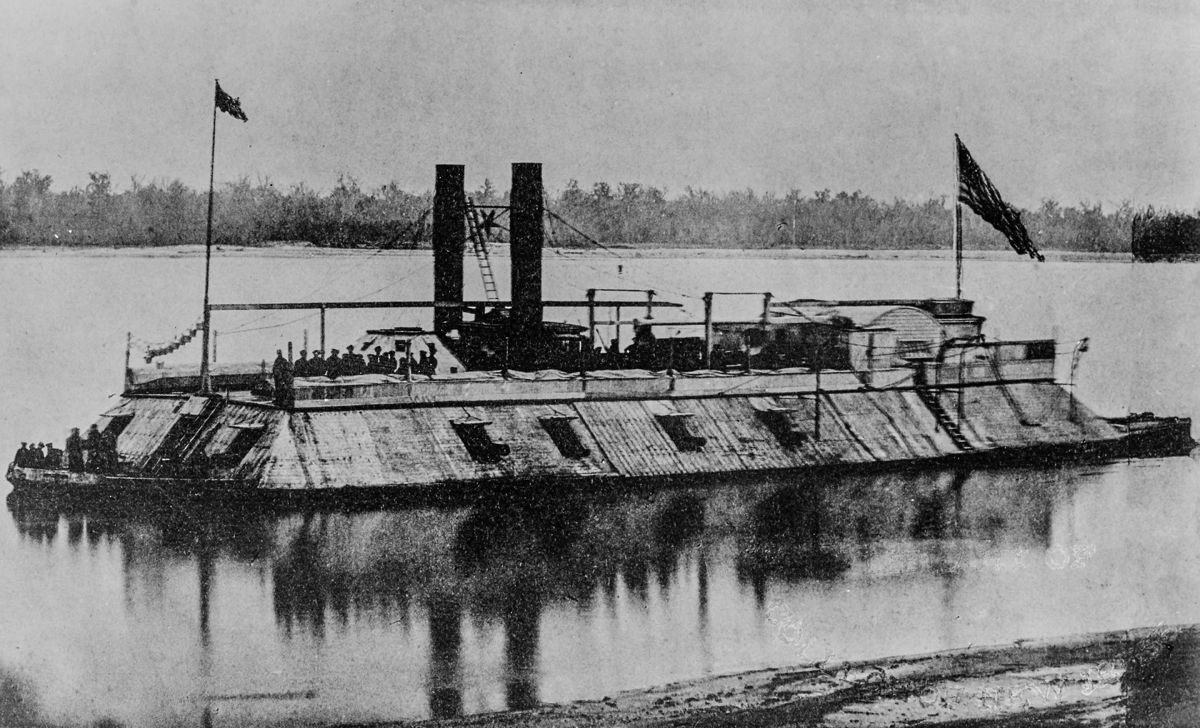
Island Number Ten While it no longer exists today, the Mississippi having washed over most of it and carving a channel elsewhere, “in 1862 the island was a two-and-one-halfmile-long mud patch lying in a great loop of the Mississippi, “rimmed with strong ramparts and heavy guns, so menacing that even Flag Officer Foote was afraid of it.” That, however, did not deter Secretary of War Halleck from launching an amphibious expedition to take the river from the enemy. The expedition was to consist of 20,000 men led by Gen. John Pope “supported by Flag Officer Foote who had seven iron-plated gunboats and a fleet of barges mounting big mortars.” The plan was for Pope to block downstream re-supply routes. To do this, Pope’s transports had to get past Island Number Ten. It is not intended here to recount the action in detail but rather to provide a brief glimpse of Foote’s part in the operation. Pope needed transports and transports needed protective gunboats. For his part to isolate the island. Foote, stomping about on crutches from slow-healing wounds received at Fort Donelson, “held his flotilla just upstream from the island, moored his mortar boats along the bank, opened a long-range bombardment, and studied his problem with rising pessimism.” Said to be as tough as any man in the Navy, he refused to run in close to the strong fortifications as he had the Tennessee and Cumberland forts, largely because the river ran in the wrong direction. At the other forts, his fleet fought facing upstream where a disabled vessel could drift back to safety; at Island Number Ten with his gunboats “sadly underengined,” he could not do that. While Pope’s engineers got to work cutting a new six-mile long ‘waterway’ fifty-feet wide to a depth of four feet to help reach their goal, Foote kept up the three-week long bombardment although it did not accomplish a great deal. The canal was too shallow for the gunboats and transports so Pope asked Halleck for two of Foote’s gunboats manned by soldiers to run past the island. Perhaps if the flag officer’s health had been better “he would have been bolder…” He was impatient with the enforced inaction during the ‘waterway’ digging. Turning over two of his gunboats to the Army and letting soldiers attempt to do what sailors ostensibly could not was just too much.
The Carondelet Commander Henry Walke, skipper of the gunboat Carondelet received Foote’s approval to attempt running past Island Number Ten. He told Foote he would need two things, a barge loaded high with bales pf hay lashed to the portside for gunfire protection and a dark night to conceal his movement. He got both on April 4 as the vessel “left her moorings and drifted downstream to run the gauntlet.” Walke reached the upstream end of the island without discovery. Although finally seen and the enemy alerted, he, crew and vessel managed to pass and reach
New Madrid at midnight and joined Pope’s troops lining the waterfront. Walke, an old Navy man, now issued the traditional order: ‘splice the main brace. Island Number Ten was now isolated and surrendered on April 7, 1862. “To all intents and purposes, the Confederacy had lost the middle Mississippi.” Joan Wenner, J.D. is a longtime Civil War history writer holding a law degree with particular interest in maritime and courts martial affairs. She has published in America’s Civil War, Military Heritage, and Civil War News for many years and is a book reviewer. Comments are welcomed at: [email protected].