
Through The Lens
The Devil On A Run
By Stephanie Hagiwara · Originally published June 2020 · pp. 24–25
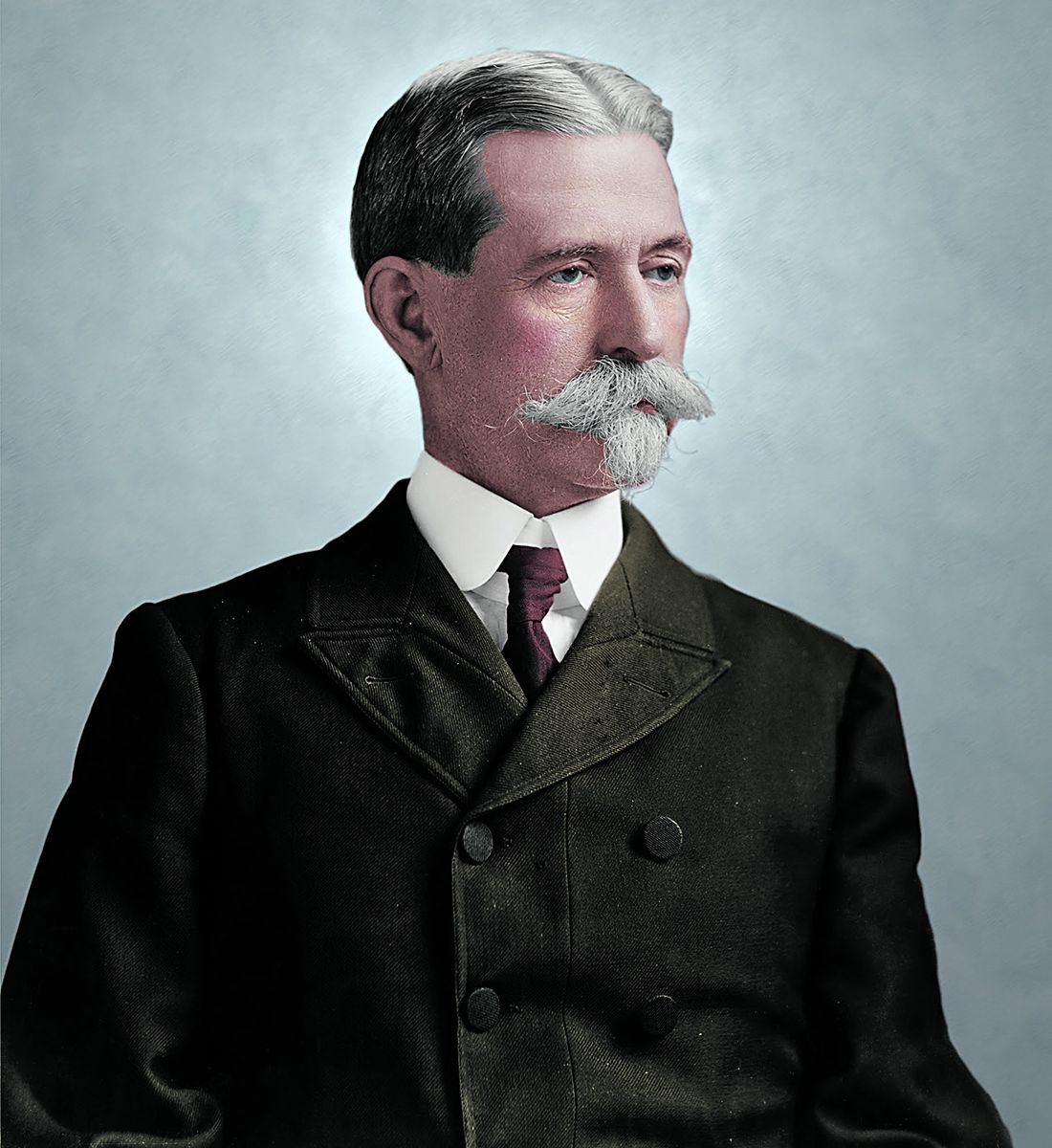
“Any army marching tonight must be made up of a set of damned fools.” – Confederate Officer On April 17, 1861, the Richmond, Va. Convention passed an Ordinance of Secession, fracturing the “Old Dominion” in two. Due to voting rights based on property qualifications, the eastern and western regions of the state had been pitted against each other since 1776. The western region considered secession “the crowning act of infamy.” An open letter published in the Kingwood Chronicle asked, “why should we thus permit ourselves to be tyrannized over, and made slaves of, by the haughty arrogance and wicked machinations of would-be
Eastern Despots.” Western delegates met in the May 13–15 First Wheeling Convention. John Carlile declared, “Let us act. Let us repudiate these monstrous usurpations; let us show our loyalty to Virginia and the Union; and let us maintain ourselves in the Union at every hazard.” On May 4, 1861, C.S. Col. George Porterfield was ordered to organize the forces in the region. Not all citizens in the western region were against secession. Philippi, the county seat of Barbour County, considered itself “the strongest secession town” in the region. “Philippi was a pandemonium,” recalled one soldier. “No order, or drill foolishness. The whole thing a holiday, full of disorder, uproar, speeches and intense excitement.” Porterfield had 773 men on active duty. His few recruits were mostly under 23 years old, lacking both weapons and ammunition. His officers came and went at will. In frustration, one soldier described Porterfield as “a polished Virginia gentleman, but as ignorant of war as a mule is of the Ten Commandments.” U.S. Gen. George McClellan sent two columns in response to Porterfield burning B & O Railroad bridges. The railroad was a lifeline for Federals bringing troops and supplies to the east, as well as western Virginia. On June 1, U.S. Gen Thomas A. Morris’s 2,000 men arrived at Grafton, W.V., 15 miles from Philippi, joining Col. Benjamin Kelley’s men. The Federals planned a two-prong attack. Kelley would lead 1,600 men in the principal advance, arriving at the rear of the town. Col. Ebenezer Dumont’s 1,400 men would simultaneously attack from the front, capturing the outnumbered Confederates. The Federals began moving into position to fight the June 3, Battle of Philippi, the first organized land action of the war. Under the watchful eyes of Abbie Kerr and Mollie McLeod, Kelley’s men boarded a train. At dawn, the pair rode to warn Porterfield. Philippi was thrown into turmoil. The citizens scurried to leave. A woman forgot her baby in the cradle. Porterfield ordered his men to “be ready to move on a moment’s notice.” Rain pelted Porterfield’s headquarters. He decided to postpone retreating to Beverly, W.Va., until dawn. The 30-mile march in the rain would ruin both his green men and meager supplies. Furthermore, the Federals would also have a weather delay. Porterfield neglected to inform his keyed-up men of the revised plans. He assumed his pickets would remain at their post all night. Instead, at midnight the drenched pickets went to bed. During the night, the Federals marched. “A cold rain was pouring down unceasingly the entire trip. It was muddy and slippery, and dark was no name for it. It seemed as if a black wall rose a few feet ahead of us all the way.” Knapsacks weighed down by sodden blankets were abandoned with a thump into the mud. Kelley’s struggling men wouldn’t reach their position in time. Through the downpour, Dumont’s men were led by Lt. Benjamin Ricketts carrying a huge ruby lantern. “Ricketts had protested the order—that light would signal the enemy!
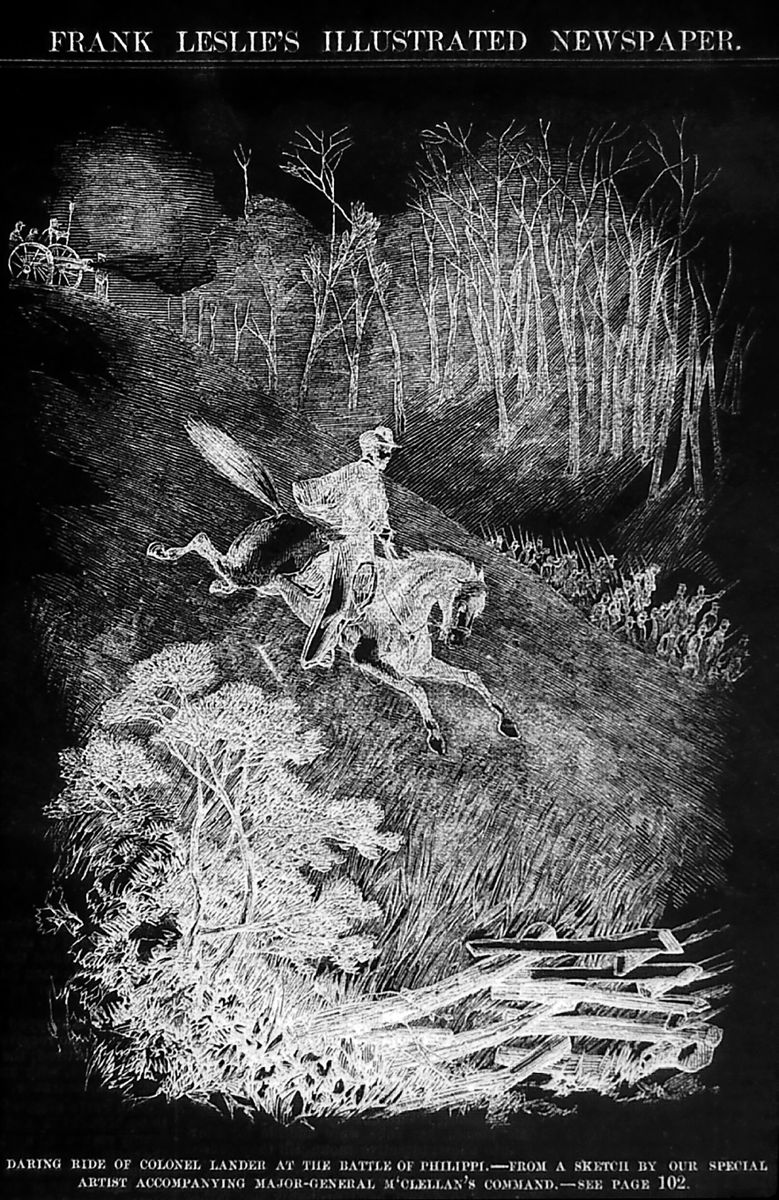
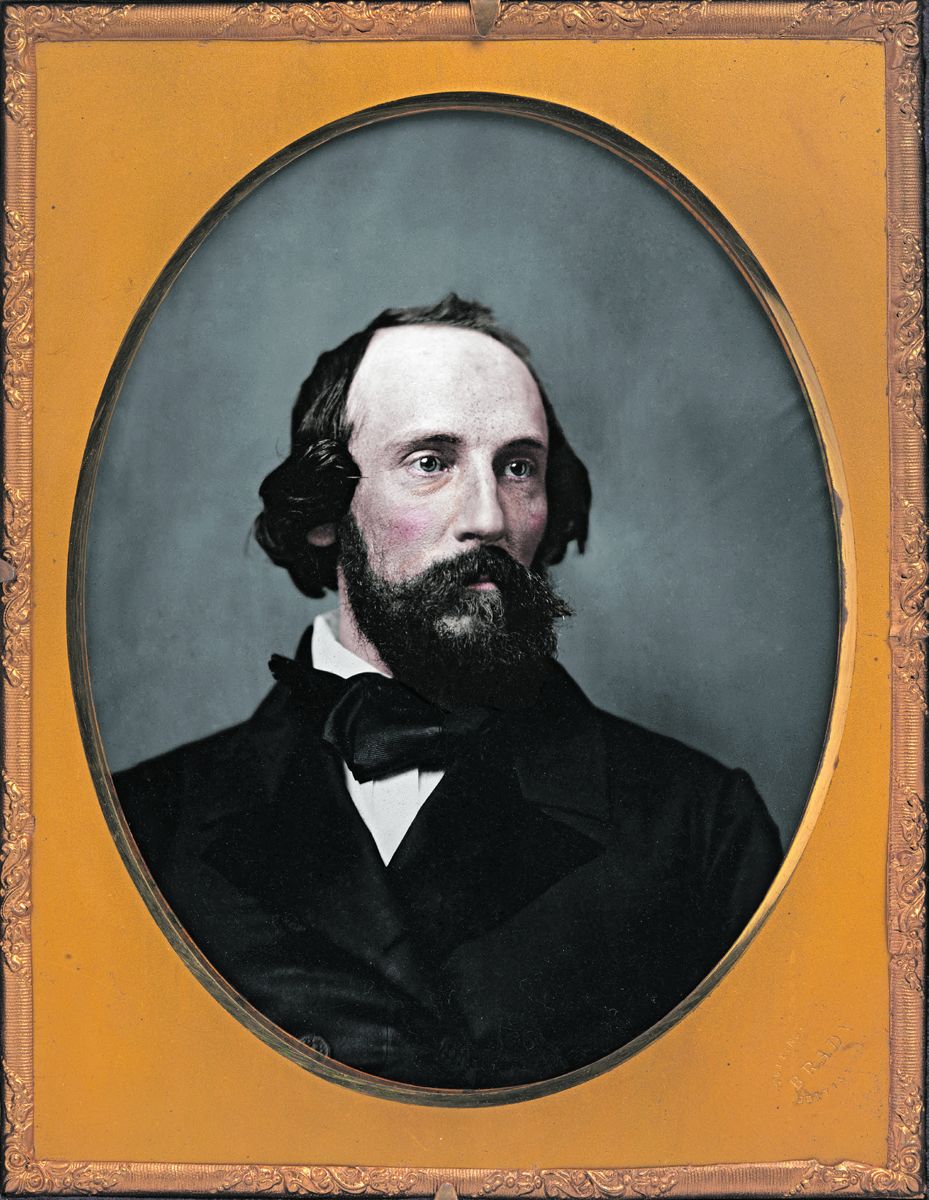
He ‘didn’t want a record in history as the first man killed.’” As dawn approached, the men double-timed to reach their position. Nationally known for his transcontinental surveys, Col. Fredrick William Lander was with Dumont. He guided and positioned two bronze 6-pdr. cannon of the 1st Ohio Light Artillery on top of Talbott Hill, overlooking the town. As he waited for the signal, Lander could see the camp tents through the fog. The town was stirring. Where was Kelley? The first shot was fired by Mrs. Thomas Humphreys. She had sent her 12-year-old son Oliver to warn the Confederates. Stragglers captured him. Humphreys “drew a pistol from her bosom and fired.” Lander accepted the shot as the awaited signal and ordered, “Fire!” The first two shots landed amongst the white tents. The infantry rushed down towards the covered bridge, clogging the road. From the tents swarmed the Rebels for their horses, “like bees from a molested hive.” The men fled “pell-mell helter skelter without boots, hats, coats or pants.” Inside the stable, 18-year-old James Hanger, who had enlisted the day before, awoke. As he ran for his horse, the third shot hit the ground, “richochetted [sic], entering the stable and struck me,” shattering his leg. Hanger would become the first amputee in the War. Lander spurred his horse over the edge and down the steep hillside “at a break-neck gallop,” leaping a fence and thundering down the bridge. An observer described “Landers Ride” as “the most hazardous ride seen by man.” The men of Capt. Rufus
Gale’s company followed by sitting down and sliding almost to the bottom. Kelley’s 1st Virginians, too late to block the Confederate retreat, rushed forward, “yelling like fiends incarnate.” Kelley rode at full gallop, firing his pistol at the fleeing foe. Sheltering behind his wagon, C.S. Quartermaster William Sims shot Kelley in the chest. Lander rode up as Sims was about to be bayoneted. He yelled, “This man is a prisoner of war, and to kill him is murder. … Go after the enemy.” After the battle, Dumont recalled, “I must confess that I never saw a flight … executed with more despatch. … They’re not much for fight, but the devil on a run!” Kelley’s troops dubbed the fight, “The Philippi Races.” Hanger was issued a peg leg and spent two months as a prisoner before being exchanged. “No one can know what such a loss means unless he has suffered a similar catastrophe,” recalled Hanger. “What could the world hold for a maimed, crippled man!” Back home, Hanger closeted himself in his room for three months before emerging walking down the stairs on the first articulated, double-joint prosthetic leg, bending at both the ankle and the knee. The former college engineering student began making artificial limbs for other wounded veterans. In 1863, Hanger was commissioned to develop prosthetic limbs for Confederate soldiers. The “Hanger Limb” became the first artificial limb massed produced. Hanger’s company today is one of the largest prosthetic providers in the world. A glorified skirmish, the Battle of Philippi boosted McClellan’s reputation, gave Kelley a promotion to general, empowered the Federals to hold the western region, spurred prosthetic improvements and enabled the creation of a new state. On June 11, western delegates met to discuss seizing the opportunity to transform the region into a state. “It requires stout hearts to execute this purpose; it requires men of courage - of unfaltering determination,” stated future governor Arthur I. Boreman. West Virginia, “the child of the rebellion,” would place a new star in the American flag. Sources: •
•
Lesser, W. Hunter. Rebels at the Gate: Lee and McClellan on the Front Line of a Nation Divided. Sourcebooks, May 1, 2005 West Virginia Archives and History. “Statehood”
•
Boltz, Martha M. “Making first artificial leg: War-wound amputation leads to crucial invention.” The Washington Times, July 21, 2007
Stephanie Hagiwara is the editor for Civil War in Color.com and Civil
War in 3D.com. She also writes a column for History in Full Color. com that covers stories of photographs of historical interest from the 1850’s to the present. Her articles can be found on Facebook, Tumblr and Pinterest.