
Fact or Fiction? Black Confederates
By Lawrence E. Babits, Ph.D. · Originally published June 2020 · pp. 1–10
This article deals with a very inflammatory topic, that has been the subject of great debate, but attempts to present some source cited documentary evidence and information in a sober, calm, and rational fashion. At the same time, I am well aware that political correctness, and this phrase applies to both sides of any argument, might not be seen here. The article is not intended to start brouhaha; rather to encourage people to do some serious research of their own and not rely on what others say. I am also trying to give credit where it is due by calling attention to accounts that people either miss or ignore for whatever reason. Today’s terminology is quite different from that used during the Civil War. A “Black Confederate” in modern usage has come to describe any African American who served in some military capacity in the Confederate Army, the terms “Black,” “colored,” and “of color” will be used somewhat interchangeably but without complicating the issue too much, many people of color were not absolutely “black” in the modern African-American context. As just one example, Native Americans living in parts of the South would often be referred to a “colored” or “mulatto. There were laws about this and North Carolina’s constitution spelled out “exactly” what a free person of color was. Under the provisions of North Carolina’s 1855 Code:Section IV Cl. 3:23, a person of color was a “free negro, free mulatto, or free person of mixed blood, descended from negro ancestors to the fourth generation inclusive.” The 1855 legal definition is about ancestry and says nothing about appearances that are seemingly so important today. The complications of this definition affect what a “Black Confederate” was in terms of his local community. This article is intended as a line in the sand arguing for more research about these people, their motivations for serving, and further analyses of local perceptions of these people versus “national” perceptions.” Black soldiers have participated in all of America’s wars since 1619. Like everyone else, they joined up for a variety of reasons that are not always clear today. Some were forced into ranks, but when that happened, the rest of the population was also being involuntarily enrolled. Anyone who has served in the military knows that their only existence, from the military’s point of view, is basically whether or not they did their duty. Many men who served were not recorded in muster rolls as to race because it was not so important to the military. Size rolls often do include such information so they could be identified if they went missing in a time when photo identifications did not exist. The Revolutionary War Maryland Continental muster rolls list names, ranks, enlistment dates, and when they were discharged or stricken from the rolls. This is true of the court martial records as well. It is only in other documents including pension records, diaries, newspaper accounts, and census data that the ancillary information comes to light. Black Confederate soldiers did exist. Few in number, Blacks served in the ranks and in companies, batteries, and ship complements during the war. The scattered information presented here shows a very small presence, but a real presence, nonetheless. They acted in a variety of roles, including infantrymen, musicians, cooks, and servants. This article will explore some of these nuances, while also identifying men who served and might be called Black Confederates today. The most important record of service, even today, is a soldier’s compiled service record, in modern terms, the DD214. This record includes the soldier’s company, regiment, rank, and sometimes in the case of non-white soldiers in the past, an indication of their race. The terms that generally appear are black, mulatto, free, and negro [sic]. The term “free” served as a modifying adjective for nouns such those just given as well as abbreviations such as “col.,” “mul.,” and others. These terms, given their specificity as to their military unit and time, are very important because they record how their military associates viewed them; since companies were usually recruited in a single locality, the term also indicates how they were probably viewed at home before the war began, and, perhaps, not how a modern person would identify them. At the same time, there is the issue of what a soldier was. The following is an excerpt from the Customs of Service For
Non-Commissioned Officers and Enlisted Men (Kautz 1865:6). The author finished the war as a general and led one of the USCT divisions into Richmond in 1865. Under the heading “The Private Soldier,” Kautz noted that “IN the fullest sense, any man in the military service who receives pay, whether sworn in or not, is a soldier, because he is subject to military law. Under this general head, laborers, teamsters, sutlers, chaplains, &c. are soldiers. In a more limited sense, a private soldier is a man enlisted in the military service to serve in the cavalry,
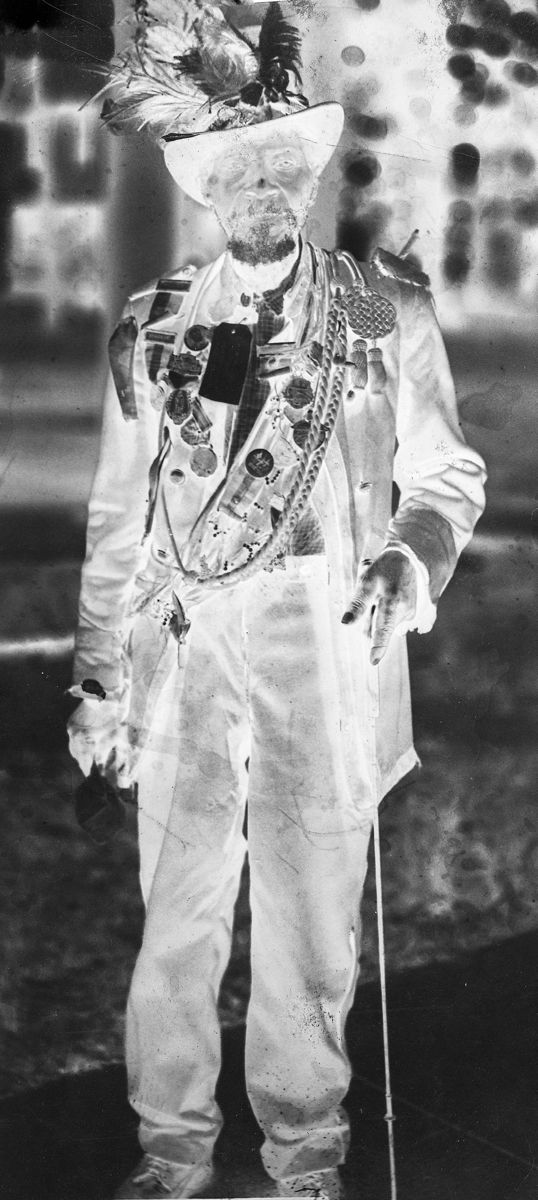
Moses G. West. image/273/193995333.
artillery, or infantry.” Note that Kautz says if a person is one of the combat arms, he is “a private soldier” (Kautz 1865:6), unless, of course, he holds a higher rank. A soldier’s service record identified the role a soldier played in his unit. If it said private, or any other military rank, then the man was obviously a weapons carrying soldier. If it said musician, cook, or wagoner, that man was still on the company rolls, being paid, uniformed, and equipped, by the government. Now, in a test of honesty and as an example of double standards being applied to Civil War soldiers, take the cases of veterans Moses G. West, a cook (West, Service Record M1820,
Source:
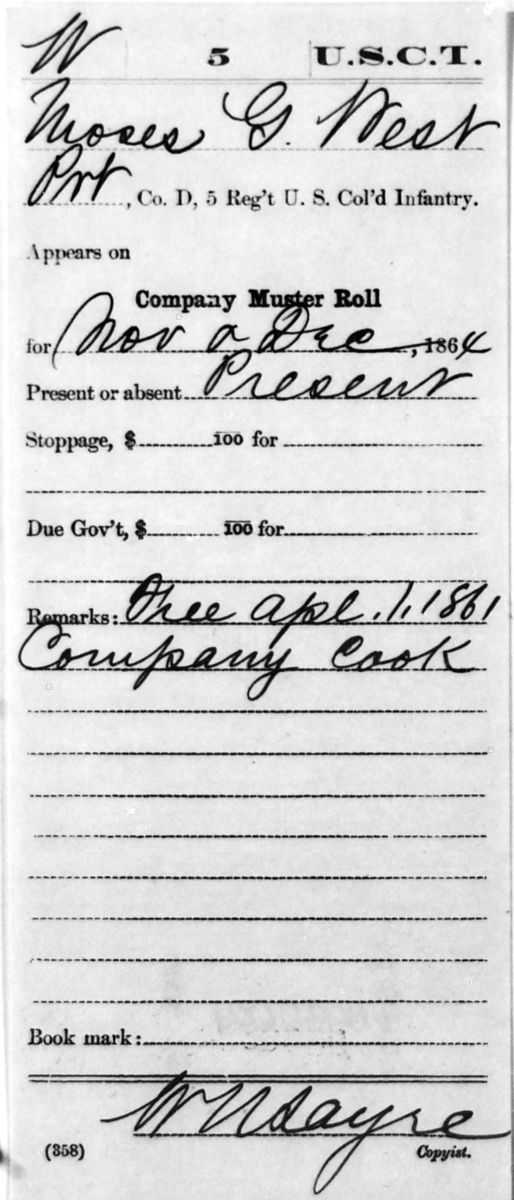
Roll 0065), and George Street, a drummer (Street, Service Record M1823, Roll 0048). Were they soldiers? Only in your own heart can you say whether they were or not, and these cases are particularly instructive, given inflammatory ways people treat this topic. Look carefully at the upper right corner of their Compiled Service Record cards shown as images here, then say whether or not they were soldiers. There have been attempts to discredit a soldier’s participation by claiming that musicians were not combatants. This is an error that has not, apparently, been noted by most descendants
George Street. image/273/263442928.
whose ancestors were musicians killed and wounded whilst beating their drums, playing fifes, or carrying wounded during battle. In the American system, first applied by von Steuben in his 1778 manual’s formation of a regiment, “the drum and fife-major two paces behind the centre of the first battalion; their places behind the second battalion be supplied by a drum and fife; and the other drums and fifes equally divided on the wings of each battalion” (Riling 1966:8). The drum was “used both by infantry and artillery; … either to give notice to the troops of what they are to do.” Among the beats were the
Source:
“The march, to command them to move, always with the left foot first” and “The retreat, a signal to draw off from the enemy” (Duane 1810:128). The two chief purposes of drummers were to maintain the step, something important in regulating the pace of an advance to ensure that a company’s soldiers were able to stay together as one compact body. The second duty was to relay commands from the leader so that all men acted as one, especially when maneuvering and firing. From the two quotations, it should be obvious that musicians had specific places in a formation and were to be there; otherwise the troops would not know the commands. The two specific beats mentioned show that the musicians had to be with their company under fire so they could signal when to advance or retreat. These beatings could not have been done from the safety of the rear echelons. As if further proof were needed, examine the following cases. Although not Confederate, and not of color, two Civil War musicians were awarded the Medal of Honor. The first was Orion P. Howe, Musician (his rank), Company C, 55th Illinois Infantry, who earned his medal at Vicksburg on May 19, 1863. His citation read: “A drummer boy, 14 years of age, and severely wounded and exposed to a heavy fire from the enemy, he persistently remained upon the field of battle until he had reported to Gen. W. T. Sherman the necessity of supplying cartridges for the use of troops under command of Colonel Malmborg” (Hartke 1973:127). The other was William Lord, Musician, Company C, 40th Massachusetts Infantry at Drury’s Bluff, May 16, 1864. His citation read: “Went to the assistance of a wounded officer lying helpless between the lines, and under fire from both sides, removed him to a place of safety” (Hartke 1973:153). These two awards show that musicians were definitely in combat and should put to rest statements that they were not. Musicians were specifically mentioned in North Carolina laws related to the militia, and then to the state troops taken into Confederate service. On September 26, 1861, the North Carolina legislature enacted a law (North Carolina 1861:2425) requiring all white males between eighteen and fifty who were residents be placed on the militia rolls. The law included a statement that it was unlawful to “enroll any free persons of color, except for musicians. When the unit was in the field on actual service, four free persons of color could be allocated to each company as cooks, who were to be fed and paid by the State.” North Carolina militia companies formed the base on which the later state troops and volunteer companies subsequently accepted for Confederate service were formed. The older militia regulations were simply adopted by companies and regiments being raised for Confederate service and carried as if legally binding. For individual states, only one other will be cited here so as to not get bogged down. On June 28, 1861, the Tennessee State Legislature passed an act authorizing recruitment of state militia units. Section 1 authorized enlisting “all male free persons of color between the ages of fifteen and fifty, or such numbers as may be necessary.” Section 2 stated their wages at $8.00 per day, plus rations, and a clothing allowance that would be used to pay for their uniforms (Tennessee 1861). This act did not state that these enlistees were combat soldiers, musicians, cooks, or wagon drivers, just that they could be called up. The Confederate Congress passed “An Act for the Payment of Musicians in the Army not Regularly Enlisted,” on April 15, 1862. This law stated that “whenever colored persons are employed as musicians in any regiment or company, they shall be entitled to the same pay now allowed by law to musicians regularly enlisted; provided that no such persons shall be so employed except by the consent of the commanding officer of the brigade to which said regiments or companies may belong” (Confederate States 1862:39). The April 1862 Confederate act concerning musicians also suggests that, in addition to free blacks formally enlisted as musicians in North Carolina units, others could be employed as musicians within a unit, and although paid by the government, they were not officially enlisted; instead they seem to have been hired. The distinction between being enlisted and hired is not entirely clear, but hiring a musician may not have required taking an oath of allegiance. That said, wording of the 1862 act may also suggest that, at least in the national Confederate government’s eyes, free black musicians were never considered formally enlisted as Confederate States Army soldiers, only as state militiamen, even though they were now actively participating in field operations including combat, as members of state regiments serving in a Confederate Army. In 1863, the Confederate Congress refined the law about musicians under the Regulations for the Army of the Confederate States 1863:XXIX:section 75, page 13, which stated that “The musicians of the band will, for the time being, be dropped from company muster-rolls, but they will be instructed as soldiers, and liable to serve in the ranks on any occasions.” This regulation applies to bandsmen, not the drummers and fifers serving at the company level where they were already in the ranks. Six days later, the same Congress approved an “An Act for the Enlistment of Cooks in the Army,” that authorized a company commander to “enlist four cooks for the use of his company, whose duty it shall be to cook for such a company – taking charge of the supplies, utensils, and other things furnished.” The act went on to stipulate “the cooks so directed to be enlisted may be white or black, free or slave persons,” with the provision that “no slave shall be so enlisted without the written consent of his owner.” Anyone enlisted and placed on a company’s muster roll was paid along with everyone else in the company. At the rate of twenty dollars per month for the senior cook, and fifteen a month to his assistants, a lot more than an infantry private received. The cooks also received the same clothing allowance as the company’s rank and file soldiers (Confederate States 1862: Chapter LXIV:48, approved April 15, 1862). Regulations regarding any slaves enlisted under this act stipulated that their pay for serving as cooks would go to their masters. Researching any Confederate soldier is not always a straight forward proposition. In the case of Black Rebels, it is far more complicated. As one example, Private Samuel Chavers, from Orange County, N.C., served in the 28th North Carolina Infantry. He enlisted in Company G, during September 1861, was captured 13 months later on December 13, 1862 at Fredericksburg, then was shortly thereafter paroled. His capture is interesting because Lane’s Brigade was well away from Marye’s Heights and the “Sunken Road.” In Lane’s report, it was noted that the “twenty-eight and thirty-seventh …
opened a terrific and deadly fire upon them, repulsing their first and second lines and checking the third. These two regiments were subjected not only to a direct, but to right and left oblique fires … whole command held their ground until the twenty-eight and thirty-seventh had fired away not only their own ammunition, but that of their own dead and wounded … being flanked right and left, fell back in an orderly manner, and were resupplied with ammunition. … The men of the twenty-eighth and thirty-seventh “fought like brave men, long and well” (Army 1864:523). After being captured and rapidly paroled, Chavers asked for, and received, a discharge in January 1863, because he was of “mixed blood” and was “partially negro.” (See number 1) On his discharge for being mixed race, company commander
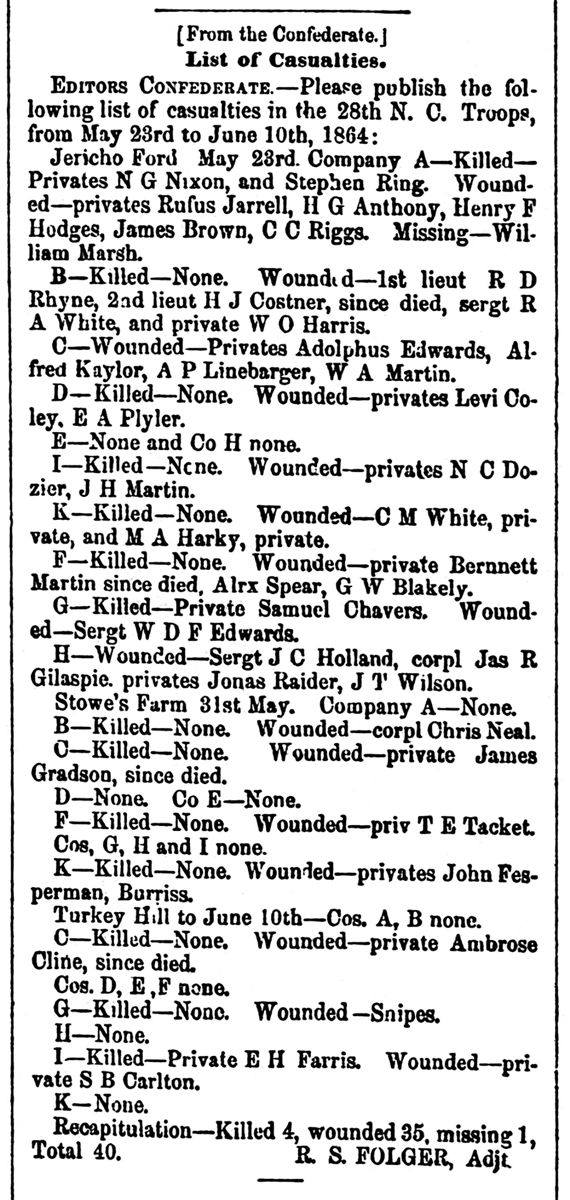
George Johnston noted that he was a “faithful soldier,” and “fought through all of the battles from Hanover Courthouse to Fredericksburg.” Chavers’ roster entry in the NC Troops 28th regimental history ends in 1862, but from his compiled service records, it is clear that less than a year later Chavers reenlisted in the same company and received a $50.00 bounty for doing so. Why he did so is unknown but the $50.00 bounty, survivor’s guilt at leaving his “pards” behind, and, perhaps, a feeling of duty, could all be drawn from his account. Chavers’ Compiled Service Record includes a statement by his last company commander noting that he had reenlisted in December 1863, and was killed in action at Jericho Mills, Va., in May 1864. His death was reported in the June 29, 1864, Raleigh Weekly Standard shown below.
➀
“Camp 28th Regt N. C., Troops, Dec. 23d, 1862 Hon James Seddon Secty War. C.S.A.
Sir, I have the honor to apply for a discharge from the service of the Confed. States, in behalf of private Samuel Chavers, of my Co. G. 28th Regt. N.C.I. on the following grounds. Samuel Chavers, of Orange CT. North Carolina, being partly of negro descent, has never been admitted to the rights of citizenship in the County; when the state militia of the County were enrolled at the beginning of the war, his name was stricken from the list on the same account and he was not allowed to be mustered. He volunteered 2d Sept. 1861 to serve for one year, although he was told by the Militia officers that he was not liable to military duty. His term of service has expired; he has been a faithful soldier up to this time, and has fought [emphasis added] in almost every battle from Hanover C.H to Fredericksburg. I most respectfully submit that faithful service of fifteen months when he was not liable to military duty, is an additional argument for his exemption now. Most respectfly your obdt servnt Geo. B.Johnston Capt. Co. G. 28th Regt N.C.T. I solemnly swear that the statement of facts above given, so far as relates to my being of mixed descent, being denied the privileges of citizenship, and have been stricken from the muster roll, is correct in ever illegible Samuel Chavers Geo B Johnston [illegible] that the name of the said Samuel Chavers was stricken from the rolls of my militia Co. by myself, because I was told by my predecessor in office that he said Chavers was not liable to military duty, being of mixed neg. descent. Henry C. Andrews 1st Sergt Co. G. 28th N.C. Regt”
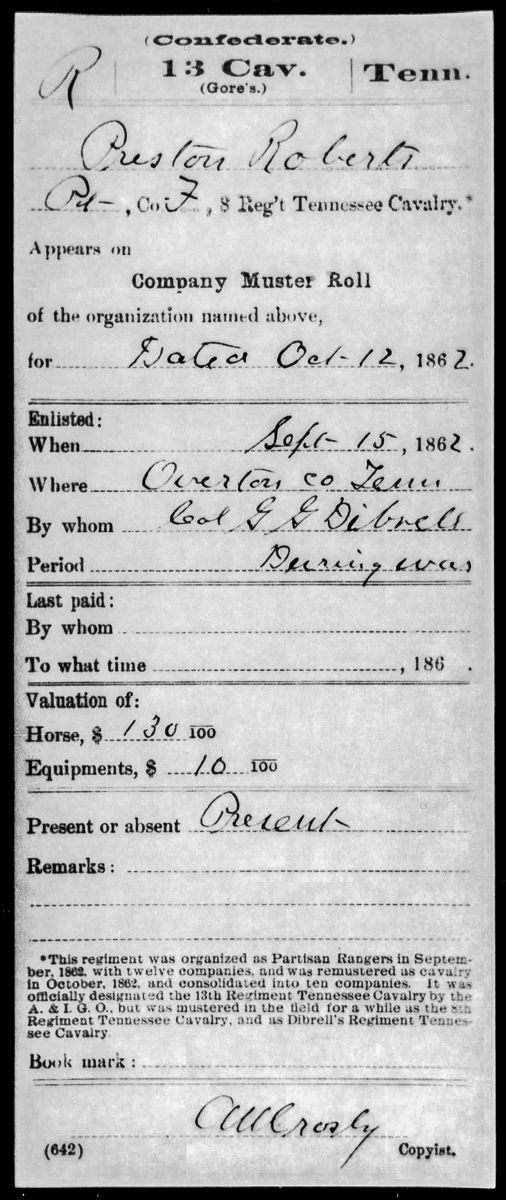
“Samuel Chavers a private of Capt G W McCawleys Compy, 28th Regt N.C. was enlisted by Capt G.W. McCawley the 8th day of December 1863 for service for the war was Killed in action the 23rd day of May 1864 at Jerico Ford Va. Said Samuel Chavers was last paid by Capt D. A. Parker to include the 31st day of December 1863. He has pay due him from that date until the date of his death. 2 months & 23 days fifty five + 43/100 dollars $52.43 Due him for clothing fifty dollars $50.00 Bounty fifty dollars $50.00 Total amount due one hundred [sic 150] & 43/100 dollars $152.43 His personal effects were left on the field, he owes the C. S. nothing G. W. McCawley Capt Petersburg, Va. Co. G, 28th NC Sept 13th, 1864” (See number 2): Unlike the vast majority of government paid and clothed Confederate Blacks who were cooks and musicians, Chavers was most certainly acting as battle line Confederate infantryman engaging Union troops under fire. His captains clearly stated he was a combatant and used the words “fought” and “killed in action.” Chavers entered service before the Conscription Act, got out of the army for being “mixed blood” after over a year of service, then reenlisted almost a year later knowing what infantry service meant, and served until he was killed May 23, 1864. But is Chavers unique? Not really. Michael Bradley’s history of Forrest’s staff and body guard has a statement in the foreword that is germane when discussing Black combatants. “Indeed, riding with Forrest as combat soldiers were a handful of AfricanAmericans, some of whom were members of the general’s personal bodyguard. Of the black men who served under him, Forrest would later say, “There were no better Confederates.” Though many of this group are now lost to history, some are to be found in the available records. … Some of the black Confederates joined the Veterans Association established by the Escort and Staff. At least one of them became an officer of that body” (Bradley 2006:22). The men riding with Forrest saw a lot of hard fighting including Polk Pleasant Arnold and Preston Roberts. Arnold joined the Confederate Army in 1863 and “served as a private in Nathan Bedford Forrest’s Escort under Captain J. C. Jackson in Lieutenant Nathan Boone’s Platoon” (Bradley 2006:219). Arnold was killed in action at Harrisburg, Miss., July 17, 1864. You do not get killed in action unless you are a combatant. Arnold’s widow, Caldonia, drew a Confederate pension for her husband’s service that stated Arnold was a Negro (Bradley 2006:48, 219). Preston Roberts, enlisted as a Private in Co. F, 13th (Gore’s)
Tennessee Cavalry (Confederate), September 15, 1862, for the war. His horse was valued at $130, and his equipment at $10.00. (Roberts n.d.M268, Roll 0056, Fold 3, Tennessee Confederate Soldiers). What the bare bones Compiled Service Records references do not state is that Roberts and the Thirteenth served under Nathan Bedford Forrest. Roberts himself “served as head of the mess for the cavalry when it was in camp. Roberts was in charge of all funds to purchase the food that was not provided by the commissary, and he commanded seventy-five cooks” (Bradley 2006:219). Roberts survived the war and in his newspaper illustration is apparently wearing a United Confederate Veterans uniform (Roberts n.d.). At Chickamauga, during the forlorn and desperate Confederate assaults against Thomas’s position a group of Black men from the 4th Tennessee Cavalry, Davidson’s Brigade, Wheeler’s Corps, suffered casualties. These men might be seen as atypical because they were servants. According to regimental quartermaster, Captain Joseph P. Briggs, the servants had been tasked with guarding horses whilst the troopers went into the fight on foot. A black servant named Daniel McLemore, servant to the Colonel of the regiment, had organized some regimental servants into a company numbering some 40-50 men. After the regiment had been fighting for some time, they asked Briggs if they could participate in the fighting. Briggs later recalled that, “After trying to dissuade them from this, I gave in and led them up to the line of battle in [sic] which was just preparing to assault Gen. Thomas’s position. Thinking they would be of service in caring for the wounded, I held them close up the line, but when the advance was ordered the negro company became enthused as well as their masters, and filled a portion of the line of advance as well as any company of the regiment. While they had no guidon or muster roll, the burial after the battle of four of their number and the care of seven wounded at the hospital, told the tale of how well they fought.” I downloaded this quotation from C. W. Roden’s website because it was so different in that the servants formed a company worth of soldiers, went into the fight, took casualties, and were noticed. I would very much like to have a citation for Brigg’s account, but don’t have it at present. Another account of a servant acting in a different role with a Confederate Army was reported by Lt. Col. Arthur Fremantle, a British observer traveling with the Army of Northern Virginia during the Gettysburg Campaign. “I saw a most laughable spectacle this afternoon-viz., a negro dressed in full Yankee uniform, with a rifle at full cock, leading along a barefooted white man, with whom he had evidently changed clothes. General Longstreet stopped the pair, and asked the black man what it meant. He replied, “The two soldiers in charge of this here Yank have got drunk, so for fear he should escape I have took care of him, and brought him through that little town.” The consequential manner of the negro, and the supreme contempt with which he spoke to his prisoner, were most amusing. This little episode of a Southern slave leading a white Yankee soldier through a Northern village, alone and of his own accord, would not have been gratifying to an abolitionist. Nor would the sympathizers both in England and in the North feel encouraged if they could hear the language of detestation and contempt with which the numerous negroes with the Southern armies speak of their liberators” (Lord 1954:41-142). A much maligned account occurred in 1865 during the Confederate retreat to Appomattox. Virginia veteran R. M. Doswell wrote an account involving Confederate Infantrymen of Color for the Confederate Veteran in 1915. The late date has caused many to discount it because he wrote during the height of the “Lost Cause” movement. In the account’s snippets,
“R. M. Doswell, a Virginia private, was on the muddy road with a dispatch when he saw a wagon train under the guard of Confederate Negro Troops. “A singular sight to me,” Doswell wrote. The wagons were halted, and in the rear, no more than a hundred yards away, a Federal cavalry regiment was forming for a charge. The bluecoats fell into line on a hillside and galloped down on the wagons. The Negroes fired rapidly and drove them off. While Doswell stared in admiration at the colored troops, the Union cavalry wheeled back into sight, this time in a determined charge that broke up the train and turned the vehicles from the road. The Negro soldiers were quickly captured” (Davis 1959:176). incorporated into the Burke Davis book To Appomattox, (See number 3). Doswell’s account has been discredited because it was written during the “Lost Cause” effort, but during the siege of Petersburg, at least one Maryland infantryman, John Gwinn Barber, “Applied for appointment as Drillmaster for Negro commands being formed” on March 25, 1865. Barber, a former color bearer was not simply seeking to get out of the trenches as he was already detailed as a clerk in the Confederate Treasury Department (Driver 2003:368). Henry Ammen, another Marylander noted in his diary entry for March 23, 1865, that “Negro recruiting going on rapidly in Richmond” (Driver 2003:323). The men Doswell saw were probably some of the Black Confederates recruited and drilled in Richmond less than a month before. Clearly, there were Confederates of Color being assembled, outfitted, and trained less than a month from Lee surrendering the Army of Northern Virginia. Doswell’s account is far more specific than two reports found in the Official Records.
The first relates to an engagement between the 9th Michigan Infantry and Forrest’s Cavalry at Murfreesboro, Tenn., during July 13, 1862. The Ninth’s commander, Lt Col. Parkhurst reported that in addition to “The forces attacking my camp… There were also many negroes attached to the Texas and Georgia troops, who were armed and equipped, and took part in the several engagements with my forces during the day” (OR XVI:805). A similar, but less specific account is found in a May 30, 1862, report by Colonel Benjamin C. Christ, 50th Pennsylvania Volunteers, who noted “There were six companies of mounted riflemen, besides infantry, among which were a considerable number of Colored Men,” in an engagement along the Coosaw River in South Carolina (OR XXVI:24). This report is somewhat supported by an 1862 photograph of members of 2nd South Carolina relaxing somewhere along the coast. Individual, more generalized, eye witness accounts include Union soldier Alfred Bellard and a U.S. Sanitary Commissioner named Steiner, both in 1862. Bellard was on the Peninsula during the Union attempt to get past the Confederate defensive line anchored at Yorktown when he made a drawing of a Confederate sharpshooter firing on his regiment and recorded what happened: See above number 4). U.S. Sanitary Commission inspector, Dr. Lewis Steiner, was in Frederick, Md., when General Jackson’s infantry marched in on Sept. 6, 1862. He kept a diary and in it recorded incidents he observed during the Rebels’ occupation. In recording what he saw, he noted that: (See number 5). Steiner went on to include a telling statement about musicians in stating “Drummers and fifers of the same color abounded in their ranks” (Ibid. page 21). Steiner did not initially mention musicians until as an afterthought. The number of Blacks may thus have exceeded his estimation since the “3,000 negroes” were definitely not presented as being in ranks in the initial statement. Steiner’s account is cited fairly often. There is certainly a major issue because of the numbers he gives. Jackson’s Second
➃
“On each of our posts was stationed one of Berdan’s sharp shooters, who were always on the look out for game, and woe to the rebel who put himself in their way. One of then who was armed with a telescope rifle had placed a negro picket “Hors de Combat” the day before. In front of our line stood a large hollow tree, having loop holes cut into it so that a rifle could be run through and discharged at our men without danger to the negro who fired it. On this occasion our sharp shooter had fired twice at the black without hitting him, but in the afternoon he left the tree and was taking a walk for the benefit of his legs, when he was suddenly flopped on his face before he had taken six steps., Two white men who [sic were] with him tried to haul him back, but a few does of leaden pills being thrown that way, he was left alone until darkness” (Donald 1975:56-57).
➄
Over 3,000 negroes must be included in this number. These were clad in all kinds of uniforms, not only in cast-off or captured United States uniforms, but in coats with Southern buttons, State buttons, etc. These were shabby, but not shabbier or seedier than those worn by white men in the rebel ranks. Most of the negroes had arms, rifles, muskets, sabres, bowie-knives, dirks, etc. They were supplied, in many instances, with knapsacks, haversacks, canteens, etc., and were manifestly an integral part of the Southern Confederacy Army. They were seen riding on horses and mules, driving wagons, riding on caissons, in ambulances, with the staff of Generals, and promiscuously mixed up with all the rebel horde. The fact was patent, and rather interesting when considered in connection with the horror rebels express at the suggestion of black soldiers being employed for the National defence.”
Corps left Frederick in response to Special Order #109 issued on Sept. 9, 1862, so Steiner’s observations took place between Sept. 7 when the Army of Northern Virginia arrived in Frederick and Sept. 10 when Jackson’s Corps left. If Jackson’s Corps had about 15,000 men just before Sharpsburg (Clemons II:2012:598), then 20 per cent of his command was Black. This figure needs to be further clarified because Confederate strength reports allegedly did not count cooks and wagoners. Those “non-combatants” can be figured at 4 cooks and 1 wagoner per company, or 50 total per regiment, an admittedly loose figure given that not all regiments had ten companies. Jackson’s four divisions (Ewell, A. P. Hill, Jackson, D. H. Hill) had some 90 regiments. That figure, times 50 cooks and wagoners, gives a total of 4500 noncombatants, probably an overstatement but good enough for this purpose and not figuring that at least some cooks and wagoners were white. Those 4,500 additional men require a recalibration of the 15,000 men Jackson’s Corps had by raising the total to 19,500. With that number, the 3,000 “negroes” reported by Steiner would represent 15 per cent of Jackson’s total command without considering servants “belonging” to officers who were certainly included to some extent in Steiner’s observation. There is no record I have ever seen that even hints at Jackson’s Corps having 3,000 Blacks associated with it, either in ranks, in noncombat rolls, or as camp followers. Returning to the other non-combatants, it is important to consider cooks. In his unofficial handbook for men going on active service, Union Captain Egbert Viele described food preparation. “The company rations are usually taken charge of by the orderly sergeant, and issued daily to the cooks, by whom they are prepared and served to the company. The men of the company serve in turn as cooks, two being the usual number serving at once” (Viele 1861:35). Obviously, those who were good cooks would be in demand whilst poor cooks were heartily damned by the men. Good cooks could soon find themselves drawing better pay in many cases, even though they enlisted as soldiers. At the start of the war, food was generally prepared by the soldiers themselves as Viele mentioned. Conrad Wise Chapman provides a good account of the various duties that changed as the mess did after every “army move or a fight.” “Ike Kerr filled the place of cook … a good natured well disposed fellow—He was nicknamed Sibley from the shape of his hat which had been used to hold water so often that it became the shape of a funnel … Young of German decent was second in that Department and made the fires Rosencrantz attended to the frying of the meat. Tom Brown the lazy drummer of the Co. made the Coffee. Bob and I were the water toaters, and Johnny Rochel the bully and head of the mess and was always ready to stand up for mess no 1” (Bassham 1997:37). Some units hired cooks, others were enlisted as cooks, and some units rotated the duty among their soldiers. As Chapman points out, not all cooks were “people of color.” Numerous “non combatants of Color” such as cooks were sent to Union prison camps after being captured. One example was John Williams, a Black cook in the 2nd Maryland Infantry. Williams was on furlough during December 1864 and back with the company a week later. After spending the next three months rotating in and out of the Petersburg trenches, he started on the march to Appomattox but never finished it. Captured at Hatcher’s Run, April 4, 1865, he was sent to the Point Lookout POW camp and not released until June 19, 1865 (Driver 2003:302, 545). If he was not considered a soldier, the question of why he remained imprisoned at Point Lookout for over a month after the war ended, needs to be asked, not whether he was a “real soldier.” The Federals apparently considered him a military man, despite his color. A point of clarification should be inserted here. There is a definite difference between a free man of color serving as an enlisted, paid, and clothed cook for an infantry company and a body servant acting as a cook. Without the Confederate muster rolls, it would have been hard for Federal captors to determine the man’s status, especially if he were in a Confederate uniform. Some Confederate cooks later joined the USCT, and given their dates of enlistment, it is possible to suggest several reasons, financial, getting away from home areas, camaraderie already known from prior service, and the like. These men include Abraham Roach, who served with Company A, 8th North Carolina Infantry from November 1862 until at least October 1864, the date of the unit’s last surviving muster roll. Whether he deserted or was discharged from Confederate service remains uncertain, but on April 28, 1865, two days after the Army of Tennessee surrender at Bennett Place, he enlisted in Company M, 14th U.S. Colored Heavy Artillery, at New Bern, N.C. He remained with the unit almost eight months until December 11, 1865, when he mustered out at Fort Macon. Roach later received a Union army pension for his service. One primary documentary source used for today’s research into military service is pension documents. In 1885, North Carolina enacted a law, the North Carolina Pension Law of 1885, was enacted to provide support for Confederate veterans who lost an eye, arm, leg, or had been completely disabled by service. The same law also allowed pensions to widows of soldiers slain in battle; four years later the law was amended to allow widows of soldiers who died of disease to claim a pension. Applying for a pension required filing an application before a county pension board. These boards, representing both the local community as well as the state, considered evidence of service, including any supporting affidavits. If the local board approved, it was forwarded to the Pension Bureau headed by the State Auditor who had the final decision. Veterans could also be added to the pension rolls by actions of the General Assembly. The North Carolina Pension Act of 1901 further expanded the range of qualifications to include all Confederate veterans who could no longer perform manual labor and widows of any Confederate soldier or sailor. Under the 1901 act, pensioners were placed into one of four classes; each provided a different financial stipend, based on the disability. Nearly every later North Carolina General Assembly further amended the law. Originally ownership of property worth $500 kept applicants from receiving a pension; that figure was later raised to $2,000. Inmates at the Soldiers’ Home, those receiving pensions from other states, and deserters were denied pensions. In 1927 the North Carolina Pension Act was again amended, dividing pensions into two classes. Class A pensions were reserved for white Confederate veterans while Class B pensions were assigned to widows of white soldiers and to former slaves and, apparently freemen of color, who proved that they had acted as servants to soldiers or otherwise worked in a support capacity for the Confederacy, not necessarily as soldiers or musicians. North Carolina followed South Carolina “Colored” servant pension act of 1923. A few men of color applied for pensions prior to 1927, but most were rejected because of race or because they were never actually enlisted Confederate soldiers. The 1927 act created a problem because there was a shortage of forms for those not applying as soldiers. Consequently, when clerks simply used the old forms, they sometimes noted whether the veteran was a servant or any of a number of other non-combat roles, but many times they did not. This has led some researchers to conclude that a servant, usually their ancestor, was a soldier. Note that this distinction is not about enlisted, or hired, cooks and musicians. So, ultimately, a conclusion must be drawn. Yes, Blacks did serve and were paid and uniformed just as were enlisted Confederate soldiers. They often saw, and participated in, combat, due to their roles as musicians and rarely as infantrymen. Some men of color were soldiers in the ranks with weaponry, but they were certainly not numbered in the thousands and their numbers are far less than the roughly 180,000 men of color who served in the United States Colored Troops or U.S. Navy during the war, but nevertheless, these men deserve further investigation, analysis, and understanding of the multiple contexts of their service and individual motivations for serving. In these internet days, some avid researcher compelled by the government to enforced isolation at home, needs to start pulling the service records, company by company, of Confederate regiments and searching each for indicators of race or ethnicity. Acknowledgments In preparing this article, information came from many sources. Imagery for this article includes material from Fold 3. Research included looking at various websites, including one maintained by C. W. Roden, where some confirmatory material was found. Two people specifically encouraged me to try and present information drawn from original sources, Jim Beale, a fellow reenactor and marksman, and Jack Melton, publisher of Civil War News. As with most research, I drew upon a wide variety of folk with knowledge of the current, not so civil, war roiling the waters of Civil War research. References Cited: Army 1864 Reports of the Army of Northern Virginia from June 1862 to an Including the Battle of Fredericksburg, Dec. 13, 1862. R. M. Smith, Richmond. Bassham L., editor 1999 Ten Months in the “Orphan
Brigade” Conrad Wise Chapman’s Civil War Memoir. Kent State University Press, Kent, OH. Bradley, Michael R. 2006 Nathan Bedford Forrest’s Escort and Staff. Pelican Publishing, Gretna, LA. Clemens, Thomas G. editor 2012 The Maryland Campaign vol. II. Savas Beatie, El Dorado Hills, CA. Confederate States 1862 Public Laws of the Confederate States of America Passed at the First Session of the First Congress. The Statutes at Large of the Confederate States of America, Richmond 1862: 29, 48. 1863 Regulations for the Army of the Confederate States. Richmond, VA. Davis, Burke 1959 To Appomattox. Popular Library, Rinehard & Company, New York. Donald, David H., editor 1975 Gone for a Soldier The Civil War Memoirs of Private Alfred Bellard. Little, Brown and Company, Boston. Driver, Robert J. Jr. 2003 First & Second Maryland Infantry C.S.A. Willow Bend Books, Bowie, MD. Hartke, Vance, Chairman 1973 Medal of Honor Recipients 1863– 1973. Committee on Veteran’s Affairs, United States Senate, Government Printing Office, Washington, DC. Kautz, August V. 1865 Customs of Service For NonCommissioned Officers and Enlisted Men. Lippincott, Philadelphia. Lord, Walter L. 1954 The Fremantle Diary “Three Months In The Southern States (AprilJune 1863).” Little, Brown, and Company, Boston. North Carolina 1861 Public Laws and Resolutions of the State of North Carolina, Sept. 26, 1861, p 24-25.
Riling, Ray 1966 Baron Von Steuben and his Regulations. Ray Riling Arms Books, Philadelphia. Roberts, Preston n.d. Combined Service Records, National Archives, M268, Roll 0056, Washington, DC. IN Fold 3, Tennessee Confederate Soldiers Steiner, Lewis 1862 Diary entry for Sept. 6, 1862. In Harwell’s Union Reader. Pages 19-21 in original. The Civil War Reader. Mallard Press 1991. Street, George n.d. Combined Service Records, National Archives, M1823, Roll 0048, Washington, DC. Tennessee 1861 AN ACT for the relief of Volunteers. Public Acts of the State of Tennessee Passed at the Extra Session of the Thirty-Third General Assembly. Chapter 24:49-50, Nashville. West, Moses n.d. Combined Service Records, National Archives, M1820, Roll 0065, Washington, DC Viele, Egbert L. 1861 Hand-Book for Active Service. D. Van Nostrand, New York (reprinted by Invictus, Johnson Graphics, Decatur, MI., n.d.). Larry Babits has been reenacting since 1960. He served in the U.S. Army’s B Company, 21st Infantry (Gimlets) during 1963–1966. Babits earned degrees at Maryland and Brown leading to a career teaching archaeology and military history at Washington and Lee, Armstrong State, and East Carolina. A retired rugby player, Larry is now working on the sequel to his studies of the 1781 battles of Cowpens and Guilford Courthouse although he admits to taking breaks from corona self isolation to practice black powder marksmanship, getting ready for the next chance the First Maryland has to shoot at the N-SSA nationals.