
The Graphic War
West Point
By Salvatore Cilella · Originally published July 2020 · p. 26
West Point The Graphic War highlights prints and printmakers from the Civil War discussing their meaning and most importantly, the print maker or artist’s goals. The firm of Currier and Ives had a stellar stable of established artists whose work today commands premium prices in the auction world. Each carved out particular areas to depict: Louis Maurer specialized in horse portraits and prints; Arthur Fitzwilliam Tait concentrated on sporting life and the great outdoors; Thomas Worth was a master at comics; George Durrie left a legacy of nostalgia in his winter scenes of pioneer tranquility. The only woman in the group was Fanny Palmer. She was born Frances Flora Bond. Married to Edward S. Palmer, the two emigrated from Leicester, England, to America with two young children. Edward was fond of shooting and
Francis Flora Bond Palmer— “Fanny Palmer.” Only female artist hired by Currier and Ives. Public domain. drinking, and his son very much mirrored the old man. Fanny was relegated as the family’s breadwinner; fortunately she had the talent and skill to carry it off. How and when she joined the Currier firm is unknown, but colleague Louis Maurer described
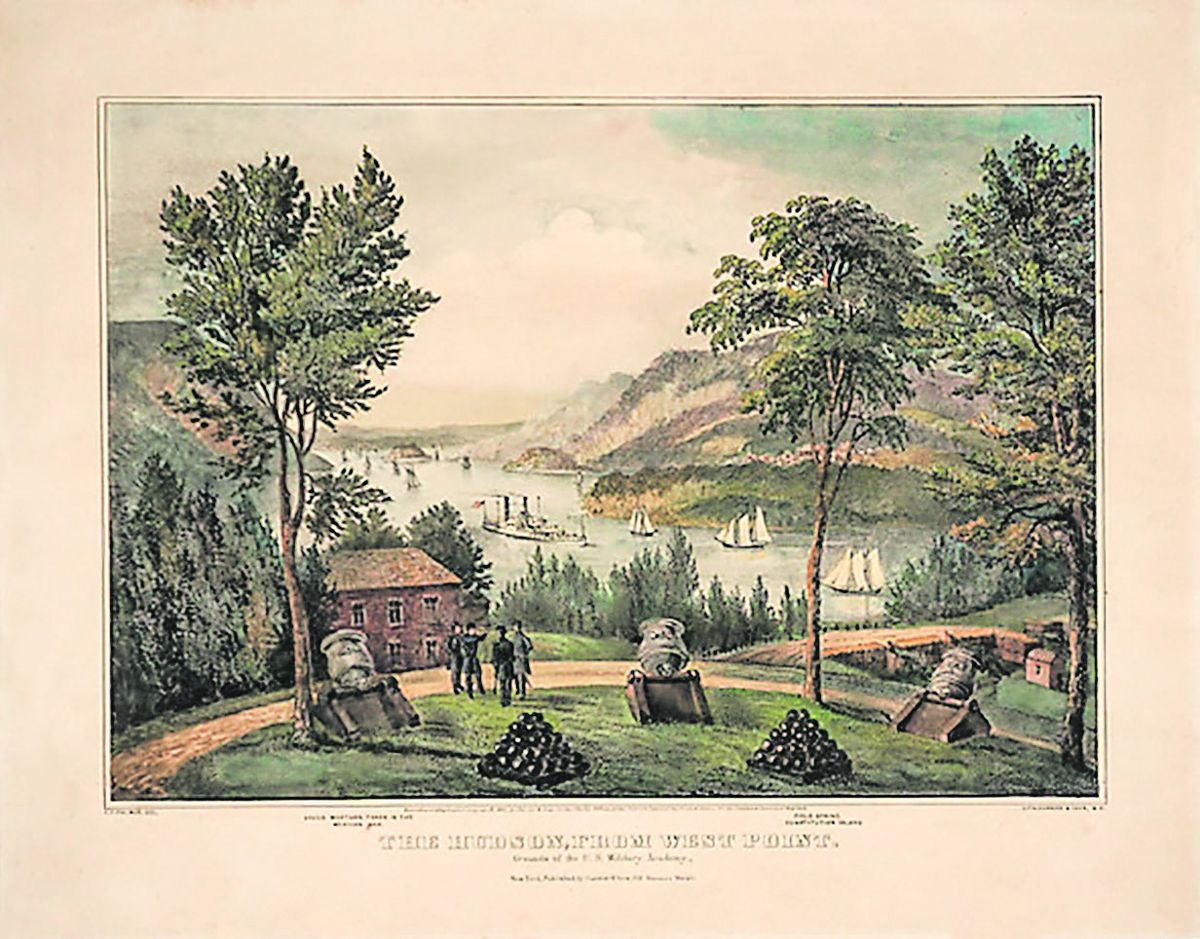
The Hudson, from West Point. Public domain.
her as “a small, frail woman with large dark eyes and typically English complexion, on the whole rather plain in appearance, but perfectly delightful manners.” Like a modern woman, she worked from home and did all she could to “add to the family income.”1 She was employed by the Currier firm to sketch and paint “atmosphere and background.” Many of her compositions show the New York City area and the lush hills and valleys of the Hudson River. She would rapidly sketch out the scene much like a camera’s eye. Her expertise lay in capturing country scenes, cottages, and other views of nostalgia so common to Currier’s more famous prints. During her 26 year tenure with Currier, Palmer produced more than 200 lithographs. During the Civil War, Currier and Ives became a household name. Their scenes of battles, generals, maritime engagements,
Mississippi River landscapes, and patriotic motifs were extremely popular with their northern customers. Fanny’s proficiency at what could be called “set designs” or “tableaus,” made her invaluable to the Currier firm. She produced the “Terrific Combat between the Monitor and the Merrimac.” Perhaps the rarest print Fanny was responsible for was “The Hudson, From West Point: Grounds of the U. S. Military Academy.” It is “a sign of the longtime neglect of women artists in the nineteenth century and of the tendency to stereotype warfare as a province of male interest alone that her achievement as a war artist has not heretofore been recognized.”2 Unfortunately, as skillful as Fanny was creating the scene, she was less adept at drawing the human figure. As the print of West Point indicates, the few humans who occupy the scene are less important than the accoutrements of war and splendor of the Hudson River Valley. In the foreground four cadets survey the river northward, one with a spyglass. They are surrounded by three mortars and two pyramids of solid shot. The title margin indicates that the brass mortars were taken in the Mexican War. In the distance are Constitution Island and the town of Cold Spring on the east bank of the river. “In the middle of the Civil War, they were comforting reminders of a previous American victory.3 The print of West Point was one of several executed by the Currier firm showing northern military strength as the rebellion raged on. Fanny was employed to produce more bucolic military forts and installations, particularly around New York City. It was not lost on the firm that many southern sympathizers populated New York.4 Fanny spent her entire career with Currier. Her life was not without heart ache. Husband Edward fell down stairs drunk and broke his neck. He died
March 7, 1859. James Ives was reported to remark that it “was the best thing (Edward) ever did.” Fanny’s son succumbed to tuberculosis at age 33. Fanny passed away, also of TB, August 20, 1876, at the age of sixty-four. She is buried in Greenwood Cemetery, Brooklyn.5 Endnotes: 1.
Harry Peters. America On Stone: The Other Printmakers to the American People. New York: Doubleday & Co., 1931, 113. See also Charlotte Streifer Rubenstein, Fanny Palmer: The Life and Works of a Currier & Ives Artist. Syracuse: Syracuse University Press, 2018. Hereafter, Rubenstein, Palmer. Mark E Neely, Harold Holzer. The Union Image: Popular Prints of the Civil War North. Chapel Hill: University of North Carolina Press, 2000, 112. Gale Research Company, Currier & Ives: A Catalogue Raisonné. Detroit: Gale Research Company, 1984, Vol. 1, 331; Rubenstein, Palmer, 127. Bryan F. Le Beau. Currier & Ives: America Imagined. Washington: Smithsonian Institution Press, 2001, 70. Peters, 115.
After 43 years in the museum field, Salvatore Cilella devotes his time collecting American prints and maps and writing. His last professional position was President and CEO of the Atlanta History Center. His most recent books are Upton’s Regulars: A History of the 121st New York Volunteers in the Civil War (U. Press Kansas, 2009). His two-volume Correspondence of Major General Emory Upton, (U. of Tennessee Press, 2017), is the recipient of the 2017–2018 American Civil War Museum’s Founders Award for outstanding editing of primary source materials. His latest book “Till Death Do Us Part,” is an edit of Upton’s letters to his wife 1868-70, published this spring by the Oklahoma University Press.