
This And That
Lincoln vs. McClellan, 1864
By Gould Hagler · Originally published July 2020 · pp. 32–33
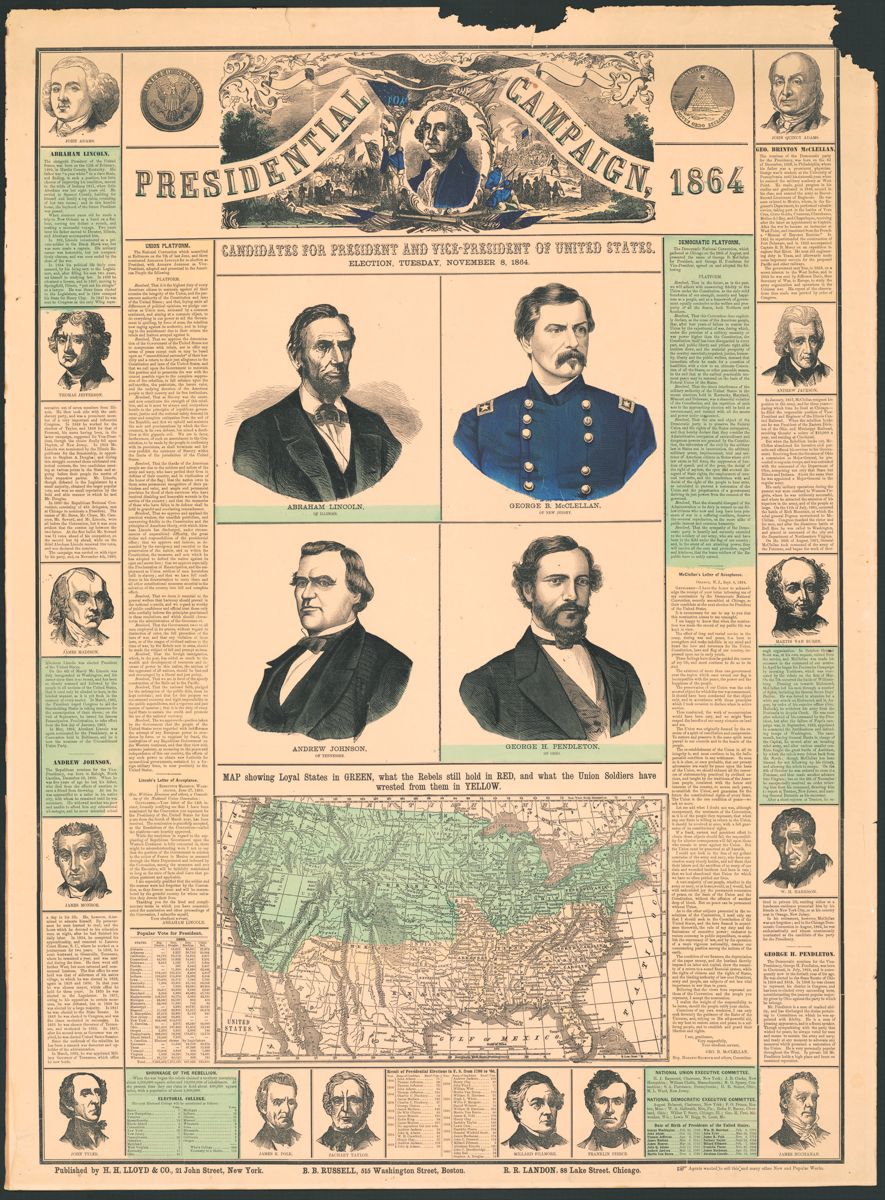
Lincoln vs. McClellan, 1864 According to the Franklin Repository, Chambersburg’s Republican newspaper, the presidential contest in 1864 presented a clear choice to the electorate. A vote cast for McClellan would mean a “humiliating surrender to our barbarous foes.” A choice for Lincoln was a choice for the “utter overthrow of treason.” The Valley Spirit, edited by Democrats, also saw a stark contrast. The Spirit embraced McClellan, who as president “would remove all obstructions and make the road to re-union and peace easy….” A ballot cast for Lincoln was a vote for “executive despotism and the destruction of constitutional liberty in America….” In this column we will return to the Valley of the Shadow archive and review the Chambersburg newspapers in October and November of 1864. Through these two different prisms we will examine the candidates, the issues at stake, and the campaign as it was waged in the local press. After election day we will view the significance of the Republican victory as it was seen by the highly partisan journalists in this Pennsylvania community of 5,000. By 1864 Abraham Lincoln was a stranger to no one. Nevertheless, the Repository reminded the readers of the details of his life in an article that also introduced Lincoln’s running mate, Andrew Johnson. The laudatory biographies stressed their humble origins. Both men were born in slave states, “into a class of poor whites which slavery creates and preserves for its own convenience.” Lincoln entered Illinois as a “portionless, illiterate boy.” Johnson in his youth was “poor as Lazarus.” These two determined, self-made men were the ones to lead the country to victory. The Repository further emphasized that Lincoln and Johnson were not fanatics. “Mr. Lincoln was never an Abolitionist until slavery declared war on the Union.” Johnson was “a tacit supporter of slavery until slavery struck at the life of his country.” The Valley Spirit reminded readers of George McClellan’s military record and contrasted his approach to the war with Lincoln’s. By his victory at Antietam McClellan saved Pennsylvania from invasion in 1862, a matter of some importance to the citizens of this vulnerable border region. Though McClellan was not in command at Gettysburg, the victory there was largely due to his efforts, as the army that drove the invaders from Pennsylvania was the army he built. The Democratic candidate was not only a skillful general but also a humane one. The Spirit quoted a letter written by McClellan to Lincoln urging that the war be “conducted upon the highest principles known to Christian civilization.” McClellan had criticized the destructive campaign waged in the Shenandoah Valley. The war ought not be a “war upon populations, but against armed forces and political organizations.” The Spirit argued that there was more at stake than Christian principles: there would be payback for this “desperately wicked” method of warfare, a policy “revolting to the civilization of this age.” The people of south central Pennsylvania would be the ones to suffer from any retaliation that was sure to follow. In one issue the Repository named prominent Democrats who were supporting Lincoln. One was the James Reynolds, Pennsylvania’s quartermaster general and brother of Gen. John Reynolds, slain at Gettysburg. Another was Gen. George McCall, formerly the commander of the Pennsylvania Reserves, who had served under McClellan but “espoused the cause of Lincoln as soon as McClellan was nominated.” These and others named had “adhered to the Democratic party until it proved itself utterly faithless to the government, and they have sacrificed party to save a country imperiled by treason.” These Democrats are doing the right thing, the Repository told it readers. Other Democrats should do the same. Both newspapers ran articles on the soldier vote, seen to be a significant factor in the election for two reasons. The votes themselves mattered, of course, and the sentiments of the soldiers also would influence others. One Franklin County soldier,
“Presidential campaign, 1864. Candidates for President and Vice-President of United States. Election, Tuesday, November 8, 1864.” Library of Congress.
writing from a hospital, informed the Repository that a vote was held there and “it was unanimous for Lincoln.” The same soldier reported a similar outcome in another military hospital: 147 for Lincoln and only 16 for “Geo. B. Stick-in-the-mud.” The Spirit ran a report on some chicanery aboard a naval vessel. A correspondent wrote that “Today two citizens came aboard…vested with authority to receive votes for the State of New York.” Three hundred New Yorkers lined up to get ballots but “it was ascertained that none but Union Abolitionist tickets were in possession of the deputies….” The vast majority of the sailors were McClellan men and they “were privileged to return to their quarters.” The Repository also reported on such shenanigans (allegedly committed by Democrats, of course), with one article detailing massive fraud in New York. The Republican paper also wrote on the problematic logistics of collecting votes from soldiers in the field. A Pennsylvania official, commissioned to deliver election blanks to soldiers in Atlanta, was stuck in Chattanooga. “It is possible,” wrote the editors on October 12, “that most of the votes in that army, if not all, will be lost.” The Confederates had a stake in this election also. Their preferred candidate? It depends on whom you ask. “All the traitors, north and south, are on [McClellan’s] side,” proclaimed the Repository. Not so, answered the Spirit. Citing editorials in two Richmond papers, the Democratic editors in Chambersburg stated confidently that Southern leaders feared that the election of McClellan would result in the swift demise of their new nation. The position of the Repository was straightforward and easy to understand. Lincoln was prosecuting a hard war and would hammer the South into submission. Peace and reunion would come with overwhelming victory. The Spirit’s goal also was peace and reunion, but the method it advocated required some nuanced argumentation. The hard war united the South in its rebellion. McClellan’s humane approach would separate the Southern people from their misguided leaders. The Richmond Enquirer, argued the Spirit, fervently sought “disunion and a Southern Confederacy, and it is but natural that it should espouse the cause of the man who has done more to make re-union of the States impossible…than any other man living. Had Lincoln conducted the war on the humane Christian and constitutional principles advocated by McClellan…the rebellion would have long since ended. the “popular majority against postscript that will be news to Monuments: In Honor of a Fallen The masses of the Southern peo- McClellan will be the largest ever most readers of Civil War News. Nation, published by Mercer ple…would have revolted against cast” and that the electoral vote Our friends in Chambersburg University Press in 2014. Hagler their leaders and returned to their would be at least 205 of the 234. wrote about Lincoln, his running speaks frequently on this topic allegiance and brought the secedThe despondent Spirit wrote: mate Johnson, and his opponent and others related to different ed States again within the fold of “The election is over and the McClellan, but not a word about aspects of the Civil War and has the Union.” Democracy are defeated, by the Democrats’ nominee for vice been a regular contributor to CWN Lincoln’s policy made this what means we need not stop president. His name was George since 2016. He can be reached at course impossible and forced to inquire….” The Lincoln vic- H. Pendleton, an Ohio man who [email protected]. the Southern masses to support tory would be “fraught with the had served in the United States the rebel leaders. The South was most dire consequences to our House of Representatives. After fighting against a war “waged for poor and bleeding country, and the war he was elected to the the purpose of subjugating the will render peace and reunion an Senate and later was ambassador South, and to uproot and destroy almost hopeless possibility