
“Killed in Battle September 17th”
By Shannon Pritchard · Originally published July 2020 · p. 37
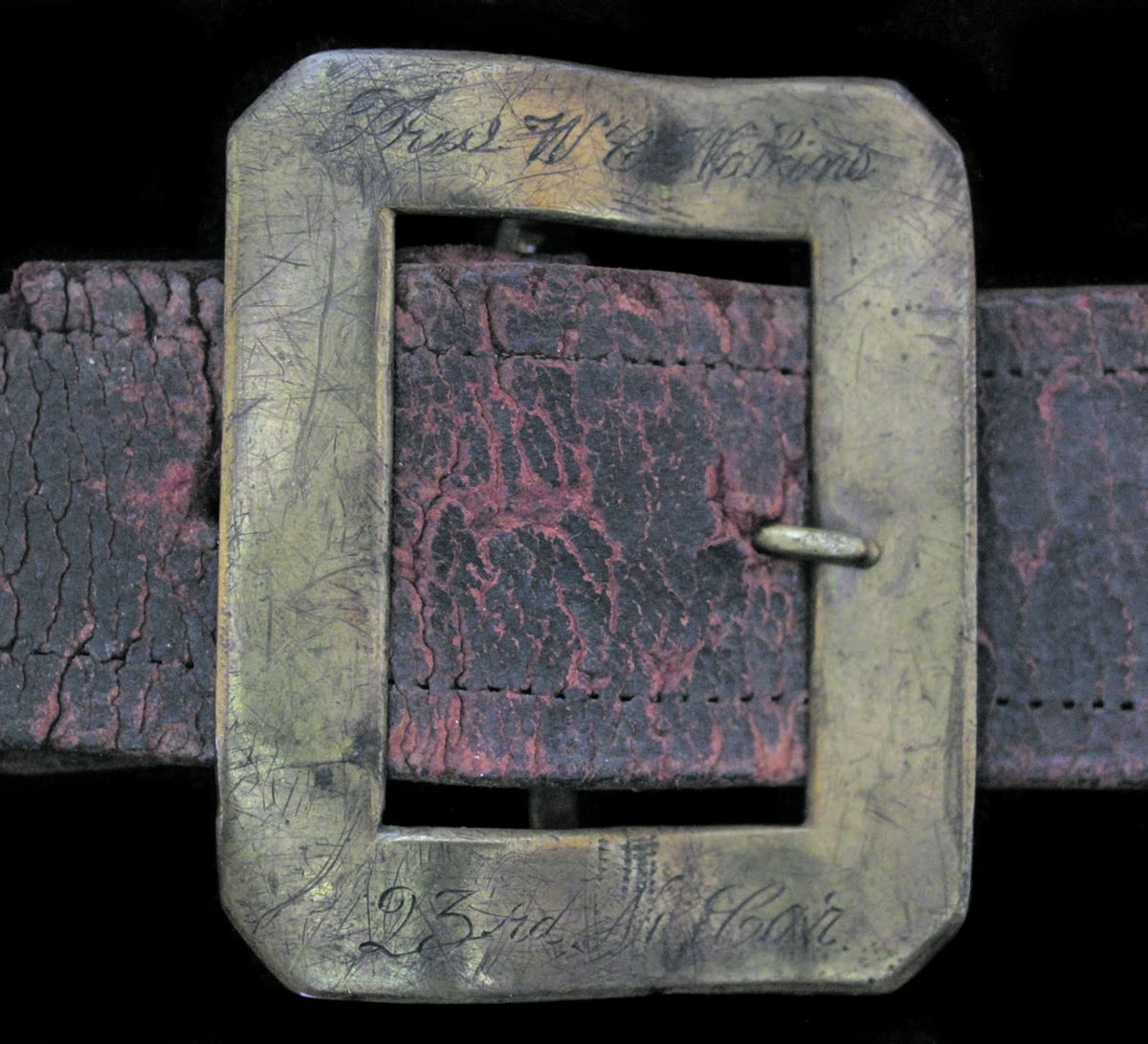
“Killed in Battle September 17th” by Shannon Pritchard The most common accoutrement waist belt in the Confederate army was a standard belt that utilized a plain buckle with a single tongue made out of iron or, less frequently, brass. There were also many more fixed tongue frame buckles, and forked tongue frame buckles made and worn during the War than CS marked buckles. However, the survival rate of these simple utilitarian belts is much lower than CS marked specimens for several reasons. When the armies surrendered, the privates turned over their arms and accoutrements to the victors, and of course many of those victors wanted to take a War souvenir home. It is certain that they would have preferred to carry a belt with a CS buckle home than a plain unmarked belt; so many CS marked belts were saved in this manner. Another reason for the low survival rate of the plain utilitarian belts was simply that they were utilitarian. The South was destitute after the War. Everything was in short supply. Returning Rebels not only needed draft animals to make a crop, they also needed harness. Consequently, most of these belts were adapted to farm use and were quickly worn out. This well-worn, simple belt is not very glamorous, but it was when new. Private Watkins had his name and regiment professionally engraved into the buckle’s face to serve as identification. As can be seen by the metal and material under both sides of the rivet that secures the buckle, the belt was covered with yellow cloth and brass braid when it was new. It must have been bright and ornate in those early days. This likely would not have lasted long in the field with cap and cartridge box, bayonet scabbard, and perhaps a knife all mounted on it. You can see from the bends in the buckle that the belt saw very hard usage, but it still remains strong enough to wear. We collectors often use and hear the term “if only it could talk” when examining a particularly intriguing artifact. This one does. Private Watkins’ North Carolina Hill’s first acts after crossing the Potomac in to Maryland was to buy a large field of corn and turn in his division” wrote a veteran of the march. From Sept. 5, until the 10, the 23rd remained in camp near Frederick, Md. Private Watkins, despite his age, the merciless battles around Richmond, and the severity of the march, was still with his comrades and ready for the fray. Watkins’ term of enlistment expired on Sept. 10; he had been discharged for being physically unfit to continue, but he expressed his wish to take part in the coming battle.2 After all the hardship and bloodshed, only truly devoted patriotism could have kept the man in the ranks. Leaving the camps at Frederick, the 23rd marched up South Mountain and laid down without covering on the western slope through the night of Sept. 13. The following day the men took a position at Fox’s Gap, a critical crossing if McClellan was to be held until Stonewall Jackson could return from Harper’s Ferry. Their position was at the center of General Garland’s one thousand man brigade along the ridge crest, behind a fallen down stone fence. Though outnumbered three to one, Garland’s men held the gap even as their general was dying, but late in the day as the brigade was being enveloped and enfiladed, they were ordered to withdraw; this they did in a scramble for life down the mountainside in the quickly fading light. The necessary time had been bought and paid for in blood. Marching along the Boonsboro Road, they reached Sharpsburg on the 15, crossed Antietam Creek, “took position along the ridge in an open field,” and waited. Daylight on Sept. 17, saw the dawn of the most desperate conflict the New World had ever seen. To face the onslaught the 23rd was able to muster but few men; between battle losses and bare feet the regiment was a skeleton. After fighting desperately in the Cornfield, the regiment retired to the famous “Sunken Road” and continued to suffer. Somewhere on that bloody field, Private William C. Watkins went to his reward, his discharge in his coat pocket,3 and a bullet through his body. The belt that he had turned into a “dog tag,” now worn, torn, and bent, was removed and sent home as a souvenir. Watkins’ mortal remains rest there still, but his spirit lives on in those who remember his sacrifice. 1. 2. 3.
Endnotes:
Leather belt and belt buckle of Private Watkins. Courtesy OldSouthAntiques.com.
Roll of Honor Citation tells us that the Anson County, N.C., volunteer entered the N.C. State Troops on May 22, 1861. Watkins enlisted in the Confederate Army in Company A, the Anson Ellis Rifles of the 13th North Carolina Infantry on Sept. 10, 1861, for twelve months service. He was thirty-eight years old at the time of his twelve-month enlistment and was not required to be in service. Shortly after enlisting he was sent home sick, but soon returned and bore his part in the Peninsula Campaign in the spring of 1862. That spring the regimental designation was changed to the 23rd North Carolina Infantry, under Brigadier General Jubal Early. Ordered to take up the mud march to Richmond on roads in which mules disappeared, they were about faced and marched back to aid General Longstreet in the battle at Williamsburg on May 5. After burning a small amount of powder in which four of the 23rd were wounded, they once again took up that muddy path through the woods “wet as rain can make us, with knapsacks and every shred of extra clothing gone, we marched back to the brow of the hill where we first formed in line of battle. Here amid mud and rain we were held in line of battle till 3 a.m. …then twelve miles were tramped, or rather stumbled, through darkness, mud and slush, before halt was made for rest of sleep, the tenacious mire was often knee deep. Shoes were pulled from our feet by it and lost. Pantaloons became so caked and weighted with mud that many, in sheer desperation and utter inability in their exhaustion, to carry an extra ounce, cut off and threw away all below the knees.” It did not get any better for four more days, when they finally reached the Chickahominy on the evening of May 9. While the Confederates rested around Richmond, the army was reorganized and the 23rd found themselves in Samuel Garland’s Brigade of Daniel Harvey Hill’s Division. On May 30 a reconnaissance by the 23rd in which several men were killed and wounded, discovered the enemy’s weakness at Seven Pines. The following day D. H. Hill’s Division furiously assaulted the Yankees. A Northern writer observing the attack of the 23rd wrote: “Our shot tore their ranks wide open, and shattered them in a manner frightful to behold, but they closed up and came on as steadily as English Veterans. When they got within four hundred yards, we closed our case shot and opened on them with canister. Such destruction I never witnessed. At each discharge great gaps were made in their ranks. But they at once closed and came steadily on, never halting, never wavering, right through the field, right up to our guns, and sweeping everything before them, captured our artillery and cut our whole division to pieces.”1 The attack drove the invaders back on their third line, two miles in rear of the first line they attacked, but at a terrible cost for the 23rd, which lost in excess of 50% casualties. Having escaped the carnage of the June 26 attack at Mechanicsville, the following day the men were marched to the Confederate far left at Gaines Mill, where they skirmished through the afternoon and then charged the Yankees near sundown, breaking their portion of the line, in the great assault that broke McClellan’s Army. Though allowed to lick their wounds while the battles of Savage Station and Glendale were fought, they were yet to see the worst, Malvern Hill. Of that awful, disjointed uphill attack of men against iron, Major General D.H. Hill said, “it was not war, it was murder.” Destroyed, only seventy men of the gallant regiment were left when it was over. The regiment arrived at Second Manassas too late to do more than march over the mangled bodies that were strewn about, “the most gruesome of our whole war experience” wrote a 23rd officer. On Sept. 5 they waded the Potomac River and entered Maryland to drums beating and flags flying. “We were a hungry, jaded, weather beaten, battle worn set. In the forced marches to the northward, wagon trains had been outstripped, green corn and apples forming for days almost our only food… One of General
North Carolina Troops 1861–65 Vol. II page 205 North Carolina Troops 1861–65 Vol. II page 224 North Carolina Troops 1861–65 Vol. II page 224
Shannon Pritchard has authored numerous articles relating to the authentication, care and conservation of Confederate antiques, including several cover articles and is the author of the definitive work on Confederate collectibles, the widely acclaimed Collecting the Confederacy, Artifacts and Antiques from the War Between the States, and is co-author of Confederate Faces in Color.