
The Unfinished Fight
Isaac Hollis & Sons (formerly Hollis & Sheath)
By Craig L. Barry · Originally published July 2020 · pp. 18–19
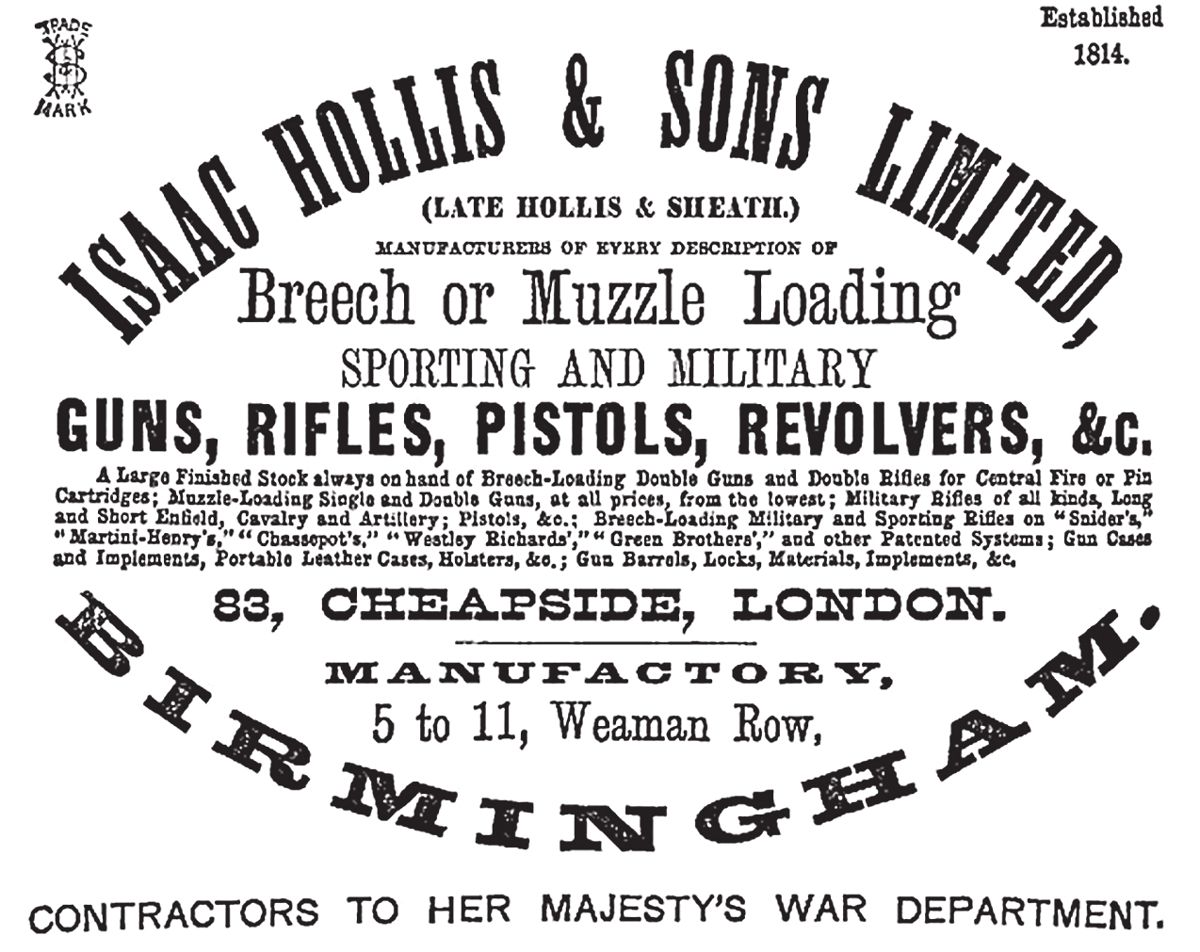
Isaac Hollis & Sons (formerly Hollis & Sheath) The English Gun Trade has families that overlap and intertwine over the course of the decades, and in some cases centuries, while they are in the trade. There are many cases where nephews share the same names as uncles, eldest sons with fathers, etc., J.E. Barnett commercial gunmaking firm is a great example of this. Reconstructing the Isaac Hollis story is somewhat complicated because it was a family with several branches in the Birmingham Gun Trade. The seminal gun-maker William Hollis was born in 1777 and established his business in 1807 at St Mary’s Row; he was recorded there until 1811. He most likely had at least one brother, Richard Hollis, in the firm.
There was also a nephew named Richard Hollis (1829-1853). Around 1814 William and his brother moved to 73 Bath Street and did business as Richard & William Hollis at Bath Street until 1829. In 1838 the firm became William Hollis & Sons, but reverted back to a sole proprietorship as William Hollis in 1839 when sons Frederick and Isaac formed Hollis Bros & Company. When William Hollis died in 1856 at the age of 79 he claimed to be the oldest manufacturer and contractor in Birmingham. In 1829 William’s brother Richard Hollis opened his own premises at 3 Lench Street. In 1833 Richard also occupied 20 St Mary’s Row, but for a short time only. In 1847 Richard moved from Lench Street to 79 Weaman Street, and it appears that he teamed up with Christopher Hollis, possibly a brother or son, as the record is not clear. This firm is no longer recorded after 1853. The firm of Hollis Brothers & Co started trading from 11 Weaman Row in 1839. The partners were Isaac Hollis and Frederick Hollis. The well-known pistol maker William Tranter, also a member of Birmingham Small Arms Trade, was apprenticed to the firm of Hollis Bros & Co. at the age of 14. Tranter left Hollis Bros in 1839. He went into partnership with John Hollis at 1011 Weaman Row between 1844 and 1849, and then with Isaac Brentnall Sheath from 1845. The firm of Hollis & Sheath, a partnership of John Hollis and Isaac Brentnall Sheath formed in Birmingham, England, was located at 10-11 Weaman Row in 1844 through 1850, then 49 Whittall Street through 1853, and finally at 5-11 Weaman Row from 1853-1861. The firm stopped trading as Hollis Bros in 1848 some years after the death of Frederick Hollis. Hollis & Sheath Company was the name of the firm when it was involved in setting up the first Ordnance contracts for the Enfield pattern 1853 and later as founding members of the Birmingham Small Arms Trade. Around 1861 the firm became Isaac Hollis & Sons and claimed establishment from 1814, however their immediate predecessor was the firm of Hollis & Sheath. Isaac Hollis & Sons were recorded in 1861 through 1900 after which time the firm became Hollis, Bentley & Playfair. When the first Ordnance Department contract for Enfield long rifles was placed with Birmingham gun makers in October 1853, the responsibility for “setting up” or assembling he weapons fell to four firms, one of which was Hollis & Sheath. They were supplied by names familiar to students of the Civil War Enfield. We have previously examined in detail the outworker system of manufacture of Birmingham in use by gun makers. The piecemeal system resulted in delays when a lack of standardization with the component parts led to problems in manufacturing the arms. Even with sealed patterns and government inspections at the “Tower,” tolerances were sloppy and much work had to be rejected. Ironically, the original four firms selected as “setters up” (including Hollis & Sheath) had to default on their obligation due to a lack of enough rear ladder sights; other makers were found to finish the orders, including Deane, Adams & Deane, and Wm. Tranter. Hollis was not strictly dependent on military arms, as an advertisement from the late 1860s suggests that if it shoots, Isaac Hollis could probably make it for you: ISAAC HOLLIS & SONS (late Hollis & Sheath) Manufacturers of Every Description of Breech or Muzzle Loading Sporting & Military Guns, Rifles, Pistols, Revolvers &c., A Large Finished
Stock always on hand of BreechLoading Double Guns and Double Rifles for Central Fire or Pin Cartridges; MuzzleLoading Single and Double guns, at all prices from the lowest; Military Rifles of all kinds, Long and Short Enfield, Cavalry and Artillery; Pistols &c.; BreechLoading Military and Sporting Rifles on ‘Snider’s,’ ‘Chassepot’s,’ “Major Fosbery’s,’ ‘Green’s,’ and other Patented Systems; Gun Cases and Implements, Portable Leather Cases, Holsters &c. Manufactory 5 to 11 Weaman Row, Birmingham, established 1814. You can tell a good deal about a business from court records of the time and what activities landed them before a judge. Samuel and Saul Isaac of the commission house of SIC & Co were in court quite often. The assassination attempt on Emperor Napoleon in January 1858 by two Italian revolutionaries (Pierri & Orsini) involved bomb components made in England. The two would be assassins were armed with Adams revolvers made by Hollis & Sheath. France began threatening overtures to invade “Perfidious Albion” in retribution, which directly led to the 2nd formation of the British Volunteers to address the so-called “Crisis of 1858.” Fortunately for militarily disaster-prone French, cooler heads prevailed. At the April 1858 trial of the conspirators, gun maker Isaac Hollis was called to give testimony, which took an amusing turn under cross examination, as follows: Examined by the AttorneyGeneral—State your name and occupation. Isaac Hollis —I am a manufacturer of guns and pistols at Birmingham. On the 29th of October last (1857) two persons came to me and purchased two revolvers. I have since seen both those persons in prison at Paris. The Director of the prison, or the Governor, I do not know his name, pointed out two persons to me; they were Pierri and Orsini. They purchased two revolvers, each with five chambers. This is one of them (looking at one produced by Estien), the numbers are 5,609 and 5,561. This is the other (looking at it). Each of them had a case or box with implements complete. Those are the cases (those produced by Estien); the price was 95 (this should probably be shillings) each, including the boxes, all complete. Orsini paid, and we sent them to the hotel in Worcester Street in our town, to Mr. Pierri. Orsini then wore a beard that had disappeared when I saw him in Paris in prison. (Cross-examined by James) James – Revolvers lately have come a good deal into use, have they not? Hollis – They have. James – Are they used more than other pistols, should you say? Hollis – I should say so, now much more than ever. James – They were used, as we know, a good deal in the Russian War; almost every officer in the army is now provided with them. Hollis – I believe they are. James – How many may you make in the course of a year? Hollis - I could not tell you, some hundreds. James – It [the revolver] is an American invention, is it not? Hollis – Not at all… James – I thought they took the credit of it. Hollis – Not at all, these are Adam’s patent. Isaac Hollis & Sons became volume producers of military guns and inexpensive trade guns, but they also made quality sporting guns for the South African as well as the Asian/Indian markets, the Australian and New
Zealand markets, and the domestic English civilian market. In 1861 Isaac Hollis, by now at least 66 years old, patented a trigger guard (No. 1082) and he patented another in 1868 (No. 4922) when he was over 73. Other patents for the firm include Patent No. 386 of 21 Feb.1855, and 3,036 of 22 Dec. 1856, for F. Prince’s Percussion Breech-loading arms. This license was taken over by the London Armoury Co. Ltd. in 1861, probably at the time Hollis and Sheath were reorganized into Isaac Hollis and Sons. Isaac Brentnall Sheath was granted British Patent No 996 in April 1853 for a percussion revolver. Isaac Hollis was granted British Patent No. 1083, 1 May 1861 for a Trigger Guard Construction; he also registered Design No. 4922 on May 18, 1868, for a Trigger Guard design; presumably while Isaac Sheath was no longer a named partner after 1861, although he was still affiliated with the firm as late as 1868. A later court case which caused a lot of comment in the Gun Trade concerned a rival firm charged with conspiracy to defraud J. Hollis & Greener by stamping the firm’s names on sporting guns they sold as genuine articles. Both Greener and Hollis sued and recovered damages.
Craig L. Barry was born in Charlottesville, Va. He holds his BA and Masters degrees from the University of North Carolina (Charlotte). Craig served The Watchdog Civil War Quarterly as Associate Editor and Editor from 2003–2017. The Watchdog published books and columns on 19th-century material and donated all funds from publications to battlefield preservation. He is the author of several books including The Civil War Musket: A Handbook for Historical Accuracy (2006, 2011), The Unfinished Fight: Essays on Confederate Material Culture Vol. I and II (2012, 2013) and three books (soon to be four) in the Suppliers to the Confederacy series on English Arms & Accoutrements, Quartermaster stores and other European imports.