
“Give Them Fredericksburg”: The 20th Massachusetts at Gettysburg
By Sarah Kay Bierle · Originally published July 2020 · p. 17
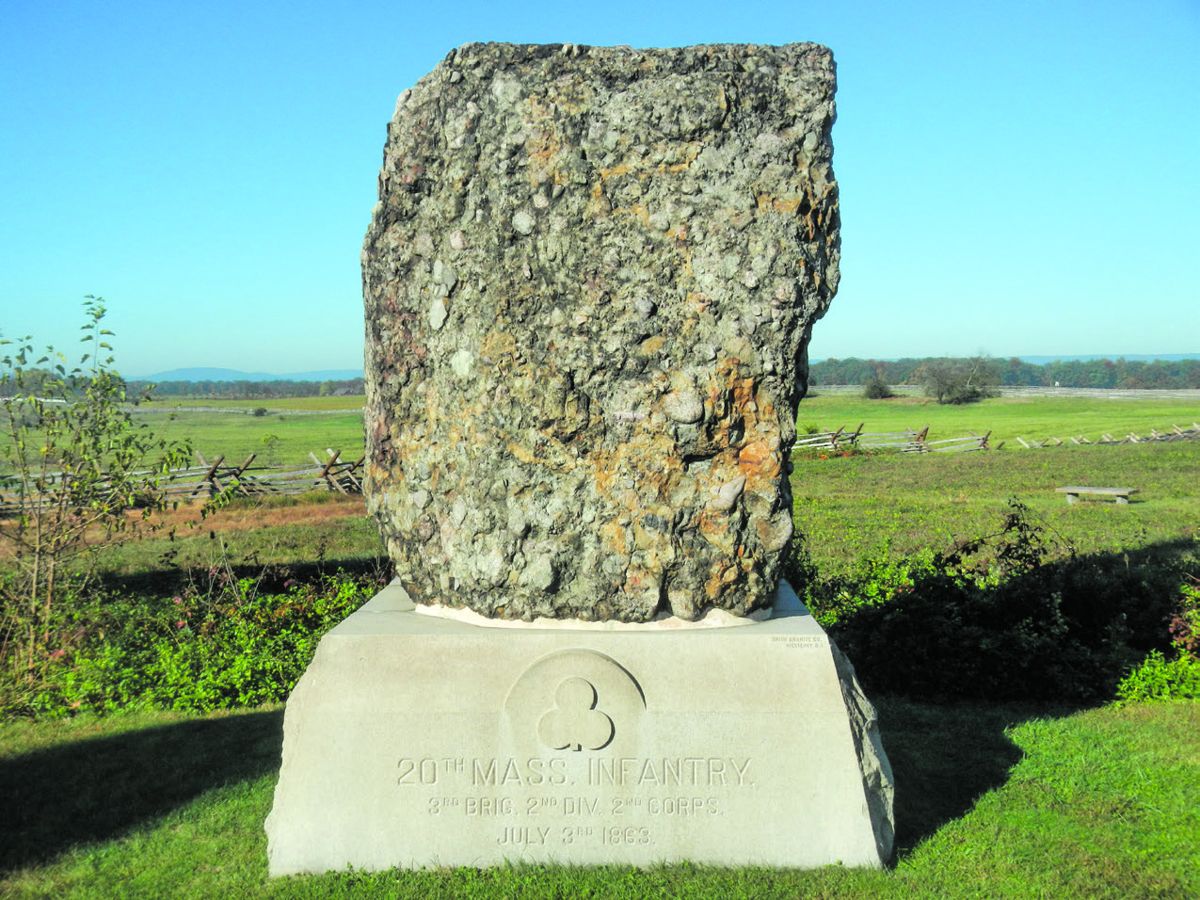
P. Alexander’s guns trained a crossfire over open ground that Union infantry would have to cross to reach the high ground. Below the heights, in a sunken road, Confederate infantry from Longstreet’s Corps waited to add their rifle fire to the defense. French and Hancock’s Divisions from the II Corps made the early assaults. Howard’s Division, including the Third Brigade with the 20th Massachusetts followed in the footsteps of their unsuccessful attacks. Around 1p.m., their brigade went into action, deploying in line of battle after crossing the infamous millrace that cut across the open ground. Anchoring on William Street, the 20th Massachusetts formed the brigade’s right flank with their attack aimed at rifle pits along the heights, not the actual Sunken Road further down the line. The Harvard Boys advanced about sixty yards under artillery and rifle fire, then stood fast, and returned fire. Other regiments in the brigade fell back, and for a little while the 20th stood alone, unwilling to retreat and suffering heavy casualties. “The Twentieth Massachusetts stood firm and returned the fire of the enemy, till I had, with the assistance of my staff and other officers, reformed the line and commenced a second advance,” recalled Colonel Hall, the brigade’s commander. Twice, the regiment advanced. The 20th “showed the matchless courage and discipline,” but courage and training would not prevail against the deadly crossfire; the brigade finally fell back to the millrace where they held a position into the night. Despite the risks, some soldiers crawled back into the field and dragged wounded comrades to safety under the cover of darkness. According to their official records, the regiment lost 163, over half the 307 men they had in the ranks when the battle began; the majority were lost in the assault on Marye’s Heights. Nearly six months later, the 20th Massachusetts laid low on July 3, 1863, as a terrific cannonade shook the ground. Across open fields, Alexander’s Confederate artillery again pounded the Union army, but this time the roles were reversed. Federal troops waited in defense; the Confederates could make the attack. Captain Henry L. Abbott described the afternoon in his battle report: “After the cessation of the enemy’s artillery fire, their infantry advanced in large force. The men were kept lying on their bellies, without firing a shot, until. . .the enemy having got within 3 or 4 rods of us, when the regiment rose up and delivered two or three volleys, which broke the rebel regiment opposite us entire to pieces, leaving only scattered groups. When the enemy’s advance was first checked by our fire, they tried to return it, but with little effect, hitting only 4 or 5 men. We were feeling all the enthusiasm of victory, the men shouting out, “Fredericksburg,” imagining the victory as complete as everywhere else as it was in front for the Third Brigade.” However, disaster loomed for the Union line as Confederate units broke through. Quickly, the officers of 20th Massachusetts repositioned the men, where “the enemy poured in a severe musketry fire, and at the clump of trees they burst also several shells, so that our loss was very heavy, more than half the enlisted men of the regiment being killed or disabled while there remained but 3 our of 13 officers… . Notwithstanding these adverse circumstances, the men of this command kept so well together that after the contest near the trees, which last half an hour or so was ended, I was enabled to collect… nearly all the surviving men of the regiment and returned them to their original place in the pits.” The cost had been heavy for the 20th Massachusetts, but they had helped hold and secure the Federal line on Cemetery Ridge. The reputation of their unit had been forged on many fierce battlefields, but in these soldiers’ minds Fredericksburg had been the moment that prepared them for Gettysburg. Feelings of relief and revenge prompted the chant “Fredericksburg, Fredericksburg” as they poured a shocking volley into the Confederate infantry in front of their position near the center of the line at Gettysburg. The battle in central Virginia six months earlier had left a deep impression on the 20th Massachusetts soldiers. Their urban attack, assault on Marye’s Heights, and horrifying night on the battlefield left that town’s name as the place where they fought against terrible odds with a foe most probably never got close enough to see. On a ridge in Pennsylvania, they had their moment of payback, and they knew it. They gave them
“Give Them Fredericksburg”: The 20th Massachusetts at Gettysburg by Sarah Kay Bierle “The moment I saw them, I knew we should give them Fredericksburg,” declared Captain Henry Livermore Abbott, recalling when he spotted the Confederate infantry advancing to attack the Union center the afternoon of July 3, 1863. The Pickett-Pettigrew-Trimble Charge moved across nearly a mile of open fields, destined to meet a devastating fate. Some Union soldiers waiting along the stonewall could have used their experience six months earlier to warn the gray-clad troops, but it was no time for warnings. The soldiers of the 20th Massachusetts recognized a moment for revenge, a change to pay back the losses suffered on the plains in front of Marye’s Heights. At both battles, the 20th Massachusetts, “The Harvard Regiment,” fought in the Third Brigade, Second Division, II Corps. Formed in 1861 and initially including many university graduates and students, the volunteer unit served until the end of the war and suffered the most casualties of any Massachusetts regiment. The unit had battle experience from Ball’s Bluff, the Peninsula Campaign, and Antietam by December 1862 when they stood on Stafford Heights, looking across the Rappahannock River at Fredericksburg, an open plain, and Marye’s Heights rising to the west. On Dec. 11, 1862, the 20th crossed the Rappahannock under fire and help secure a Union foothold on the Fredericksburg side, pushing Barksdale’s Confederates back and allowing completion of the pontoon bridge at the Upper Crossing. Forming on Hawke Street, the regiment received orders to “clear the street leading from the bridge at all hazards.” Supported by two other regiments, the Harvard Boys plunged into the fight, driving back the Confederates and securing the Federal grip at the Upper Crossing. That night and the following day some tended to the wounded, others took advantage of the situation to plunder homes or have impromptu concerts on pianos left behind by fleeing civilians. Another day of combat dawned on December 13, one that would be etched in the minds of the regiment’s survivors. From Marye’s Heights, standing west of Fredericksburg’s close streets, Colonel Edward
“Fredericksburg” and all the tragedy, carnage, and horror that word had come to symbolize for those survivors from Massachusetts.
Sarah Kay Bierle serves on staff at Central Virginia Battlefields Trust. CVBT is dedicated to preserve hallowed ground at Fredericksburg, Chancellorsville, The Wilderness, Captain Henry L. Abbott recognized his regiment would unleash “Fredericksburg” on the advancing Confederates at Gettysburg on July 3, 1863.
and Spotsylvania Court House. To learn more about this grassroots preservation non-profit, please visit: www.cvbt.org.