
Through The Lens
Amid The Shriek Of Death
By Stephanie Hagiwara · Originally published July 2020 · pp. 24–25
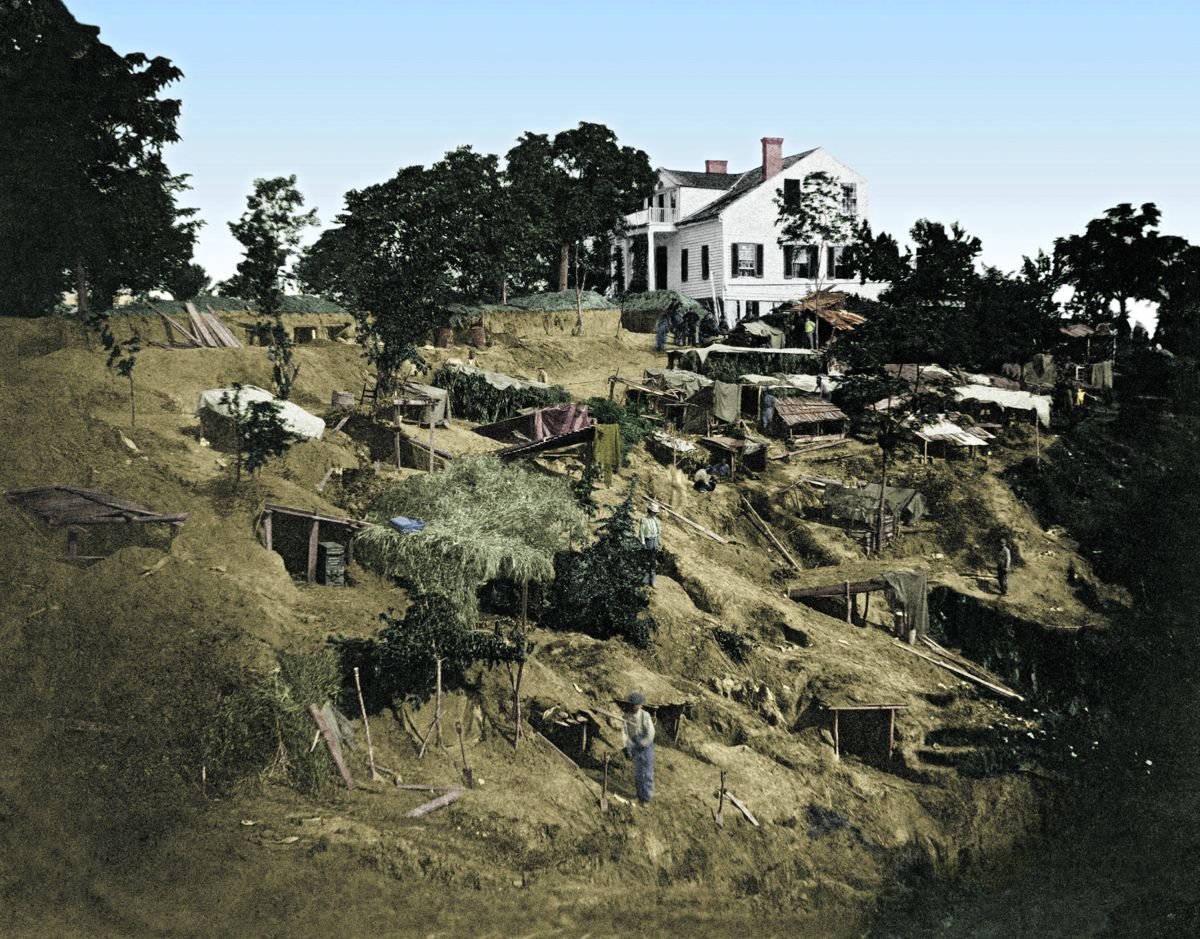
Amid The Shriek Of Death “Ah!” said I to a friend, “how is it possible you live here?” “After one is accustomed to the change,” she answered, “we do not mind it; but becoming accustomed, that is the trial.” – Mary Ann Loughborough
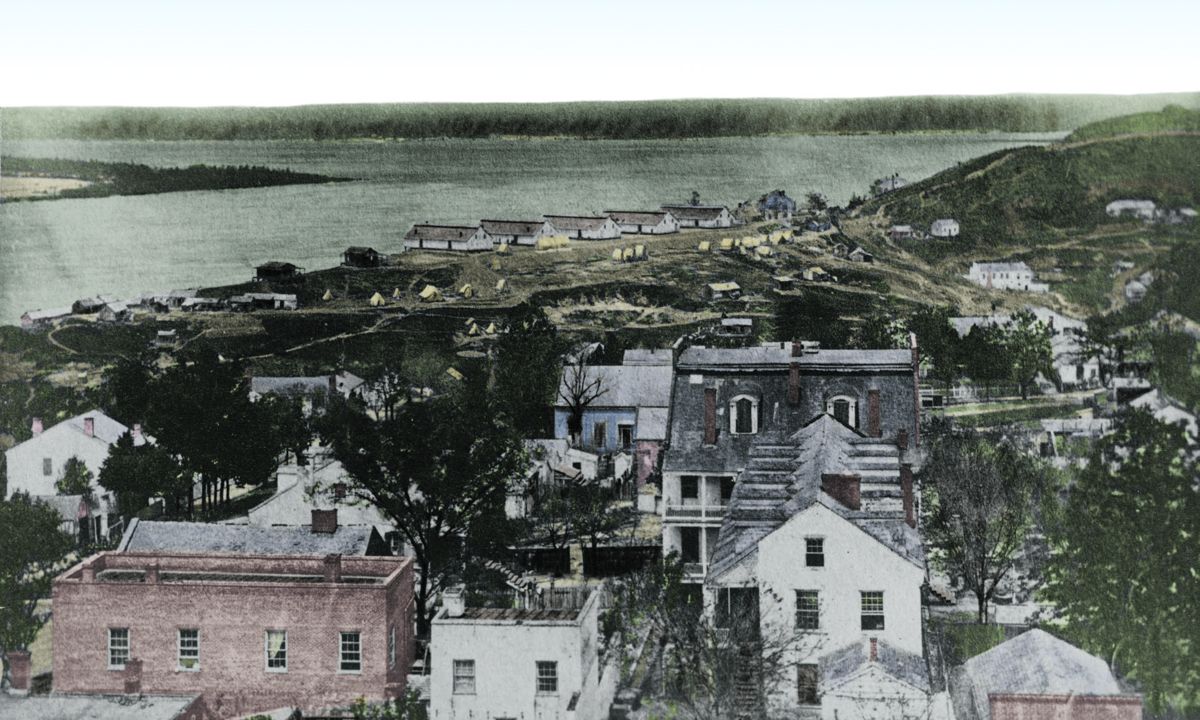
Seizing control of the Mississippi River was part of the grand Federal strategy to split the Confederacy in two. Perched atop bluffs towering above the river, Vicksburg, Miss., foiled the plan. The Federals launched their Vicksburg Campaign in December 1862. By April 1863, six different attempts from the north, east, and west had failed. Gen. Ulysses Grant resolved to gamble all his resources and career on an attack from the south. First, his naval resources attacked Vicksburg’s river batteries. Grant’s May 16-17 victories at Champion Hill, and Big Black River Bridge, Miss., positioned the Federals to attack Vicksburg from the only place that had any hope of success. The movements to reach this point have been considered “one of the greatest campaigns in history.” As the Confederates fell back to Vicksburg, Confederate Gen. John Pemberton pondered his choices. President Jefferson Davis considered the loss of Vicksburg a political, military, and personal disaster; his plantation Briarwood was in the area. Davis telegraphed Pemberton “to hold Vicksburg at all hazard,” adding that, “if besieged he would be relieved.” His commanding officer, Gen. Joseph Johnston, considered locations lost could be regained, “but an army lost was lost forever.” Johnston warned Pemberton, “If … you are invested in Vicksburg, you must ultimately surrender. Under such circumstances, instead of losing both troops and place, we must, if possible, save the troops. If it is not too late, evacuate Vicksburg and its dependencies, and march to the northeast.” Pemberton still considered Vicksburg, “the most important point in the Confederacy.” He rode in silence with Maj. Samuel Henry Lockett, the only staff-officer with him. Lockett recalled, “He was very much depressed by the events of the last two days. … He finally said, ‘Just thirty years ago I began my military career by receiving my appointment to a cadetship at the U. S. Military Academy, and today – the same date – that career’s ended in disaster and disgrace.’” On May 17, disheartened soldiers began arriving in Vicksburg. “I shall never forget that woeful sight of a beaten, demoralized army that came rushing back— humanity in the last throes of endurance”, recalled Dora Miller. “‘What can be the matter?’ we all cried, as the streets and pavements became full of these worn and tired-looking men. … The reply was: “‘We are whipped; and the Federals are after us.’” On May 19 and 22, Grant’s men attacked Vicksburg. Instead of attacking demoralized men, 10,000 men who had not fought days earlier were ferociously defending the City. Pemberton’s reserve repulsed the Federals. Grant turned to setting up a twelve-mile siege line around the City. “The soldiers got so they bored like gophers and beavers, with a spade in one hand and a gun in the other.” As his men dug, Grant shelled Vicksburg with 220 guns and additional 100 naval guns from the river. To protect themselves, residents sheltered in caves dug in the yellow clay hillsides. “So great was the demand for cave workmen, that a new branch of industry sprang up and became popular.” Caves ranged from a cubby hole to many roomed dwellings outfitted with furniture, rugs, and doors. The residents kept busy by visiting the balcony of the courthouse to view the Federal batteries “amid the clump of trees on the far distant hillside,” and the gunboat in the river “that had the temerity to come down as near the town as possible.” They watched as “one of the transports had been fired by a shell, and was slowly floating down as it burned.” They would sing as “the noise of the shells threw a discord among the harmonies.” Loughborough would wonder, “How could we sing and laugh amid our suffering fellow beings—amid the shriek of death itself?” “When the real investment began a cat could not have crept out of Vicksburg without being discovered.” The livestock Pemberton had driven into the city were gone. As hunger grew, other animals disappeared. The Mississippi may have been nearby but flowed with muddy water. Sentinels were posted around wells, so that “none might be wasted for purposes of cleanliness.” As the days passed, the hope that “Joe Johnston is coming!” was fading. Johnston knew he lacked the troops to effectively attack Grant or mount a rescue attempt; he had serious challenges acquiring more men. Gen. Robert E. Lee was planning to take the War to the North, a venture that ended at Gettysburg. Johnston’s high regard in the Confederacy was diminishing. He ignored critics like the Mobil Register claiming Johnston was “fighting Grant daily by giving him a ‘terrible letting alone.’” On June 28, a note was slipped under Pemberton’s door urging, “If you can’t feed us, you better surrender us, horrible as that idea is, than suffer this noble army to disgrace themselves by desertion.” On July 3, Johnston sent word that to save the army; he would create a diversion by attacking on July 7. Pemberton had intercepted messages that Grant would be attacking on July 6. Pemberton polled his officers then made his decision. On July 3, white flags were raised as Gen. John Bowen and Col. Louis M. Montgomery rode out from the surrounded city to negotiate “terms for the capitulation of Vicksburg.” Bowen was dying of dysentery but was selected as Grant’s former neighbor and friend to facilitate negotiations. Grant sent his reply, “… Men who have shown so much endurance and courage as those now in Vicksburg, will always challenge the respect of an adversary, and I can assure you will be treated with all the respect due to prisoners of war.” His terms were unconditional surrender. Pemberton was holding out for his men to be paroled instead of taken prisoner. Grant’s officers urged that it would be better to parole the men then ship 30,000 POWs to northern prison camps. “There are no troops more difficult to control, officers and men, than those on parole,” Gen. Lew Wallace had written three months before. They “become lousy, ragged, despairing and totally demoralized.” Combined with logistical issues, it was decided that, “All things considered, dropping a large lump of paroled soldiers in the heart of the Confederacy might do the Confederates more harm than good.” On July 4, Pemberton surrendered. Gen. John Logan’s 45th Ill. had dug bombproofs near the James Shirley home on the outskirts of town. His division was the first to enter the city. The men carried food they shared with the remark, “Here, Reb, I know you are starved nearly to death.” Regardless, it would be nearly 80 years before Vicksburg would resume Fourth of July celebrations. Congratulations poured in for Grant. Perhaps the most rewarding was from a writer who acknowledged disagreements with Grant’s strategy. “I never had any faith, except a general hope that you knew better than I.” The letter ended with President Abraham Lincoln admitting, “I now wish to make the personal acknowledgement that you were right and I was wrong.” Sources: •
•
•
•
•
Loughborough, Mary Ann. My Cave Life in Vicksburg With Letters of Trial and Travel: D. Appleton and Company. 1864 Korn, Jerry. The Civil War: War on Mississippi: Time Life Books. 1985 White Jr, Ronald C.. American Ulysses: A Life of Ulysses S. Grant: Random House Publishing Group. 2016 Symonds, Craig L.. Joseph E. Johnston: A Civil War Biography: W. W. Norton & Company. 2015 Catton, Bruce. U. S. Grant: The Civil War Years: Grant Moves South: Open Road Media. 2015
Stephanie Hagiwara is the editor for Civil War in Color.com and Civil War in 3D.com. She also writes a column for History in Full Color. com that covers stories of photographs of historical interest from the 1850’s to the present. Her articles can be found on Facebook, Tumblr and Pinterest.