
The Graphic War
The Yacht Rebecca
By Salvatore Cilella · Originally published January 2020 · pp. 22–23
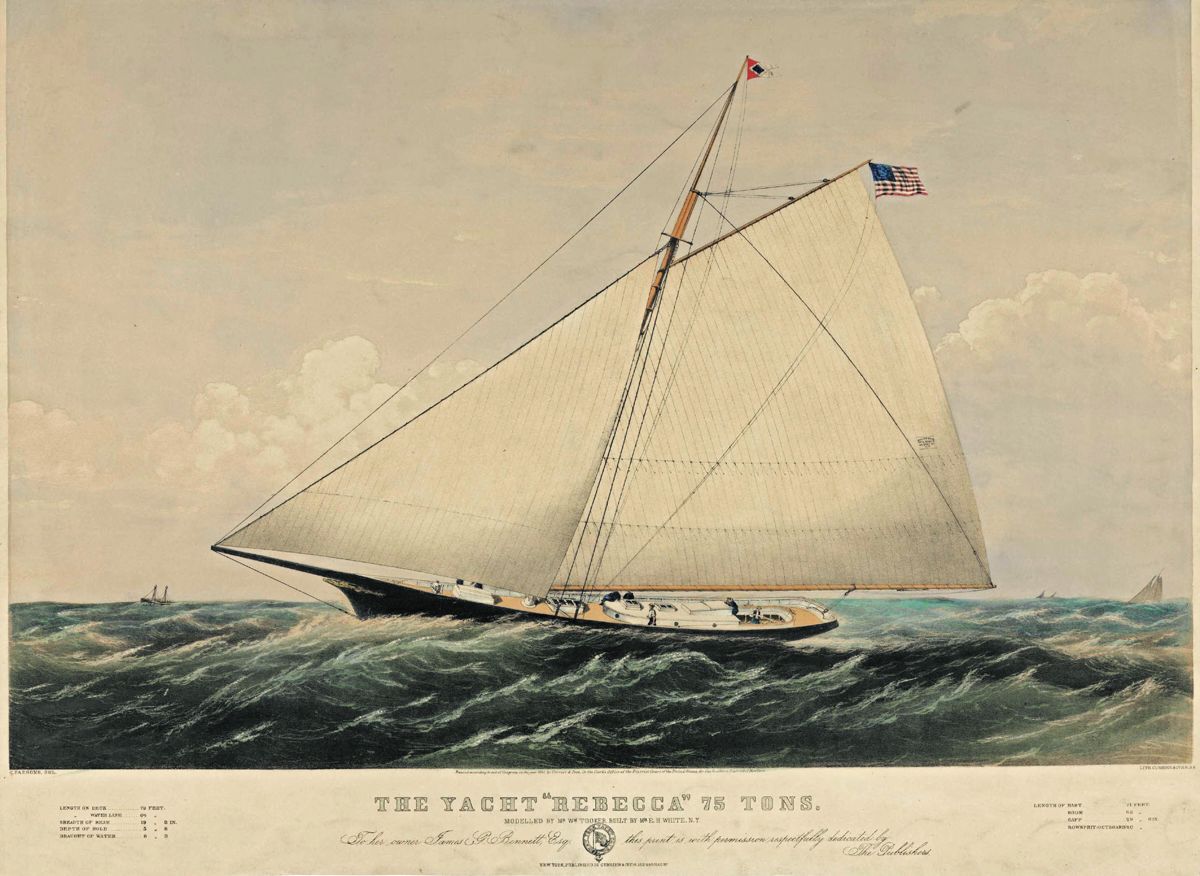
The Graphic War highlights prints and printmakers from the Civil War discussing their meaning and most importantly, the print maker or artist’s goals. When is a Civil War print not a Civil War print? Why, when it’s a yacht, of course. During the height of the lithograph’s popularity, and just prior to the ascendancy of the photograph, Currier and Ives documented myths and idealistic versions of America. In addition to their extensive battle and military prints, the firm also produced trotting prints, horse races, and scenes portraying the rarified playground of yachting. In 1861, Currier published the print “The Yacht ‘Rebecca’ 75 Tons.” It was originally painted by a leading American marine artist, Joseph B. Smith (1798–1876), who worked with his son William until the younger Smith joined the 14th Brooklyn, which ultimately became the 84th New York Volunteers.
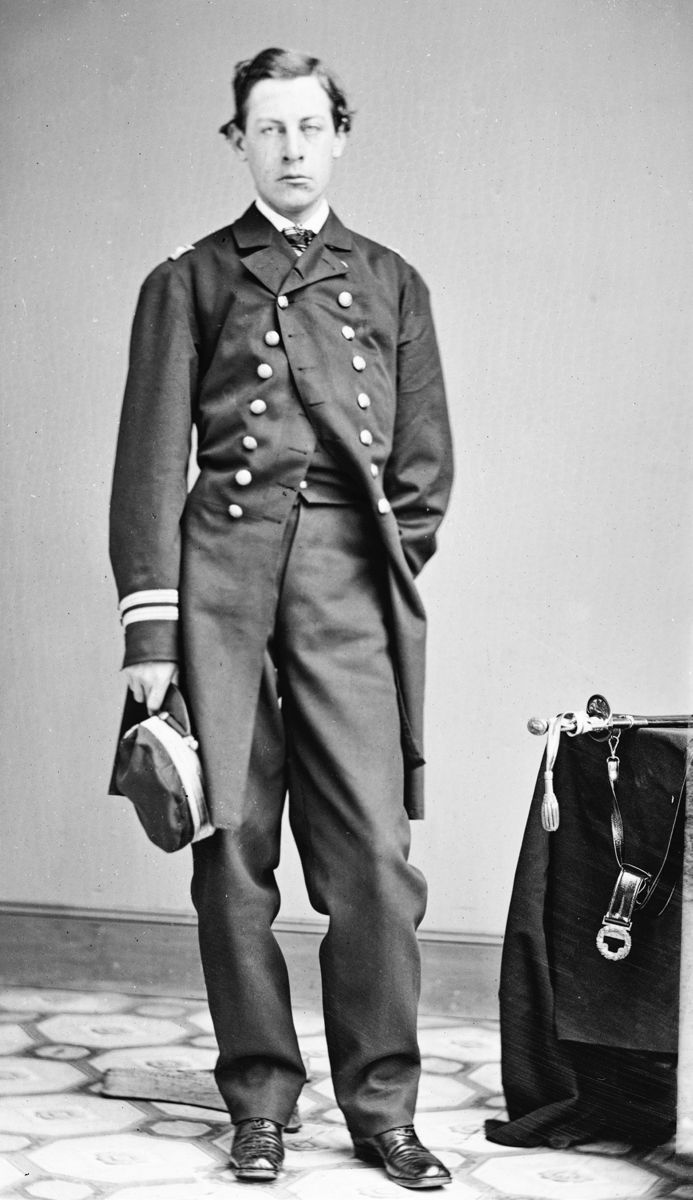
When Currier decided to portray the yacht, it turned to one of its premier in-house artists, Charles Parsons, to transfer Smith’s dynamic painting into a marketable print. As the title margin indicates, “To her owner James B. Bennett, Esq., this print is with permission respectfully dedicated by the Publisher.” It was described as a 77-ton, 72foot centerboard sloop. More intriguing than the history of the print is the intrigue, on a national level, involving the yacht’s role in the Civil War. Not much attention was paid to the yacht`s naval efforts either during the great conflict or by successive historians and scholars. The owner of the boat, James Gordon Bennett Jr. was the playboy son of the founder, owner, and editor of the New York Herald. The younger Bennett had raced Rebecca in the 1857 annual sail of the New York Yacht Club and he was admitted to that elite membership at age 16. Bennett, Sr. was an avid anti-Lincoln partisan calling the 16th president “a third-rate Western lawyer,” an “illiterate Western boor,” and a “vulgar village politician.”1 He wielded the Herald as a bludgeon to attack Lincoln at every opportunity. Once the war began, Bennett senior experienced a miraculous conversion to Union, Lincoln, and the northern war effort. Speculation was that he thought better of the vitriol he was spewing through his articles and editorials when a mob stormed the paper immediately after Sumter. In order to make amends, Bennett raised the flag over his building and quickly issued patriotic editorials.2 Perhaps his most bizarre move involved his son’s sloop, Rebecca. He sent his competent and trusted reporter Henry Villard to Washington on a most peculiar mission. Bennett, through Villard, offered Lincoln the yacht Rebecca for the government to use in the revenue service. The offer wasn’t free. In return, Bennett wanted Lincoln to commission junior as a lieutenant in the Navy. As author Ted Widmer points out: it is unlikely that “Lincoln had ever even heard the word ‘yacht’.” Villard, for his part, promised that “the Herald would hereafter be unconditionally for the radical suppression of the Rebellion by force of arms.”3 Lincoln accepted the sloop and true to his word, appointed the younger Bennett to the Internal Revenue Service where he was commissioned a lieutenant. He served until May 11, 1862, when he resigned.4 Before Bennett’s offer to Lincoln, almost unnoticed in one of the Herald’s “cheeky” ads (Widmer’s term), in fine print was an ad for the sale Rebecca: “Can be seen at Greenpoint.” As author Widmer concludes, “perhaps Bennett’s willingness to offer Rebecca” to the Lincoln administration “had something to do with the fact that no one wanted to buy her.”5 1.
Endnotes:
As cited in Ted Widmer, “Yacht for Sale,” New York Times, April 21, 2011. Adam Goodheart, 1861: The Civil War Awakening, New
York: Alfred A. Knopf, 2011, 209-210. Bennett denied the mob’s evil intentions writing in an editorial that they were most interested in getting copies of the latest issue of the Herald. Ibid., 416-417. Widmer, Ibid. Robert S. Harper, Lincoln and the Press, 320. (See James M. Perry, A Bohemian Brigade: The Civil War Correspondents, 54-55. See also the Lehrman Institute Presents: Mr. Lincoln and New York, “James Gordon Bennett (1795-1872).” The New York Times reported September 9, 1861 a “Captain Coxetta” cruised the yacht Rebecca, Capt. J. G. Bennett, Jr., but without success.” Widmer, Ibid. For further reading see: Adam Goodheart, “1861: The Civil War Awakening”; Michael Burlingame and John R. Turner Ettlinger, eds., “Inside Lincoln’s White House: The Complete Civil War Diary of John Hay”; Douglas Fermer, “James Gordon Bennett and the New York Herald: A Study of Editorial Opinion in the Civil War Era, 1854–1867”; Don C. Steitz, “The James Gordon Bennetts; Memoirs of Henry Villard,
Journalist and Financier”; James L. Crouthamel, “Bennett’s New York Herald and the Rise of the Popular Press”; Oliver Carlson, “The Man Who Made News: A Biography of James Gordon Bennett, Sr.”; The New York Herald, April 23 and 30, 1861; “Mr. Lincoln and New York” [mrlincolnandnewyork.org]; “The Lincoln Log”
[thelincolnlog.org
After 43 years in the museum field, Salvatore Cilella now spends his time writing and is the author of several articles and books. His last professional position was President and CEO of the Atlanta History Center. His most recent books are Upton’s Regulars: A History of the 121st New York Volunteers in the Civil
War (U. Press Kansas, 2009). His two-volume Correspondence of Major General Emory Upton, (U. of Tennessee Press, 2017), is the recipient of the 2017–2018 American Civil War Museum’s Founders Award for outstanding editing of primary source materials. His new book, Upton’s letters to his wife, will be published this spring by Oklahoma University