
National Treasure
By Joel R. Kolander · Originally published January 2020 · pp. 34–35

As an unfortunate side effect of time, the War of 1812 is a conflict known to many in name alone. Its dates, battles, ships, and the brave men who fought on both sides have long begun their slow fade into the pages of history books. A surprising feat considering the magnitude of the events that transpired in those two and a half years. The White House and Capitol building were burned to the ground, our National Anthem was penned, Captain Oliver Hazard Perry defended our country from enemy vessels in the Great Lakes, and the phrase “Don’t give up the ship,” was first uttered. It was a war filled with acts of incredible valor, fierce battles, future presidents and generals on the battlefield, and epic naval slugfests as the young United States yet again confronted one of the most powerful nations on earth. One such battle in that conflict was the Battle of Fort Stephenson. Far from the largest battle of the war, there were only approximately 1,500 total combatants, but it did mark a substantial change in momentum and perfectly symbolized a proud and plucky American force against the overwhelming odds of the British and their mighty Navy. Fort Stephenson was barely more than a trading post fortified by log palisades and a large ditch, and unfortunately surrounded by high ground. It was located where modern-day Fremont, Ohio, currently rests, now a small town about 20 miles down the Sandusky River from the southwest corner of Lake Erie. This small fort was all that stood between an American supply depot further inland and a British floatilla accompanied by a band of Native American warriors led by Shawnee warrior chief Tecumseh.
The sides were far from evenly matched. 700 British Regulars and 700-800 Native Americans were led by General Henry Proctor and came backed by several gunboats of the British fleet as well as a howitzer. The Americans were commanded by 21-year old Major George Croghan. His forces were a 160-man garrison and a weathered 6-pounder cannon named “Old Betsy.” Croghan was ordered to evacuate and set the fort ablaze, but the young Major and his men remained behind prepared to defend
Auctioned on Dec. 6-8, 2019 at RIAC. To see the results visit: www.rockislandauction.com.
Lieutenant Benjamin Johnson
President Andrew Jackson it to the last. Croghan wrote a letter in the days preceding the battle: “The enemy are not far distant. I expect an attack. I will defend this post till the last extremity. I have just sent away the women the children and the sick of garrison, that I may be able to act without encumbrance. Be satisfied. I shall, I hope do my duty. The example set me by my Revolutionary kindred is before me. Let me die rather than prove unworthy of their name.”
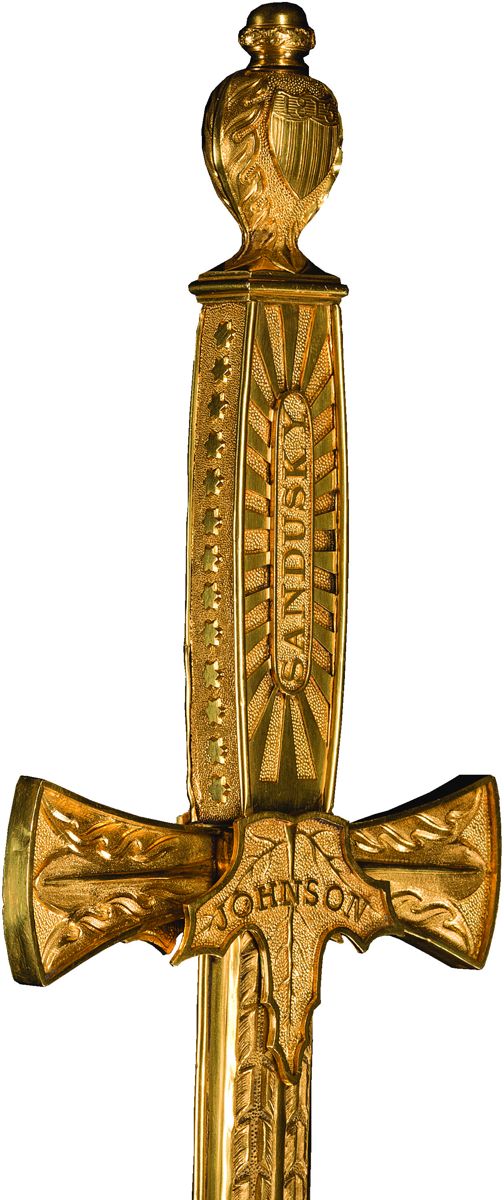
Days later, on August 1, 1813, Fort Stephenson found itself surrounded by Native American warriors and a British gunships. When British officers presented the terms of surrender, the reply came, “The fort will be defended to the last extremity; no force, however great, can induce us to surrender, as we are resolved to maintain this post or bury ourselves in its ruins.” When the British officers further implored the Americans to surrender because they could not prevent the warriors from a massaHistoric National Treasure Solid Gold Fitted Ames cre once the fort was taken, Congressional Presentation Sword Presented by the Americans said, “When President Andrew Jackson to Lieutenant Benjamin this fort is taken, there will Johnson’s Family for Gallantry and Good Conduct in the be none left to massacre.” Defense of Fort Stephenson During the War of 1812
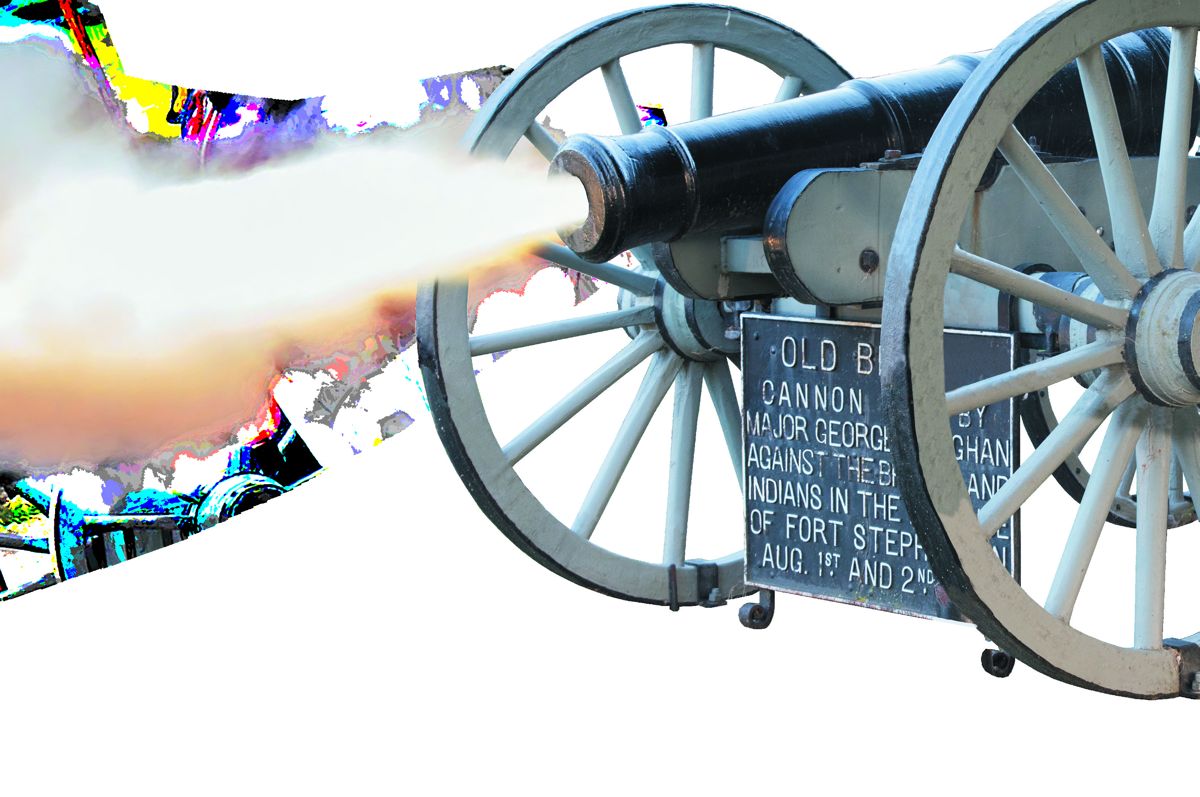
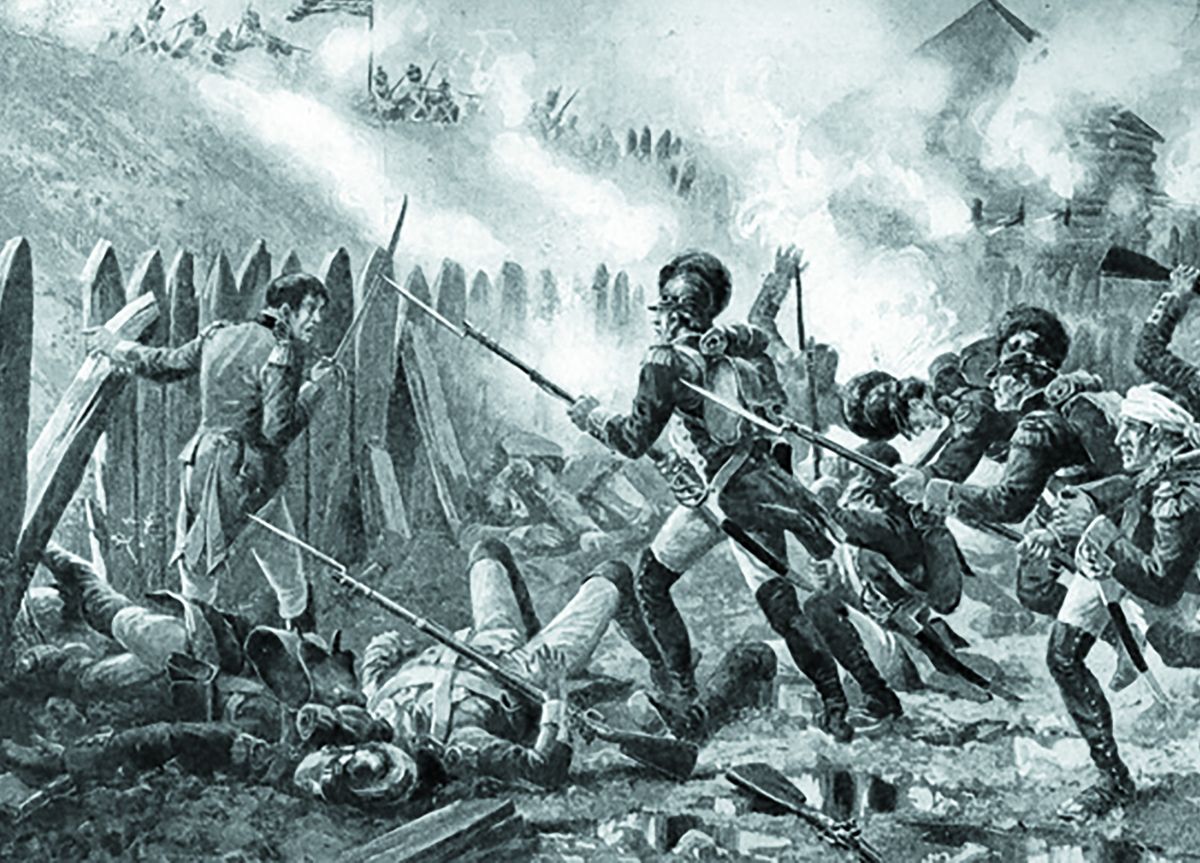
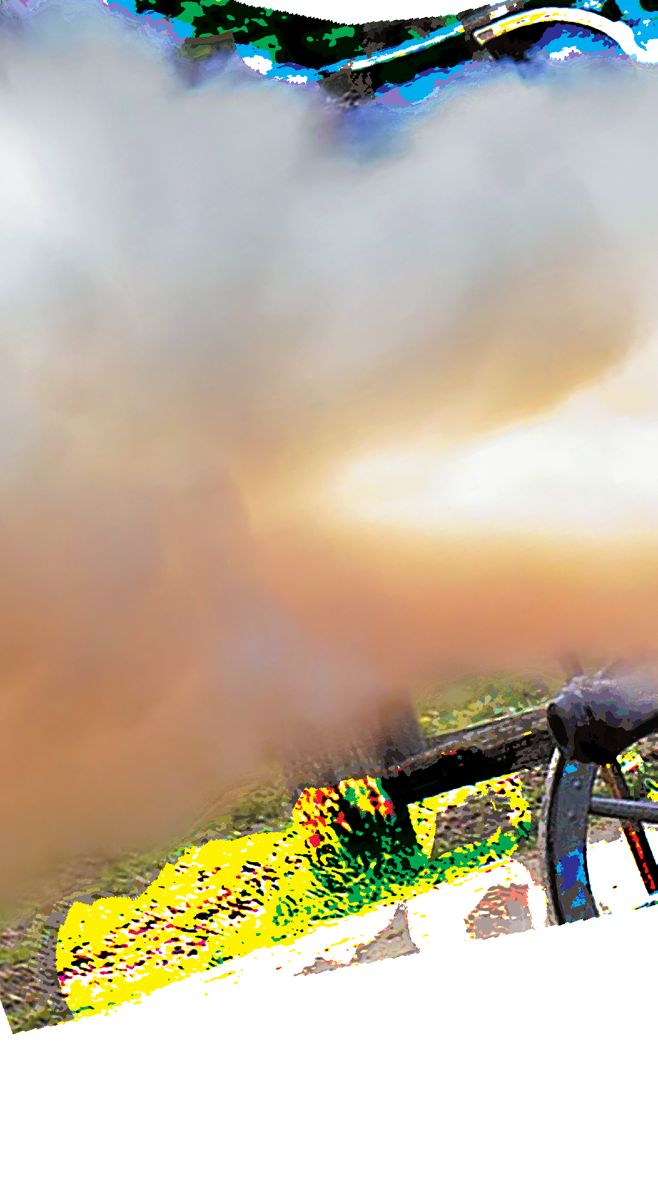
This began an overnight bombardment by the British to weaken the fort’s palisades. The Americans answered with “Old Betsy,” moving her between shots to give the appearance of more guns returning fire. As the British columns marched on the Fort the next day, American soldiers had orders to preserve their gunpowder and only fire when the Englishmen were so close that every shot would invariably find its mortal mark. When that moment came, the experienced American infantrymen rained down terror with their .69-caliber Springfield muskets on the tightly-formed British columns. The assailants sprinted for the cover of the ditch, expecting weakened walls from the night’s artillery bombardment, but the palisades remained largely intact against the smaller 6- and 12-pounder British guns. Without axes to hack the walls or ladders to scale them, the British were musket fodder, or would have been were it not for Old Betsy. When the ditch was filled with Englishmen, a small port hole in the palisade flanking the ditch quietly opened and Old Betsy finally spoke in her terrible tongue. Given a half load of powder and a double load of lead slugs, her blast ripped through the mass of men at a distance of 30 yards. Subsequent shots tore men to bits until the remaining survivors fled to the cover of the woods. In the course of half an hour, the battle was won. It was truly a change in momentum for the United States who at that point had little to crow about in the War of 1812. They wasted no time in seizing the opportunity to do so now. Croghan in his own report to Harrison had the following to say of his officers, “Too much praise can not be bestowed upon the officers, the non-commissioned officers, and privates under my command for their gallant and good conduct during the siege.” One of those officers was Lieutenant Benjamin Johnson. After the battle this native Kentuckian was promoted to Captain in the 2nd Regiment of Riflemen, and the praise being heaped upon him would not stop with Croghan’s. His popularity would raise him to a Representative in the Kentucky legislature for many years where he was popular with his constituents. Even though Captain Johnson would die in 1830 at just 40 years of age, his valor was not soon forgotten. In 1835, Congress passed “a resolution presenting… a sword to each of the officers… for their gallantry and good conduct, in the defense of Fort Stephenson, in eighteen hundred thirteen… Resolved by the Senate and House of Representatives of the United States of America, in Congress assembled, that the President of the United States present a sword to each of the following officers engaged in that affair.” Given posthumously, this incredible sword was presented by President Andrew Jackson himself “to the eldest male representative of Lieutenant Benjamin Johnson.” Forged and crafted by master artisans at the N. P. Ames, this stunning sword represents the highest level of U.S. presentation swords. In private collections today, there are only approximately SEVEN solid gold mounted swords presented by the president and congress for all U.S. wars. It is unquestionably a national treasure. Not only is the craftsmanship of this sword exceptional, it has the materials to match. The cruciform hilt, four-sided grip, mounts, and throat of the scabbard are comprised not of gold plate, but of solid gold. The scabbard is gilt silver, and the length of the blade is etched with detailed embellishment and includes the presentation text, “Pursuant to a Resolution of Congress of the 13th of February 1835” on one side, and on the other, “Presented by the President of the U.S. to Lieutenant Benjamin Johnson.” A sword of such beauty, history, and bravery is museum-worthy in every sense of the word. Those vying for this masterpiece aren’t just adding an exceptional blade to their collection; they are volunteering to safeguard this incredible American artifact for the next generation to cherish. This study in gold, silver, and steel tells the tale of when a little fort marked a big change for the entire nation.
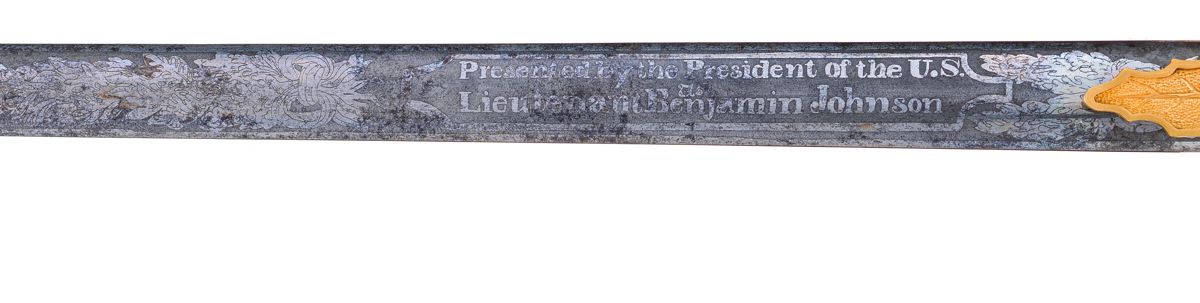
“Presented by the President of the U.S./TO/Lieutenant Benjamin Johnson”
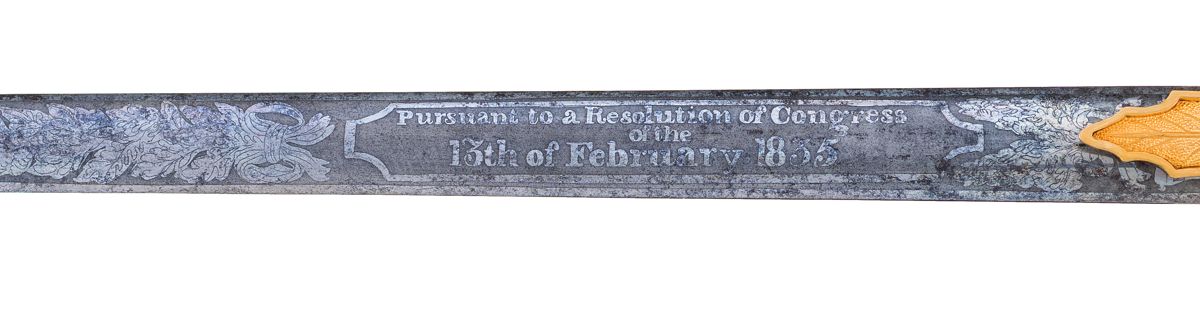
“Pursuant to a Resolution of Congress/of the /13th of February 1835”
Old Betsy was a 6-pounder cannon alleged to have served in the French-Indian War. Her devastating fire turned the tides at Ft. Stephenson nearly a half century later. She currently resides at the Soldier’s Monument in Fort Stephenson Park in Fremont, Ohio.