
Fort Fisher, North Carolina: The Gibraltar of the South
By Chris E. Fonvielle Jr. · Originally published January 2020 · p. 31
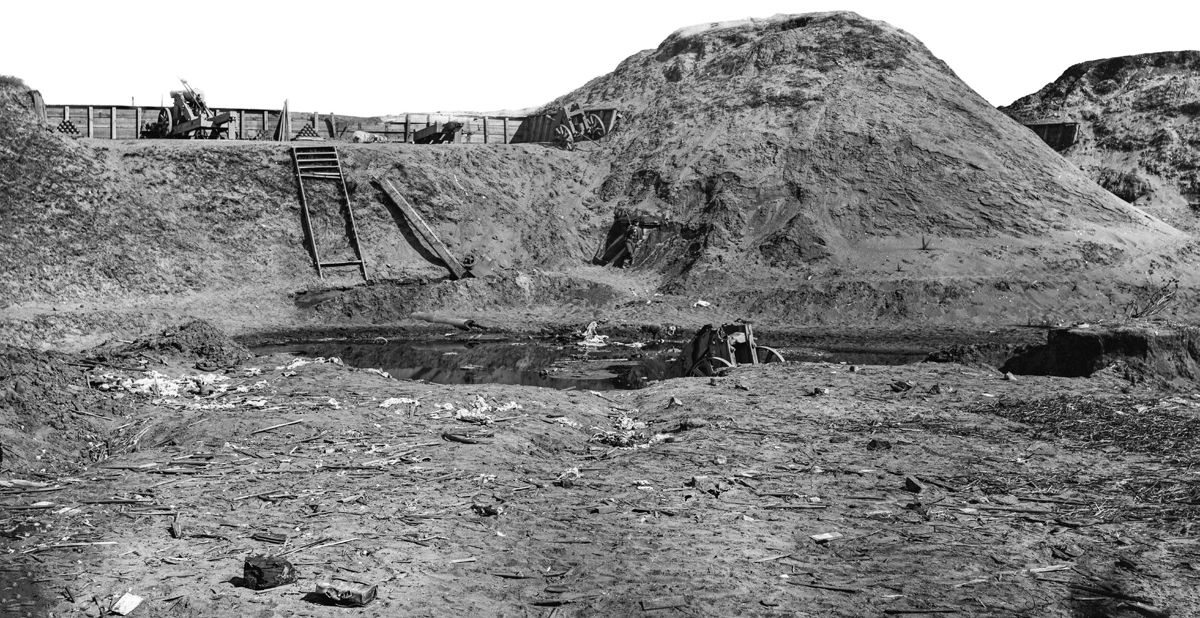
General Robert E. Lee’s telegram to military authorities in North Carolina in late 1864 expressed a sense of urgency. “If Wilmington falls, I cannot maintain my army,” he wrote. The message was clear. The survival of the Army of Northern Virginia, and thus the Confederacy, depended upon the survival of Wilmington as a blockade running seaport. For more than three years, Confederate commerce vessels had been importing firearms, ammunition, edged weapons, blankets, medicines, hardware, food, and civilian goods from Europe, especially Great Britain, through the U.S. Navy’s blockade of Wilmington to help the Confederacy sustain its war effort. Wilmington was ideally situated for the blockade running trade as it was located near the British transshipment points of Bermuda and Nassau, out of which blockade-runners operated. As the ships approached the seaport on the Cape Fear River, they could access the harbor by two entryways: Old Inlet at the mouth of the river, and New Inlet six miles to the north. The dual passageways, separated by Bald Head Island and Frying Pan Shoals, offered blockade-runners a choice of entry and exit. Union blockading vessels off Wilmington found it virtually impossible to halt the more than 100 speedy steamships and an undetermined number of sailing vessels that enjoyed an astounding success of about 85 percent. Once the smuggled supplies reached the Tar Heel seaport they were transported along three railroads to the needy on both the battlefront and home front. The most important was the Wilmington and Weldon Railroad which ran from Wilmington to Goldsboro and then Weldon, North Carolina, where it connected with the Petersburg and Weldon Railroad. The Wilmington and Weldon Railroad served as Gen. Lee’s main supply route in the last year of the war and became known as “Lee’s Lifeline” and the “Lifeline of the Confederacy.” To protect Wilmington, the Cape Fear River, the Wilmington and Weldon Railroad, and the inlets that blockade-runners used, Confederate engineers constructed a vast network of forts and batteries. To protect New Inlet, the most popular entryway for blockade-runners, they built the strongest seacoast fortification in the Confederacy—Fort Fisher. It was like no other fort that had ever existed before the Civil War. Its elevated artillery batteries, made of beach sand and wooden bunkers underneath, rose high above the sea beach and kept Union blockading gunboats at bay. With good reason Confederate and Union observers alike dubbed Fort Fisher the “Gibraltar of the South.” In September 1861, the works were named in honor of Colonel Charles F. Fisher of the 6th Regiment N.C. Troops, who was killed in the war’s first major land battle at Manassas, Virginia on July 21, 1861. After Union forces captured New Bern and Beaufort, North Carolina, and retook Norfolk in the spring of 1862, Wilmington became the closest seaport to the Virginia battlefront. “To close the port of Wilmington is undoubtedly the most important and effective demonstration that can be made,” exclaimed U.S. Secretary of the Navy Gideon Welles. “If of less prestige than the capture of Richmond, it would be as damaging to the Rebels.” Yet President Abraham Lincoln’s administration and the U.S. War Department ignored Welles’s requests for support in an attack on Wilmington which it considered of little strategic value compared to Richmond, Chattanooga, and Atlanta. Consequently, the Union navy shifted its attention to Charleston, the birthplace of secession and the war, and the center of popular and political interests. Operations on the Mississippi River, especially against Vicksburg, also took precedence. The government’s attitude toward Wilmington finally changed in the summer of 1864. In early August, Adm. David G. Farragut sealed Mobile Bay, Alabama to blockade running, leaving Wilmington as the only major seaport open to trade with the outside world. President Lincoln now agreed with Secretary Welles’s plan to strike Wilmington, but deferred final approval to Lt. Gen. Ulysses S. Grant, commander of U.S. Army forces. Grant initially expressed little enthusiasm as it would require him to provide a large expeditionary force to assist the navy. In his opinion he needed more soldiers to maintain the pressure on Robert E. Lee. Since the late spring of 1864, Grant’s operational forces—the Army of the Potomac and the Army of the James—had been battling Lee’s Army of Northern Virginia for possession of Petersburg. As the summer progressed, the siege had devolved into a stalemate that neither side had been able to break. Grant did not believe he could afford to dispatch troops for an attack on the coast of southeastern North Carolina. Welles argued that the deadlock in Virginia could be broken by closing Wilmington to blockade running, thus denying General Lee the weapons, food, and clothing his army so desperately needed. Grant eventually came around, but it was not until December that the expeditionary force was ready to go. Admiral David D. Porter commanded the naval task force that targeted Fort Fisher. He assembled the largest fleet of the war—64 warships mounting a total of 627 cannons. Porter believed it would take that kind of firepower to reduce the massive stronghold. Over a two day period, December 24-25, 1864, his warships fired at least 20,271 shells at the sand bastion in the largest naval bombardment of the Civil War. Nevertheless, the stout Confederate defenses and defenders held their own. The Union defeat at Fort Fisher was offset by Gen. William T. Sherman’s capture of Savannah, Georgia on December 21, 1864. For his part Grant was glad to see Sherman safely on the coast and eager to transfer his powerful 60,000-man army by sea to Virginia for a final showdown with Lee at Petersburg. Sherman had other plans. He proposed to march his army to the Old Dominion by way of the Carolinas, destroying supply depots and railroads and “smash things generally” along the way, as he had done so effectively in his “March to the Sea” across Georgia earlier that autumn. Once he reached Goldsboro, North Carolina his army would be in an advantageous position to strike the Army of North Virginia from below. Sherman predicted that his advance would force Lee out of Petersburg and into open country where he and Grant together could trap him in a pincer movement. Sherman’s ambitious plan and his confidence pleased Grant. The crowning benefit might well be the collapse of the Confederacy. “Make preparations to start on your Northern expedition without delay,” Grant wrote Sherman. “Break up the rail-roads in South & North Carolina and join the Armies operating against Richmond as soon as you can.” Having agreed to Sherman’s bold Carolinas Campaign, as historians call it, Grant determined to guarantee its success by furnishing Sherman’s army with provisions, reinforcements, and equipment, or a haven on the seacoast if need be, halfway between Savannah and Petersburg. Wilmington took on a whole new meaning for Grant. The city must be captured! To cooperate with the mercurial Admiral Porter, Grant assigned the capable and affable Brig. Gen. Alfred H. Terry, respected commander of the newly formed 24th Army Corps, to command the Wilmington expeditionary force of 9,600 officers and men. Porter’s warships, slightly scaled down to 58 in number, and Terry’s transports reached Fort Fisher late on the night of January 12, 1865. The battle opened early the following morning. The navy proceeded to bombard the fort for two-and-a-half days, firing almost as many projectiles (19,682) as in the Christmas attack. As Porter’s gunboats pummeled the defenses, Terry’s infantry landed. After positioning his troops over the following two days, he launched a ground assault late on the afternoon of January 15. A shore party of more than 2,200 volunteer sailors and Marines from various ships in the fleet also stormed Fort Fisher.
The Confederate defenders, led by Colonel William Lamb and Maj. Gen. W.H.C. Whiting, rushed from their bombproofs to meet the attack. They succeeded in turning back the poorly armed and disorganized naval column that had advanced along the beach, but soon became embroiled in hand-to-hand combat with Union soldiers who had secured a lodgment on the fort’s ramparts. The savage, close-quarters fighting raged for more than five hours before the heavily outnumbered and outgunned Southerners were driven from the fort. With both Lamb and Whiting seriously wounded, the surviving 2,000 defenders surrendered at about 10:00 o’clock on the night of January 15, 1865, After receiving reinforcements, the Federals then launched an attack upriver to capture Wilmington on February 22, 1865. No longer able to supply his depleted and embattled troops by way of the Wilmington and Weldon Railroad, and now threatened by two numerically superior armies, Lee was forced to retreat from Petersburg. The situation was just as he had predicted if Wilmington fell. Grant followed closely on Lee’s heels, battling him to Appomattox Courthouse where, on April 9, Lee surrendered the Army of Northern Virginia. The Union victory at Fort Fisher and Wilmington severed Lee’s lifeline and guaranteed the success of Sherman’s Carolinas Campaign. The Fort Fisher State Historic Site will commemorate the 155th anniversary of the Second Battle of Fort Fisher the weekend of January 18-19, 2020. For further reading, see: Chris E. Fonvielle Jr, The Wilmington Campaign: Last Rays of Departing Hope.