
Book Reviews
Book Reviews — January 2020
Originally published January 2020 · pp. 38–42
Civil War News book reviews provide our readers with timely analysis of the latest and most significant Civil War research and scholarship. Contact Stephen Davis, Civil War News Book Review Editor. Email: [email protected].
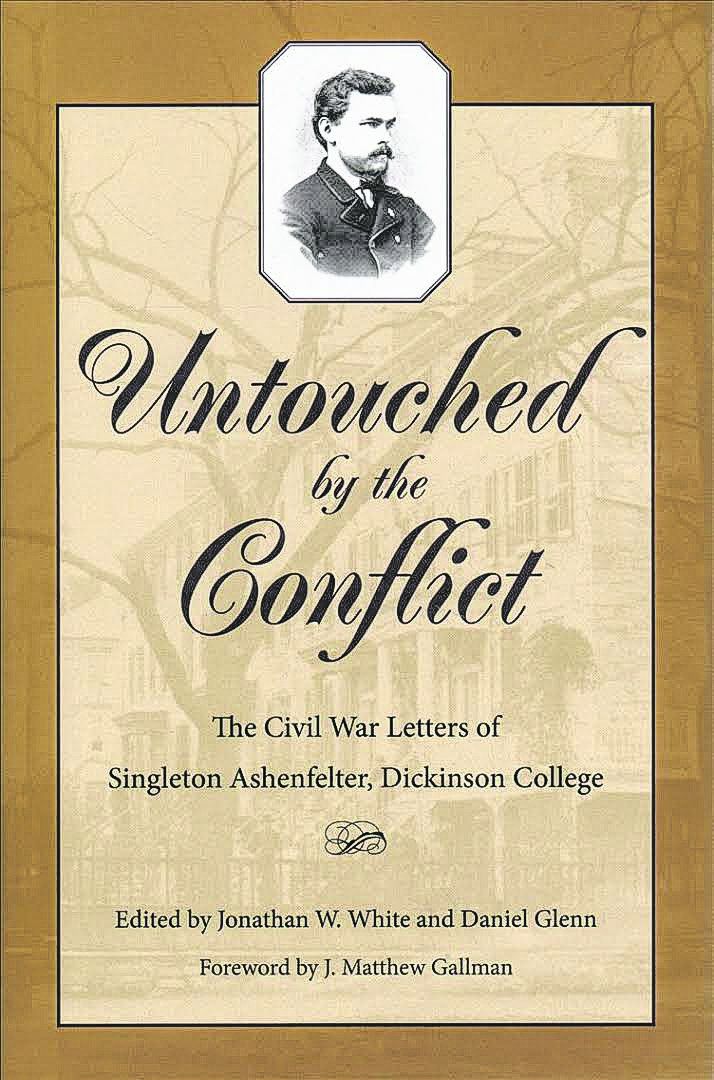
College Life during the Civil War Untouched by the Conflict: The Civil War Letters of Singleton Ashenfelter, Dickinson College. Edited by Jonathan W. White and Daniel Glenn. 35 photographs, notes, index, 180 pp., 2019. Kent State Univ. Press, www. KentStateUniversityPress.com. $29.95 cloth. Reviewed by Paul Taylor
The Civil War letters of Union soldiers have been published by the score over the decades. However, those penned by Northern civilians, especially those written by college students, remain elusive. That may be a bit surprising, for while the popular image of young men rushing to enlist in the Union army after the attack on Fort Sumter dominates historical memory, those who opted to stay home were not a small minority. In fact, sixty percent of white, Northern males of military age chose not to enlist and fight in the Civil War. It is within this latter category that readers learn of Singleton (“Sing”) Ashenfelter, a seventeen-year-old, middle-class white man, who, in 1862 was attending Dickinson College in Carlisle, Pa. This revealing new work collects forty-nine letters that he wrote to his good friend, Samuel
Pennypacker, beginning in April 1862 through July 1865, which was just after the war and his studies ended. As the title of this book asserts, Ashenfelter truly was “untouched by the conflict,” not merely physically but emotionally as well. Indeed, his sense of detachment from the great rebellion is striking. He is, of course, aware of the war but it is always in the background. His letters contain little personal thought about the war or the broader Northern home front. For example, during the Confederacy’s September 1862 Maryland invasion which culminated in the battle of Antietam, we learn that Ashenfelter responded to the invasion by penning a patriotic poem that, by so doing, he felt he had displayed “sufficient patriotism.” Reconsidering, he then joined the local “milishe” but gave the impression he did so as a lark, rather than out of any profound sense of duty. Ashenfelter described himself as a pro-war abolitionist who disdained Northern Copperheads. He wrote how “the South should be made to understand that she cannot do just as she pleases,” yet he never mentions who should do the fighting or why. Some of these letters are rather short while others are quite lengthy. Yet throughout, the young author’s education, wit, command of the English language, and introspective intellect are self-evident. Like many young people, however, he struggled to find his place in the world. Ashenfelter consistently ruminated about himself, his beliefs, and his internal philosophical debates to the point that it bordered on navel gazing. In this reviewer’s opinion, young Ashenfelter is not a likable character. He described himself as a materialistic atheist who looked forward to the life of a hypocrite “and a fine prospect it is.” He held the concept of principle in “utter contempt” and viewed “whatever contributes to my own personal pleasure is right: – all else, – wrong.” This type of person might be described today as a narcissist. As with many youthful men, Ashenfelter also wrote how he thoroughly enjoyed tipping the bottle and of his consistent focus on young women. As for his studies, he admitted he was not what his teachers would consider a good student, though his grades were never below average. Peer pressure was present in his life as well, for he wrote how he placed more pride upon his position amongst his fellow students than with any honors that might be granted him by the faculty. Editors White and Glenn have done impressive work in annotating these letters and adding extras that enhance the author’s mid-19th-century college experience for the modern reader. Noted scholar J. Matthew Gallman offers an insightful preface. Photographs of the work’s key participants abound as well as a descriptive listing of those persons. Four appendices include a record of Ashenfelter’s four-year curriculum at Dickinson, a fouryear summary of the expenses required to attend Dickinson, an essay on Dickinson College during the Gettysburg campaign, and Ashenfelter’s 1864 speech titled “Capital Punishment.” Despite Ashenfelter’s youthful challenges, he enjoyed a successful post-college career as both a newspaper editor and then as a U.S. attorney for the Territory of New Mexico. His Civil War-era letters offer a revealing and uncommon social history glimpse into the workings of a well-educated young man’s mind as he navigated the border between youth and manhood. Paul Taylor is an award-winning author of seven books pertaining to the Civil War era. He has recently finished transcribing, editing, and annotating the Civil War letters of Union engineer officer Orlando M. Poe to his wife. The manuscript is currently under publisher review.
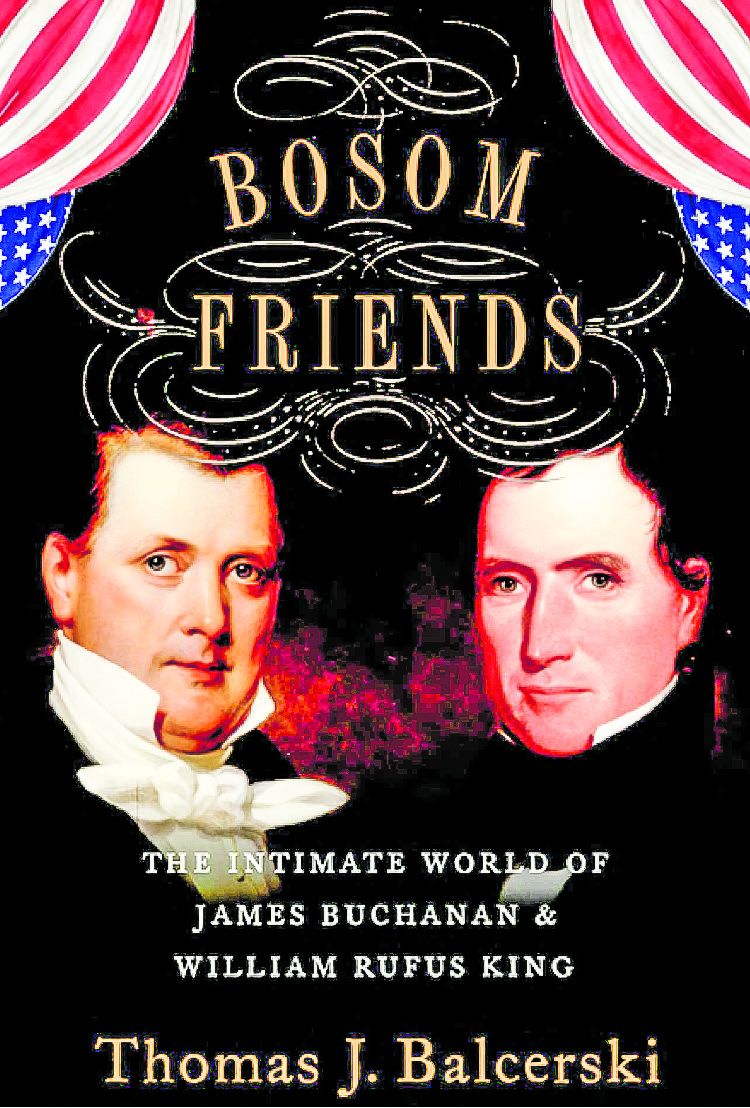
A Same-Sex Relationship that Powerfully Shaped National Events in the Antebellum Era Bosom Friends: The Intimate World of James Buchanan and William Rufus King. By Thomas J. Balcerski. Appendices, notes, bibliography, index, 352pp., 2019. Oxford University Press, global.oup.com. $34.95 cloth. Reviewed by David Marshall
This wonderful new title concerns a dual biography of two important 19th-century political figures and friends, William Rufus King and James Buchanan. Some people called them the “Siamese twins.” These men had a very close friendship that many individuals questioned, including the issues of whether there was a sexual element. Or was it a very close companionable friendship? Thomas Balcerski asserts that these lifelong bachelors formed a partnership that endured many tests during their public lives. William Rufus King was older by five years and was a Southerner, living in North Carolina and Alabama. He held several important elected positions, including the House of Representatives and the Senate. Like James Buchanan, he also held positions that took him to Europe. Buchanan was from Pennsylvania, a successful lawyer who was also elected to the House and the Senate like his close friend. Both were
Democrats who tried to avoid sectional conflict and were voices for compromise. These two important individuals lived together in Washington, D.C. Their friendship brought them messing together in boarding houses, where they often shared meals and drank together. Buchanan and King were not alone in sharing quarters in the nation’s quarters, as many elected officials did not live with their wives and families while in Washington. Additionally, their salaries and per diem were quite small compared to the twenty-first century. While their relationship was not uncommon, both men voted consistently the same way. They supported the Democratic party’s agenda, including the independent subtreasury system, a compromise tariff, and expansion of federal land-holdings. King consistently balanced the interests of the slaveholding South with those of the Democratic Party. Buchanan joined King in doing everything possible to stop abolitionism, including a gag rule on anti-slavery petitions. Both men strongly believed that their political positions were the best way to preserve the Union. However, their nearly ten-year boardinghouse relationship was unique in several ways. The two men were from different parts of the U.S.: King from the South and Buchanan from the North. King hailed from a wealthy slave owning family, and Buchanan from a poor shopkeeping family. King was originally a DemocraticRepublican, and Buchanan was originally a Federalist. However, they shared a few essential personal factors. Both were descendants of Scotch-Irish émigrés and shared ethno-cultural backgrounds. They both attended college, which in the early nineteenth century was a luxury and rare. Neither man ever married, which is one reason for gossip by many. Interestingly, both men were separated by thousands of miles during the period of 1844–1853. King served as a minister to France, while Buchanan moved from the U.S. Senate to Secretary of State under President James Polk. The author makes an interesting observation concerning the reasoning behind their waning friendship in this period, mainly due to a lack of communication and their separate romantic pursuits. Both no longer consistently agreed on numerous important issues, especially dealing with foreign policy. Buchanan encouraged President Polk to gain new territory from Mexico and Cuba, while King was steadfast against the procurement of these lands. Distance and time permanently changed their relationship. During the last years of their friendship, this political partnership reached new heights when King was elected Vice President under Franklin Pierce, and Buchanan elected president in 1856. Both were Democrats, and prior to running independently of each other they worked as running mates in 1852. In the end, their party failed to accept a “bachelor ticket.” Balcerski insightfully examines the reasons that these Bosom Friends were only able to advance one person at a time. While this volume does not offer a definitive answer as to the intimacy of the relationship of Buchanan and King during the antebellum period, some excellent arguments and well-researched evidence answer many questions that historians have entertained since the nineteenth century. David Marshall has been a high school American history teacher in the Miami-Dade School district for the past thirty-three years. A life-long Civil War enthusiast, David is president of the Miami Civil War Round Table Book Club.
Civil War Ghosts: As reported in the newspapers of the time. By Michelle Hamilton. Images, footnotes, 169 pp., 2019. Haunted Road Media, www.hauntedroadmedia.com. $14.99 paperback, $4.99 Kindle. Reviewed by Bill Hendrick
Gettysburg’s ghost tours are hugely popular. Same for Sharpsburg, also known as Antietam, where 3,650 soldiers in blue and gray were killed in the bloodiest one-day battle in American history. Indeed, ghost tours are often thronged, from Atlanta’s Oakland Cemetery to the haunting battery at Charleston to the rugged fields of Shiloh. Tours of the alleged haunts of spooks are ubiquitous across the country, because Americans seem to want to see them, and somehow feel the past in eerie graveyards like the one at Trinity Church in Manhattan, where Founding Father Alexander Hamilton was buried after Vice President Aaron Burr killed him in a duel in 1804. I don’t believe in ghosts, but I once sat silent through the wee
Spiritualism in the Midst of War hours in a Boston cemetery, staring at crumbling, tilted tombstones adorned with skulls and crossbones….you know….just in case. And that’s why Michelle L. Hamilton has written a book on Civil War ghost stories that’s fun to read, especially for people who don’t know a battalion from a brigade, because it is not a war book. She’s studied microfilm of Civil War newspapers, both Northern and Southern, and discovered many published accounts of ghost stories, reflecting a keen interest in the unknown. Her little book is a delight because it not only prints out her findings in readable type, but also publishes headlines and fuzzy microfilm images she had to strain her eyes to read. One, on the front page of the Oct. 2, 1862, issue of the Savannah (Ga.) Morning News, is headlined “A GHOST” and relates at length how the citizens of Lynchburg, Va., had “been thrown into a fever of excitement by the appearance of a ghost in their midst.” Civil War Ghosts is not a collection of ghost stories, but of actual articles about “sightings” published during the Civil War. The country was being torn apart at the time and these accounts documented chilling, terrifying tales of the paranormal that may have offered comfort to the millions in a time of massive death. People have always had difficulty dealing with the death of loved ones, which makes stories about ghosts—which would bolster a belief in an afterlife—very appealing, a balm for the soul. This explains why public interest in spiritualism surged during the
The Richmond Enquirer reported that a New Jersey regiment, quartered in the Marshall House in Alexandria, Va.—whose proprietor James Jackson was killed by Union soldiers after he gunned down Elmer Ellsworth—claimed to have seen the hotelier’s ghost and “stampeded from the premises in great terror.” The Holmes County Republican in Mellersburg, Ohio, reported that “Clevelanders are getting a good deal excited about a certain ghost which it is said has been seen by sundry individuals in various parts of the city.” Still another paper, the Burlington (Iowa) Weekly HawkEye, headlined a story “Ghost! Ghost!! Ghost!!!” “An apparition, robed in white, was seen by a number of persons last night about eleven o’clock,” it declared. And the Keokuk (Iowa) Constitution reported that twenty-five people saw the ghost and were left quite spooked. It’s quite evident that people of that age took ghosts more seriously than most folks do today. You don’t have to be a Civil War buff to get a kick out of Ms. Hamilton’s book. It’s not about fighting, but what people believed, or claimed they did. Also, Civil War-era newspapers—in the days before large reporting staffs and wire services, when telegrams were very costly—had a hard time filling up enough space with “news” to justify the advertisements—the lifeblood of papers. “My interest in the paranormal is a way to connect to the past through a unique angle,” the author says. “I have worked in museums since I was 15. My first job was at the Whaley House in San Diego, which is famous for its paranormal activity. I learned to connect with the visitors through highlighting and focusing on the history of the house by addressing their interest in the paranormal. They came for the ghosts but left learning about the history of the house. The reason I wrote the book was to answer my own questions about what people believed during the Civil War.” Bill Hendrick of Atlanta has been a journalist for 45 years, including three decades at the Atlanta Journal-Constitution and one with the Associated Press. He is currently writing a book with Steve Davis on how the Atlanta Daily Intelligencer, the city’s leading newspaper during the war, covered the conflict.
Revering Confederate Heroes, Explained
Confederate Exceptionalism. Civil War Myth and Memory in the Twenty-First Century. By Nicole Maurantonio. Illustrations, endnotes, index, 250 pp., 2019. University Press of Kansas, www.kansaspress.ku.edu. $32.50 cloth.
Reviewed by Stephen Davis
In this thought-provoking, sure-to-be-controversial new book, Nicole Maurantonio sets out to explore how some people today can view Confederate heroes and symbols with “reverence and affection” (as the SCV pledge recites) and at the same time distance those heroes and symbols from the American history of slavery, racial prejudice and repression (“heritage not hate,” as the saying goes). The author’s term to describe this phenomenon is Confederate exceptionalism, the process by which individuals can “dissociate Confederate symbols from the racist histories to which they are intimately connected.” The author, who teaches at the University of Richmond, approaches Confederate exceptionalism by focusing on a half-dozen stories. First is how “Carry Me Back to Old Virginny”—written in the 1870s by a black New Yorker who had never been to Virginia—became the state song in 1940. Fifty years later, black Virginia legislators complained that references to “the old darkey’s heart” and “I labored so hard for old Massa” were offensive references to slavery. So the state legislature retired the song in 1997. The author demonstrates that this was a case in which a cultural artifact—a song written in the 1870s by a prominent black composer of minstrel music (James Bland’s other hit was “Oh Dem Golden Slippers”)— very much became associated with the South’s history of slavery and racism. As one state senator put it, his constituents “did not want to be carried back anywhere.” With the song’s retirement, Confederate exceptionalists lost a round. Maurantonio relates attending an SCV meeting in Virginia Beach, where a lady sang the old song with tears streaming down her cheeks.
Quite different was the author’s experience when she visited the VMI museum in Lexington for the express purpose of viewing Little Sorrel, Stonewall Jackson’s taxidermied horse on display there. Quickly Maurantonio perceived that the stuffed horse was a “sacred relic” to the VMI populace, and to the museum’s many visitors. “This is the place with the horse!” she overheard one visitor shriek. Indeed, the author realized that the town of Lexington itself was involved with Confederate exceptionalism, “where Confederate memory is largely divorced from history.” Maurantonio’s toughest task, in my view, was trying to understand how Black Southerners can espouse Confederate sympathies (a scholar of less determination would have ducked the question altogether). Instead, she interviewed four African Americans to ask them. Predictably their answers varied. Karen Cooper, known as “the Black Flagger,” is a Tea Party member who exalts Confederates because “they fought the United States government.” James Haymes was eleven when he visited the Museum of the Confederacy; thirty years later he became its operations assistant. He declared that he would not “apologize for my slow talk” or “my heritage.” Teresa Roane, a Black Southerner who serves as archivist for the UDC, explains slavery this way: “I know that slavery existed. But we have to realize that it was a United States issue. All the blame cannot be put on the South.” She goes out of the way to debunk the current assertions of the Southern Poverty Law Center linking the eras of Confederate monument-building to the Jim Crow and Civil Rights eras. Less successful, in my opinion, is the chapter in which she argues that “Confederate cookbooks… reduce the Confederacy to a delicious consumable, often a delectable and allegedly apolitical confection.” Yet demonstrating the richness of Maurantonio’s narrative is her chapter on Richmond’s famed Monument Avenue, “where the tensions between past and present, nostalgia and resistance, are regularly played out.” The author circumambulates among all of these themes with intellectual dexterity. My one qualm is with her overarching use of “neo-Confederates” in referring to those who engage in Confederate exceptionalism. “Neo-Confederate” is a term that could be applied to everyone from the late, great Nashville Fugitive writer Allen Tate (1899–1979) to Dylann Roof, the Charleston mass-killer. Surely a work of this literary nimbleness could have offered us some subtle distinctions among the many types of Confederate exceptionalists. Forty-four years ago, even the famed actor George C. Scott might have been called a neo-Confederate. In 1976, America’s Bicentennial Year, NBC’s “Today” show on Fridays spotlighted one of the fifty states. Programs featured views of the state’s historic sites and presented snapshots of its famous people and celebrated events. That spring I made a point of watching the “Today” episode on Virginia. In it Scott gave a personal walking tour of the campus of Washington & Lee University in Lexington. Stopping at its historic chapel, Scott stood beside Edward Valentine’s famed recumbent statue of Robert E. Lee. Scott himself was a Virginian, hailing from Wise County in the southwestern part of the state. He wrote the monologue for his campus tour, as he delivered a meditation upon General Lee, whose character he contrasted with the lives of 1970s Americans. “This is Bicentennial America. This is Election-Year America,” Scott intoned; “this is 20th-century, thermo-nuclear, porno-liberated, cokey-alky, oligarchy, inorder-to-get-mine-I-gotta-grindyou America.” Then he asked, “what are you and I supposed to learn from or feel about the world and the character of a man like R. E. Lee?” “Well,” he answered, “there are a few qualities this remarkable creature had which may serve us too, if we consider them.” • Patience. • Quiet good humor. • Adoration of children. • Loyalty. • Respect for hard work. • Dedication to an ideal. • Love of animals. • Appreciation of duly constituted authority—coupled with an abhorrence of authoritarianism. • A devotion to history, for, as General Lee said, “It is history that teaches hope.” • Gentleness, and the aspiration to achieve gentlemanliness. • Understanding of the state of being young. • Courtesy toward the conditional frailty of advanced age. • Acceptance of responsibility. • Personal integrity. Scott’s monologue was so instantly popular that the University asked the actor for permission to print it, which he did (that’s how I got my copy). As an emblem of how many people today can look sympathetically, even reverently, upon Confederate heroes without associating them with slavery, race prejudice and repression, as a self-confessed Confederate exceptionalist, I can look no further. The Book Editor’s new book, Texas Brigadier to the Fall of Atlanta: John Bell Hood is just released by Mercer University Press.