
Through The Lens
A Bigger Chunk Than We Could Chaw (Battle of Chickasaw Bayou part 2)
By Stephanie Hagiwara · Originally published February 2020 · p. 20
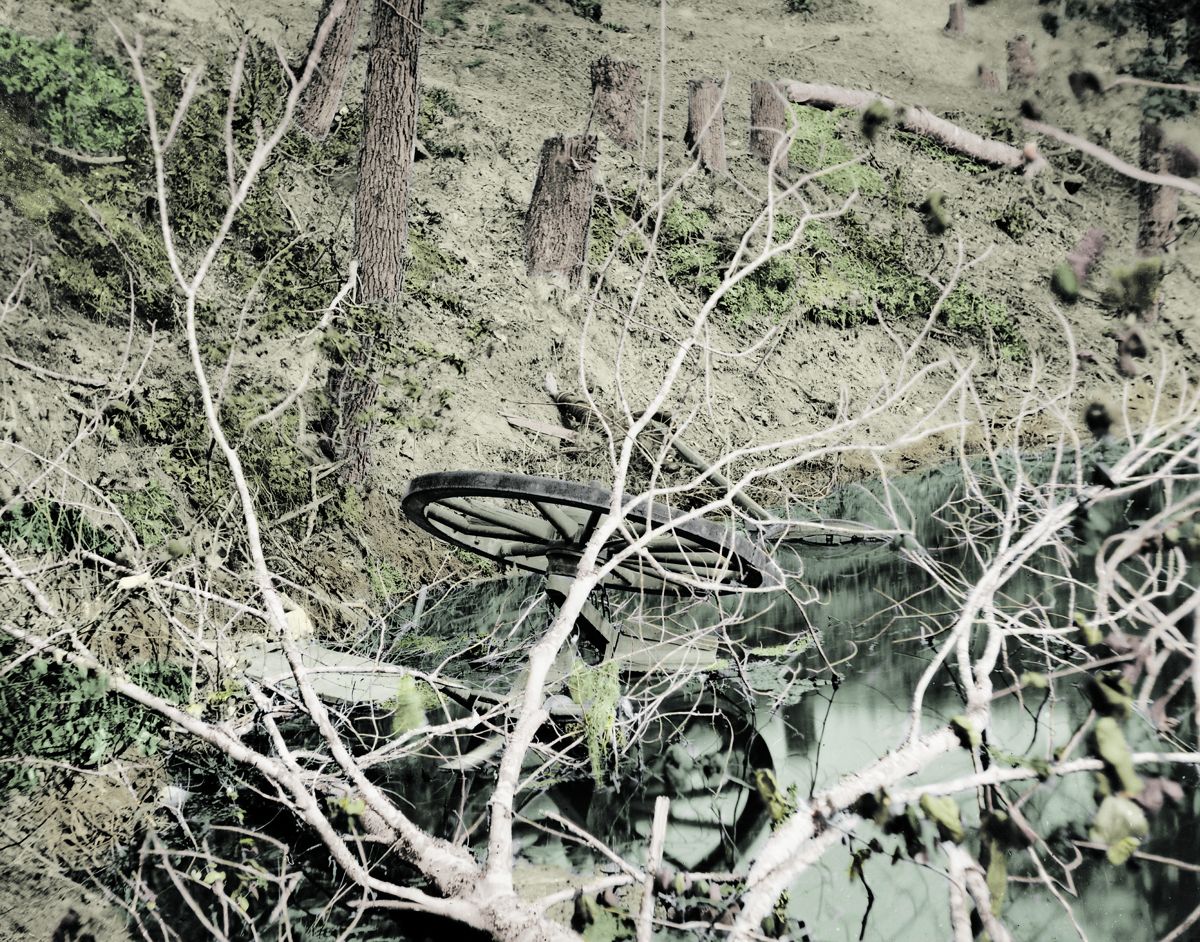
“We will lose 5,000 men before we take Vicksburg, and may as well lose them here as anywhere else.” – U.S. Gen. William T. Sherman At the onset of the Battle of Chickasaw Bayou, the first battle of the Vicksburg Campaign, Dec. 26-29, 1862, the Midwesterners of U.S. Gen. William T. Sherman’s Army of the Tennessee were in “good spirits and keen to start at any time.” They were intrigued by the strange land that combined “low boggy ground, with innumerable bayous or deep sloughs” with a dense undergrowth of woods covered in Spanish moss. None grasped that the terrain would be an adversary as formidable as the Confederates. Furthermore, Sherman did not realize that C.S. Gen. Stephen D. Lee not only knew of their “surprise” attack but had already determined the Federal’s five probable approaches and created an effective defensive plan. At Johnson’s plantation, Lee’s Louisianans withstood 20-pdr. Parrot shells fired by Wisconsin cannoneers of U.S. Gen. Morgan L. Smith’s Brigade, stalling the advance. At the same time, U.S. Gen. Frederick Steele’s Division marched to the left of Chickasaw Bayou. When Confederate infantry blocked their route, Steele ordered the 2nd Mo. Light Artillery to clear the way. The 1st Miss. Light Artillery with five pieces held firm but to conserve ammunition began to slacken their fire. Believing the enemy’s guns were disabled, Steele ordered a charge into a narrow lane ahead. Confederate artillery fired into the dense target and the blue coats dove for cover. Steele called off the charge while bringing in more guns. The increased firepower turned the tables on the Confederates but Steele was unable to punch past his foe. Back downstream to Johnson’s plantation went Steele.
Smith, ordered to cross the bayou, rode ahead to scout the way. The 53rd Ill. warned him that the enemy’s sharpshooters were active. Smith made his way to the bayou and looked through his field glass. He was shot through the hip with the bullet lodging near his spine. Smith, “coolly put up the glass and turned his horse around and rode back to the rear.” Pale, with blood dripping down his stirrups, Smith would not leave the field before shouting, “Boys give them h—l!” The attack proceeded with David Stuart taking command. The Chicago Light Artillery fired their 20-pdr Parrott guns. The 53rd Ill. skirmishers became “expert in seeking cover among themselves with the moss hanging everywhere from the limbs for further disguise.” A group of Confederate sharpshooters left their breastworks via a gully to get closer to the 83rd Ind. Six Federals countered by crossing to a large log with an excellent vantage point. The Hoosier’s first volley resulted in the Confederates scrambling (Library of Congress)
back like “frightened turkeys.” Despite the valiant effort of their brethren, the 54th Ohio suffered severe casualties clearing abatis that blocked the way. U.S. Gen. George W. Morgan noticed that the rebels were not guarding the position before him due to the width and depth of the water. Capt. W.F. Patterson’s engineers began building a pontoon bridge during the night. Later, it was discovered that the bridge was being constructed over the wrong bayou; the effort was delayed. Daybreak revealed the new construction over the correct stream to the rebel scouts. The enemy fired upon the builders; the Federals rushed to fire back. Sherman decided that on Dec. 29, he would break the stalemate by overwhelming the Confederates with his full force. Steele’s Division would cross over the single corduroy bridge on the left; Morgan’s men would use the yet to be finished pontoon bridge in the center, with U.S. Gen. A.J. Smith’s force on the right. Morgan would be in command of the entire operation. Both sides spent the morning firing their weapons and moving units about. As Morgan waited beside U.S. Capt. Jacob T. Foster’s 1st Wisc. Battery, he spotted movement on a fortified hill about a mile away. Morgan saw through his glass “a caisson, with gunners [seated] on the ammunition boxes and a few horsemen in front. I asked Foster if he could blow up that caisson. He replied, ‘I can try, sir.’” Foster fired when the caisson came within range. “The report of the gun and the explosion of the caisson seemed instantaneous; caisson and gunners were blown in the air; every man and horse was killed, and a shout went up from Foster and his battery.” About 11 a.m. Sherman decided to commence the attack. In later years the circumstances would be disputed. Just before noon Morgan’s artillery began a sustained fire as Smith’s skirmishers moved forward in pairs, widening the narrow path under fire. Spotting what he thought was an alternative path to the top of the bluff, Smith had his men wade to a sandbar mid-bayou, fling themselves behind some willow trees, and then make the last dash to the south bank. Alas, the “rebels held their rifles outside the parapet vertically in order to fire down on the Missourians, who used their hands to claw out hollows in the side of the bank in which to shelter.” In the center, Col. David Lindsey, 2nd Brigade, fired every weapon in his command to allow the engineers to finish the pontoon bridge. Nevertheless, the Confederate fire prevented the Federals from completing the last 20 yards. The blue coats, unable to see their foe, continued firing towards the white puffs of smoke on the other side. On the left, U.S. Gen. Frank Blair (brother of PostmasterGeneral Montgomery) and Col. John F. De Courcy’s brigades advanced towards the bluff. De Courcy had responded to the order by gasping, “My poor brigade!” The men immediately came under heavy fire, moved through a “nearly impassible abatis,” struggled through the underbrush to emerge on the bank of the bayou and the first line of Confederate entrenchments. The attack turned into a swarm of men, “every man for himself,” then transformed into “a terrible slaughter … too gruesome to be described, much less understood.” The men who could, retreated. According to Sgt. J.E. Leasure, 16th Ohio, “It was a desperate race, and I know it did not take me as long to get back as it did forward.” Others hunkered down until dusk. Sherman contemplated transporting the men to a different landing spot on the river. However, he had noticed watermarks on the trees “ten and twelve feet above their roots.” With the oncoming rain, Sherman knew it was time to retreat. He would later describe the area as “the strongest place I ever saw, both by nature and by art.” As Leasure wrote, “We had bitten off a bigger chunk than we could chaw.” Sources: •
•
•
•
Woodworth, Steven E. Nothing but Victory: The Army of the Tennessee, 1861– 1865: Knopf, 2005. McDonough, James Lee. William Tecumseh Sherman: In the Service of My Country: W. W. Norton & Company, 2016. Morgan, George W., “The Assault on Chickasaw Bluffs,” Battles and Leaders of the Civil War, Vol. III, Century Company, 1887. Leasure, “Chickasaw Bluffs,” National Tribune, December 25, 1884, p. 3.
Stephanie Hagiwara is the editor for Civil War in Color.com and Civil War in 3D.com. She also writes a column for History in Full Color. com that covers stories of photographs of historical interest from the 1850’s to the present. Her articles can be found on Facebook, Tumblr and Pinterest.