
The Letter
By David J. Rutledge · Originally published December 2020 · pp. 32–34
In 1978, my mother returned from Charleston with a white shoe box tied with a string. On the cover, two words were written in large letters: “FOR DAVID.” Having found it in a closet in my Uncle Johnny’s house, my mother said, “This is for you.” Later, when I opened it, I found many letters, photographs, obituaries, battle plans, and other documents written during the Civil War. When I looked at the handwriting, it appeared to be that of my great grandfather, Robert Flavel Jenkins, who died in 1936, long before I was born. I then realized that these papers had been intended not for me, but for my grandfather, for whom I was named. Many letters in the box were written by Robert’s father, Micah Jenkins, who commanded a South Carolina Confederate regiment, largely from the upstate. These letters to his beloved wife, Caroline Jamison Jenkins, are not ordinary ones. The salutations begin with: “My own darling,” “My dearest one,” and “My own precious wife.” They speak of battles, of hope, of despair, and of a relationship of two people deeply in love. Micah John Jenkins, “Prince of Edisto,” was born at Old Oak Plantation on Edisto Island, S.C., Dec. 1, 1835, the youngest son of Captain John Jenkins (1794– 1854) and his wife Elizabeth Grimball Clark (1803–1864). When he was fifteen, he entered the Citadel and graduated first in his class in 1854. The next year, then nineteen years old, Micah visited the Head of the Board of Visitors of the Citadel, General David Flavel Jamison (1810–1864), who lived in Orangeburg, S.C. He came to discuss with General Jamison his plans for opening a military academy for young boys in the upstate. There, the handsome young Micah Jenkins met Caroline Harper Jamison (1837–1902), the exquisitely beautiful daughter of the general. At first, D.F. Jamison did not trust Micah and warned him about trifling with his daughter. But this match proved successful, and on July 3, 1856, after a courtship of over a year, Micah and Caroline were married before the rising sun by the Reverend Benjamin Morgan Palmer (1818–1902) in the little Presbyterian Church of Orangeburg. The young couple moved to Yorkville, S.C., where Micah, with the help of his good friend Asbury Coward (1835–1925), built a large building with two wings. Micah and Asbury, friends from the Citadel, at the age of twenty established the King’s Mountain Military School, which was designed to prepare boys for the rigors of the Arsenal Academy in Columbia, and the Citadel in Charleston. King’s Mountain Military School grew rapidly, and by 1860, was one of the largest preparatory schools
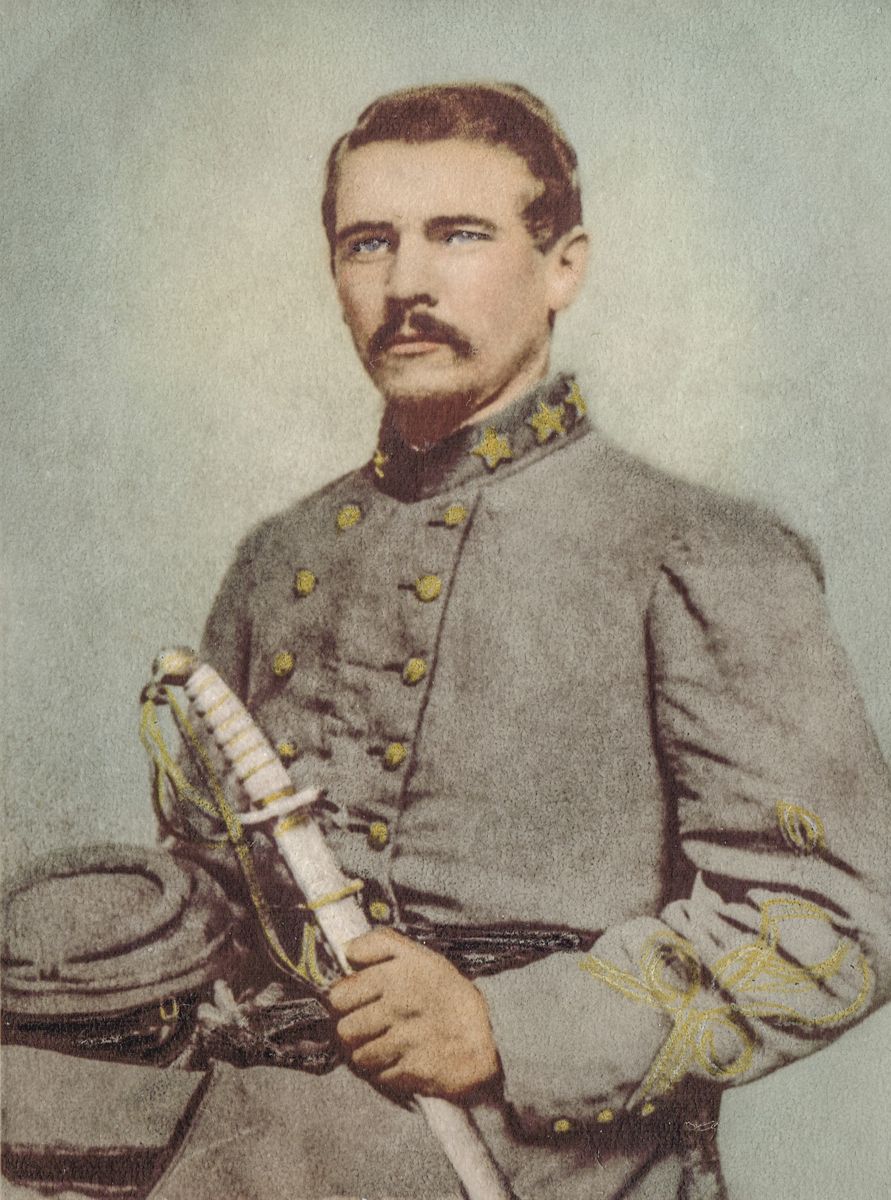
Micah Jenkins. in the state. The Jenkins family grew rapidly too. In 1857, Micah Jenkins Jr. was born; in 1858, my great grandfather, Robert arrived. In 1859, William, and then in 1861, Whitmarsh was born, followed by the youngest, John in 1863. By 1860, the clouds of secession gathered over South Carolina. When Abraham Lincoln was elected president, South Carolina reacted. In December 1860, a convention of the people of South Carolina elected D.F. Jamison, Caroline’s father, as the President of the Secession Convention. South Carolina was the first state to secede. On April 15, 1861, D.F. Jamison, who prepared the fortifications of Charleston Harbor as “Secretary of War for the Palmetto Republic,” wrote to his daughter, Caroline, his description of the bombardment of that fort: “…Dear Me!” “What a week this last has been,” Jamison wrote, “just after breakfast while the cannoning was going on both sides, Fort Sumter took fire from the shell and shot—that was thrown on her, and soon the whole fort was enveloped in a dense smoke which concealed all but the lower outlines of the building…Amid the smoke and the burning barracks, could be seen the flame from the guns of the beleaguered fortress, followed with the heavy booming of the cannons. Not long after the fire gained ground, the fire from Fort Sumter ceased, and not a sign of life was to be seen about the fort for some five hours. When the flag staff was shot down by a gun from Fort Moultrie, for some moments it was hoped that it would not be raised again, but it was soon replaced on a stronger staff. Then the firing on our side was redoubled, in about twenty minutes, a white flag was very slowly raised up by the side of the other, but in a moment the United States flag was removed and a white left standing alone. We sent over an officer to inquire of the meaning, and it ended in capitulation which was carried out today. I went over with the governor, Gen. Beauregard, and some to witness [the surrender]….” At the time of the bombardment, Caroline and her children were staying at Burwood, her parent’s home in Barnwell District of South Carolina. Her mother, Elizabeth Anne Carmichael Rumph Jamison (1814–1888) later wrote a different recollection of that battle: “My daughters and I were not far from the Edisto, and that river transmitted the sound of each gun as it was fired to us. That was our first experience in the war. We, of course were very anxious the next day to hear the result and to know what had occurred ….. We did not know for some days that our friends had not been in danger then at all.
Then followed, volunteering. My son-in law, Micah Jenkins and my oldest son David were amongst the first of the volunteers. Then came forming of companies, and the election of officers—then the hurrying off of the volunteer companies to Virginia. The making ready and waiting for the battles to come off was tiresome indeed, but had to be borne weary as it was. The following summer we waited in much suspense for what we then knew must come, — WAR IN ALL OF ITS HORRORS!” Micah Jenkins enlisted in the Confederate Army in May 1861, as a colonel. Shortly after the Battle of Frayser’s Farm in 1862, he was promoted to brigadier general. At the age of twenty-six, he was one of the youngest men to hold that rank. His regiment became known as the Palmetto Sharpshooters. Formed from South Carolina’s Fifth Regiment, the men were from the upstate counties. They fought from the beginning of the war until its bitter end, from First Manassas to Appomattox. With Jenkins as their commander, they saw action at Williamsburg, Second Manassas, Seven Pines, Fredericksburg, Chickamauga, Lookout Valley, Knoxville, and the Second Battle of the Wilderness, among many others. During the war, the women supported their efforts. In South Carolina during that conflict the fashion was economy. The song “The Homespun Dress Southern Ladies Wore” with the words: “my hat is palmetto, my dress is homespun too…” described the harsh reality of this time. Food of all kinds was scarce; it was carefully guarded and sent to the soldiers when possible. Clothing was also in short supply. By 1864, Confederate money had inflated to such an extent that one person said, “One carries their money in a basket and their purchases in a purse.” Regarding the home front, Elizabeth Jamison wrote about what was life was like for the women at Burwood. “We who had to stay at home and wait for news from the army had many times heavy hearts. But there was much for the mothers and mistresses on our southern plantations to do. And, it was astonishing how much was accomplished too. They learned to manufacture homespun, Some of them made it nice and pretty. I had a warping bars and a loom made. And took lessons in weaving from a neighbor that I might teach one of our women to weave cloth for the use of the plantation. …The prices and scarcity of wearing apparel and groceries had become so great, that my husband sent some cotton bales through the blockading fleet to Nassau and had the cotton exchanged for groceries and dry goods. Our stockings, socks, and gloves, we knitted from homespun cotton yarn…” Caroline Jenkins wrote the following concerning the difficulty she had clothing her four little boys: “Alas my boys are growing so rapidly that the clothes problem has become acute. The younger children can wear the older boy’s hand-me downs which works out well enough with a little sharing and mending, but what about my eldest boy? I tremble when I think of approaching him with the suggestion that I make him trousers from an old dress. His last pair of trousers went yesterday, and alas, they completely collapsed, without a hope of repair. I discovered an old trunk behind some abandoned farm implements in the barn. I opened it to find several old dresses belonging to past generations, a package of needles, rusty to be sure, but rust can be removed, and they will be good as new— think of it: A whole package of needles. I can hardly believe my good fortune, but best of all there was a man’s overcoat of woolen material that can be remade into coats and trousers for the boys… I cannot help but feel that benign Providence is watching over us.” Substitutes for basic items also became the standard in South Carolina during the war. Coffee was almost unheard of. “I was on the porch this morning, Caroline Jenkins wrote, “when Mr. Isaac Deveraux passed by looking very sad and worn… He is so absent minded. I doubt that he realizes it though. I invited him in for breakfast and was sorry I did for as he drank his coffee, he murmured: “Slops Maria, slops.” (Coffee made of sweet potatoes and groundnuts may not be the best but it’s our best!) I said: “What did you say, Mr. Deveraux?” And he answered: “Sorry my dear, I thought I was talking to my wife.” Then Caroline commented: “His wife has been dead for thirteen years. Poor soul, she’s better off rather than living with a man who after all that time is still complaining about her cooking.” As the war progressed, stressful as life had become on the home front, the hearts of the women were turned to the battlefields, where their men were fighting. “During this time,” Elizabeth Jamison said, “the battles were more and more bloody. Those were times sadly to be remembered, so full were they of anxiety for those who were going through those bloody battles. We heard constantly of friends who were killed. Of others being wounded, and great and anxious fears filled the hearts of those at home…Desirous of news, yet fearful of its import, only a full reliance on the tender mercy of God could sustain the soul and calm the mind in times of peril such as those.” Caroline’s experiences were similar. “Each day we went to view the bulletin of the dead and wounded. …. One morning I went with Lydia, and we were merry all the way. Suddenly, we found ourselves laughing in the mist of great silence. We looked at the list. At the top was the name of Lydia’s only brother.” In truth, Caroline, with Micah away, had very hard time. She had to make day to day decisions alone for the family to provide food, clothing and shelter for her growing boys. At one point, while Micah was as at the front, the merchants pressed her for money. He wrote to her concerning the local vendors: “Will they take Confederate money for debts. If so let me know at once and what you think about it.” Caroline tried not to let her despair reach her husband. “It was difficult to write cheerful letters,” she said, “when there was so little that is cheerful to recount. We knew our forts are threatened, and that they may even fall….There was so little food, and we had almost nothing in the way of clothing. But there was still firewood, and inside the house, it was still warm and cheerful.” Micah Jenkins’ duties took him away from his wife and little boys. In September 1863, when he was in Tennessee, hundreds of miles from home, he received the news that Whitmarsh, his youngest child had died from disease. Micah could do nothing to console his wife, except compose one of the most difficult letters he ever had to write: “Here amid the rack of arms, I have learned…that God has taken from us our beloved child, little Wittie. It fills my heart with sadness, and I feel most hard for you my own darling. Let us look to Him for comfort. He has taken our baby to heaven, and in Christ I give him. Ah, how hard and cruel is this war that even in such troubles I cannot be with you to comfort and console you.” The next year, 1864, would bring greater loss to the family, and they would be tested to their very core. In March 1864, Micah Jenkins came home to attend the funeral of his mother and to visit his family. My great grandfather, Robert Flavel Jenkins Sr., Micah’s son, remembered this visit in his later years. Robbie, who was five years old at the time, saved his brother from falling from a second story balcony. His father took him up in his arms and praised his son for this act of courage. Micah put Robbie on his great warhorse Latta and rode with his little boy for the last time. This would be one of the few memories Robert would have of his father. At the train station, Micah Jenkins looked at his friends and family and declared that “he was going to fight his last battle.” He then disappeared into the mist created by the steam of the locomotive. Elizabeth Jamison summed up Micah Jenkins’ career as follows: “My son-in-law had been wounded again and again, though not seriously injured. He was struck in his breast, the ball was turned from some cause, passed across to his arm and was extracted near his elbow. Chance played some curious freaks in the manner in which he was so often struck in battle. In the First Battle of
Bull Run his stirrup was struck of [sic, off ] his foot. In another fight he was struck in his knee by a spent ball, but not seriously hurt. At Chickamauga, a piece of shell cut into the bridge of his nose—an eighth of an inch more—sight would have been destroyed. At the battle of the Wilderness, the ball penetrated his brain, and a true hearted man, a real Christian soldier, a loving husband and father was taken to the “many mansions,” where no doubt the warm hearted one now waits to welcome the loved ones he had to leave here to struggle through many weary years. He passed away May 6, 1864.” On that date in the wilderness surrounding Spotsylvania and Orange Counties in Central Virginia, Micah, sick from typhoid fever, rode to the field in an ambulance. He was determined to mount his horse and lead his men into battle. When he exited the ambulance, he threw his arms around Moxley Sorrel, Longstreet’s staff officer and said, “We will smash them now.” Jenkins’ men were wearing new dark gray uniforms that appeared blue in the dim light of the Virginia wilderness. As Lieutenant General James Longstreet, Major General Joseph Kershaw, and Brigadier General Micah Jenkins were riding on the Orange Plank Road, Jenkins turned to Longstreet and said, “I am happy. I have felt despair for the cause for some months, but I am relieved now, and feel assured that we will put the enemy back across the Rapidan before night.” Moving down the road,
Confederate soldiers under the command of General William Mahone, who were positioned in the woods, mistook the dark uniforms of the three officers and their staff for Federal troops as the generals approached. Mahone’s men started firing. According to one witness, Jenkins rose in his stirrups and shouted: “Steady men! For God’s sake, steady.” It was too late; Longstreet and Jenkins were hit, along with two other men of Kershaw’s staff who were killed instantly. Seeing Jenkins fall from his horse, his men on the Orange Plank Road immediately faced to the right, cocked their rifles, and were about to return the fire. General Kershaw, realizing what was about to happen, screamed out to the Confederate infantry, “F-r-i-e-n-d-s!.” Jenkins’ men then lowered their rifles as Mahone’s troops, realizing their horrible mistake came running out the woods voicing their regret and to trying to help. Ironically, this happened very close to the spot and in the same manner where General Thomas “Stonewall” Jackson was mortally wounded the year before. As in Jackson’s case, there was little that could be done. Longstreet was on the ground, seriously wounded from a bullet that passed through his neck and into his shoulder. He was removed from the battlefield coughing up blood. Longstreet, though terribly wounded, would survive. Micah Jenkins, however, lay dying from a mortal wound to his forehead, paralyzing him on one side of his body. Still
John Wilson Jamison. conscious, he could not recognize any friends or fellow officers. As he lay there, he continued to call for his men to press forward, obviously thinking he was still leading his brigade into battle. Colonel Asbury Coward, his longtime friend, rushed to Jenkins side, took his hand, and asked: “Mike do you know me?” Coward felt the strong grasp of Micah’s hand as his body convulsed violently. Coward and the other officers in the brigade watched helplessly as Jenkins was gently placed on a litter. Asbury Coward and many of the Palmetto Sharpshooters wept as their young commander was taken to the rear. When Jenkins arrived at the field hospital, he was still alive, although not conscious. His head wound was so serious that those around him realized “professional aid was useless.” He lived for five or six hours, dying that Friday about half an hour before sunset. According to one of his surgeons present, at the moment Micah Jenkins breathed his last, “a bright, happy, trusting smile lit up his face.” The surgeon said, “Those around watched, we thought, we felt he was with his God.” His body was washed, and he was dressed in his finest uniform. The next day the news of Jenkins’ death reached South Carolina. Caroline Jenkins and her children were at Burwood. As was the custom for many trains, when there was bad news, the whistle sounded with long sonorous groans. On that day, Caroline and her family heard the wail of the train, heralding bad news. Caroline, her mother, and her children rushed to nearby Midway station and waited in their carriage. Her father stepped off the train. Seeing his daughter, the grim faced Jamison grasped his daughter’s hand and told her that Micah had been killed. She had been married just short of eight years, and the children, because of his absence in the war, barely knew their father. Micah’s body was brought back to South Carolina, accompanied by Caroline’s brother John Wilson Jamison (1839– 1887). His body first lay in state at the Arsenal Military Academy in Columbia, and then was removed to Summerville, S.C. The following article from the Charleston Courier, recounts his funeral: “The remains of the lamented General Micah Jenkins were interred in Summerville in the graveyard of the Episcopal Church of that place where his mother was buried. The body arrived at Summerville a quarter past three o’clock under the escort of the cadets of the Arsenal Academy in Columbia. The coffin with a Confederate flag laid upon it was placed upon a carriage, and a procession was formed from all of the inhabitants of the village and the convalescent solders in the hospital that were able to attend. Before the procession began the ladies of the village brought in beautiful wreaths and numerous bouquets of flowers and strewed them with profusion upon the coffin. The coffin was followed by several members of the deceased’s family, including his widow, his father in law, General D.F. Jamison, Major John Jenkins and Dr. Edward Jenkins [his brothers]. Upon the arrival of the remains at the village and during the passing of the processions, the church bells were tolled and every expression of grief and sympathy was exhibited by the inhabitants of the village. The ladies present at the interment bedecked the grave with flowers and gave vent to their heartfelt sorrow in the tears which were freely shared of over the mortal remains of the departed hero…” In the 1880’s, Micah Jenkins’ remains and those of his mother were moved from the little cemetery of St. Paul’s Episcopal Church in Summerville, and were reinterred in Magnolia Cemetery in Charleston. Micah was twenty-eight when he died, and he left his twenty-six year old widow to raise their four children alone. Caroline never remarried. In the box, I found the following prophetic letter Micah wrote to Caroline. Written before the 1862 Battle of Frayser’s Farm in Virginia, it best expresses his hopes and concerns for the future of his family and his despair over being separated from them: “Hdqers. ‘Palmetto Sharpshooters’ Near Richmond, May 28th, 1862 My Beloved Wife: I got a letter, five days old from you today, and was happy to hear from you again. I am now in the hands of my God, wife, and I entrust you and my dear children to his fatherly keeping. The great battle is very, very, near I think. I trust our prayers may be favorably considered by our God and that His hand will cover and protect me, so that when this unhappy war is over, I may live to be a husband to you and to my children a father. If it please God to take me away, this early in life, bid my children when they grow old enough to understand, to be good and true men, doing their duty to you, to their country, and their God. Guard and guide them as if I were with you, and be to me a true wife till God unites us in heaven. It saddens me to think of how strained your circumstances may be, but with good management and economy, which I know you will practice. I hope you will have enough to live comfortably on and to educate our children with. Brother John and Brother Edward will act a brother’s part to my family I know….[T]hough I may fall, yet I hope a blessed peace will soon give back to our country the comfort and prosperity so much to be desired. My dear wife, I need not tell you that you are my best and only loved, and that my entire, confiding, trusting warm loving heart is yours, fully and truly.