
Through The Lens
Slow Pete The Knoxville Campaign – Part II
By Stephanie Hagiwara · Originally published December 2020 · pp. 20–21
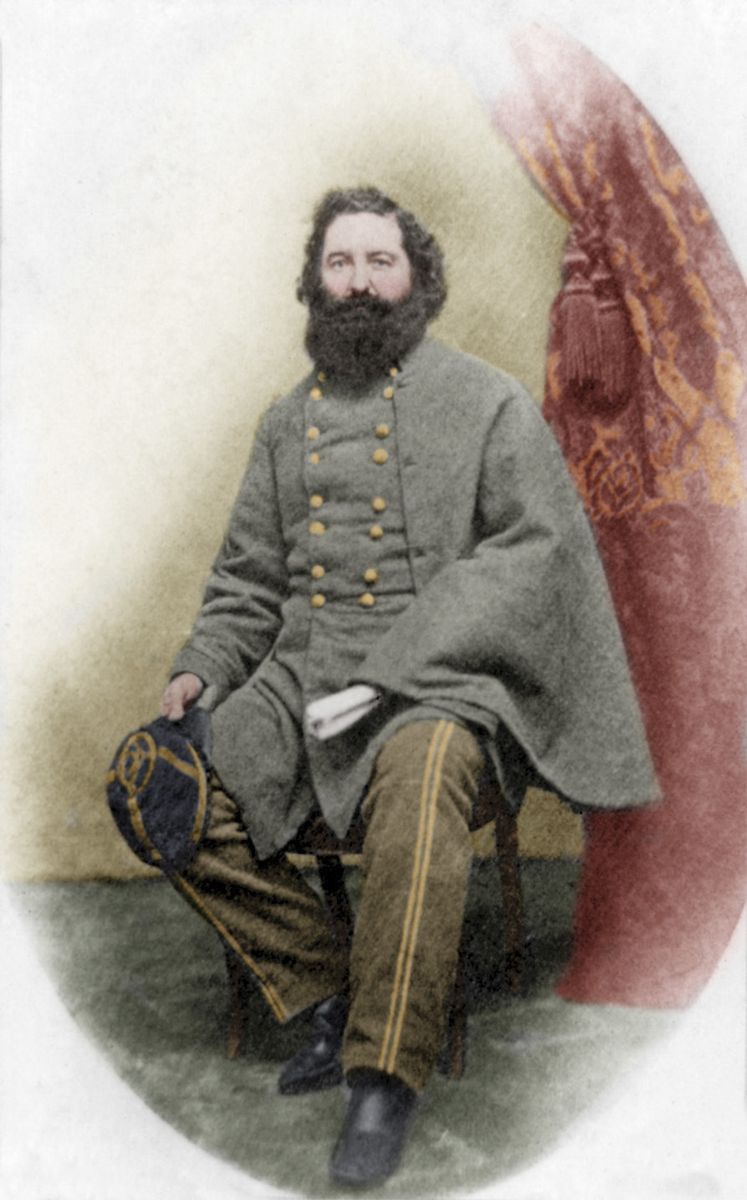
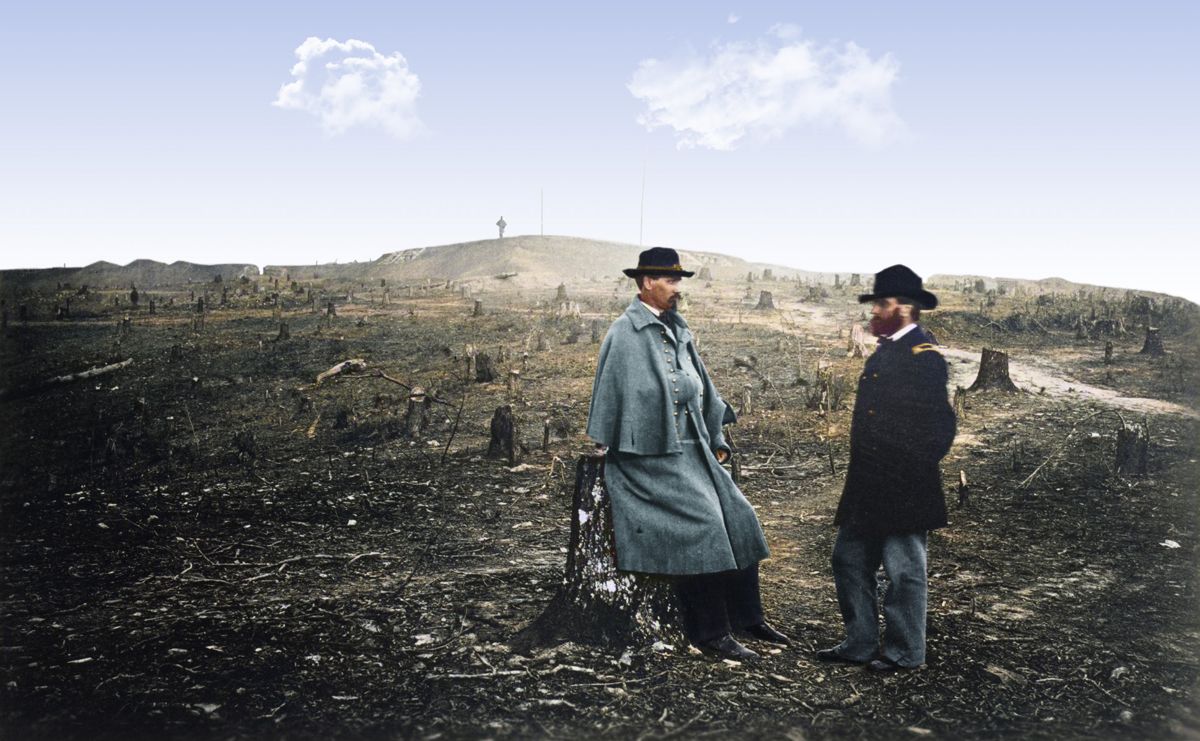
“Every day of delay added to the strength of the enemy’s breastworks” – C.S. Col. Edward Porter Alexander After the November 16, 1863, Battle of Campbell’s Station, Tenn., U.S. Gen. Ambrose Burnside’s Army of the Ohio retreated sixteen miles to Knoxville. The battle was part of a plan to distract C.S. Gen. James “Old Pete” Longstreet while Ulysses S. Grant, in Nashville, prepared for the Battle of Missionary Ridge, Tenn. U.S. Chief Engineer Capt. Orlando Poe was swiftly building Knoxville’s defenses but needed more time. Poe had teamed up with his West Point classmate and close friend, recently promoted Gen. William P. Sanders in coming up with aggressive cavalry tactics. Burnside would affectionally call the pair “hotheads.” On Nov. 17, Poe told Burnside he needed until noon on Nov. 18 to finish his defensive preparations. “The citizens of the town and all contrabands within reach were pressed into service and relieved the almost exhausted soldiers, who had no rest for more than a hundred hours,” to complete the defenses. At daylight on Nov. 18, Sanders’s 600 men moved out one mile from Knoxville’s outskirts to delay the Confederate approach. The shooting began about 10 a.m. as the fog lifted. C.S. Gen. Lafayette McLaws Division infantry “opened a vigorous fire with musketry, which was returned with equal vigor.” The severe skirmishing lasted until noon, “and then for an hour or more the firing nearly ceased, and the two lines lay there watching each other.” Instead of withdrawing, Sanders held the line to give Poe more time to “complete the defenses of the city.” The Confederates moved up four pieces of artillery and opened fire at 1:30 p.m. For two hours the Federals were pinned down, helpless under Rebel fire. At 3:30 p.m. the Confederates repeatedly charged and were repulsed. C.S. Col. Edward Porter Alexander, Sanders’s West Point roommate, installed sharpshooters inside the brick Armstrong home’s tower. During the fight Sanders rallied his men by walking the fence line, exposing himself to the enemy’s fire. About 4 p.m., from the tower came the shot that mortally wounded Sanders. The Federal line collapsed; Sanders was carried to the Lamar House, where he died in the bridal suite. Both sides had supply issues as the “Siege of Knoxville” began. The Federals were inadequately supplied by a single wagon trail through Cumberland Gap. The Confederates began the Knoxville Campaign on short rations. They scoured the countryside for food, “swapped” shoes with Federal POWs and, for their animals, salvaged shoes from dead horses. Still, Longstreet believed the lack of supplies would oblige the Federals to surrender in two weeks. While Longstreet looked for a chink in the Federal defenses, the Confederates encircled the town and dug in using captured shovels. On Nov. 21, Alexander was ordered to ready 34 cannons to bombard the Union redoubt. On Nov. 24, Longstreet canceled the attack when he learned Generals Bushrod Johnson and Archibald Gracie Jr., with 2,600 men were on route to reinforce him. On the evening of Nov. 25, C.S. Gen. Danville Leadbetter arrived. The engineer had designed the Knoxville defenses when it was under Confederate control. Longstreet and Leadbetter spent two days searching for the weak spot in Knoxville’s defenses. On Nov. 27, Longstreet, Leadbetter, McLaws, Alexander, and other brigade commanders walked the field and turned their attention to a fort named for the fallen general. Fort Sanders “boasted of eight-foot earthen walls fronted with a twelvefoot ditch. A broad stream bed 120 yards away would provide cover for an approaching army.” But the men were uncertain as to the width and depth of the ditch. “As we were looking we saw a soldier mount the parapet to come out across the ditch to the picket line. Longstreet examined & fixed his glasses on him, &, as he walked across the ditch, he said, ‘The ditch catches him to his waist.’” It would later be realized that the man must have crossed on a plank, but it was agreed, Sanders would be the target.
Rain canceled the attack on Nov. 28. Meanwhile, McLaws sent word that “a serious engagement” had happened at Chattanooga, Tenn. McLaws recommended delaying the assault until the outcome became known. Longstreet replied, “… It is a great mistake to suppose that there is any safety for us in going to Virginia if General Bragg has been defeated, for we leave him at the mercy of his victors, and with his army destroyed our own had better be, for we will be not only destroyed, but disgraced. There is neither safety nor honor in any other course than the one I have chosen and ordered.” On Nov. 29, it would be 4,000 Confederates vs. 200 Federals. The Confederates crossed over frozen ground, through rain and snow, then waded the creek to get into position 120 yards from the fort. Protecting Sanders were rifle pits, telegraph wire strung as entanglements, an abatis, and traverses had been built to protect the guns and allow passing from one position to another. Inside the fort, Lt. Samuel Benjamin, 2nd U.S. Artillery, positioned four 20-pounder Parrott rifles, four light 12-pounder smoothbores, and two 3-inch rifles. On the signal, three of McLaws’s brigades led the bayonet charge. Federals firing at point blank range did not slow their advance. Next, the Confederates were falling to the ground, entangled in the wires. Within minutes men were leaping into the 8-foot ditch and being trapped with an almost vertical ice wall rising sixteen feet above them. The 79th New York Highlanders were firing down, “literally tearing the poor fellows limb from limb.” Benjamin had prepared 20-pdr. shells with 20 second fuses that were also tossed into the ditch. Some Rebels climbed the dead bodies to reach the top. “One gallant young officer, Adjutant Cumming, from Augusta, Georgia, leaped through an embrasure and instantly demanded the surrender of fort and garrison. The Union troops cheered the feat while making him a prisoner of war.” According to Benjamin, “The whole affair lasted fully three-quarters of an hour, and the actual fight at the ditch and on the parapet over twenty minutes.” After the battle, when Longstreet received word that Grant won the Battle of Missionary Ridge, he left Knoxville for winter quarters. Longstreet’s soldiers would dub him “Peter the slow.” Inside the fort, one weary Irish prisoner took out his pipe, reached for a light, and said wryly to his captured mates: “Bedad, boys, General Longstreet said we would be in Knoxville for breakfast this morning; and so some of us are!”
Sources: Longstreet, James. From Manassas to Appomattox Memoirs of The Civil War in America. New York: J. B. Lippincott, 1895. • Official Records of the Union and Confederate Armies in the War of the Rebellion, Series 1, Part 1, Vol. XXXI. Pp. 341- 344.
of Time-Life Books. The Fight for Chattanooga: Chickamauga to Missionary Ridge. Alexandria, VA: TimeLife Books, 1985. Todd, William. The Seventyninth Highlanders, New York Volunteers in the War of Rebellion: Press of Brandow, Barton & Co.,