
More on Buckshot
By Larry Babits, Josh Howard, Matt Brenckle · Originally published December 2020 · pp. 22–24
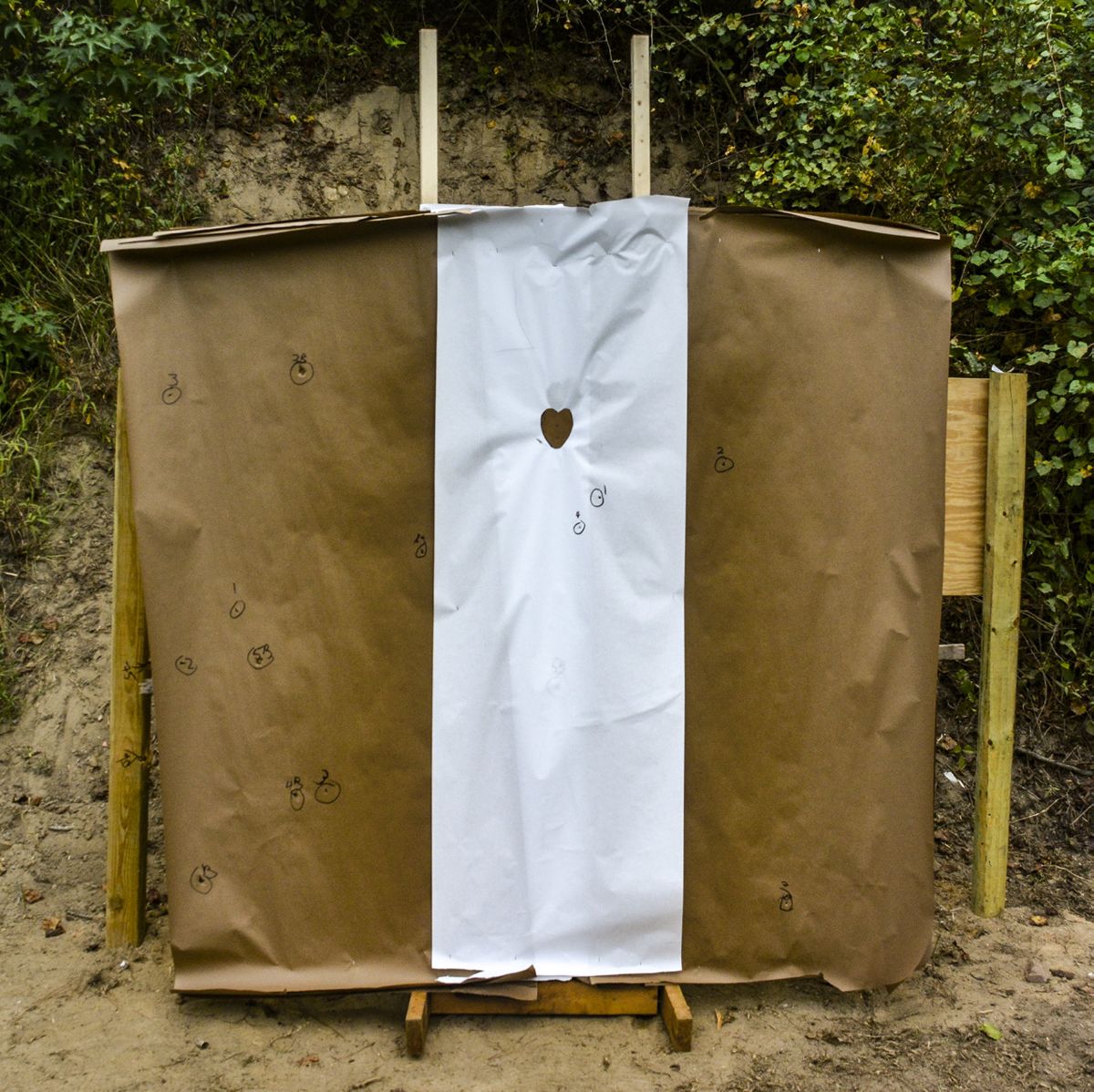
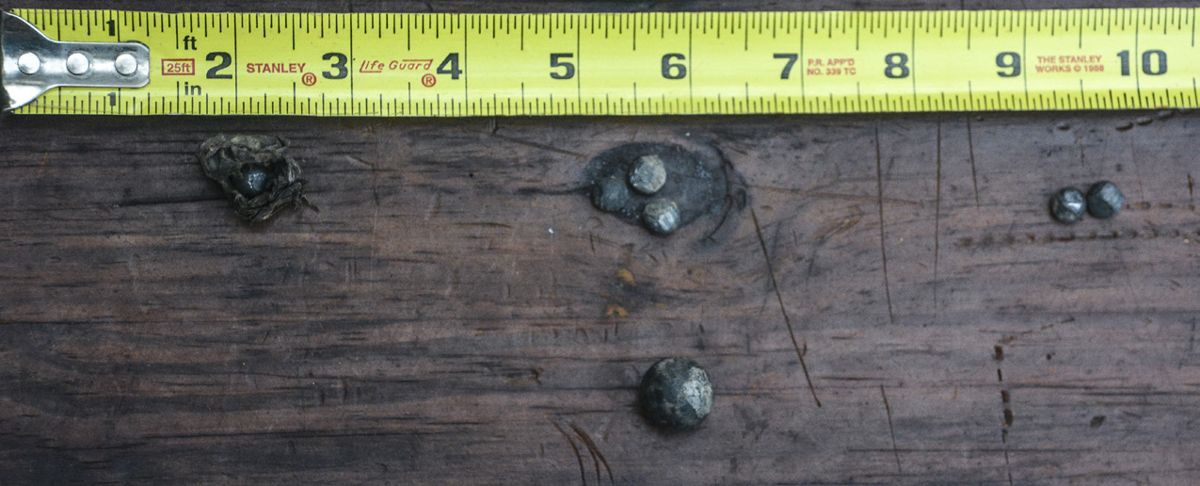
This column follows up on Joe Bilby’s mentioning buck shot at Gettysburg (October CWN) so we decided to provide some additional outstanding details. This article looks at American buckshot use before and during the War. On Gettysburg’s third day, General Pettigrew’s old North Carolina brigade came up against the “inner angle” during the climax of the big charge. Behind the stone wall was Smyth’s Brigade that included the 10th New York, partially armed with .69 smoothbores, and the 12th New Jersey known as the “Buck & Ball Regiment” (Thomas 1981:61; 1997:104). “The regiment was armed with the Springfield smoothbore musket, caliber. 69–a terrible weapon at close range. The usual cartridge carried a large ball and three buckshot, but many of the men, while awaiting the enemy’s advance, had opened their boxes and prepared special cartridges of from ten to twenty-five buckshot alone… I doubt whether anywhere upon that field a more destructive fire was encountered than at the proper time blazed forth from its front” (Potter cited in Thomas 1997:104). The volley struck home when Pettigrew’s men were “within 40 yards,” or “fifty yards from the stone wall,” halfway to the inner angle’s wall (Wragg 2000:181, 196), and a “moan went up from the field, distinctly to be heard amid the roar of the battle, but on they went, too much enveloped in smoke and dust now to permit us to distinguish their lines of movement, for the mass appeared more like a cloud of moving smoke and dust than a column of troops” (Sawyer 1881:131). As Joe pointed out, buckshot has been used for some time. He also noted that multiple loads, including extra and cut musket balls have been as well. Since as early as 1607 when Samuel Champlain fired his arquebus at Iroquois using four balls, shooters have continued to work at ensuring their shot counted. Archaeological finds include Jamestown, Va., where a man was, perhaps, accidentally shot with a bird, buck, and ball load prior to 1620. In 1760, Hugh Waddell’s North Carolina provincial militia helped repel an attack on Fort Dobbs by unleashing a surprise volley with seven buckshot and a round ball at a range inside 30 paces. That’s close range, but it is not all about a close engagement. The most famous Civil War unit using the Model 1842 with buck and ball was the Union’s Irish Brigade. General Thomas Meagher wanted his men to fire at close range and then follow it up with a bayonet charge. At Sharpsburg (I’m taking a Southron focus here), the Irish Brigade fought Confederate regiments armed with rifled muskets. One regiment of the Irish Brigade, the 28th Massachusetts was armed with Enfield Rifles, but the other four still had their .69 caliber smoothbores at Gettysburg (Thomas 1981:60). From the Sunken Lane, the defenders opened up at 50 yards and the Irish Brigade took heavy casualties. At 50 yards, traditional thinking says the Irish were too far away to charge an alert, competent, and unbroken enemy while they were at the effective long range fringe of their own weapons. While the Irish inflicted casualties, they were unable to drive the Confederates away and eventually ran out of ammunition. Their percussion ignited .69 caliber smoothbores might have been marginally more accurate for the big round ball but the light weight, .31 caliber buckshot tended to scatter. On top of that, the Irish were firing downhill and people firing downhill tend to fire over their target. Consequently, much of the Irish buckshot seems to have sailed over Confederates in the Bloody Lane. For whatever reason, a large amount of buckshot, nearly one third of the fired shot found in the Piper Orchard, was buck and ball, presumably from the Irish Brigade (Sterling 2000:339-340). Overshooting might thus be seen as a better reason for the Irish Brigade’s lack of success, but the piles of bodies in the lane say some of their shot hit home, along with that of other units using rifled weapons. Given our received wisdom, the distances here are instructive. Fighting with what was basically an 18th century weapon, the Irish Brigade could not inflict enough casualties to demoralize their opponents. A 50 yard charge against rifled weaponry was not feasible. The Confederates were hurt but not routed. The Irish Brigade ran out of ammunition and had to be relieved. The Confederates also found buck and ball effective as reported by the Third North Carolina’s Colonel William L. DeRosset’s account of the regiment’s engagement with the 11th and 12th Pennsylvania Reserves, who noted our regiment’s “smooth bore muskets with the buck and ball cartridge did most excellent service being at very close quarters not over 100 yards from the first line of Yankees” (Armstrong 2016:74-75). The 11th and 12th Pennsylvania Reserves were facing the Third but their casualty total is a caution on the effectiveness of buck and ball. At Sharpsburg, the Eleventh had 7 killed and 17 wounded while the Twelfth suffered 13 killed and 47 wounded, plus 4 missing (Sypher 1865:392). The Pennsylvanians were in small regiments, about 200 men, and had been steadily worn down with similar losses at Second Manassas and South Mountain (Sypher 1865:357, 374). Engaged multiple times at Sharpsburg, the Third lost 46 killed and 207 wounded of their 547 officers and men (Carman 2012:II:595,607). The Pennsylvania regiments had already engaged the 1st Texas, coincidently with buck and ball (Carman 2012:II:102; Sypher 1865:382), then advanced halfway into the Cornfield, gotten disordered, and when struck one at a time by the Third, fell back (Carman 21012:II:108). The two Union regiments, in the confusion of being enfiladed while their visibility was limited, may have been threatened by the wide frontage the North Carolina regiment presented that exceeded their combined numbers. The Third then drove off the inexperienced 128th Pennsylvania from close range (Carman 2012:II:122,124). This documentary information is pretty interesting but how does buck and ball actually strike home? There is a general feeling that buckshot was not “useful” outside 25-30 yards. We roughly tested some ideas about shooting buck and ball in 2005 comparing the Brown Bess, Charleville, and 1842 smoothbores, firing off hand with one experienced shooter and two with no prior experience firing live ammunition. No wadding was used other than a cleaning patch on top of the buckshot to keep it from rolling out. The round ball went in on top of the powder, then the buckshot.
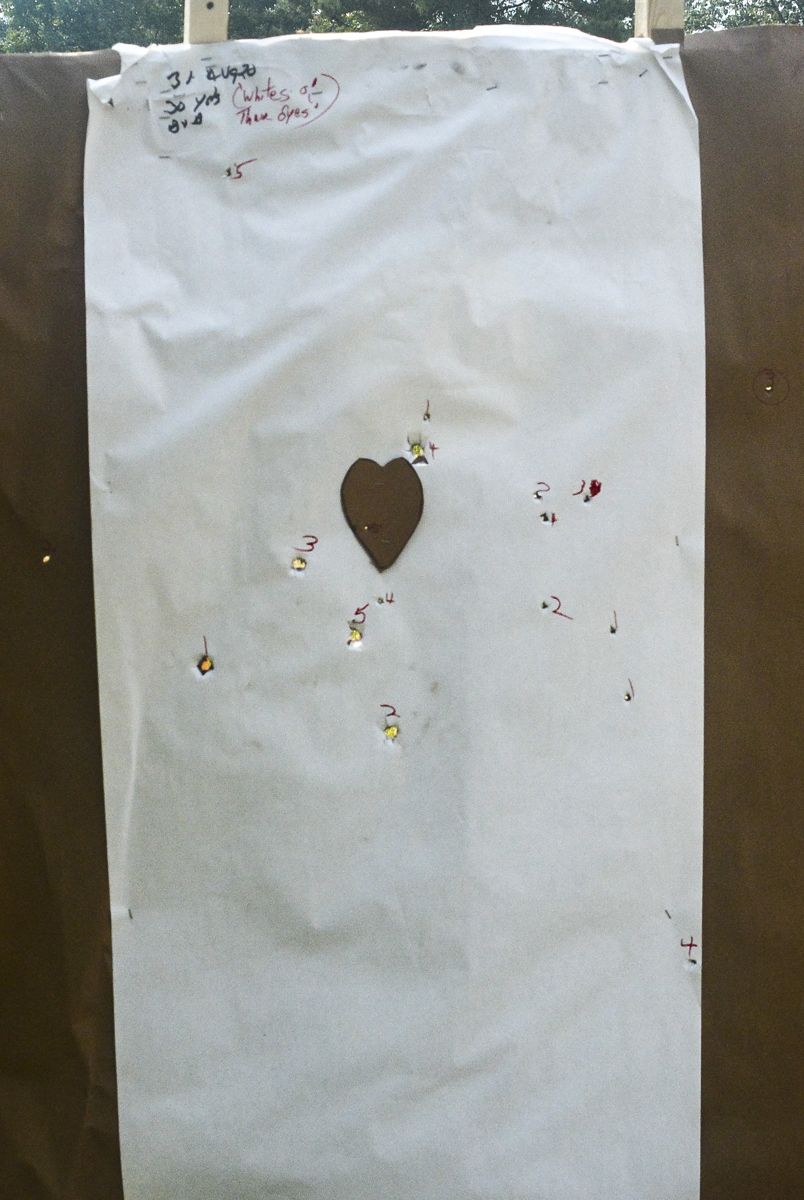
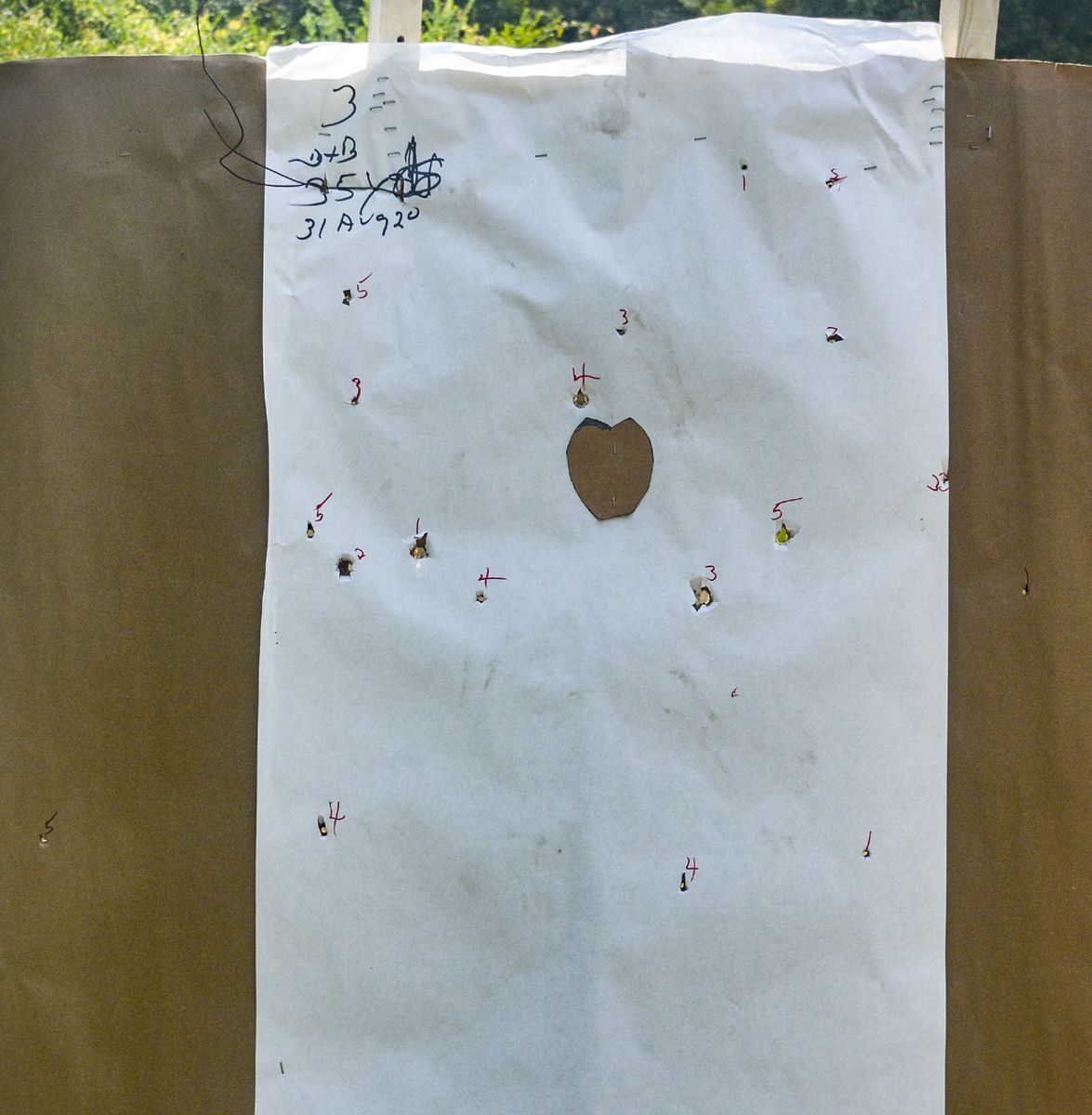
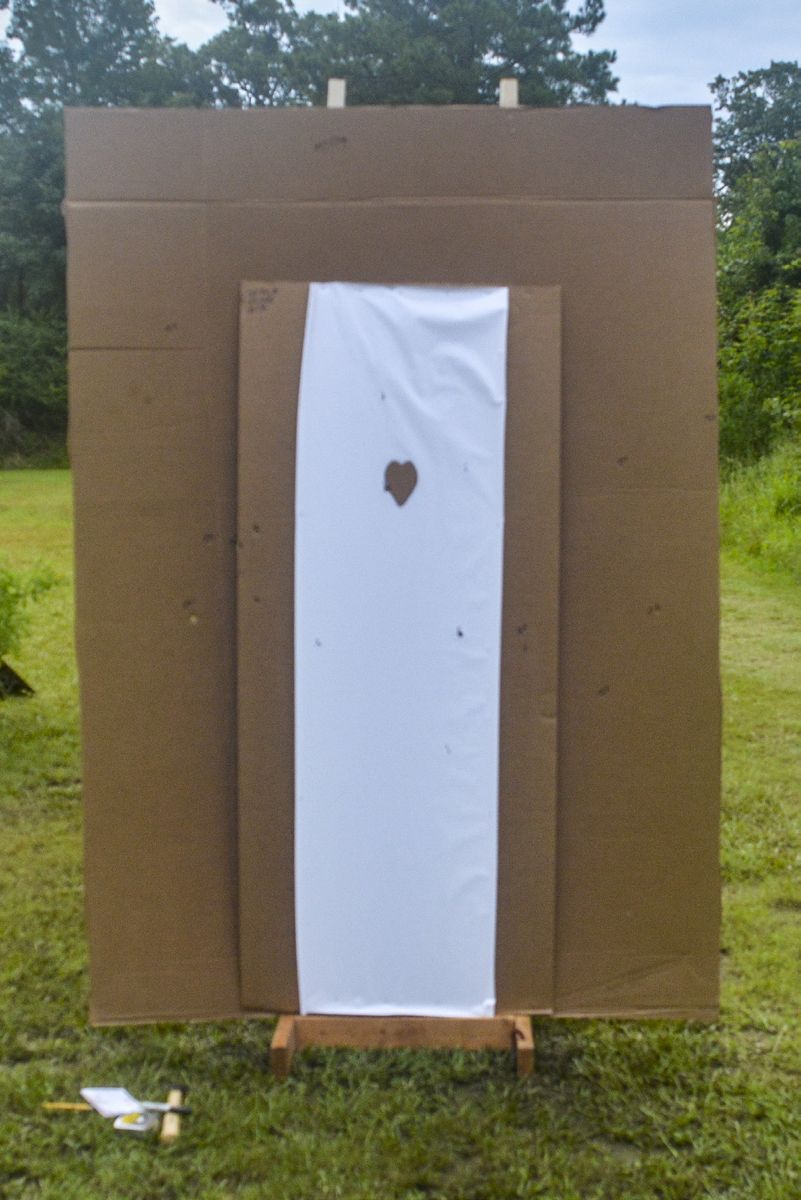
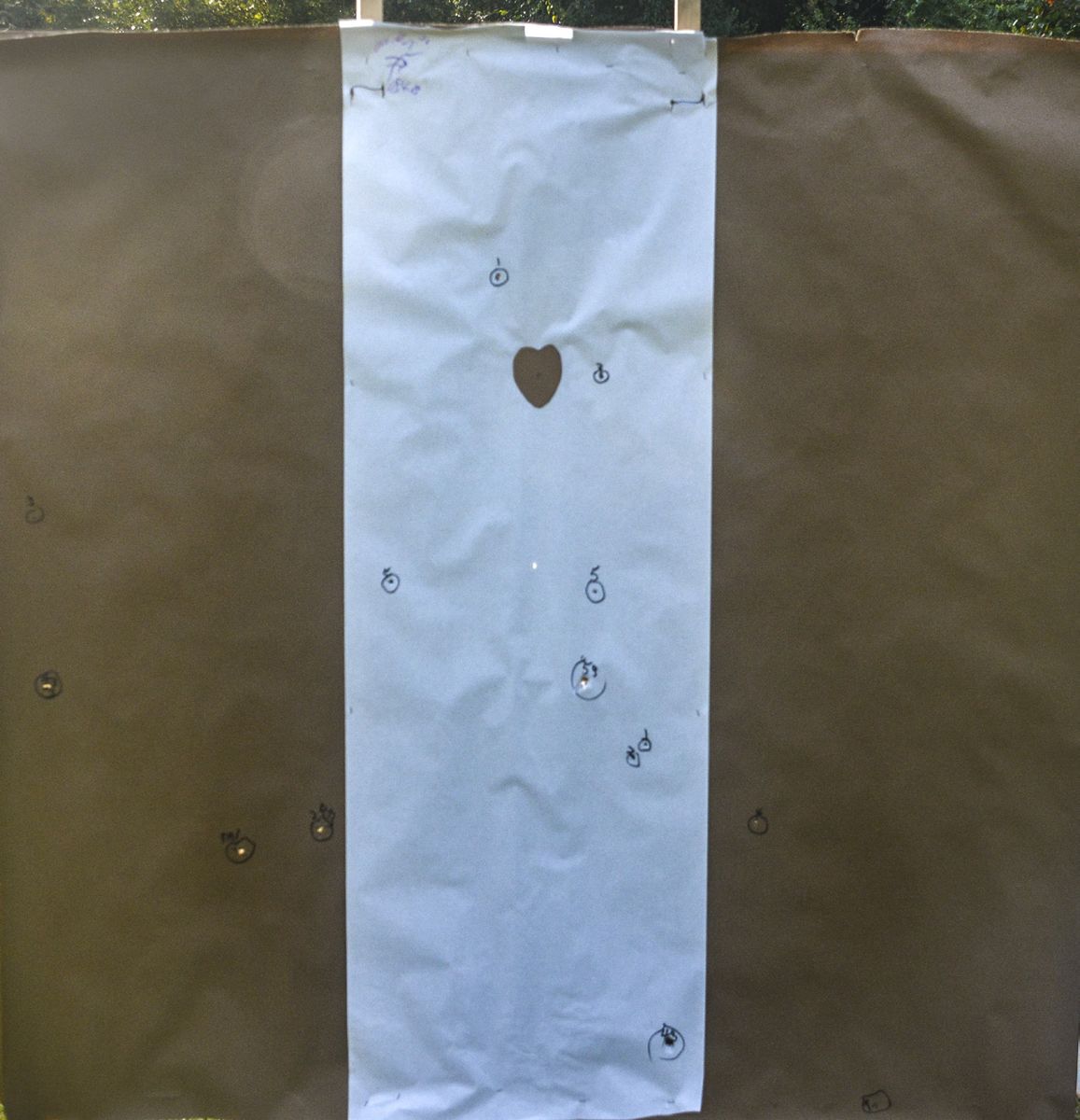
The buckshot was .36 caliber because there is evidence that Revolutionary War Southern militia, especially Marion’s partisans, used larger buckshot, but the ready availability of the .36 caliber shot was a major contributing factor. As expected, there were more hits at the shorter ranges. For comparison with combat against a battle line, these results were somewhat misleading because the target was 20 inches wide by 32 inches high. These measurements were dictated by readily available paper stock and knowledge that a linear infantry formation was calculated at 20-24 inches of frontage per man (Gibbon 1970:54). The vertical distance was seen as the torso’s center of mass. Obviously this early test did not accurately represent a linear formation because any shot deviating from the center line would not be recorded but other men would have been standing to either side. Shot that went lower or flew a bit high could also hit a soldier in ranks. The heavier .36 caliber buckshot also may have flown truer than buckshot more typically used in .69 and .75 caliber weaponry. To correct for deficiencies noted in this firing, a bigger target, standardized cartridges, and longer ranges were used. A reproduction Model 1842 was selected as the weapon because the percussion ignition would not require priming from the cartridge, thus ensuring less variation in the powder charge and a possible lessening of force due to the flintlock’s open touchhole. The buck and ball cartridges were furnished by Jefferson Arsenal (TheJeffersonArsenal@ hotmail.com). 240-409-2566. 2829 Fry Road, Jefferson, MD 21755. They made up cartridges with one .662 round ball and three .311 buckshot. Three buckshot fit in the .69 M1842 (or a Charleville) barrel without unwrapping. In a similar fashion, the larger .30-32 shot fit into a .75 Brown Bess. Having the cartridges made up by one firm ensured some standardization. Five shots were fired at five yard intervals from 15 to 100 yards. The shooter fired from a seated position. Bench shots were chosen to ensure regularity of aiming and less movement during the firing process. The musket was charged with 60 grains, FF powder first, then the round ball, followed by the buckshot without patch but still wrapped in the cartridge paper. The paper may have helped remove some powder fouling. There were actually two targets during the 2020 test firing. The larger brown cardboard was six feet wide, or 3 men shoulder to shoulder, and 6’ 2” feet high. A 23 inch wide white band down the target’s center line represented a single individual in a battle line, allowed better aiming, and showed more clearly where bullets struck. The target stood about three inches off the ground on the target frame footing. Hits were also recorded as “center man hits” by tracing the outline of a 5’ 6” by 24 inch wide soldier centered on the
Table 1 Projectile Hits Range Silhouette Hits 1 shooter 2020 Yards Ball Buckshot 15 5 20 5 25 5 30 5 35 5 40 3 45 4 50 2 55 5 60 2 65 2 70 2 75 2 80 2 85 1 90 1 95 2 100 0 N= 53/90 122/270
Wide Target Hits Narrow Target Hits (includes silhouette) (two shooters in 2005) Ball Buckshot Ball Buckshot Not Fired “ “ “ 85/90 200/270
aiming point (Duane 1810:75). All round balls that did not hit the silhouette would have hit a similar figure to the right or left, as did most buckshot. Some shot that went high between the simulated heads of the front rank individuals would have hit a soldier making ready to fire between the two front rank men but would have missed if the line was not in the make ready or fire positions. Projectiles that did not hit the wider, taller brown cardboard target were counted as flyers. Using the wider, taller target made an important distinction for identifying where buckshot hit. Firing seated also probably improved accuracy but the number of buckshot hits recorded was definitely much higher, despite using the smaller (.31), lighter buckshot. Unexpectedly, the round balls were still striking the silhouette at 100 yards. Comparing the 2005 results with what we learned in 2020 was interesting.
Inferences The larger round ball hit within the central outline of a soldier more than half the time (53/90, 58.8%) and most were in the torso suggesting a debilitating, if not mortal, wound. On the wider target, almost all round balls hit within the zone representing a three man front rank (85/90, 94%). Buckshot that struck the silhouette’s arms or legs, or to either side of the central silhouette, would have generated some wounds that would have severely injured the soldier, especially those in the lower torso or legs. Buckshot that struck the head was capable of penetrating bone and thus badly hurting the victim if damage to the target frame is any indication.
Conclusions Whether the distance between the 12th New Jersey and Pettigrew’s old brigade led by Colonel John Marshall, was 40 or 50 yards is immaterial. At either range, buck and ball is lethally effective. Even at 70 yards, round balls hit the central silhouette outline 40% of the time while the buckshot dropped dramatically to 10%. The wider target showed that, at 70 yards, all five round balls hit torsos and more than a third of the buckshot did as well. As part of a single coordinated volley that created “a slaughter pen” (Wragg 2000:196), the shock effect drew commentary from veterans. The 12th New Jersey had approximately 400 officers and men. Underestimating that total, at least 325 soldiers fired their buck and ball charges with one round ball and 12-15 buckshot, they unleashed over 4200 projectiles into the faces of about 900 men advancing in Pettigrew’s Brigade. This buck and ball study indicates that there were almost five projectiles for any man approaching the Inner Angle. Still, they recovered, formed something of a line, fired back, and small groups charged, some crossed the stone wall into the area behind the
Outer Angle. The buck and ball volley wreaked horrible damage but did not stop them. That happened when additional volleys continued the devastation. Without any doubt, then, in the words of an 1846 treatise, the smoothbore M1842 “is now all it has been, and in some points much improved…In the hands of one who has studied its properties, [it] will throw a ball with an accuracy that would surprise a large portion of those who are in the habit of using it” (Bosworth cited in Haecker and Mauck 1997:68). The authors would like to acknowledge the cooperation of the Pitt County Wildlife Club, Greenville, NC, whilst conducting the shooting trials. They are grateful for the assistance of Mike Burkey, Les Jensen, Dean Nelson, and Charles Haecker. References Cited Armstrong, Marion V. Jr. 2016 Opposing the Second Corps at Antietam. University of Alabama Press, Tuscaloosa. Carman, Ezra A. 2012 The Maryland Campaign of September 1862 Vol. II: Antietam. Edited by Thomas G. Clemens, Savas Beatie, El Dorado Hills, CA. Duane, William 1810 Military Philadelphia.
Dictionary.
Gibbon, John. 1970 The Artillerist’s Manual. Benchmark Press, Glendale, New York (originally published New York, 1860).
Haecker, Charles M., and Jeffrey G. Mauck 1997 On the Prairie of Palo Alto. Texas A&M University Press, College Station. Sawyer, Franklin 1881 A Military History of the 8th Regiment Ohio Volunteer Infantry. Cleveland, Ohio.
Sterling, Bruce B. 2000 Archaeological Interpretations of the Battle of Antietam through Analysis of Small Arms Projectiles. In Archaeological Perspectives on the American Civil War edited by Clarence R. Geier and Stephen R. Potter, pp. 323-346. University Press of Florida, Gainesville, FL.
Sypher, J. R. 1865 History of the Pennsylvania Reserves. Elias Barr & Company, Lancaster, PA. Thomas, Dean S. 1997 Round Ball to Rimfire – A History of Civil War Small Arms Ammunition. Thomas Publications, Gettysburg, PA. 1981 Ready … aim … fire! Small Arms Ammunition in the Battle of Gettysburg. Osborn Printing Co, Biglerville, PA.
Wragg, Rod 2000 Covered with Glory The 26th North Carolina Infantry at Gettysburg. Harper Collins, New York.
About the Authors
Larry Babits is a semi-retired battlefield archaeologist and currently the Editor-in-Chief for Civil War News. He shoots, less competitively today, with the First Maryland. Josh Howard is a self-employed historical researcher. A former Civil War reenactor, he has co-authored Revolutionary War books on the North Carolina Continental Line and the Battle of Guilford Courthouse. Matthew Brenckle holds degrees in archeology and maritime history from Brown University and East Carolina University. For twelve