
Through The Lens
Wanted: Eighteen-Foot-Tall Men
By Stephanie Hagiwara · Originally published August 2020 · pp. 22–24
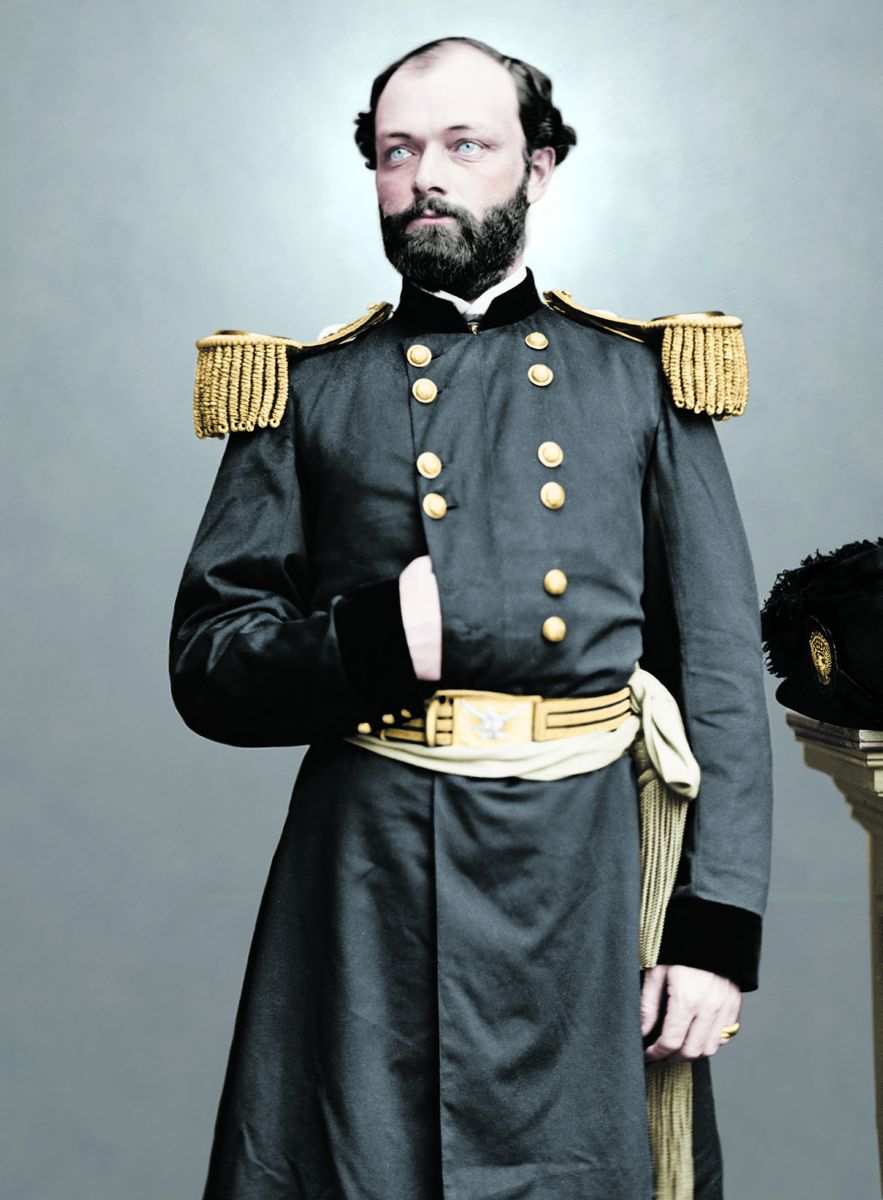
“To capture Richmond would be grand, but to capture Charleston would be glorious.” – Soldier, 11th Maine In 1862, the walls of Fort Pulaski, Ga., crumbled under the fire of U.S. Gen. Quincy Gillmore’s rifled cannons, rendering masonry fortifications obsolete around the world. In July 1863, Gillmore’s imagination turned to “the cradle of the rebellion,” the city of Charleston. Fierce fighting had not weakened the Confederates’ resolve. Would their determination hold if Charleston were shelled? It would be an engineering feat to construct a battery on top of the salt marsh. But would it be possible? On July 16, Gillmore told engineer Col. Edward W. Serrell to find a site to build a battery between James and Morris Islands in Charleston Harbor. Before the War, Serrell assisted with the design and construction of railroads and bridges internationally. He helped raise the 1st NY Volunteer Engineer Regiment and his military suggestions included long wire, armor plate, impromptu gun carriages, and iron viaducts. After breakfast Serrell and Lt. Nathan M. Edwards, 1st NY,
Gen. Edward Wellman Serrell; Colorization © 2020 civilwarincolor.com courtesy civilwarincolor.com/cwn. Library of Congress.
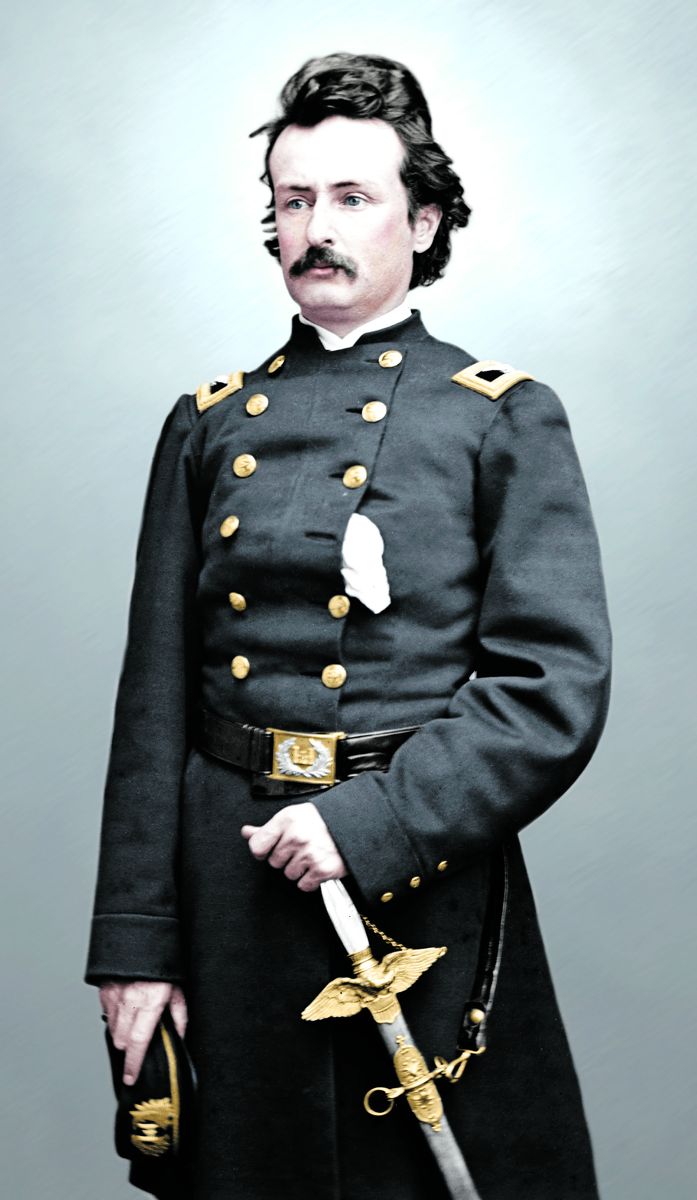
under the watchful eyes of three Confederate forts and twelve batteries, examined the marsh. The site consisted of “soft, black mud, from sixteen to eighteen feet in depth, overgrown with reeds and grass, traversed by numerous deep and tortuous bayous, and subject to daily overflow by the tides.” The men were able to support themselves crossing unstable mud by sitting on a fourteen-foot plank as they pushed it forward between their legs. In the evening, Serrell proposed building the battery about 7,900 yards from Charleston in a location where the mud “seemed of slight depth.” Pilings pounded into the mud, with sandbags atop a platform of grillage, made of large yellow pine logs, could support a gun not weighing over 10,000 pounds. On August 2, Gillmore approved the plan for construction. According to talk around camp, Serrell tasked a young lieutenant to oversee the build. A jester requisitioned, “twenty men eighteen feet tall to do duty in fifteen feet of mud,” and that “the regimental surgeon splice three six-foot men together to give him his eighteenfoot-tall man.” The hurried construction was hard labor, in intense heat, under Rebel fire. It took the weight of thirty men to drive each piling down into the mud. A two to fourfoot-wide and seventeen-hundred-yard plank road was built. Along the slippery boards, the 7th New Hampshire men would fall into the marsh while carrying 13,000 sandbags during the hour trip. The 7th referred to the project as the Marsh Croaker, Mud Lark, and Serrell’s Folly. Another soldier described it differently, “We’re building a pulpit on which a Swamp Angel will preach.” The “Swamp Angel” was an 8-inch, 200-pdr. Parrott rifle cannon weighing 16,577-pounds. To fire a shell capable of reaching Charleston, Serrell estimated the cannon needed to be elevated to an angle never used before by a large Parrott and would require loading 20 pounds of powder instead of the usual 16. Furthermore, when considering the Parrott’s reputation for bursting, the whole endeavor could be
Gen. Quincy Gillmore; Colorization © 2020 civilwarincolor.com courtesy civilwarincolor.com/cwn. Library of Congress.
Drawing of the burst Swamp Angel from Plate XXXIII, from the book, Engineer and Artillery Operations Against The Defenses Of Charleston Harbor: 1863. The 8-inch Parrott rifle burst firing its 36th round firing a projectile weighing 150 pounds, with a propellant powder charge of 16 pounds, at 31° 30’ elevation.
considered an artillery and construction experiment. On August 21, Fort Sumter was already under Federal fire when Gillmore received word the Marsh Battery was ready. Gillmore sent a message to his counterpart, C.S. Gen. Pierre Beauregard, “demanding the immediate evacuation of Morris Island and Fort Sumter by the Confederate forces” or Charleston would be fired upon in the “heart of the city.” Beauregard was out when the letter arrived. His staff, due to lack of signature, did not believe it was an official message and returned the letter. Lt. Charles Sellmer, 11th Regiment Maine Volunteers and his regiment were tasked with manning the battery. Orders had been issued to fire the Swamp Angel towards St. Michael’s steeple in Charleston every fifteen minutes, and at night, both to avoid Federal shipping and to prevent endangering Federal POWs. A compass reading had been taken and the bearing chalked in the Swamp Angel’s position. It was the first known use of a compass reading in firing an artillery piece. Low tide delayed the arrival of the boats with the cartridges until one o’clock on the morning of August 22. At 1:30 a.m., the first shot was fired. War correspondent Frank Vizetelly was reading in his hotel room when he heard “the whirr of a phantom brigade of cavalry galloping in mid-air…My first feeling was that of utter astonishment; but a crash, succeeded by a deafening explosion in the very street on which my apartment was situate, brought me with a bound into the centre of the room. Looking from the window, I saw smoke and fire issuing from a house in which were stored the drugs of the medical purveyor…The hotel was crowded with speculators who had been attracted to the city by the sale of some blockade cargoes, and the corridors were filled with these terrified gentlemen rushing about in the scantiest of costumes and the wildest alarm…On reaching the hall I found a motley crowd, some of whom with the biggest of words were cursing the Federal commanders. Whirr! came another shell over the roof, and down on their faces went every man of them into tobacco-juice and cigar-ends and clattering among the spittoons.” To the surprise of the 11th Maine, “at every shot fired from the Swamp Angel gun the whole structure swayed to and fro as if it were a vessel afloat. The pintle block holding the gun-carriage in place moved gradually from the epaulement with each shot, until
CWN after the sixteenth shot it had gotten back nearly three feet,” ending the firing. Beauregard sent a message protesting the bombardment without allowing non-combatants to leave the city. Serrell had estimated it would take two days to make the necessary repairs. Gillmore avowed he would hold off resumption of firing until 10 p.m. of the 23rd. On August 23, the 11th Maine had to wait for hours “…around the battery, seated upon loaded shells, watching the enemy’s projectiles as they approached… luckily not a single shell burst in the air, all striking quite near enough, but sinking into the mud before exploding. Mud-spattering the only damage caused by them.” As per Gen. Edward Wellman’s orders, at 10 p.m. the command was given to “Fire.” The seventeenth shell hurled towards the city. During the attack six shells had exploded in the cannon. Sellmer knew the gun would soon burst. He tied two lanyards together and positioned his men outside the battery when firing. On the thirty-six round the whole battery turned “into one sheet of flame.” The cannon had burst. Sellmer and three men were injured. The last shell reached its target. “The gun itself had died like a soldier, face to the foe.” On November 2, President
The “Marsh Battery” and the 8-inch Parrott rifle known as the “Swamp Angel” after the explosion on the night of August 23, 1863. Colorization © 2020 civilwarincolor.com courtesy civilwarincolor.com/cwn. Library of Congress. “In the construction of the Marsh Battery, the following labor and materials were expended: 13,000 sand bags. 123 pieces, 15 to 18-inch diameter, yellow pine timber, 45 to 55 feet long. 5,000 feet 1-inch boards. 8 paulins, 18 x 28-feet each. 9,516 feet 3-inch pine plank. 300 pounds 7-inch, and 300 pounds 4-inch, spikes and nails. 600 pounds round and square iron. 75 fathoms 3-inch rope. These quantities do not include the material or labor employed in the bridges and plank walk across the marsh, and the boom, or on the road and pier at the old engineer camp, which were incidental to the construction of the battery.” – Report of Colonel Serrell, Engineer Office, Morris Island, S.C., Sept. 10, 1863.
The Swamp Angel, after it burst, laying on the pulpit of the Marsh Battery, near Morris Island, Charleston, S.C. Colorization © 2020 civilwarincolor.com courtesy civilwarincolor.com/cwn. Library of Congress.
Jefferson Davis arrived in downtown Charleston. The area was known as the “Shell District.” Buildings had been damaged or destroyed by shelling. At City Hall Davis addressed the large crowd. He “believed Charleston would never be taken.” He asked if the city should be left “a heap of ruins or prey for Yankee spoils?” Cries of “ruins, ruins,” were heard, supporting Davis’s perpetual campaign to resist surrender. On Dec. 24, 1864, Gen. William T. Sherman wrote that Charleston “is now a mere desolated wreck and is hardly worth the time it would take to starve it out.” The city would surrender Feb. 18, 1865, as part of the second phase of the “March to the Sea,” that went north into the Carolinas. Today the Swamp Angel is mounted on a pedestal in Cadwalader Park, Trenton, N.J. • •
•
Sources:
The Cornhill Magazine, Vol. 10-11, page 109. Smith, Elder & Company, London. 1864. Stryker, William S. “The Swamp Angel”, Battles and Leaders of the Civil War, Volume IV, pages 72-74: The Century Company. 1884. Wise, Stephen R. Gate of Hell, Campaign for Charleston Harbor, 1863: University of
The Marsh Battery as of Oct. 12, 2017. This was the location of the 8-inch Parrott rifle known as the Swamp Angel. Morris Island can be seen in the far background. Almost nothing remains of the once, grand battery. GPS coordinates are 32°43’13.38”N, 79°53’23.37”W. Photo by Jack Melton.
South Carolina Press. 1994. Maxfield, Albert, The Story Of One Regiment; The Eleventh Maine Infantry Volunteers In The War Of The Rebellion, pages 108, 138-147: J.J. Little & Co. 1896. Bostick, Douglas W. Charleston Under Siege: The Impregnable City: The History Press. 2010.
•
• •
Gillmore, Q. A. Engineer and Artillery Operations Against The Defenses Of Charleston Harbor: 1863: D. Van Nostrand. 1865 OR, Series I, Volume 35, Part 2, page 284. Ed. Moore, Frank. The Rebellion Record: A Diary of American Events, Volume 8, page 2: D. Van Nostrand. 1865.
Stephanie Hagiwara is the editor for Civil War in Color.com and Civil War in 3D.com. She also writes a column for History in Full Color. com that covers stories of photographs of historical interest from the 1850’s to the present. She also has had her work published in The Artilleryman Magazine. Her articles can be found on Facebook, Tumblr and Pinterest.