
The Graphic War
In Memoriam
By Salvatore Cilella · Originally published August 2020 · pp. 26–27
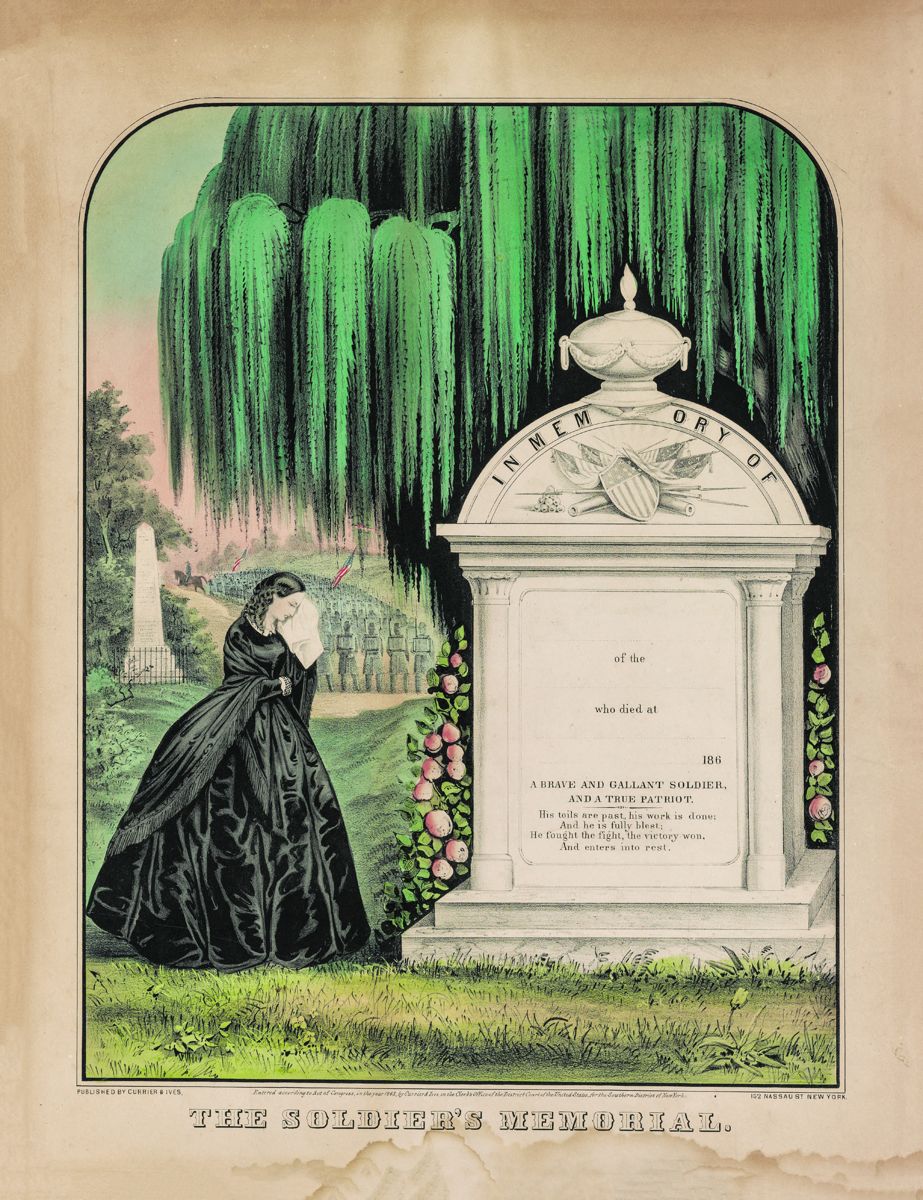
In Memoriam The Graphic War highlights prints and printmakers from the Civil War discussing their meaning and most importantly, the print maker or artist’s goals. For years before the Civil War, the firm of Currier and Ives produced small folio lithographs either entitled “In Memoriam,” or “Sacred to the Memory.” The market for these was families mourning the loss of loved ones. Families looking for some physical, visual reminder of their deceased could purchase for little money, a reminder that hung on the wall. Undoubtedly, more versions of this print will come to light; to date more than 20 different iterations printed before the war have been identified.1
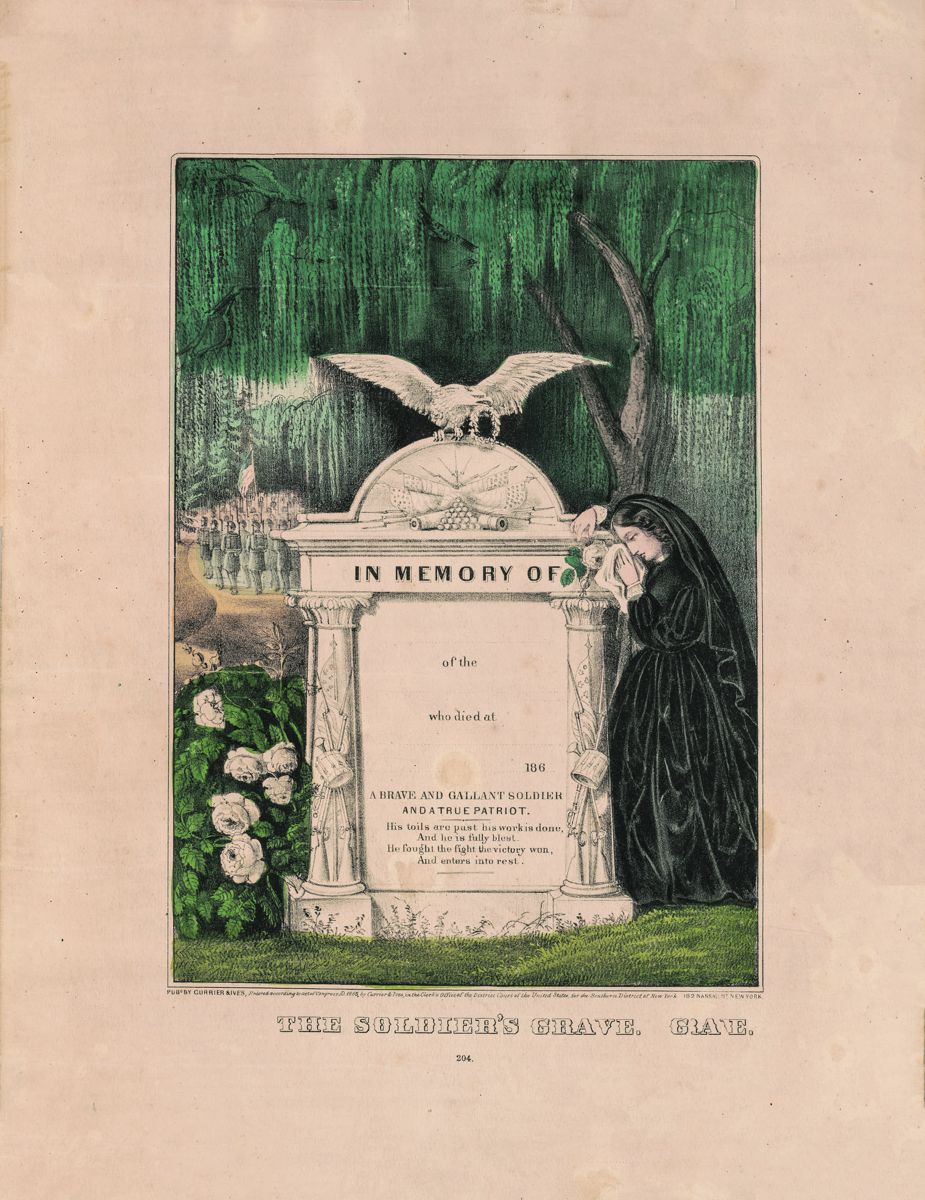
In 1862, 1863, and then in 1865, with the ravages of Civil War touching nearly every household in the country, Currier responded to the national tragedy and the market, and re-introduced the same prints with the new titles: “The Soldier’s Memorial” in one version, or “The Soldier’s Grave” in two versions. They were essentially identical; vertical rather than horizontal, usually with a lone mourner, who was almost always a woman, but sometimes a small family, mourning the family member in the frame. She and they, are dressed in black; she has buried her face in her handkerchief. The center of the print featured a monument topped by an American eagle with a wreath in his mouth, cannon, cannon balls, and flags. In some versions, an urn replaced the eagle. To either side of the white memorial monument are stacked arms and drums. In the background are surviving soldiers marching into the distance. Above the monument, topping it off are either weeping willows or, as it appears in some extant, presumably Southern oriented examples, Spanish moss dangling from the trees. Much like other prints, such as family, birth, death, and wedding registers, Currier, and to a lesser degree, his competitors, produced mourning prints that were meant to be written on. Currier provided the template; the family filled in the particulars: “In Memory of ____of the (regiment) Who Died at ___186. A Brave and Gallant soldier and a True Patriot. His Toils Are Past, His work Is Done;/And He Is fully Blest:/He Fought the Fight, the Victory Won./ And Enters into Rest.”2 Once filled in, the “death record” undoubtedly received a conspicuous place of honor in the home. Drew Galpin Faust, who wrote the essential This Republic of Suffering: Death and the American Civil War, furthered our understanding of the Civil War’s tragedy and death on the large scale experienced by the American public. Summed up, she wrote of the war’s impact on dying, killing, burying, naming, realizing, believing and doubting, accounting and numbering. These were not stages of grief, but new realities unfaced by prior generations. She writes compellingly about the mystery of the war’s deaths since “nearly half the dead remained unknown, the fact of their deaths supposed but undocumented, the circumstances of their passage from life entirely unrecorded.” The Currier mourning print served a double meaning for those whose loved ones rested in unmarked graves. As Faust writes, “The Soldier’s Grave” lithograph with its inscribed details offered the family who “had no actual grave to mark, … a substitute.”3 These rapidly drawn and crudely produced prints have appeal to print collectors; but they have a more significant use as important genealogical documents establishing a soldier’s service in the Northern war effort.
Endnotes: Gale Research Company, Currier & Ives: A Catalogue Raisonné. Detroit, Gale Research Company, 1984, 2 Vols. I, 346-347. Harry Peters. Currier & Ives. New York: Doubleday & Co., 1931, 2 Vols., I, 216.
Gale, II, 621. Drew Galpin Faust, This Republic of Suffering: Death and the American Civil War, New York, Alfred A. Knopf, 2008, , 267, 231.
After 43 years in the museum field, Salvatore Cilella devotes his time collecting American prints and maps and writing. His last professional position was President and CEO of the Atlanta History Center. His most recent books are Upton’s Regulars: A History of the 121st New York Volunteers in the Civil War (U. Press Kansas, 2009). His two-volume Correspondence of Major General Emory Upton, (U. of Tennessee Press, 2017), is the recipient of the 2017-2018 American Civil War Museum’s Founders Award for outstanding editing of primary source materials. His latest book Till Death Do Us Part, is an edit of Upton’s letters to his wife 1868–70, published this spring by the Oklahoma University Press.
“The Soldier’s Grave.” New York: Published by Currier & Ives, 152 Nassau St. New York, [1865]. Library of Congress.