
Fishing Creek Confederacy in Pennsylvania 1864
By John A. Punola · Originally published August 2020 · pp. 44–45
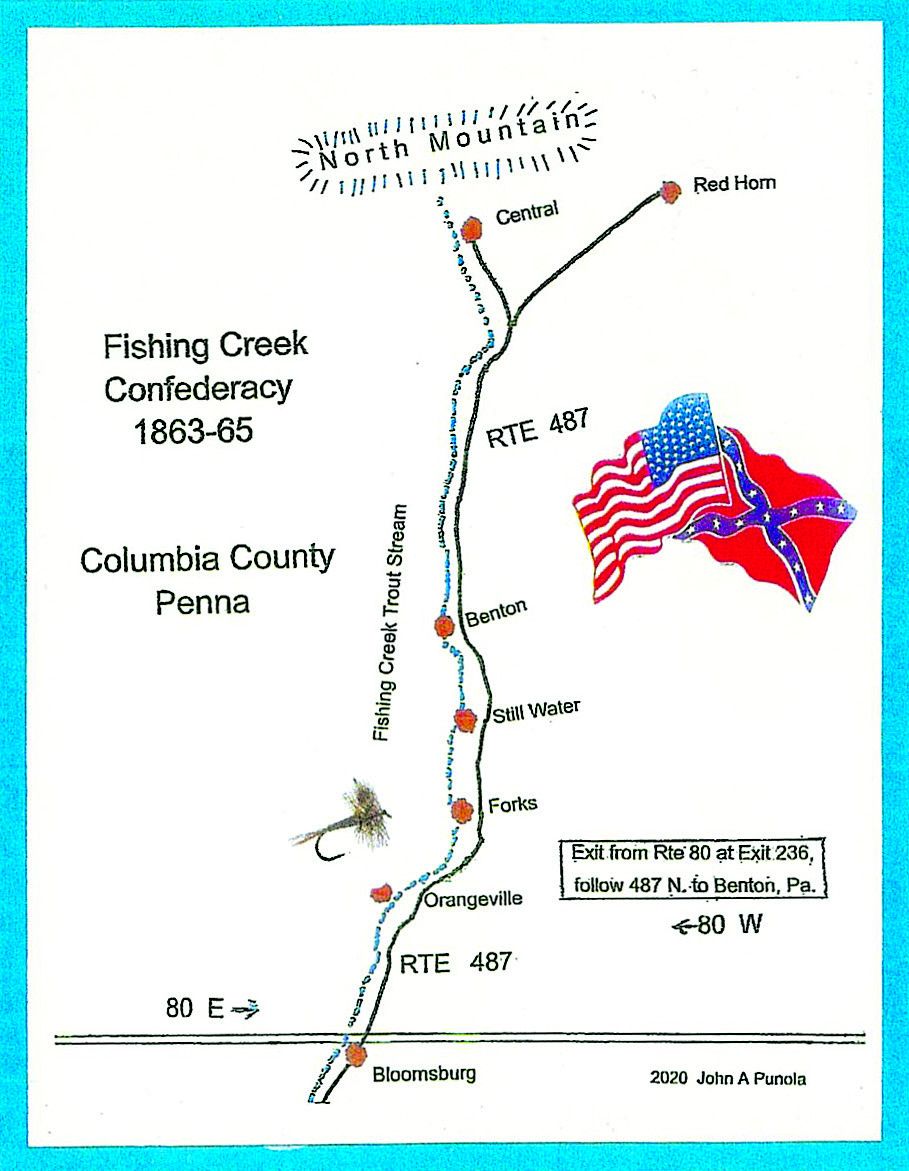
It was early May and I planned a trout fishing trip to the Bloomsburg, Penn., area to do some trout fishing in upper Columbia County. My wife Nancy, also my outdoor photographer, accompanied me while I explored Fishing Creek trying to catch some rainbow trout that inhabited this famous stream. To finish our trip we would spend a day attending the annual Civil War Weekend at Bloomsburg Fairgrounds. It was an ideal time to visit the area, fish for trout, or attend festivities at the Civil War Weekend. We traveled to Bloomsburg, Penn., from our home in Madison, N.J., and when we exited at Bloomsburg, we stopped to refill the gas tank, plus enjoy a cup of coffee with our sandwich. The lady in charge asked if we were in the area for the weekend, when I told her yes, she said “That’s nice, if you attend the Civil War Weekend, I think our men of the Fishing Creek Confederacy are supposed to be there.” I knew then our plans were going to change. I had no previous knowledge of the historical significance of the Fishing Creek Confederacy, so now we formulated plans to visit the town of Benton, Penn. All we had to do to reach the town was to follow Route 487, which paralleled Fishing Creek all the way to Benton. The saga of the Fishing Creek Confederacy’s resistance to the draft is virtually unknown to history buffs knowledge of the Civil War, unless you live in Columbia County, Penn. Let’s begin with the surrender of Fort Sumter in Charleston, S.C., after shelling by Confederate artillery. The Union now faced the possibility of war with its Southern states and was woefully unprepared. The standing Union regular army numbered about 30,000, with the majority of its manpower either on the western frontier or based to defend Washington, D.C. The Union’s reservoir of service men lay in the trained and maintained state militias that could be called by President Lincoln to join the regular Union army; this was done in short order. The call went out to the states to begin activating their militia and prepare for active duty, designated reporting stations were quickly assigned, and militia units prepared to report for duty. On April 15, 1861, Lincoln gave the order for 75,000 men to serve for three months, with options of extension if needed. The Pennsylvania share of the quota was fifteen regiments, mixed branches. Immediately after the surrender of Fort Sumter, there was a sudden surge in patriotism to defend the North and save the Union; Pennsylvanians quickly filled their prescribed quotas. The prevailing thought was that the 75,000 addition to the main army would soon defeat the Southern states who dared attack the Union, and they would
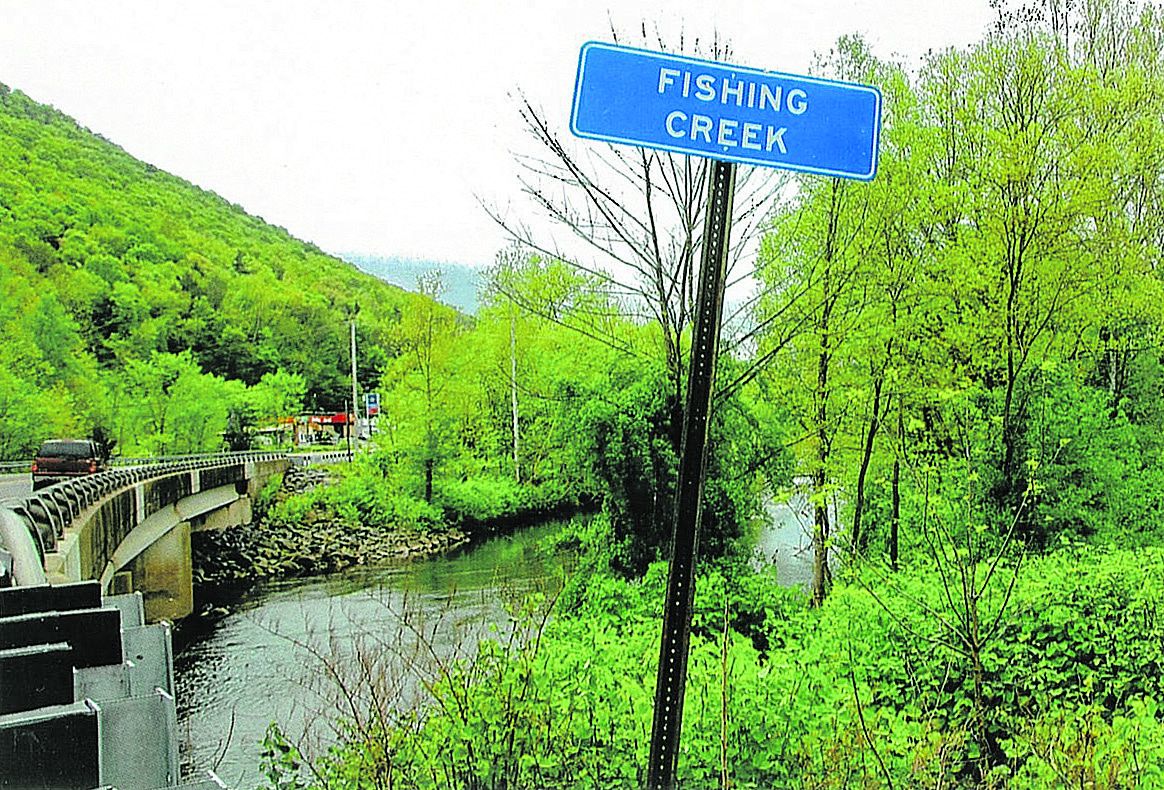
The beautiful Fishing Creek landscape in Columbia County, Penn., home of the Fishing Creek Confederacy which existed during 1863–1864 before being decimated by superior Union forces.
quietly return to their home states. Quick and efficient was the popular view in Pennsylvania and men were anxious to march off to perform their duty. The North had overall advantages over the South except for one category, military leadership. The Southern states were home to eight military schools producing leaders. The top United States Military Academy cadets at West Point, N.Y., were bright, skilled Southern students, who soon resigned and departed for home to join their state’s Confederate units. On July 21, 1861, the first full scale battle of the Civil War took place at Manassas (Bull Run), Virginia. The Union army was severely defeated by the Confederates and retreated to Washington, D.C. Had Jefferson Davis, President of the Confederacy, taken the advice of his generals, Johnson and Beauregard, it was possible the Confederate army could have pursued the retreating Union army all the way to Washington, D.C., and seized the Union’s capital, but they chose not to do so. Confederate president Jefferson Davis stated he did not want a prolonged war and thought Abraham Lincoln would agree to a conference to settle their differences. Instead President Lincoln chose a hasty military build up to subdue the newly declared nation. Pennsylvanians were shocked and angry by the defeat at Manassas and Governor Curtin was concerned with the possibility of a costly and prolonged war. The first two years of the war resulted in a string of Confederate victories despite the heavy advantages of the Union manpower, supply, and equipment which resulted in several leadership changes by Abraham Lincoln but no improved results on the battlefields. Things were getting bad on the home front; resistance and discontent grew along with public impatience, and concern about the horrific losses in men and material. Citizens along Fishing Creek were not just concerned, they disagreed with Lincoln’s conduct of the war and were openly talking about withdrawing their support and participation. Still looking for a major victory, the Union Army of the Potomac met the Confederate Army of Northern Virginia at Manassas again on August 28-30, 1862. The results were the same, another victory by the Confederates; Abraham Lincoln was putting more pressure on General George McClellan for a badly needed victory against the unbeatable Robert E Lee and his Confederate army. The two armies met Sept. 17 when the massive Battle of Antietam, resulted in such a bloodbath, it was difficult to claim a victory. Robert E. Lee wisely
There actually is a Fishing Creek and it does exist as a popular trout fishing stream. The stream is clearly marked with colorful signs at various locations.
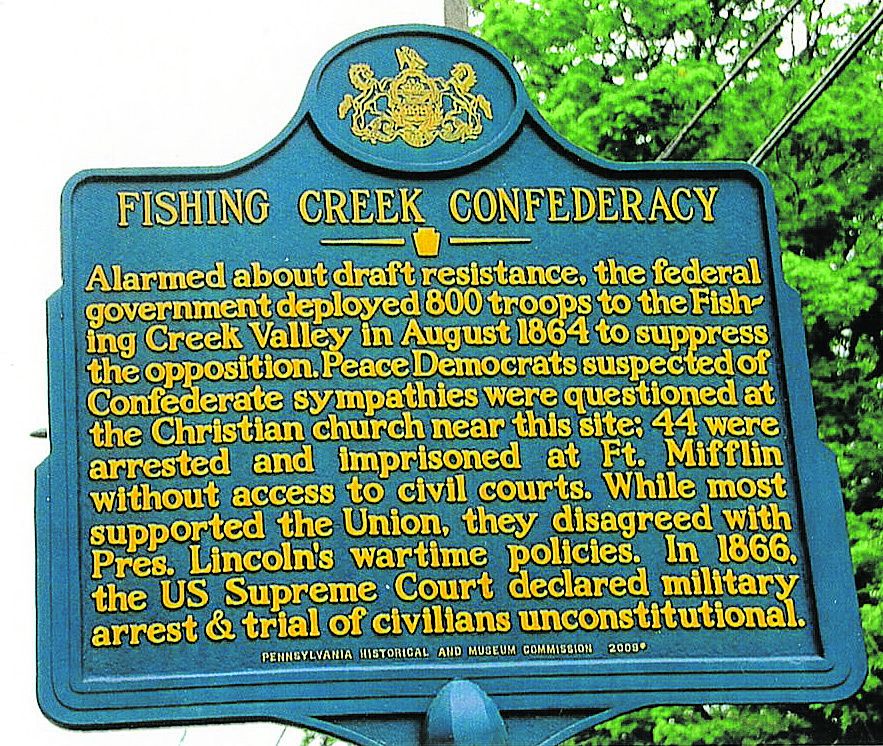
This large impressive metal sign erected by Pennsylvania Historical & Museum Commission 2009, appears on Route 487, Main Street Benton, Penn. chose to withdraw from Maryland and took his army back to Virginia. McClellan proclaimed victory, and on September 22, President Lincoln issued his awaited Emancipation Proclamation granting freedom to all slaves in Southern States. The year 1862 ended with another horrific disaster in December when the Confederate’s dealt the Union another major blow at Fredericksburg, Va. In January 1863, President Lincoln made his speech to the government and declared the war to save the nation was over; the objective was now to free the slaves from their bondage throughout the Southern states. He also announced the imminent start of a military draft, badly needed to replace the continued high losses from battle casualties and a high desertion rate. The impending draft call up was not good news in the state of Pennsylvania. There was talk and rumors of Confederate scouts in the state plus agents of the Knights of Golden Circle supposedly active in Western Pennsylvania, the Reading area, and also Columbia County in northern part of the state. Draft eligible men around Fishing Creek vowed not to report for any active service; this geographic area later declared itself the Fishing Creek Confederacy. Congress finally enacted the draft law on March 3, 1863, and immediately there were rumors of armed action threatened by draft resistance men and Confederate sympathizers. The rumors proved just that, no violence happened, just more idle gossip. Men of the Fishing Creek Confederacy had no intention of answering the call when the draft quotas reached Fishing Creek, and the wait for the call up could arrive anytime. The draft call for Columbia County arrived in mid-July 1864 when 618 men classified as selected received a notice to report on a designated day. True to their anti-draft stand, 463 draft eligible men of Fishing Creek Valley did not answer the call, and had no intention of changing their minds. Now it was a matter of how long the Union would wait before using force to round up the Fishing Creek Rebels. The men of the targeted area were tough and skilled with firearms, with a great knowledge of the forest. I drove north on Route 487 closely following Fishing Creek and passed thru Benton. I had called my fishing friends, Barry and Cathy Beck, who have long family ties to the area and live and operate a famous trout fishing business in Benton. We arranged to meet the Becks for a casual lunch where I could relax and learn some history from people who live in the heart of the Fishing Creek Confederacy. I took particular interest in the beauty of the area and noted trout fishermen catching and releasing rainbow trout. The developing story about the Fishing Creek Confederacy diverted my attention. Instead of trout fishing I was now eager to learn more about the Civil War. In the summer of 1864 the Civil War, many parts of Pennsylvania were subjected to military raids wherein citizens were arrested by Union soldiers, imprisoned in military prisons, then tried by military commissions in direct defiance of the constitution of the United States. States’ rights were violated as well as common law, which provided trial by jury in civil courts for all who were not specifically in the Union Army or Navy. Pennsylvania suffered Union military raids in Berks, Clearfield, Columbia, Pike, and Schuylkill Counties. The Columbia County raids targeted the Fishing Creek Confederacy because one vicious imaginative charge against the inhabitants of that peaceful region was that a conspiracy to support the Southern cause existed there. There is no proof that any connection ever existed between Richmond, Va., and Benton, Penn. Before the Civil War, the people of Fishing Creek lived in a high state of prosperity, refinement, and independence. They were descendants with ties to relatives from the Revolutionary War. They were intensely patriotic and took an intelligent interest in their public affairs. After the outbreak of the Civil War,
John and Nancy Punola, were warmly welcomed by the local population on the occasion of their visit to the Fishing Creek Confederacy.
CWN and a Republican, Abraham Lincoln, was elected president, their interest greatly intensified. These farmers and business men listened to political speeches of Republicans and Democrats. They read all the newspapers and pamphlets they could find, and formed private clubs to discuss the merits of the two parties. They were solid, loyal Democrats with few exceptions and not pleased with the war policy of Abraham Lincoln. Early in August 1864, Lieutenant James S. Robinson and a half dozen men from Luzerne County rode into Columbia County. Without warning they challenged a man they met along the road. The challenged man was ordered to stop; when he refused he was fired upon. The man defended himself and returned fire, hitting Lieutenant Robinson who later died of a gunshot wound. Who fired the fatal shot remained a mystery until twenty-five years later, when a neighborhood quarrel about a boundary line, resulted in serious charges being lodged with the authorities. An individual named Eli Young was arrested and tried for the shooting in Luzerne County Courthouse. He was declared innocent on grounds of self defense, and the charges dropped, case closed. Another serious charge lodged against Columbia County citizens as a reason for the invasion of Fishing Creek, was that the citizens had organized a secret society to resist the draft; its name was the Knights of the Golden Circle. This false charge was presented at a Military Commission in Harrisburg, Penn., where a number of witnesses testified under oath for both the government and the defendants that the organization was not secret, being open for anyone interested in attending. The only secret part was a password or sign such as those common in all lodges, and that it was a political club, known as a Democratic Lodge or Club. The name, Knights of the Golden Circle, was applied only to those who wished to malign members at the time of the arrests and trials. For the record, the KGC had dissolved at its last meeting in May 1863, well over a year before the military action began. The final charge, the crowning achievement in the fanatical version, was the imaginative claim that there was an armed citadel, a real fort, built on the rocky ramparts of North Mountain, complete with entrenchments and a large number of well armed men with stores of ammunition. There was also supposed to be a big bronze cannon, dragged up those rocky trails and steep precipices, but from where? No one could say where the cannon came from, maybe smuggled all the way from the Confederates in Richmond, Va. Rumors were rampant about a well manned fort with cannon; no one produced any proof, but there was plenty of idle talk minus facts. Exaggerated statements were made over and over so often and so loud that those who made them may have in time, come to believe a major part of what they were stating. Certainly, outsiders were led to believe that conditions within Columbia County needed an investigation by the military. Immediately after the shooting of Lt. Robinson, the incident was lodged in both Harrisburg, Penn., and in Washington, D.C., and there was concern that Union troops would soon be appearing in Columbia County. Union squads were active in other parts of Pennsylvania searching for draft evaders but were not finding any. The arrival of Union troops into Columbia County was anticipated. Would the draft evaders scatter into the familiar forests, or consolidate for a battle? On Aug. 13, 1864, the first detachment of troops arrived in Bloomsburg. Others came later so that within a few days, the armed force numbered one thousand men, with Major General Darius Couch, Commander of Dept. of Susquehanna, in command. The combined force camped on the Fair Grounds near Bloomsburg. It consisted of a company of cavalry, a section of the Keystone Battery from Philadelphia, plus a battalion of infantry. Finally, a battalion of the Veteran Reserve Corps was added to the camp, making the Army of Occupation complete. This well-trained unit with one thousand men, supplies, and equipment was ready to march up the Fishing Creek Valley. The impressive show of force shocked and frightened the village people in its path. Onward past scattered homesteads, in search of rifle pits that were never dug, to arrest draft evaders, who had not deserted, to display its proud might against a mirage that did not materialize, against a populace that just wanted to be left alone. News of the Union soldiers’ arrival traveled swiftly up the Fishing Creek Valley. The inhabitants were told by some they would be arrested, placed in prisons without trial, and their buildings destroyed by fire. The coming of a military force aroused excitement and turmoil throughout Columbia County especially in the northern townships where the expedition was known to be headed. On Aug. 14, the day following the arrival of an advanced detachment in Bloomsburg, a meeting of Fishing Creek residents was held between Stillwater and Benton. This was the famous Rantz Meeting, sometimes cited as the main cause of the military invasion. The troops did not come into Columbia County because of the Rantz Meeting. The coming of the troops caused and produced the meeting. The meeting would not have been scheduled but for the threatening presence of the military force. It was a natural and spontaneous result of the alarm and excitement felt by innocent and indignant men who heard reports that this armed force was coming into their neighborhood to burn, destroy private property, and make arrests. Older and wiser members of the Fishing Creek community were called to the meeting and advised that all men assembled there should return to their homes and that they should offer no resistance if the soldiers came, but should go on about their business and attend to their duties as citizens. They were told that if anything did happen to them they had the law to fall back upon and that their neighbors would not let them suffer. The meeting quietly dispersed and the men returned to their homes. That was all there was accomplished at the Rantz Meeting. On Aug. 21, the remaining troops at the Bloomsburg Fairgrounds, broke camp and traveled to a new encampment in Coleman’s Grove, just outside Benton. During the ensuing week scouting parties were sent forth searching, unsuccessfully, for evidence of an armed insurrection. Finding nothing, the troops looted pig pens, chicken roosts, and ripe cornfields. On Aug. 28, Major General George Caldwalader arrived to assume command. Squads of troops were posted at various positions throughout the northern townships and, at the break of dawn, the signal was given, and 100 doors were pounded upon as occupants were aroused from their beds, and arrested without due process of law, in defiance of their constitutional rights. The prisoners were marched to a church near Benton, where they were taken before an officer who desecrated the pulpit by standing therein. The proceedings were hurried and brief. About half the prisoners were discharged without any reason being given for either their arrest or discharge. Forty-four were chosen, taken on foot to Bloomsburg, placed on a train, and conveyed to Fort Mifflin near Philadelphia. The prisoners were without any food until they arrived at Philadelphia. At Fort Mifflin, a notorious, cruel camp, they were herded into an underground imperfectly ventilated, rat infested, bombproof. They were denied air, exercise, or the light of day, denied free correspondence with friends or counsel, denied knowledge of any charges against them or the names of their accusers. The imprisoned men spent several months of misery confined to Fort Mifflin, before they were released and returned to their Fishing Creek area homes. After the roundup was complete, attention was directed to the plan to punish the arch conspirators.

General Caldwalader marched his thousand troops northward to the head of Fishing Creek and made camp at the foot of the mountains that shut in the narrow and beautiful little valley. Troops began an intensive hunt for the fort with its two field pieces, its big brass cannon, plus five hundred bold, bad men awaiting a battle on North Mountain. General Caldwalader was an officer of experience and military reputation, and that search of the upper end of Columbia County was made with thoroughness and precision. The soldiers who had such an easy, pleasant time down in the lower valley, now had to climb and claw their way up steep ravines, over rocks and stones, windfalls, thru briars, and almost impossible laurel thickets in the wilderness of the upper end of Columbia County. They scoured the region and into Sullivan County. For their efforts, the troops found two old bear traps, a place where huckleberry pickers had a picnic, and nothing else. They never located the phantom fort, the twin cannon, the rifle pits, or any hostile draft resistors. General Caldwalader terminated the search and marched his troops back to Bloomsburg, where he declared the whole project a farce. Perhaps it was a farce for the general and his soldiers, and for the malignant false reports that had urged Caldwalader onward; it was a grim scenario for forty-four sick and suffering innocents quartered at Fort Mifflin, and for the wives and families who were daily terrorized by the Union soldiers. Civilians were victims of cruel treatment and structural damage similar to the conduct of Union troops against unprotected citizens down South in the real Confederacy. The occupation violated all the rules of common, decent treatment of captive civilians. Truly a shameful time in history of Columbia County during 1864. After the end of the Civil War, in 1866, the United States Supreme Court reviewed the case of the prisoners and declared the arrest and non-trial of the Fishing Creek civilians as unconstitutional; as is noted on a historical marker along Route 487 in Benton. The Fishing Creek Confederacy was short lived, no major battles, no winners, or losers. Yet the storied tales of the frustrated Union soldiers doing their best to find and capture draft deserters remain part of the romantic culture of the Fishing Creek Confederates whose descendants are still a part of the community, and would never think of moving to any other place in the Union. The Columbia County Historic & Genealogical Society, and the Press Enterprise newspaper, both of Bloomsburg, were valued assets in our search for Fishing Creek Confederacy information, and we thank them for their generous time and assistance.