
The Unfinished Fight
A Few Thoughts on the U.S. Model 1841 Percussion Rifle
By Craig L. Barry · Originally published August 2020 · pp. 18–19
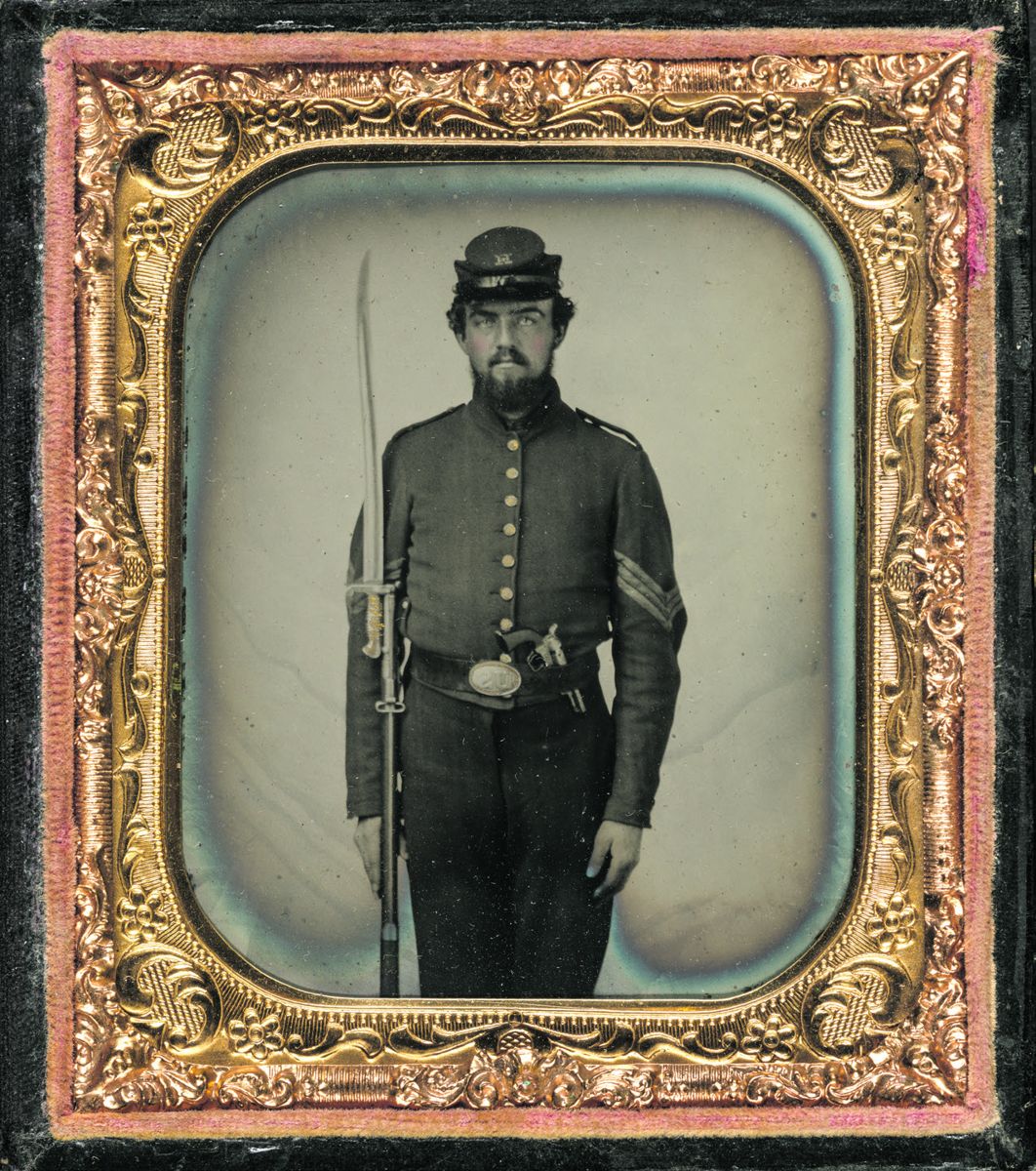
The decision to abandon flintlocks and start producing percussion rifles and muskets led to a new military rifle design in 1841. The so-called U.S. M1841 rifle was stocked in hard oiled finished, Pennsylvania grown, American Black Walnut and brass mounted, weighing nine pounds twelve ounces, with an overall length of 48 ½ inches. The lacquer brown .54 caliber barrel was 33 inches long with seven grooves and a (slow) 1:72 inch twist. The 5 ¼ inch lock plate was flat with beveled edges; the plate and hammer were color case hardened by quenching, and the lock plate was let into the stock to bevel height. All furniture was polished brass. The barrel was secured by two band springs that held brass bands in place. The upper band was doubled looped, 2 9/16 inches long on top, and 3 ¼ inches long on the bottom. Both upper band straps were 15/32 inch wide. Screws and sling swivels were oil quenched and blackened. The barrel carried the inspected, proofed, and acceptance (“V,” “P,” and “Eaglehead”) stamps, as well as a date on the 2 1/16 inches long tang that usually matched the lock plate date. Some contractor made barrels were stamped ‘STEEL.” The stock was marked with an inspector’s cartouche in the round or oval styles of the 1840’s or the square or rectangular styles of the 1850’s opposite the lock. A simple brass blade set 13/16 inch from the muzzle served as a front sight. The non-adjustable rear sight was a simple “v” notched block in the “Pennsylvania/Kentucky” rifle tradition. Surprisingly, for a rifle, the sights were set for fifty yards.
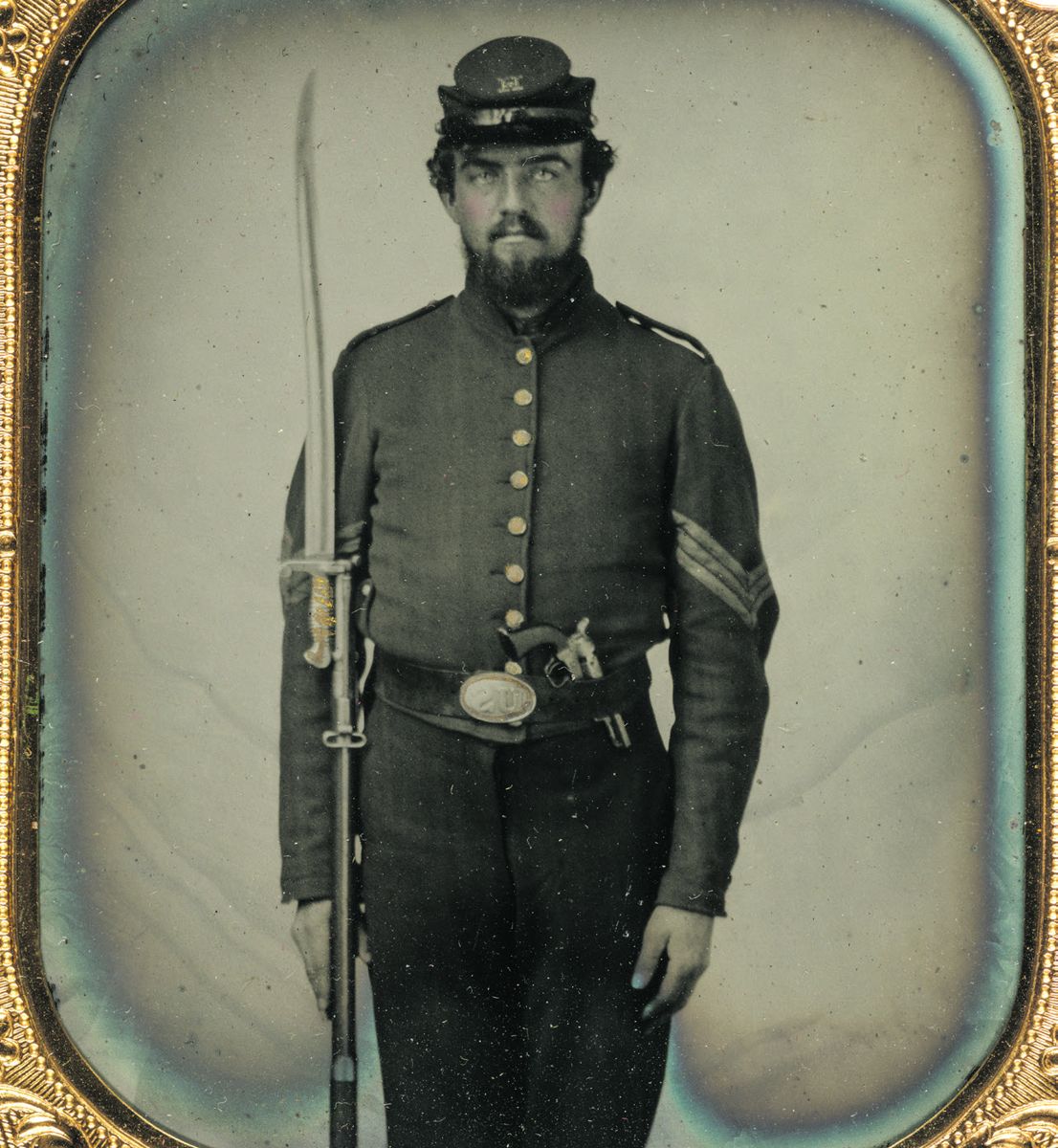
The brass trigger plate was nine inches long with rounded ends and held a blued trigger on a lug. A separate brass trigger guard (bow) was attached with two spanner nuts. The 4 3/8 inch brass flat butt plate was stamped with a small “US” to the rear of the upper tang screw. The 32 ¾ inch bright steel ramrod had a 23/32 inch long brass trumpet or flared shaped tip with a concave front for loading round balls. A “spoon” device in the stock channel secured the ramrod. A distinctive feature of the U.S. M1841 rifle was its large brass patch, or implement, box that measured 7 5/8 inches by 1 11/16 inches. The bottom of the patchbox mortise typically carried one large very shallow circular cut centered with sometimes two others faintly visible on the side with shallow holes in their centers, remnants of the bit used to make the mortise depth cut. The bottom front end of the mortise was drilled out to hold the space cone. Inside the implement box were carried the three M1841 rifle’s tools; on top was a wiper with a long shaft, in the center the combination tool, a cone wrench with a single screwdriver arm, and on the bottom a ball screw on a short shaft to allow it to fit next to the cone. When all three tools and a spare cone were carried, there was little room for anything else in the box. Most tools were contractor made and were japanned black or oil quenched blackened carrying a stamp such as “S,” “M,” or a large “US.” Springfield and Harpers Ferry-made tools have a grayish blue finish with a small ‘US” stamped on them. The lock plate was stamped with the name of the maker in one or two vertical lines over the year behind the hammer. For those made at Harpers Ferry Armory, a spread eagle and “U.S.” were in front of the hammer. The M1841 percussion rifle used a cartridge containing a pre-patched .535 round ball and 75 grains of powder. The M1841 rifle would have an influence on the new advanced design for the Closeup of the Union soldier. .58 caliber M1855 rifle that incorporated both the new .58-minie bullet as well as the Maynard tape primer system. The first two (of five) variations of the U.S. M1855 rifle, made in 1857 and then modified in 1858, were brass mounted like the M1841. Production of the M1841 rifle did not begin at U.S. armories until 1846 when 700 were turned out at Harpers Ferry. Between 1846 and the end of production in 1855, 25,296 rifles were produced at Harpers Ferry. There is some controversy over production at Springfield Armory as there are no records indicating any production of M1841
rifles but some believe a limited number (3,200) were produced in 1849. Springfield records are somewhat unclear; the 3,200 referenced as “3,200 arms” may not be M1841 rifles but rather shortened M1842 muskets altered for the Fremont Expedition. It is worth noting that any M1841s produced at Springfield Armory would be exceedingly rare because Springfield did not produce muzzle loading rifles similar to the M1855 either, only the longer three band rifle musket. Harpers Ferry Armory made the U.S. model rifles. The reasons for this division of manufacture were not documented.
The rifled military arm was far from a new design by the time of the Civil War. The smoothbore muskets still dominated as the military arms because of the difficulty in loading a rifled infantry arm quickly or repeatedly. To be effective, a rifle required a tight-fitting projectile to achieve the necessary compression and take the spin afforded by the rifled barrel. The problem was that once the barrel heated up, the tight-fitting bullet no longer loaded as quickly or easily. Taking a practical feature from the frontier, it was discovered that a slightly smaller bullet wrapped in a greased patch rammed home much more easily. The use of the patched round ball also gave rise to a distinctive characteristic of the frontier hunting rifle, the patch box on the rifle stock. In the patch box one could easily store a supply of greased patches (or grease) and keep them free of dirt and contaminants that would normally stick to such a material stored elsewhere. It also held various necessaries such as tools, spare flints, or a spare cone if the rifle had a percussion lock. The patch box is still a feature found on flint and percussion “American mountain” black powder hunting rifles, but in terms of any military application it proved short-lived. The United States was quick to adopt and improve upon the new ballistics technology but with a nod to its frontier heritage, it was slower to adopt the new trends in military arms design, particularly where elimination of the patch box was concerned. TheM1841 percussion rifle had a large brass patch box in the stock. The Maynard tape primer M1855 rifle still had a patchbox when production began in 1857, as did the last generation of the three band M1855 rifle-muskets in production through early-1861. Strong consideration was given to continuing the patchbox for the new U.S. M1861 rifle musket; a prototype version with a round lid was proposed but never produced. The following account from Claud E. Fuller’s classic The Rifled Musket, (1959) lends insight into the discussions which occurred during 1860, just prior to the Civil War: From the best information the board can obtain from officers using the rifle musket it appears the patchbox is very convenient and useful for carrying a greased rag or grease. The report of inspectors general indicates that the same difficulty has been found in our service that has been reported in the British service in India with regard to the drying up of the grease used in the cartridge as a
CWN lubricator for the bullet of the rifle musket; and as the use of a lubricating material is very important for accurate shooting with these arms, the Board is of the opinion that the patchbox should be retained, and they recommend the adoption of the pattern presented from Springfield Armory (marked A 117) as the neatest and cheapest plan offered. Major Hagner desires to record his dissent to the above recommendation…the arm fabricated for the general service should consist of as few parts an [sic] be as little costly as possible to fit for effective service. The patchbox in the stock is costly and cannot be of general use in the ranks as grease…renders the arm untidy to handle if so used. Should marksmen on special service in deliberate firing find it best to have an additional supply of grease on hand it can be carried with equal convenience in a box detached from the gun and of little cost. The patchbox has not been applied to the rifle musket in any European service, as far as known to me although the cartridges used by them are not superior to our own. Ultimately, the exigencies of the Civil War and its increased demand for small arms dictated that cost and additional production time necessary to add a patch box was no longer desirable, at least on U.S. model rifle muskets. The projectile or (for the Enfield) the cartridge paper itself was lubed instead. The patch box was still found on commercially made military rifles of proprietary design such as the Sharps rifle even though they were breechloaders with no need of a greased patch. The M1841 continued to see service throughout the Civil War; despite the design being 20 years old, it was far from obsolete. Craig L. Barry was born in Charlottesville, Va. He holds his BA and Masters degrees from the University of North Carolina (Charlotte). Craig served The Watchdog Civil War Quarterly as Associate Editor and Editor from 2003–2017. The Watchdog published books and columns on 19th-century material and donated all funds from publications to battlefield preservation. He is the author of several books including The Civil War Musket: A Handbook for Historical Accuracy (2006, 2011), The Unfinished Fight: Essays on Confederate Material Culture Vol. I and II (2012, 2013) and three books (soon to be four) in the Suppliers to the Confederacy series on English Arms & Accoutrements, Quartermaster stores and other European imports.