
A Candid Interview with Garry Adelman, American Battlefield Trust’s Chief Historian
By Chris Mackowski, Ph.D. · Originally published August 2020 · pp. 6–10
If anyone in the Civil War community sets the bar for excitement and enthusiasm, it’s Garry Adelman. Garry is the chief historian for the American Battlefield Trust, and during his time with ABT, he has made himself into a household name through his embrace of social media and his explosive energy. As Garry often says, he’s excited about sharing Civil War history, and he wants to do everything he can to help his audiences be excited about it, too. I had the chance to sit down with Garry for an extended conversation about how he got into Civil War history, how his career evolved, and the impact social media has had on the field. During the course of our conversation, we also got to talk about his passion for battlefield preservation, his fascination with Civil War photography, and his work as a historian. Chris Mackowski: I think the place I’d like to start is last summer, when we were on the roof of the Fahnestock Building in Gettysburg doing a Facebook LIVE for the American Battlefield Trust, and from where we were standing, we could look down onto Baltimore Street and see the former restaurant you used to own. Garry Adelman: Yes. Chris: And, to me, that’s a fascinating journey of you going from street level to roof level. Garry: Oh, interesting metaphor. Chris: Can you trace that journey a little bit for me? Garry: I became obsessed with the Civil War in high school by picking up William Frassanito’s books.
Garry Adelman, William Frassanito and Tim Smith at Frasanito’s Family grave site in Evergreen Cemetery, Gettysburg, 1996.
Chris: That’s a two-for-one, because it’s Civil War and it’s photography—your two big things. How did that steer you? Garry: I was always that kid—I don’t know why; but when I was seven, I’d see a picture from when I was three and wonder where it was taken, and I’d want to go back and take another picture of it. For whatever reason, this was burned into me. In high school, my freshman year, I would take pictures of buildings before they were demolished with the intent of going back and taking a picture of it later after it was demolished. So, I don’t know why, but this idea of time passing over a certain place has been of interest to me since I was a little boy. Chris: That’s fascinating. Garry: I have no idea why. So, in my last day of sophomore year of high school, when I was not a good history student at all because I didn’t read for pleasure, and didn’t read most of what was assigned me, I finished my exam early and went to the Evanston Township High School Library, a massive library, and I have no idea why, but I walked over to the 973’s and pulled this book with bright red letters saying “Antietam” on the side. I didn’t know what Antietam was. I guess I knew the North fought the South, but not much more than that. When I stress that I was 16 years old and didn’t know what the Civil War was, I mean it. I pulled that book off the shelf and opened to a page that showed dead bodies lying in front of the Dunker Church with a pair of shoes lying there, and then a picture of the same place today, it immediately hit me. I couldn’t wait to get back in the fall and check that book out. (chuckles)
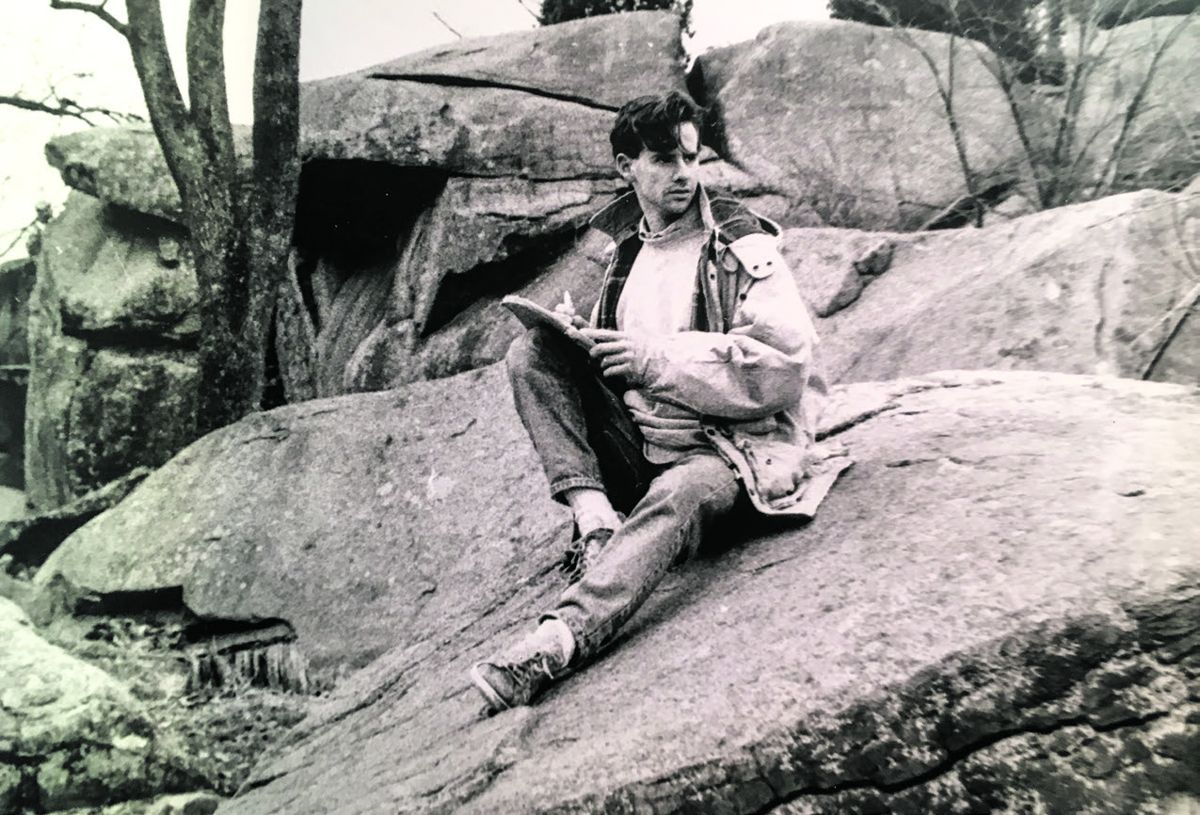
One of hundreds of times Garry has posed in the same spot as did sketch artist Alfred Waud at Gettysburg, 1989.
I didn’t think to go to another library and get it, I guess. But, that was it. I became obsessed with it. I got The American Heritage book after that, and then suddenly, for birthdays and Hanukkah, people were giving me Civil War books, and I was suddenly reading for pleasure. That’s what changed. That changed everything that very moment. So, suddenly, there was an author who was doing what I’m naturally born to do, study time and place together, and here it was in a book. He was the first one I’d ever seen do it, and he pioneered this. My kids know this: they would not exist were it not for William A. Frassanito. There is no doubt about it. I’d have never moved to Gettysburg or met my wife were it not for getting obsessed with his books. Tim Smith and I, we are officially his students and he is our mentor, and he sends us out to do his work to some extent, and I’m very proud to be in that position. If I see somebody on the field with a Frassanito book struggling to find a modern location, because his moderns were taken in the ’70s and ’80s, I always help them because, on my first trip to Gettysburg, a man did that for me. He saw me with my Fraz book—F-R-A-Z—and he helped me and I’ll never forget it. So, literally because of Frassanito’s Antietam book, I was instantly obsessed. I started reading for pleasure for the first time in my life and obsessed about it for the coming years really. I still went to school to get a business degree in hotel and restaurant management, but I was more obsessed with history at the time, I just didn’t think I could make money at it. Chris: Yeah.
Garry: During college, a couple of times I visited Gettysburg, Antietam, and Fredericksburg. Then I was really hooked. I didn’t know what “obsessed” was until those first few trips. Chris: What was your first experience on a battlefield like? Garry: Though the Antietam book was my real entry, when I read the Gettysburg book, I was obsessed. Then I got his Grant and Lee book, and I just knew I had to visit a battlefield. I couldn’t make that happen until July 1988, the 125th anniversary of Gettysburg. That’s not why I went, but that’s when I was able to work it out. I was in college at the time, and during the summer I was doing restaurant stuff, running a busy booth at the Taste of Chicago. After that experience, after working ten straight twelve-, thirteen-hour days, I flew to Gettysburg and visited a girlfriend of mine who was living in Baltimore at the time. All I wanted to do was drive to Gettysburg and Antietam, which I did, twice I drove out to Gettysburg during that trip; and because I was so obsessed I thought something almost supernatural would happen. You know, I would touch the rocks and I’d close my eyes…. It ended up being a little anti-climactic, with a distinct exception of walking around the woods at Devil’s Den on the road, and I kind of had a feel, spatially, for where I was because of the then-and-now photos. I knew what was where, but I didn’t exactly know any detail. Things never quite sit the way you think they are until you go. When I turned the corner on Sickles Avenue, and I was writing “somewhere in Devil’s Den,” and then looked up and saw the dead sharpshooter’s position, with which I was particularly obsessed, and I stopped right there, stopped walking and wrote: “WOH, I just saw the dead sharpshooter’s position; I’m trembling + I can’t breath (sic.) right – my heart is pounding quickly + my mouth is dry; this is Amazing. I wrote that in my journal upon glimpsing the site, before I even walked up to it. Within two minutes, I’d set up
Section of Garry’s July 1988 journal where he wrote his impression upon seeing the Dead Sharpshooter Position.
Signing Devil’s Den books at Gettysburg’s old Cyclorama building, 1999.
my camera on a tripod and laid down in the same spot, because to me I was getting closer with my subject. That’s not for everyone. You know, people interact with battlefields in different ways. A lot of people wonder what the code of conduct is on a battlefield. What are you supposed to do at this place? Can you have fun? Does it have to be all heavy reverence? Can there be some irreverence? I’ve seen people be happy, I’ve seen them be sad, I’ve seen them be confused, I’ve seen them be angry, I’ve seen them lash out at the tour guide, I’ve seen them pass out, I’ve seen them cry, and whatnot. I look to the veterans: they had fun. They used a battlefield for various things while they also paid honor to their comrades’ sacrifices and their own deeds. So, I think there’s a pretty wide boundary of what’s okay on a battlefield. You don’t have to lay down in the spot of the dead, that’s a little bit morbid to many. To me, it brings me closer to the subject. Chris: While you’re discovering this connection to the battlefield, though, you’re still carrying on life as usual, too, right? Garry: Yeah, I’d been working for a prominent restaurant corporation in Chicago. I had a great job. When I got out of college, I started managing a restaurant and did that for about two and a half years. Restaurant people work a lot, and you don’t get a lot of vacation time, especially when you’re first starting out, so I would close up the restaurant on Saturday night, once in a while at 2 a.m., start driving, and get there, it’s about a 12-hour drive from Chicago, and with the time change, I’d get there at about, you know, 3 p.m. the next day, and I’d spend a couple of hours ’til it got dark, then I’d spend the whole next day, then I’d drive back. It was just nuts. I did this 11 times. One day my car broke down on the side of the road, it was in rural Michigan, and everybody was so nice, they helped me out, and right then and there I decided, “I have to get out of the city.” I was 25; I had gray hair, some gray hair, I had more hair than I do now but some of it was already gray at the time. I was stressed out, and I just then and there pretty much decided “I’m going to move to Gettysburg” without a job. Which is what I did! I tried to find work as a restaurant manager because everybody needs that, right, except bad idea to move to a tourist town in September when they’re not hiring. So, unable to find a job, my then-girlfriend and I opened a restaurant there on the corner of
CWN Baltimore and Middle Street. It was called The Food for Thought Café and Coffee House, and it was a little ahead of its time because it was a health food restaurant and coffee house. This was 1992/93. We were the only espresso machine within 30 miles. Chris Mackowski: So once you got to Gettysburg, what got you into the history field there? Garry Adelman: At first I worked 120 hours a week, then it was 100, then it was 80. Eventually, we got supervisors to help us and business was good, and I was down to 60 and then even 50 hours a week over the years, and the more that happened, the more time I had to do other things. In 1994, I took and passed the Licensed Battlefield Guide Exam, became a guide in 1995. By then, I’d written my first article for Gettysburg Magazine, and by 1997, I wrote Devil’s Den: A History and Guide. I co-wrote that with Tim Smith. So when I was running the restaurant, I was kind of getting into my Civil War career. In 1992, I joined the Gettysburg Battlefield Preservation Association as a board member, started advocating for battlefields, which, by the way, is pretty funny because my goal in moving to Gettysburg was to pursue my passion, become a battlefield advocate, and write, which is pretty funny considering what I do now. (laughter) Chris: You seem to have planned it out pretty well! Garry: Yeah, this 25-year-old kid kind of laid out, “Okay this is what I’m going to do,” and I had no reason to think I could do it. I had never written anything of note before. In the meantime, my girlfriend at the time; Gettysburg wasn’t for her, but I had everything I wanted there. I wasn’t ready to leave. So we wanted to sell the restaurant, and we found a buyer in Gettysburg College, who wanted to set up a new operation called Starbucks. Well, I was the only trained barista in some distance, so they asked me if I would consult, and I said “No, hire me to run it.” So, they bought my restaurant, and I ended up working for Gettysburg College and running their Starbucks operation, their snack bar called The Bullet Hole, and all their concessions, all their food services outside their cafeteria. Chris: Did working for the college free you up in the summer time? Garry: Exactly. It was perfect. I had this great situation going there. I was at Gettysburg. I worked on the battlefield. It’s on the college campus which is battlefield. And by that time, that’s from ’95 to ’99, I solidified being a battlefield guide. I already had a book out, I was speaking to round tables and, I was working on another book. My next one came out in 2000, Little Round Top: A Detailed Tour Guide. I wrote more articles for Gettysburg Magazine and I appeared in Civil War News. It kind of started happening. It was just a very gratifying and shocking experience that once this sort of trifecta of giving tours, speaking to groups, and having something written came together, that’s when everything changed. Even before the days of social media, people started knowing who I was, and I didn’t know who they were. It was a very interesting phenomenon. They would see you at a round table; they would see you on a tour, they’d see you on Pennsylvania Cable Network or something like that. Chris: And then suddenly you wake up one day, and you’re like “Holy shit, it happened!” Almost like it crept up on you, and then suddenly there it was. Garry: Yeah, yeah, and this is while I was still running restaurants. Another change happened, though: I realized I wanted to go back and study history officially. Remember, I wasn’t a history undergrad. So, in 1999, I did two things. I started working for Thomas Publications, then known as “The leader in Civil War books… and more.” I was their marketing guy. They had a lot of great titles, and I had a great job there as well, so that was my exit from restaurants. I officially got out of restaurants in 1999. I also started pursuing my master’s in Applied History at Shippensburg University of Pennsylvania where I had a great experience, by the way. During that time, I was exposed to even more stuff. In any case, while I was at Thomas Publications, I had written in my journal, “Mark my words: before long I shall crack the ceiling of getting on a Civil
Before he even worked at the Trust, Garry was giving tours for the organization, such as here in the Bloody Lane at Antietam at a Teacher Institute, ca. 2009. Photo by Steven Stanley.
War documentary.” Chris: So that was your next goal? Garry: Oh yeah, and finally it happened. I got on one that was about William Frassanito. It was about Civil War photography, and there was one episode that was just about Frassanito, and he was somebody I knew. I was wellversed on him. Of course, it was like two and a half years until it aired. Oh my God, that was a painful wait. But in the meantime, historian Tom Desjardin couldn’t do an appearance on Civil War Combat, and he recommended me, so I was on Little Round Top on a Civil War Combat thing, and that’s right around 2000. At that same time, Tim Smith and I started giving battle walks for the Gettysburg National Military Park. Those are usually reserved for rangers, but we felt we had something to offer that other people don’t do, sort of a lot of post-battle and battlefield focus, a lot of photography focus. A lot of people didn’t really focus on that, especially back then. So for the better part of twenty years, we gave tours at the anniversary with these battle walks, and they were always filmed by Pennsylvania Cable Network. You do one of those, and suddenly people know who you are. They invite you to their round table. They want you to write for their publication. Things spiraled. Chris: Did that open some doors for you? Garry: Yeah, I stayed at Thomas Publications until 2002. Armed with my master’s, I went out looking for another job and found one at History Associates, Inc., in Rockville, Md. I found my dream job. This is a place that just hires historians and archivists to do things for them for hire; it’s a consulting firm, a consulting firm that made a lot of its money doing research to support litigation on either side. It was great because we were just fact finders, usually for environmental research, and either way the place would get cleaned up, it’s just a matter of who’s paying for it. It was very gratifying research and detailed detective work. We also wrote books for corporations. That was fun and gratifying. We also did work for a lot of museums and whatnot. While I was there, I started kind of carving out a Civil War niche. I was, like, “Hey, wouldn’t it be great to just be able to do Civil War stuff here?” So I would look for requests for proposals to respond to. On the second one, by an outfit known as the Civil War Preservation Trust, I did an RFP for their Third Winchester Battlefield, and we submitted for that, applied for it, and got it. Chris: So your first interaction with the Trust! Garry: And my first battlefield layout. I had helped writing a few signs before; and by the way, anyone who’s done that feels the weight of responsibility, especially when you first start doing it: “Oh my God, this is it; it’s in the ground.” Semi-permanent or permanent, it has a real impact. So along with my buddy Tim Smith, whom I brought on as a contractor, and Amber Moulten Wiseman, who’s a professor, we laid out that battlefield and wrote 22 signs, later learning that 22 is way too many for a battlefield trail and way too expensive. We learned about a lot and started experiencing the push and pull between access and preservation. Is it better to get people out to a battlefield? What if they want to go on a bike? What if they have mobility issues? Does it have to be a flat surface? What about just grass? What about when the trail goes down a hill, do you want to have liability for people slipping down a hill or something like that? This was, in parts, a controversial project because, for some parts of it, we wanted bikes to be able to pass each other and secured a grant from a foundation that wanted the paths to be bike accessible. Money makes the world go round, and we couldn’t have possibly done this interpretation without it, but there was also some public backlash and outcry. We learned some things as a result. But now, I mean, it’s a great thing for the community; it’s very gratifying. Chris Mackowski: How did you follow that up? Garry Adelman: We followed that up with work at the First Day Chancellorsville; we laid out and interpreted that. The Slaughter Pen Farm at Fredericksburg; we laid out and interpreted that, then we laid out and interpreted Mine Run, Payne’s Farm, which we laid out and interpreted. Those were my first four battlefields and I did them before I was with the Trust. In the meantime, at History Associates, while doing other work there, I was spending about a quarter of my time doing Trust projects, preparing for Civil War 150. Remember the Sesquicentennial? I was doing research for donors and influential politicians who might be more likely to support particular efforts if they knew about their Civil War ancestry. I was helping out with Trust events. I was giving tours. I was helping with research. So, before long I was working most with Civil War Trust departments, or what was then called the Civil War Preservation Trust. When my time at History Associates had sort of run its course, which, by the way, I’d still be working there because I loved that job. The only job I could conceive of that would be better would be working for the Civil War Preservation Trust, and since I knew everybody there, I teased the idea with them of working there. They were into it. Long story short: they created a new position called Director of History and Education. That was April of 2010. The Trust had never truly focused on education before then although they had an education person or two. My sort-of predecessor, Nicole Osier, was taking the department in a good direction, energized by the Trust’s digital director at the time, Rob Shenk. But the Trust never talked much about education, never appealed for money to support education, didn’t have a video program, nothing like that. So things changed around then. Chris: So you got the job and really start to transform things. How much of that, certainly, has to do with you coming in brand new, and how much has to do with a lot of the technology that the Trust hadn’t taken advantage of before? It seems like that must have been kind of a neat convergence—and a convenient one. Garry: It was. When I got there, there was a teacher institute; there were some traveling trunks going around the country; there was a free downloadable curriculum, by our own admission, a pretty below-average curriculum, and I can’t think there was much else going on. But under Rob Shenk and Nicole Osier, they started building content. Instead of linking to other people’s websites, they thought, “Hey, maybe we should have these assets on our own website.” They built “This Day in the Civil War;” they started building out the biographies of some major people in the Civil War; they started really started covering some bases and building out what was, until 2010-ish, a pretty crappy website. Now I’m pretty sure the Trust has the best website, at least for the Civil War, in terms of its breadth. It’d be hard to say otherwise, I think. But that was kind of the scene at the time. In 2010, I think the education department’s record for a year of fundraising was $20,000. Five years later, we were raising $500,000 for education because we had more programs we needed to support. So, it was an interesting time. Social media is there and apparently there to stay. Anybody could take their phone or their SLR camera out and shoot video and propagate that video via email or social media. And all of us started recognizing that. Chris: I think you have been, in particular, on the leading edge of that. You’ve really embraced that in a way that a lot of the field hadn’t. Garry: Yeah, let me weigh
On the Rose Farm at Gettysburg 150th. Photo by Garret Radke.
in on social media for a quick second. The Trust had a pretty lackluster Facebook page at the time, no Linked-In presence, no Twitter presence. I mean, this was 2010, so it was pretty early for some of that. Instagram; the first time I’d heard about it was 2011. That doesn’t mean it wasn’t around in 2010, but there was this sea change sort of happening. Our digital director, Rob Shenk, he started pushing this, saying, “Hey, we can send out an email and ask for money, and if we’re going to send out an email and ask for money to support a land deal, maybe we need an article about that. Maybe we need ten facts about that battlefield. Maybe we need to shoot a video about that battlefield. Oh, wow, if we’re going to shoot that video and put it on our website, maybe we can put that video on social media as well.” So all these things started coming together. In the meantime, I had already come to the Trust. I was using Facebook a lot, and it didn’t take long before the dark side of social media affected me. I only had one page at the time; it was my personal page, which meant that my Civil War friends were subjected to my personal stuff and my personal friends were subjected to my Civil War stuff. People who might not be crazy about something I did had access to personal things. So it didn’t take long before that got too murky and, for a particular reason or two I won’t say, I eventually established my own “Garry Adelman’s Civil War Page.” I can’t remember what it was called originally, but I had to change the name for some reason. Oh, it was called “Garry Adelman, Author.” Then people didn’t know which page was which. It was a disaster, and I had to use a friend of mine who had a friend who worked at Facebook to change that. So, I started this page, in 2011,
Rushing for reinforcements on the field of Pickett’s Charge, 2015. Photo by Bruce Guthrie. right in time for the 150th, perfectly, and just started making two posts a day. I didn’t know any rules, but I did pay attention to whether a photo did better, a single photo, a group of photos, a video, or a question. I liked every comment if I liked it, if I, in fact, thought it was a good comment. I liked every one. I used to like every share when somebody shared one of my posts, so I interacted. Nobody else ever did my page but me, and I just started doing it two a day, and I slogged away for two years, doing two posts a day about my work, Trust work, Civil War photos mostly, until I got to 1,000 likes. It took a long time, and I remember it was right before Gettysburg 150, the greatest Civil War week of my life, that I finally reached 1,000. It’s at 24,500 as we meet right now. For somebody who used to harass his friends, “Listen to me about the Civil War, it’s really interesting, let me show you this picture!”; then to be able to have the same conversation with thousands or tens of thousands of people is just not only mind blowing, but wildly gratifying. Because of Facebook, because of social media and, of course, because of my position at the Trust, when I give a talk now, there’s usually more people there, so instead of talking to two friends of mine who don’t care about it, I can talk to 10, 100, 500 people, and then it can be preserved and shown on video later. So it’s this great world that we live in, and social media is an important part of it. Chris: Yeah, yeah. People feel like they’re your pal. Because they interact with you, they read about you on a daily basis. It’s like the old news anchors where they come into your living room every night, and so you felt like you were friends with Walter Cronkite. Garry: You feel like you knew him, yeah. Chris: He didn’t know who the heck you were, but it’s an interesting rapport to have. Garry: You’re right. They’re on a first-name basis with me, which is interesting, and sometimes first and second name. It’s interesting, you know. “That’s Garry Adelman!” No, I’m just “Garry.” That’s who I am. So that’s been a very interesting thing, as well. Chris: Were there other aspects of celebrity that took some getting used to? Garry: Honestly, people write me a lot and basically say, “I want to take your job from you.” They don’t say it in those words, but that’s really what they want. They want to know what it took to get where I’m at. And it’s good. Reading back into my journal
Garry shooting one of his signature social media videos in Chattanooga, Tenn. Photo by Buddy Secor.
where I tried to predict the future, because of that, I remember what it’s like, and I hope to answer other people’s questions who might be in the same circumstance I was in twenty some years ago. I actually shot a video for In4, I did it myself with a tripod, called “Becoming a Historian In4.” Now I can just send people who ask a link. I guess the other thing that I’ve learned is that you have to be patient. I mean, a history thing doesn’t just happen. It takes a lot of careful work over the years, so I stress patience. I stress being careful. I stress carving out something that you can be the best at. What are you going to be the best at; and don’t say “the Civil War.” Nobody’s the best at the Civil War. Don’t even say “the Battle of Stone’s River.” Maybe it’s one part of that battle, or maybe it’s one part of social history or something like that. Another important thing: don’t compromise. I mean, I know so many people who’ve endorsed other people’s crappy books and projects, and they knew they were crap, but they were their friends so they did that sort of thing. I think you have to be uncompromising. Once you compromise yourself, those things can come back to bite you professionally. So, perseverance and passion and patience and, at first, volunteering, I mean, I still do a lot of volunteer work but I used to do a lot of volunteer work because, in the end, this is about people. Relationships aren’t quite everything, but they’re very close to everything, and you may have to develop positive relationships with 50 people before one helps you get on that documentary, or one helps you get that book published, or one helps you get the job you truly want. Chris: And if you do it in an explicit “I want to get something out of you” kind of way, that undermines the whole thing. Garry: Correct. Chris: You have to do it for the right reasons. Garry: Yes, you’re right. I mean, you can be cognizant of “Hey, you know what, these people could help me someday.” I thought it when I gave my first tour to Jim Lighthizer and some other board of trustee members. I didn’t kowtow to them, but I thought “Here’s a guy I’m glad I’m giving a tour to.” I’m sure he didn’t remember that tour, when I came and interviewed with him years later. Um, you never know. I could have had no idea that I’d ever be working at the Trust at that point. I don’t even know if I wanted to work at the Trust at the time I gave him that tour. But I
CWN did good work, I gave him a good tour, and I didn’t say like “What can I get out of you later?” I did my work well. That stuff really pays off. In my case, it took me forever, it feels like, you know? I moved to Gettysburg in 1992 and didn’t get my dream job until 2010. That’s the better part of two decades. And so that took a lot of patience and a lot of free work over the years. Chris: There’s that whole idea that you really have to bust your ass and be willing to put in the time, pay your dues and just work it. That’s part of the process. Garry: Oh my word, it takes a lot of hard work. I mean, do you think during the Civil War Institute at Gettysburg College that I wanted to be at that event running a snack bar and taking out trash in front of all the other historians? No—but I did. That was my job, and I was in Gettysburg, I was moving along well. And eventually, I would speak at the Civil War Institute, and they invite me to speak there every year or two. So, yes it was not easy. I worked very hard, and I spoke to a lot of groups, the smallest of which was three. In the old days, I would drive several hours just to speak to forty people. That doesn’t make sense for me anymore, but I did it and you should, too, whoever’s reading this. If you want to have a job in history, you have to stand out among all those other thousands of people who have the same idea you do and are probably equally passionate. So you need something to stand out. Chris: Passion is not enough. Garry: It’s not close to enough Chris: If you say, “Well, I’m really passionate about this,” that’s your starting point. That’s not your selling point. Garry: Right. And it’s the same way with the Trust. I mean, we have passionate people working there, but one of the reasons we’re successful is because we don’t have 50 Garry Adelmans there. We have professional lobbyists and professional real estate people and professional development people, because none of that land gets saved without a lot of money and a lot of professional work with the government and on the real estate side and on the event side. I mean, no land gets saved without that. So, passion definitely is not enough. When it comes to getting a history job, if you can get a parttime history job, you’re doing well. I still have three part-time history jobs outside my full-time job, as I know you do, too, Chris. (laughter)
Chris: True! (laughs) So let me go back, because you talked a second ago about being the best at something. How would you describe what you are the best at? Garry: Well, mine’s not topical. What I’m the best at, or so people tell me, is getting people excited about our subjects, about especially the Civil War and history in general. I love the idea that I’m serving people a positive experience. My particular brand is that every day is a great day to learn about history. That is something that people call out about me the most. It’s my enthusiasm. Chris: I would agree that you are the benchmark for that. Garry: Cool. Thank you. Anybody who knows me, and the social media world has only solidified this, knows that this is just how I am. Period. I’ve had many people in the last three years, because they see me on my videos, who think it’s some sort of contrivance, and then they meet me, and I’m like “Wow, check it out! You just got a new Toyota! Wow, that’s awesome!” And they’re like, “You’re actually like this.” It’s surprising…. Chris: I’d heard that about you before I first met you: “What you see with Garry is what you get. That’s the real Garry.” One of the things that’s made an impression on me is that you maintain a very high-profile presence, but you make a real effort to protect your family’s privacy. How do you compartmentalize that when you are so face-forward with everything else? Garry: Well, first of all, my wife Jennifer helps with that because “Bachelder-Coddington Award-winner Garry Adelman” still takes out the garbage and picks up the dog crap in the back yard. So, she definitely keeps me grounded on that front. We met on the Gettysburg Town Square. She went to Gettysburg College, although I didn’t meet her until years later; she used to come in to my restaurant. So, she has some exposure to this Civil War stuff. But one key about all this is something I learned from friends and ex-girlfriends, all of whom I made hate the Civil War because I just didn’t know when to stop. I had learned before I met Jen and before my kids were born, to not push it. So I really don’t. I love this subject, I’m obsessed with it, but I don’t like much talking about it when I’m out and about doing things. Sometimes, I’ll get recognized. It happens here and there. But I don’t like much talking about it when I’m with my family because that’s not what they’re there for. So, first of all, it’s that.
Secondly, my kids don’t give a crap about my public presence. They’ve grown up with it, they’ve watched it grow, but they do not give a crap. They give a crap about playing soccer in the basement with me or riding bikes around the neighborhood or playing tennis or playing Risk or whatever we’re doing. That’s what they care about, so it’s easy in a way. My family polices it for me. Happily, it is our main breadwinner thing, so, happily, they’re very tolerant of my many travels and everything like that. I will say, because of my Facebook page, I want to make people think that I’m everywhere all the time having the greatest day in the world, and many days are like that, let me just say for the record, but I don’t travel nearly as much as people think. People always think I’m everywhere, but the way the posts are timed it makes it seem like I’m never home. That’s not the case. Chris Mackowski: That was one thing for me, growing up: I always wanted to be a writer, and it would be so cool to have my own books—and today I’m still scratching my head, like, “Oh my gosh, it happened!” But for my kids, it’s like, “Eh, big deal,” you know? They grew up around it, so it just didn’t have the excitement for them that it had for me, and I’m sure that’s kind of the same experience for you with your kids: “Well, of course dad’s on TV. Of course dad’s here or there. Of course dad’s doing this.”
Holding up photos, (a 3D Gettysburg Battlefield photo is resting on the easel), while smiling or talking are among Garry’s hallmarks. Photo by Buddy Secor.
Garry: Yeah. Jen hasn’t come to one of my talks or presentations in a long, long time. I used to ask her to come to about one a year. Now, it’s not even that often. It’s been years since she’s come to one, but she’s seen quite enough of it. She was at a doctor’s appointment recently and it came up; I don’t know, small talk during the appointment, and somebody was into the Civil War, and Jen said something like “Oh, my husband works in that stuff,” and all of a sudden the woman was like, “Oh, I know him!” And what did my wife say? She said, “Yeah, if you see him on TV, he’s usually waving his arms around a lot,” which, when my kids make fun of me, that’s exactly the thing they do. Chris: Do you mind talking about your kids at all? Garry: Not at all. They are in fourth and sixth grade. We live in Maryland, away from the city. Jen and I are both city people, but raising kids in a smaller town was for us. It’s interesting: There were 4,000 kids at my high school, and that was my bag. I went to Michigan State for my undergrad. I only liked big schools, and I loved my experience. But that’s not always what you want for your kids. So, we’re happy to be out in the country, so to speak. Much to the shock of everyone who meets them, my boys are rather shy. A lot of kids are, I know, but they’re particularly shy, which seems strange around me. But at least one if not both of them have my level of energy, and I can’t explain that either. But we do chill out at night, there is such a thing. People find that hard to believe. But, we all love watching movies together and other things like that. Chris: So you’ve talked about your family in the work-family balance. I want to come back to the “work” component in a moment. But first, I want to ask you about another of your passions; something you’ve become really well-known for, and that’s your interest in Civil War photography. It eventually led to your involvement with the creation of the Center for Civil War Photography. We’ve been talking a lot about the Trust, but I know the CCWP is really important to you. Tell me a little about that. Garry Adelman: The CCWP has been critical in my journey in the field and among the most enjoyable parts! Given that Civil War photography was my spark, I suppose that’s not surprising. It started coming together when I was delivering a photo program in 2000 at the Capital District Civil War Round Table in Albany at the behest of the late Sue Knost, who brought together some people who knew the subject. Among the participants were wet plate photographer Rob Gibson, whom I already knew from living in the Burg, and Bob Zeller whom I met there for the first time. It was stunning; we were three people who all knew the subject but with different areas of expertise. One knew how to make Civil War photos, another knew how to view and understand them, and another how to use them. We decided soon after to host a seminar of our own in Gettysburg which we called the Image of War. Meanwhile, Bob and Rob had founded the Center in concept, along with the late Al Benson. I and another came on as founders. I was vice president and seminar coordinator. Bob Zeller was president—roles we both hold two decades later. The Center stared publishing a newsletter, which is now a journal, with great content. We started advocating and raising money in support of digitization and trying to be out front in scholarship. We have held an Image of War seminar every year since 2001; for the coming 20th seminar, we will be back in Gettysburg this October. Being in the Center and planning the seminars has resulted in my having great relationships with people who are excellent at what they do including Will Greene, Mike Gorman, Ron Coddington, Wendell Decker, and many, many others. I’m extremely proud to be a part of the CCWP. Chris: Looking at the photography, the preservation, and the social media, looking at the whole package, it really seems like you’re living the dream. Garry: It’s not only a dream job, it’s beyond any dream job I could’ve conceived if somebody would’ve asked me “What’s your dream job,” you know? I keep saying this, but I marvel at where I find myself. I thought this obsession would taper off eventually, but I can honestly say I am more into this stuff now than I’ve ever been. I have a job that not only helps to educate people about this, but that everything I do goes toward permanently preserving those places. It just never ends, and it’s great to have a life’s work that you’ll never complete. Chris: What a great life. Garry: I’m like a lot of older people who’ve had a satisfying life, and I marvel at what I’ve seen and what I’ve done and what I’ve been able to be part of. I’m living it right now, and it’s just great and it keeps getting better. Chris: You’ve been at the American Battlefield Trust since 2010, so you’re going on ten years. That’s a pretty good run so far. Garry: These words might seem trite later, but, man, I have an incredible team. ECW folks know Kris White, who helped found ECW, and is the Trust’s education manager. Kris is not only a workhorse but knows more about history than I do. He’s very organized, and we’re able to do a lot more because I have him. More recently, we’ve also had Dan Davis, who ECW people also know and who is doing great work for us. So I have this core team of history nerds supported by a great video guy, Andy Poulton, and our longtime land steward, Matt George. Between them and the rotating interns we have, and some great contractors we use, the impact of what we see educationally is just mind blowing. We can, on battlefields, in books, in print, through the media, at events and on social media, provide this education to a broader group of people and better than we’ve ever done it before. Our videos and programs are better than they’ve ever been. In any given week, people will watch more than a million minutes of our videos on YouTube alone. That’s to say nothing of the hundreds of thousands of people who engage with us on Facebook and the tens of thousands on our other social media platforms. That we’ve become the leader in Civil War video in a program that didn’t even exist until six or seven years ago at the Trust is very gratifying. We have the best animated maps, I think, of anybody out there. Our short four-minute videos, intended for adults but great in the classroom, have exceeded my expectation. We have our interactive war department, which has taken off in the YouTube era, and we have this new series called “Battlefield U” to answer people’s most basic questions; I’ll say a lot of our rise started with that. When I got there, we weren’t answering people’s most basic questions. What was the
Civil War? Who fought in the Civil War? How many casualties were there? What happened to the prisoners? What happened to the dead? Things people ask you on a battlefield tour. So one of the first things I did was implement a Civil War facts page, and within a month it was our most popular page, and it has remained that ever since, for something like eight years with a few exceptions. When there’s a big controversy in Civil War land, our Confederate flag videos do well, our monuments assets might do particularly well. But, overall, it’s the basic facts that people crave, that the masses crave. So, we’re trying to be out there for students and for strollers who might be interested, and we find that as many as half of our website visitors; we had about ten million unique visitors last year, were students, which is just great because that’s who’s going to perpetuate our democracy. We have to teach history to each other, and that includes young people who might not support the Trust financially for decades. This is why we do a teacher institute. Our education program has also gone beyond the videos, beyond our website, and beyond the teacher institute to where we do these generation programs where they’re free to parents who bring kids out on battlefields. We found that our members support things like this. We have a fieldtrip fund that wasn’t even around five years ago, and now more than 25,000 students have been on battlefields because of this fund, or at least with the help of this fund. I’m sure I’m leaving out a whole bunch of things. Chris: Wow. So, let me start to wind things down by asking about an article that appeared a little while ago in Civil War Monitor, written by Jenny Johnston. It called you “the unintended expert.” I think that sort of brings us back to where you and I started this conversation. Garry: That was a beautifully written story by Jenny. Chris: I thought it was an interesting way to characterize you. Garry: It’s true, though. I mean, I was a 16-year-old kid from Illinois who was a C and D history student, who had some things that he loved about the past but was not a serious student about it and hardly knew anything about history, even Illinois history. I didn’t read for pleasure. So it actually was unintended. My obsession with Gettysburg initially was to go through all this photographically. Only later did it morph into this idea that “Ahh, Frassanito taught me that photos are primary sources. What is a primary source?” Ah ha! Something that actually documents something at the time at which it happened. Only later did it become a general history obsession. What’s interesting is that I had little interest in other areas of history. Right now, I’m reading a book called On Grand Strategy and I’m learning a lot about the Peloponnesian Wars and other things like that—things I’d had no idea about it. I’m spending a lot of time learning about the Rev War now because the Trust is in those areas, and I need to be good at it. And, you know what? I’m fascinated with them. One day, maybe I’ll finally get interested in the Civil War navies or about cavalry or something like that. But you can’t do it all. It’s just great to know that you’ll never ever finish what you’re interested in. Not everybody has that, and I wish they could. Adapted from an interview conducted by Chris Mackowski for Emerging Civil War; our conversation has been lightly edited for length and clarity.