
This And That
The Strange Case of John Forney
By Gould Hagler · Originally published April 2020 · pp. 30–31
Early last year two “This and That” columns peeked into the Valley of the Shadow archive to see the different ways newspapers in Staunton, Va., and Chambersburg, Pa., reported on selected events before and during the Civil War. We know that the Virginians’ perspectives differed from the Pennsylvanians’. We may not have given sufficient attention to the stark contrast between views held by Democratic and Republican editors who were close neighbors in Chambersburg and other Keystone State communities. I searched two newspapers in Chambersburg, the Valley Spirit, a Democratic Party organ, and the Repository, a Republican paper, to see what they had to say about the suspension of the writ of habeas corpus. These led me to other publications in Pennsylvania. As I read, I came across an interesting story about a Pennsylvania man, John Forney, who shot and mortally wounded Lieutenant E.N. Ford. Was Forney a deserter and a murderer, or was he an honest citizen who justly defended himself in his home and was persecuted by a tyrannical government? Forney, a resident of Fulton County (just west of Chambersburg), first appeared in the record during early 1863. According to an account in the Jan. 28 Spirit, Forney was exempted from the draft because of his age. Afterwards, “for some cause not well understood,” the draft commissioner wrote “not exempted” next to Forney’s name, which then “was put into the wheel and drafted.” Forney appeared again before the commissioner, accompanied by a neighbor who attested to his age. For the second time his exempt status was recorded by the commissioner. When the Provost Guard went to the county to arrest deserters and draft dodgers, either “through the negligence of the Commissioner, or some other cause,” Forney was listed among the drafted men who failed to report. He was arrested on Jan. 17. Brought before a court on a writ of habeas corpus, Forney presented his case to the satisfaction of the judge, who ordered
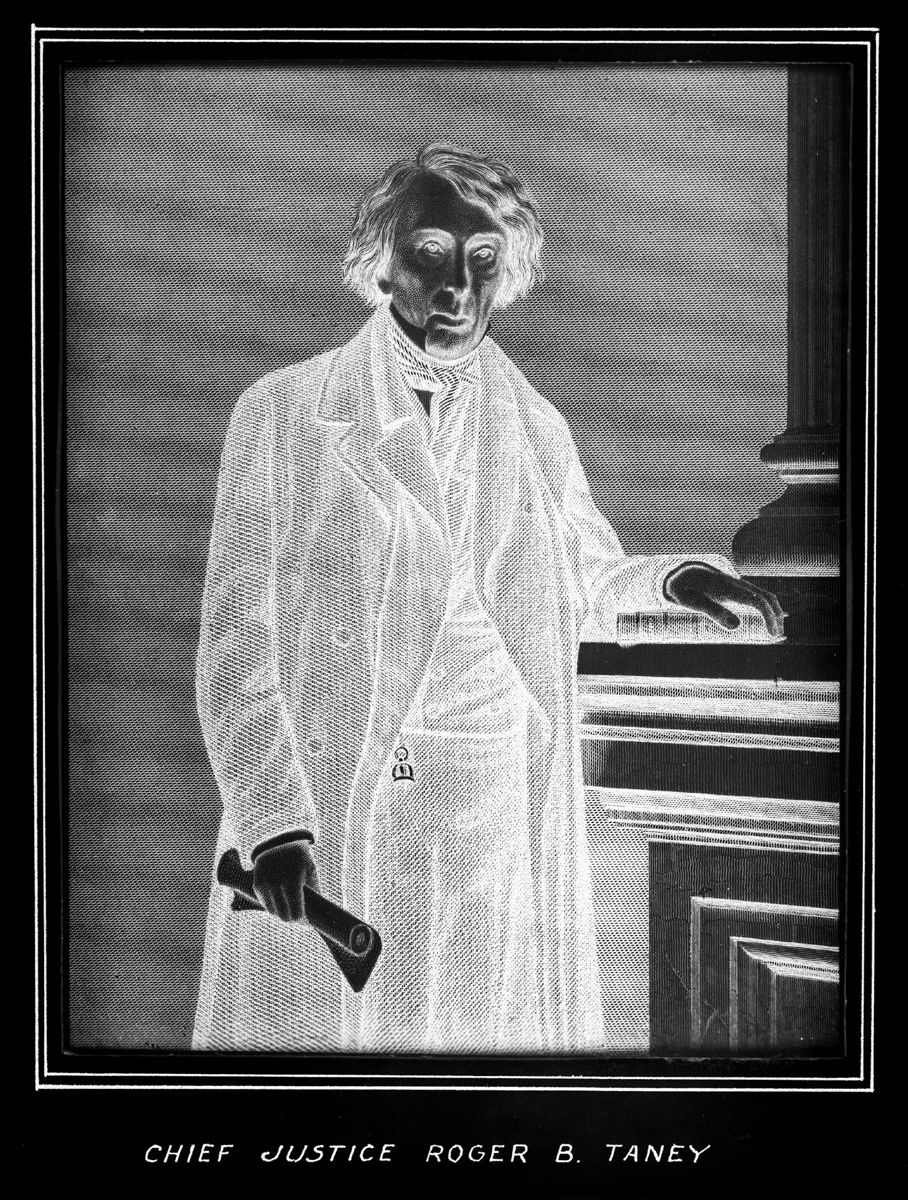
Chief Justice Roger B. Taney.
(Library of Congress)
Forney’s discharge. Lieutenant Ford, the commander of the Provost Guard, attempted to re-arrest Forney at his home, when “the unfortunate shooting took place.” Forney surrendered voluntarily to the civil authorities, but was taken by the military and imprisoned in Washington. After presenting these facts, the Spirit offered some opinions. “There seems to have been a direct collusion between civil and military authorities in this case, and an attempt on the part of the military to act at deciding the civil law. This raises a question regarding the rights and liberties of every American citizen.” The Spirit expressed dismay that decisions of civil courts could be overridden and the military allowed to remove a citizen charged with a crime from the state for trial before a distant military tribunal. The Spirit reported that Pennsylvania’s governor had been petitioned to intervene, “to vindicate the dignity and supremacy of the laws and Courts of the Commonwealth.” The Spirit urged that Forney be returned to Pennsylvania for trial. When Lieutenant Ford died of his wounds on Feb. 13, Forney was still locked up in Washington. At some point in the next few months, Forney was returned to Pennsylvania and held for trial, but he would have another adventure before his trial began. This adventure was brought about by a Confederate cavalry raid on McConnellsburg during Lee’s invasion of Pennsylvania. We learn about these goings on in the Sept. 30 edition of the Repository. It was reported that Forney, who had been “taken out of jail and carried off by the rebels during the [June 21] raid…, returned on the 21st Inst. [Sept.], and surrendered himself to await his trial at the October term of Court.” Forney’s whereabouts between the raid and his return are not reported, but it is interesting to note that Forney had now twice turned himself in voluntarily. On Jan. 20, 1864, the Repository told its readers of the trial, which resulted in Forney’s acquittal. “The fact that Forney killed Lieut. Ford was not denied but the defence was founded on the allegation that Forney did not owe service and that Ford had no orders or authority to attempt his arrest.” The Repository was not critical of the court nor of the jury but there was more to be said: “That Forney was legally acquitted seems to be free of doubt; but that he was an instrument in the hands of abler and worse men, was painfully manifest from various facts elicited in the history of the case; and that the aim of his masters was to breed revolution, defeat the conscription, and prevent the increase of our armies, cannot be truthfully questioned. That they have in this case, been saved by the generous bearings of our criminal code in all cases of reasonable doubt, is their fortune – not their just reward.” What is this about? Who were these abler and worse men? For this we turn to the Jan. 20, 1864, Spirit. “The grand jury of Fulton…ignored the bill of indictment against Henry G. Smith and John A. Robinson, as accessories of the shooting, there not being a particle of evidence to convict them of any complicity in the affair.” Per the Spirit, they were innocent, but who were they? I found them identified in an earlier report in the Potter Journal (Jan. 18, 1863). Henry G. Smith was the publisher of the Fulton Democrat. John A. Robinson was a local official, a prothonotary. Both were Democrats, of course, and both suspect in the eyes of Republican papers like the Repository and the Journal. The Repository seemed merely resigned to the acquittal; the Spirit was more positive. The Jan. 20 Spirit quoted with approval the Fulton Democrat’s opinion on the verdict, a determination reached after a threehour deliberation. “The result of this trial will be regarded as right and proper by every candid man who read the evidence, and we are sure that there was not an individual in the Court room who expected anything else than a prompt verdict of acquittal.” The Daily Pittsburgh Gazette (Jan. 22) admitted that the verdict was just, but like the Repository, said that “from various facts elicited in the trial it was apparent that [Forney] had been aided by bad men, whose object was to incite people to resist the conscription act.” The Jan. 20 Lewistown Gazette reported on the acquittal with less nuance than the Repository and the Pittsburgh paper: “There were some queer doings in that region, as is proved by the fact that a deserter can wantonly shoot down an officer and not be punished for it.” The Gazette was a Republican paper which in this same edition endorsed Lincoln for re-election, referring to the president as “that honest and incorruptible Patriot.” The reporting in the Potter Journal also lacked nuance. This paper did not wait for a trial to form its opinion. Much earlier, in February 1863, the Journal reported that Forney shot an unsuspecting Ford as the lieutenant approached the house; that Forney was a deserter; that Ford had been detailed to arrest him; and that this deserter had been arrested and “had escaped by a habeas corpus.” The details of the shooting, Forney’s standing in relation to the draft and, of course, whether Ford was acting under orders when he attempted the second arrest were important details that did not seem to concern the Journal. There is also the odd choice of verb associated with the writ of habeas corpus: most people would not consider a man released by order of a judge to have “escaped.” After the acquittal, however, the Journal was more matter-of-fact. On Jan. 17, 1864, the paper gave a brief summary of the events leading up the trial and stated without comment that Forney had been acquitted. No calling Forney a deserter; no allegations about abler and worse men. We do learn one other fact about Lieutenant Ford that may account for the earlier bias: he had once been employed at this very newspaper. We have seen how the military, the judges, the newspapers, and the jury all spoke and acted in this strange case of John Forney. In the spring of 1864 the voters had their say as well. From Philadelphia’s Daily Evening Bulletin, April 7: “Rewarded – John Forney, of Fulton County in this State, who killed Lieut. Ford for attempting to arrest him as a deserted conscript, was elected Constable by the Democracy of Todd township at the late election – receiving all but three of the entire Democratic vote polled.” Vox populi auditur. Sources: The newspapers cited in this column can be found at Valley of the Shadow archive (http:// valley.lib.virginia.edu/ and at the Pennsylvania Newspaper Archive (https://panewsarchive.psu.edu/). Gould Hagler is a retired lobbyist living in Dunwoody, Ga. He is a past president of the Atlanta Civil War Round Table and the author Georgia’s Confederate Monuments: In Honor of a Fallen Nation, published by Mercer University Press in 2014. Hagler speaks frequently on this topic and others related to different aspects of the Civil War and has been a regular contributor to CWN since 2016. He can be reached at [email protected].
The Merryman Case While I was perusing Pennsylvania newspapers to learn about John Forney and Lieut. E.N. Ford, I found a lively discussion of a more famous story, the case of John Merryman, a Maryland planter and militia leader. In May 1861 Merryman was arrested by the military for his role in the destruction of railroad bridges and telegraph lines, an effort undertaken to prevent the passage of troops through the Maryland. He was imprisoned in Fort McHenry. Merryman was not charged with a crime nor allowed access to legal counsel or civilian authorities. President Lincoln had authorized the army to suspend the writ of habeas corpus. Chief Justice Roger Taney ruled that only Congress could suspend the writ. The president himself lacked that authority and could not delegate to the military a power he himself did not have. Taney ordered the commander of the fort to bring the prisoner before the court. The commander refused. A review of news reports provides some interesting perspectives on this controversy. In June the Valley Spirit condemned Lincoln’s suspension of the writ and condemned the continued imprisonment of Merryman and the defiance of the court order. The Spirit published Taney’s long opinion in its entirety, an opinion ruling against the military’s “attempt to trample on the Constitution by destroying the great writ of habeas corpus.” The commander, the editor wrote, “informs the Chief Justice that he is authorized by the President to suspend when he pleases the operation of this writ which is the only guardian and security of liberty.” Lincoln’s action was “a dangerous usurpation of power,” the Spirit asserted, and added that “We are now carrying on a War to maintain the Constitution and Laws and must not see them trampled underfoot and the liberties of the people destroyed by the very Government that is professing to sustain them.” Another Democratic paper, the Lancaster Intelligencer, agreed with the Spirit. Of Taney’s opinion the Intelligencer wrote: “Like everything else emanating from this venerable and learned jurist, it is a lucid and unanswerable exposition of Constitutional law.” The military authorities ignored the newspaper editors as they had ignored Justice Taney. While the Franklin Repository did defend the suspension of the writ several times during the war, it did not report on the Merryman case. Other Republican papers covered the case in some depth. The Press, a major Republican paper in Philadelphia, discussed Taney’s opinion on June 1 and June 10. Justice Taney “appears wholly unconscious that the seat of Government…was threatened by hostile armies” and, in issuing his opinion, “took no notice of the fact that…Merryman was one of a number of armed men, who, confederating with the invaders…burnt bridges on the railroad over which [Government troops] were traveling.” The opinion was, moreover, “in exceedingly bad taste” and displayed Taney’s “petulant temper.” Bad law and bad manners too, according to the Press. Not all support for the Lincoln administration came from Republicans. The Sunbury American, a Democratic paper, argued that “In times such as these, the personal liberty of the subject must give way to the security of the State. Inter armes leges silent.” This was a rebellion, said the American, and Merryman was “a rebel traitor.” Merryman was indicted for treason in July and released on bail. He was never tried. Like Forney, Merryman found some vindication through politics. After the war he was elected by the Maryland General Assembly to the office of State Treasurer, a position he held from 1870 to 1872. He died in 1881.