
The Graphic War
Richmond Burning
By Salvatore Cilella · Originally published April 2020 · p. 24
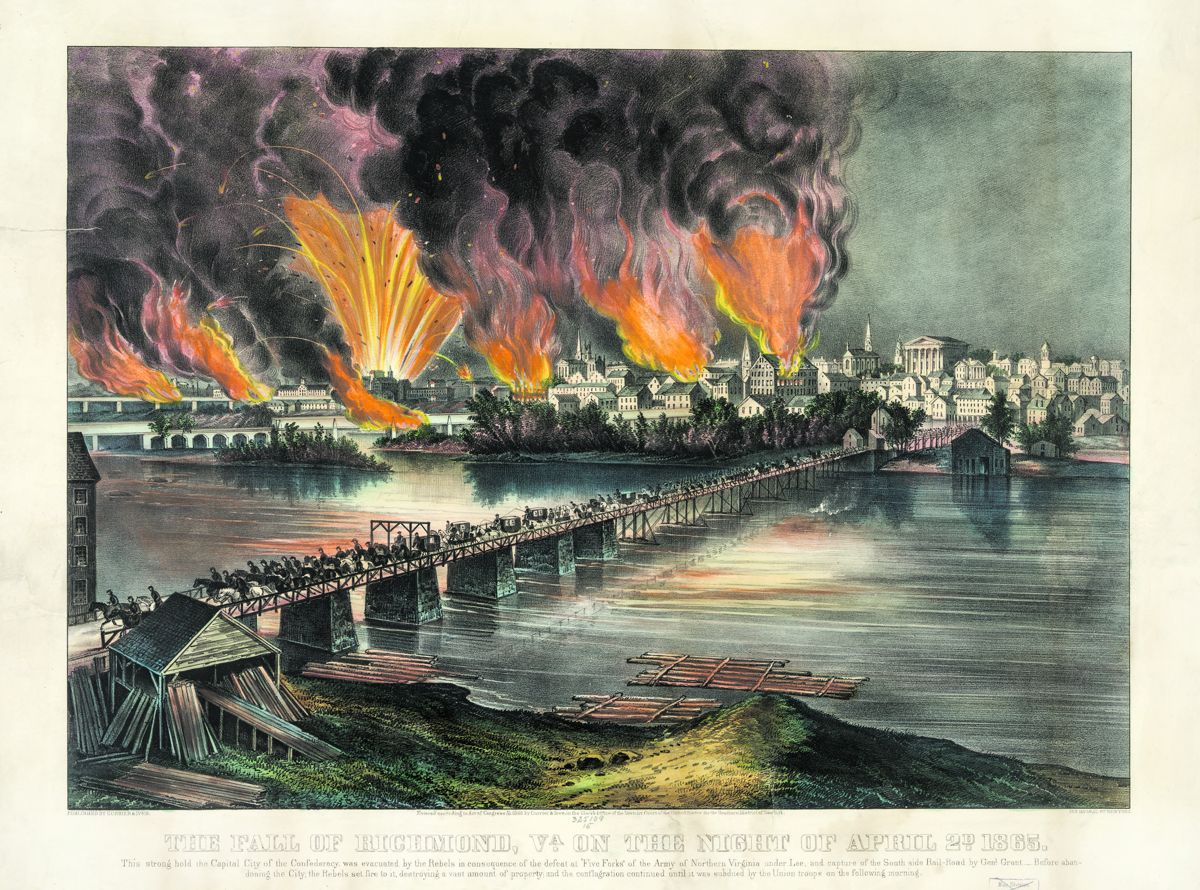
The Graphic War highlights prints and printmakers from the Civil War discussing their meaning and most importantly, the print maker or artist’s goals. To every Civil War student and scholar, April stands out in singular fashion from the other eleven months. Fort Sumter in 1861; Shiloh in 1862; prelude to Chancellorsville which began on May 1, 1863; Grant’s preparation for the Overland Campaign in 1864; and of course Lee’s surrender, the fall of Petersburg, the fall of Richmond, and Lincoln’s assassination in April 1865, must have kept the oracles busy looking for mystical patterns. There really weren’t any, the seasons and the weather had more to do with the movements of armies than coincidence and happenstance. Most military action ground to a halt during the inclement and unpredictable winter weather and renewed in the spring. All the major events enumerated above were depicted by nearly all large lithographic firms. True to its strategy of providing visual documentation of a current event, Currier and Ives rushed out a dramatic view of Richmond burning on the night of April 2, 1865. Entitled “The Fall of Richmond Va. on the Night of April 2nd 1865,” the title margin carried three more lines explaining the vivid visual. “This stronghold and Capital City of the Davis Confederacy, was evacuated by the Rebels in consequence of the defeat at ‘Five Forks’ of the Army of Northern Virginia/under Lee, and capture of the South Side Railroad by the brave heroes of the North, commanded by Generals Grant, Sheridan and others. Before abandoning the City the/Rebels set fire to it, destroying a vast amount of property and the conflagration continued until it was subdued by the Union troops in the following morning.” Sheridan’s defeat of Pickett at Five Forks opened the flood gates. Early that morning, April 2, 1865, Lee realized that a breakthrough had occurred at
Hatcher’s Run. By 11 a.m., Lee informed the higher ups in Richmond that he could no longer hold his position and was preparing a westward movement. Davis gave up the ghost and by night fall, Confederate General Richard Ewell ordered all material that would aid the enemy destroyed. Mob panic and a strong breeze set the town on fire. Law and order ceased to exist, and pandemonium reigned. At dawn, Ewell “ordered his men take control of the Mayo’s bridge at the foot of 14th Street, the only remaining bridge across the James,” and then set it afire. As the troops reached the foot of 14th Street, “the arsenal…reputed to have…750,000 loaded projectiles, exploded over their head.” A correspondent reported that the “city magazine passed out of existence.”1 Ewell depended on Provost Marshall Isaac Carrington to burn the warehouses. Captain Clement Sulivane, a 26-year-old from Maryland was tasked with guarding Mayo’s toll bridge until all rebel units were safely across. Once Carrington’s men had burned the “tobacco warehouses and the railroad bridges,” Sulivaine was to “perform the final act of demolition and burn Mayo’s bridge, the last intact span across the river.”2 Currier tried to capture all the pathos of this historic event not in one print, but in three. Unfortunately they did not identify any landmarks leaving us to reconstruct the event. Two of the three prints were issued as small folios including this one, which was hurriedly produced. It differs from the other small folio with minor changes in depicting pedestrians and carriages on the bridge. The large folio shows more of the foreground and the spot where the bridge connects to the land. Taken from the perspective of the city of Manchester across from the capital, all three folios show the steady stream of fleeing refugees crossing the James River using Mayo Bridge at 14th Street (Currier did not identify it). The capitol building, high on the hill, is shown to the right of the flames consuming the city.3 In 1932, print dealer and collector Harry Shaw Newman of the Old Print Shop in New York City teamed up with renowned Currier collector, Harry Peters to produce two lists of the best 50 large and best 50 small folio Curriers. Fifty years later, another generation re-examined the original lists and came up with 100 in each category, one of them being the “Fall of Richmond.”4 Endnotes: 1.
-
(Library of Congress)
Ken Bivin. https://www.historynet.com/americas-civil-war-thefall-of-richmond.htm. Nelson Lankford. Richmond Burning: The Last Day of the Confederate Capital. New York: Viking, 2002, 83. Gale Research Company, Currier & Ives: A Catalog Raisonne. Detroit: Gale Research Company, 2 Vols., 1984. I, 203. Robert Kipp. Currier’s Price Guide to Currier and Ives Prints. Brockton, MA.: Currier Publications, 1989. 45-46.
After 43 years in the museum field, Salvatore Cilella now spends his time collecting American prints and maps and writing. His last professional position was President and CEO of the Atlanta History Center. His most recent books are Upton’s Regulars: A History of the 121st New York Volunteers in the Civil War (U. Press Kansas, 2009). His two-volume Correspondence of Major General Emory Upton, (U. of Tennessee Press, 2017), is the recipient of the 2017–2018 American Civil War Museum’s Founders Award for outstanding editing of primary source materials. His latest book is an edit of Upton’s letters to his wife 1868– 70, published by the Oklahoma University Press.