Identified Knife / Fork Combination
By John Sexton · Originally published April 2020 · pp. 20–21
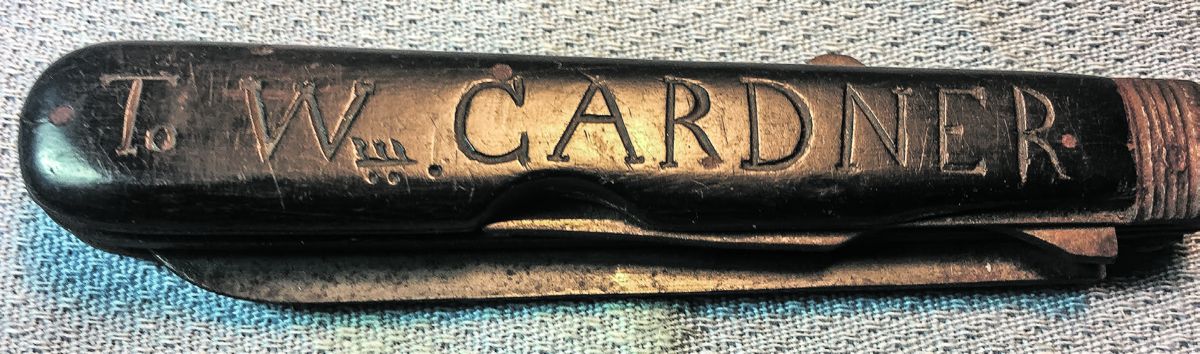
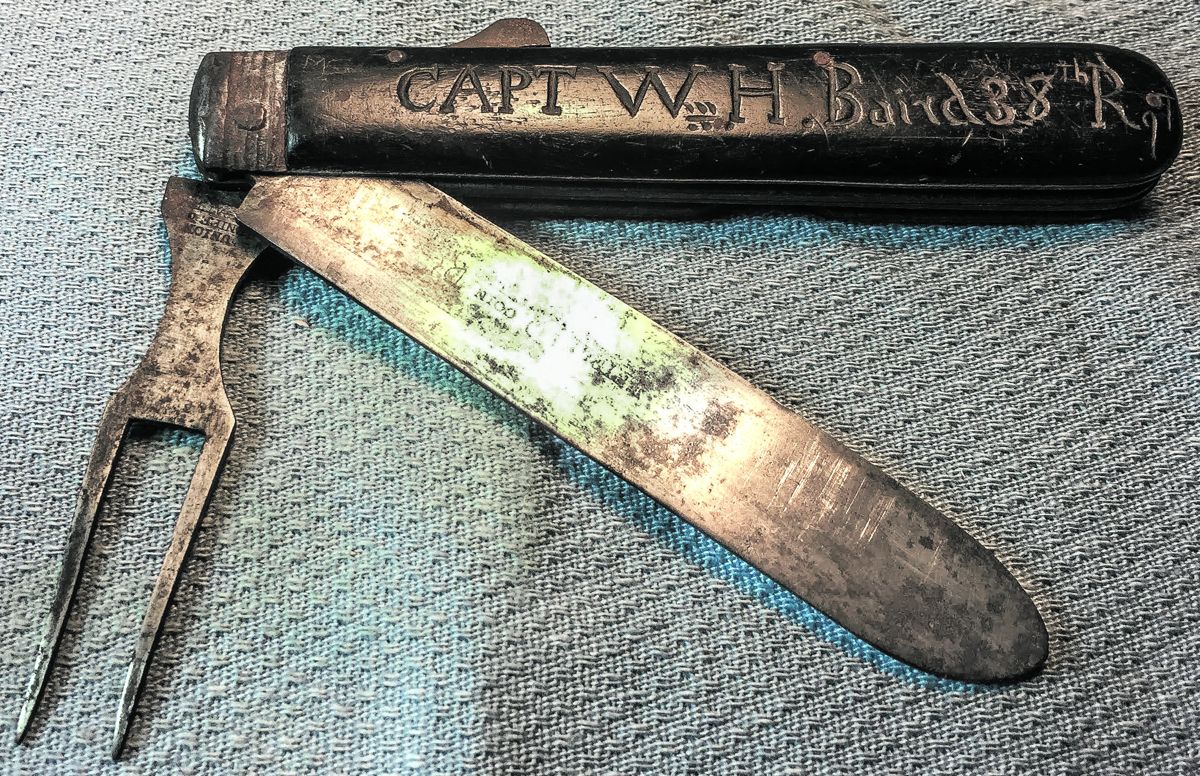
Dear John: I am writing seeking assistance about how to discover the value of a Civil War era folding knife. I have included some photos of the knife and the history I have been able to find. This knife is been in my family for a very long time, but I do not know how we came to have it. As you can see in the photographs the knife is engraved by hand and apparently belonged to Capt. William H. Baird of Company H, 38th Regiment, New York Infantry. On the other side of the knife is the name “William M. Gardner” who apparently received the knife as a gift from Baird. I have done some research and had no trouble finding information on Baird. He was an officer at the first Battle of Bull Run. A fascinating account of that battle was written by him in a letter to his brother in July 1861. I’ve included a link to that letter. In it he mentions saving the life of a Confederate soldier who was badly injured in the leg. No name was mentioned in that letter. However, information on a William Gardner was available and shows that he was at the same battle and badly injured with a leg wound. I think it’s very possible that may be the William Gardner to whom knife was given. Thank you for reading this email and taking the time to perhaps have a look at what I have enclosed. David Savage Dear Mr. Savage: William Baird does have a fascinating history, but the name on other side of knife is not William M. Gardner, but a much less common name William Cardner. The letter you cite from 1st Manassas shows Baird’s gallantry and it is no wonder he went through the ranks with promotions and accommodations. Baird entered service May 24, 1861, at Geneva, NY, as a Captain in the 38th New York Infantry. He must have received this Union Knife Company knife/ fork combination sometime prior to his leaving the 38th in July 1862. This particular patent item was very popular with soldiers in the field and excavated parts are very common in Civil War campsites. More common are knife/ spoon/fork combinations. Captain Wm. H. Baird’s name is carved in same hand that carved the other side’s “To Wm. Cardner,” using the same abbreviation for William and same slab serifs. I can find no one named Cardner as a soldier, maybe he was a family friend back in New York? Or did he mismark the “G” and name really is William Gardner. Baird does not give a rank, so possibly he was not one of the 350+ soldiers North and South with that name, but there are no Gardners in the 38th NY Inf. Gardner’s name may not add much to the value unless William Gardner’s story is rescued from history which I have not been able to do. Colonel, and later general, in the Confederate Army, William M. Gardner is the only officer Gardner listed among the Confederate wounded at Manassas; if Baird had gifted this William Gardner, he most assuredly would have recognized this West Pointer by rank, and it would be part of historical record. Regardless, William Henderson Baird has a remarkable Civil War history but not in the 38th NY Inf., but in the hard fought and unjustly labeled “Harper’s Ferry Cowards”, the 126th NY in which he was commissioned major during August 1862. Baird was removed from service surrendering the 126th at Harper’s Ferry in October 1862. The newly formed 126th was just 2 weeks old at the time and 907 men surrendered, in what was the largest surrendered American military force till Bataan in WWII. President Lincoln reappointed Baird after an outpouring of support from several generals and his commanding colonel in the 126th. The 126th would show their “manhood” after their capture and humiliation. Eliakim Sherrell, colonel of the 126th would be killed defending the Union line against Pickett’s charge at Gettysburg.
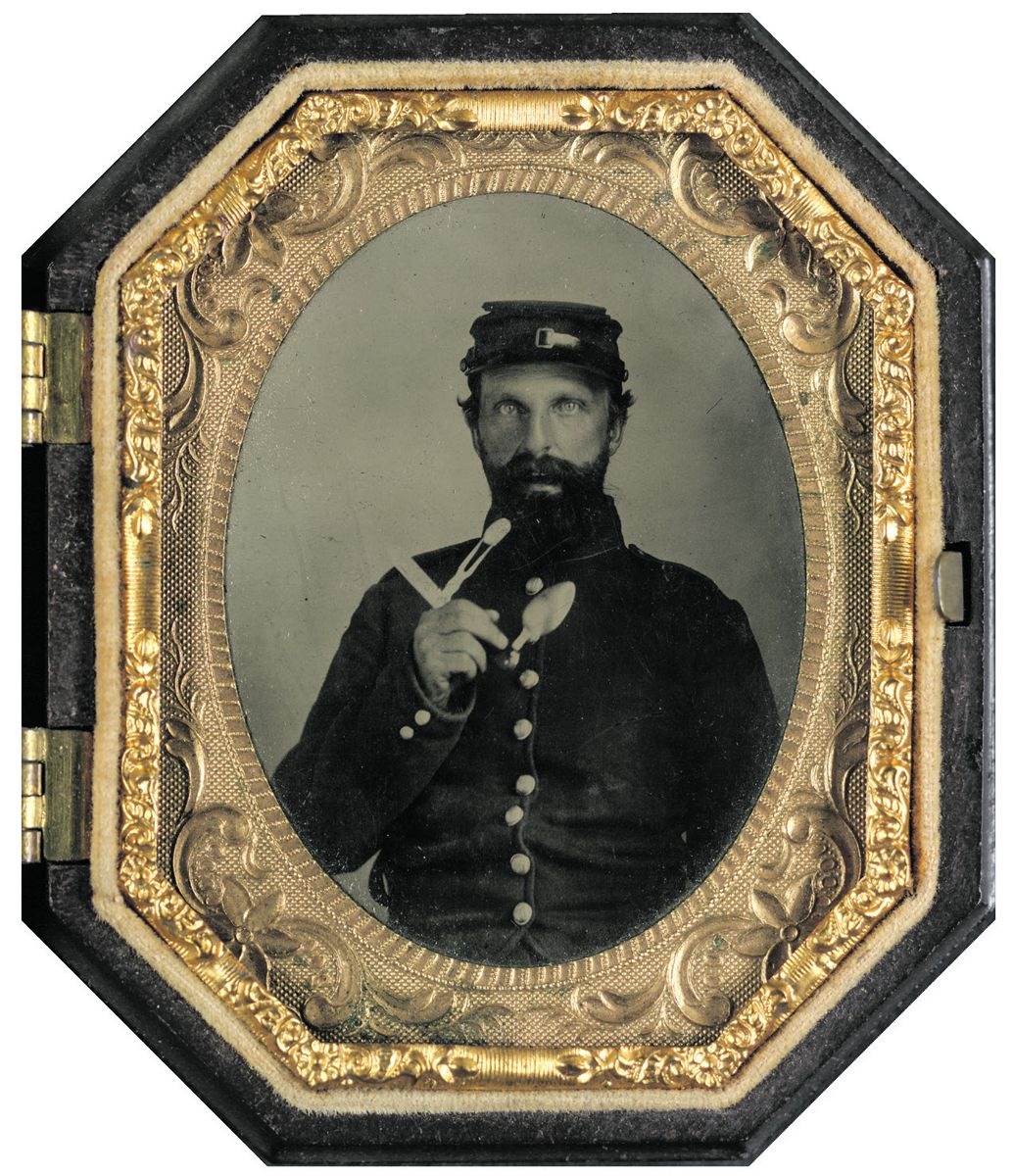
Baird would be promoted Lt. Colonel of the 126th and would take command of the regiment when Col. James Bull retired from service due to poor health in the spring of 1864. Baird led the 126th gallantly through the Overland Campaign against Richmond that led to the June 16, 1864, battle of Petersburg where the 126th was in Hancock’s II Corps. Colonel Levin Crandall of the 125th NY was leading the right wing, including Baird’s 126th, when Crandall was shot in face and Baird ordered to take command. Baird was now leading the 3rd brigade, 2nd division of the II Corps through heavy fire close to the Confederate entrenchments. Baird was shot through both lungs by a musket ball. He was attended by his adjutant, Spencer F. Lincoln, who stayed with him on the field taking final messages for his wife and two children at home. Baird died less than one hour after that mortal shot. Adj. Lincoln, while attempting to take the body back to Union lines, was shot and killed; since both bodies lay in front of the strong Confederate defenses, Baird’s final messages lost. William H. Baird (August 19, 1831–June 16, 1864) was one of many casualties from the 126th. The total enrollment of the regiment during service was 1,036 of whom 17 officers and 259 men were killed. The total of killed and wounded in the regiment amounted to 535. The killed and wounded at Gettysburg amounted to 228; 57.4 per cent of regiment was casualties in the war. The 126th rid themselves of the nickname “Harper’s Ferry Cowards” forever. Baird’s tombstone reads “COL. WM H. BAIRD / 126TH NY Vols / KILLED / IN THE BATTLE OF PETERSBURG VA / June 16 1864 / Age 32 yrs 19 mos 27 days.” Union Knife Company patented hands to eat. This was such a popular item that several wartime photographs are posed with the soldier holing this unique utensil. One tintype of a private holding one sold at Heritage Auctions for $1,200 in 2008. I have seen many of these knives sold over the years. A fine complete example by the same maker with no history is available for about $200-300 in the Civil War market. Identified examples, such as this one, inscribed by an officer killed in action, should bring several multiples of the basic sale value. If I were cataloging for auction, I would estimate your “Union” knife/fork combination for $600-800, and not be surprised to see it bring more.
Unidentified soldier in Union uniform with combination forkknife-spoon eating utensil. (Liljenquist Family Collection of Civil War Photographs. Library of Congress). Another image of a solider holding a knife/fork/spoon combination utensil sold for $1,195 at Heritage Auctions, Dallas, Texas, (lot 57657, Nov. 20, 2008) folding cutlery combinations were copied after Sheffield-made combinations originally made for picnicking and for military officers. But this particular Civil War utensil was ingenious in that the knife part would slide off the fork so a soldier could use both
John is an certified appraiser with International Society of Appraisers specializing in Civil War memorabilia. He authenticates and evaluates other rare and valuable historic items as well. His website is www.civilwardealer.com. He is coauthor of the book Confederate Bowie Knives (2012) by Jack Melton, Josh Phillips and John Sexton, that was published by Mowbray Publishing, Inc. Send “Ask The Appraiser” questions and photographs to [email protected].