
Book Reviews
Book Reviews — April 2020
Originally published April 2020 · pp. 38–42
Civil War News book reviews provide our readers with timely analysis of the latest and most significant Civil War research and scholarship. Contact email: [email protected].
A Confederate and His Family Confront War The Yankee Present. By Philip Ross Chadwick. Westbow Press, www.westbowpress.com, 2018, 163 pp., softcover, $13.95. Reviewed by Wayne Wolf
In this novel of historical fiction, the author uses the life of his distant ancestor, Thomas Hanner Lyle, Company B, 14th Tennessee (CSA) Infantry Regiment to delve into the psychological stresses for a soldier going to war. Leaving a new bride pregnant with their son, Thomas feels the need to fight for his ideals and support the Southern cause. In a series of flashbacks, the author uses imagery from Thomas’ antebellum farm life to show how war disrupted family, affected those left behind, changed the soldier, and destroyed the social and economic fabric of life. Within Thomas’s story are woven many incidents that define a soldier at war. He is wounded at the Battle of Shepherdstown, listed as missing in action at Chancellorsville, and has his letters with a Yankee present (the bullet that caused his injury) returned to his wife with no explanation, leaving her uncertain over his fate. He experiences the lack of food, the excitement of letters from home, and the pride of being promoted to sergeant for bravery. Yet, the last two years of the war are spent officially missing while recovering from a broken arm and leg. Not writing home during this time, he is unaware of the mental torture his family is enduring. His family is aware that thousands of families never find out the particulars of their loved ones death or final resting place. This is a novel that adds no new historical facts to the record but encourages historians not to neglect the mental and psychological strain placed on both soldiers and their families during war. When battles and statistics flow from the pen of researchers, this novel begs they examine the individuals behind the numbers and add a human dimension to their work. Each soldier and his family are profoundly affected by decisions to go to war, a lesson as true today as during the Civil War. While a careful editing would have removed some grammatical lapses, this book should appeal to a younger generation of readers interested in the trauma of war. The price of the novel is reasonable, and the storytelling makes the reader want to finish the book without taking a break. Wayne L. Wolf is Professor Emeritus at South Suburban College and the author of numerous Civil War books and articles. He currently is concentrating on publishing soldier’s letters that add to the understanding of life during the war.
Getting to know the Troup Artillery Sons of Tom Cobb: Troup Artillery, Athens, Georgia. By William Sidney Smedlund. Maps, illustrations, appendices, bibliography, photos, rosters, notes, index, 320 pp., 2019. Self-published. smedlundbill@ gmail.com. $48 hardcover plus $5 postage. Reviewed by Charles Kelly Barrow
Cobb: Troup Artillery, Athens, Georgia, Mr. Smedlund provides a vital resource for those who desire personal accounts or are in search of genealogical information on this Clarke County, Georgia, artillery unit. Charles Kelly Barrow, Ed.S has been passionate about the War Between the States since he was a young boy. He is currently a teacher of high school history, as well as the Vice-Chairman of the Georgia Civil War Commission. His favorite topic, and one he has published articles and books about, is the blacks who served and fought for the Confederate States of America.
There are few books written concerning artillery units and their history; yet, Bill Smedlund’s Sons of Tom Cobb: Troup Artillery, Athens, Georgia brings a focus on the exploits of Athens’ most famous artillery unit. Mr. Smedlund covers these men from January 1861 until they disband on April 9, 1865, outside Appomattox Courthouse. The book is not only a military history, but it delves into the personal side of each soldier. The Troup Artillery consisted of young men who included 41 sets of brothers, 34 brothers-inlaw, and over 30 cousins. These family connections made this unit perform well under the most severe of circumstances. The biographical sketch of each soldier provides details such as wives names, postwar jobs, and significant accomplishments. This is a treasure trove to any genealogist. When reading the first-hand stories from letters, diaries, and postwar reminiscences, the reader will be moved by the detailed accounts of engagements. The emotions are raw as soldiers tell of losing friends, brothers, commanders, and the casualty numbers on both sides. This is especially true with accounts pertaining to the Battles of Fredericksburg, Chancellorsville, and Gettysburg. The retreat from Petersburg to Appomattox Station is a blow by blow nail-biting account that has the reader desiring that these boys can achieve the impossible. The chapter entitled “Appomattox Station and The
Long Walk Home” details what the men experienced as they made their way toward home or North Carolina so they could join Confederate General Joseph E. Johnston and continue fighting. The perseverance of the seven men who desired to see the Natural Bridge in Virginia before returning to Georgia is to be commended. Finally, the story of the Troup Artillery flag is a story within itself. When the new unit flag was presented before General Robert E. Lee in June 1863, Captain Henry Hull Carlton promised, “The flag should never be disowned, dishonored, or surrendered.” The flag escaped capture, even after being shot down numerous times, but went on to be present when Confederate President Jefferson Davis’ daughters visited Athens. In 1995, Bill Smedlund gave the Civil War community Camp Fires of Georgia’s Troops 1861–1865, an asset for anyone researching locations of the Georgia troop’s camps during the War for Confederate Independence. With Sons of Tom
Selectively Picking “A Snitch, Indeed”…But Whose! up the Pieces Engines of Redemption: Railroads and the Reconstruction of Capitalism in the New South. By R. Scott Huffard Jr. Illustrations, figures, graph, tables, appendices, chapter endnotes and bibliography. 324 pp., 2019. University of North Carolina Press, Chapel Hill. www.uncpress.org, paperback, $32.50. Reviewed by Richard J. Blumberg
Engines of Redemption provides a good example of how history is almost always written by the victors. Huffard’s latest work presents an interesting argument that railroads were a conduit for elite whites and railroad management companies to exploit racial, social, and economic tensions in the name of capitalism. Railroads always played an important role throughout America. One of the first forms of mass transit, it provided efficient transport of troops and supplies during the war. It also became a popular form of passenger travel. However, it also brought its own challenges in management, safety regulations, government policies/intervention, and health related issues. The economic culture of the South was permeated with political, racial, and entrepreneurial strife before and during the Civil War. During Reconstruction, the North sought better trade routes and economic growth by expanding rail routes to increase commerce. This made railroads a very lucrative target. The book is divided into two parts. Part One describes the love affair of antebellum America with the railroad. Part Two provides various case studies related to the unique problems encountered in the New South. Some of these include: safety regulations, track durability, the spread of yellow fever, and the consolidation of various rail lines. This section is especially interesting for railroad enthusiasts since it covers train wrecks, robberies, and the growth of monopolistic management companies. Both parts of the book are set in the American South during the 1880s and 1890s. Huffard uses illustrations, a graph of train wreck events, and recollections of personal rail journeys to show readers how Northern capitalists took advantage of the devastated South. He effectively validates his argument, while providing additional information about railroad operations. Readers will learn how rail routes could make or devastate a city’s economy. He also discusses the challenges of how to manage and rework rail lines of different track widths. Much like what happens in our economy today relative to financial crises and natural disasters, certain companies and cities were selectively chosen to survive the changes in railroads, while others were simply lost in a desperate fight for economic survival. An interesting note related to this work is that the story of African American contributions is purposely excluded. The redemption of the railroad came primarily at the hands of white supremacy. Therefore, the public media was essentially controlled by their agenda and desires. Huffard’s work is a delight for railroad enthusiasts, logisticians, and those interested in management principles. Richard had a 26 year Active/ Reserve career in the Army. Seventeen years were spent in assignments dealing with Corps and Theater Army level multi-functional logistics. His current works include an article awaiting publication on the influence of music in the Civil War. He has also begun a series of articles emphasizing the contributions made during the Civil War to modern logistical operations.
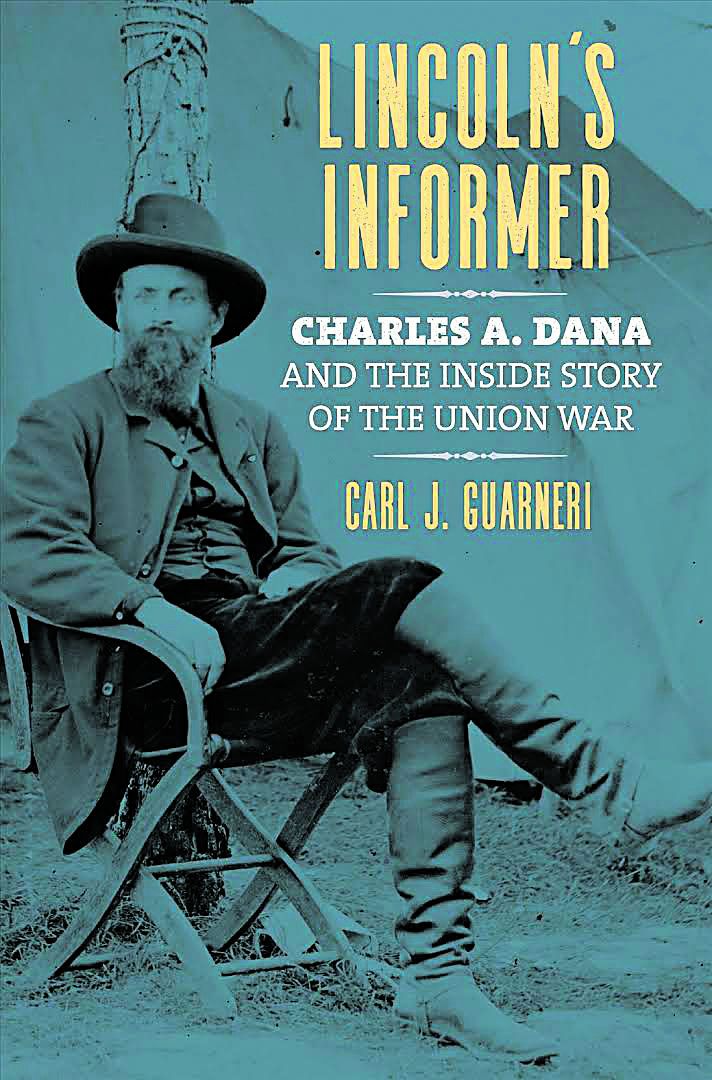
Lincoln’s Informer: Charles A. Dana and the Inside Story of the Union War. By Carl J. Guarini. Maps, Illustrations, Photos, Index, Notes, Bibliography, 520 pp. University of Kansas Press. www.kansaspress.KU.edu, 2019, hardcover, $39.95. Reviewed by Joseph Truglio
According to Webster’s Collegiate Dictionary, an informant is one who gives information against another for money or other rewards. That seems to fit Dana’s character. However, he is much more than that. Starting in 1849, Dana was the managing editor of the N.Y. Tribune, one of the most influential newspapers in the nation. It was owned by Horace Greeley. Greeley and Dana had a volatile relationship. Both were abolitionists but Dana wanted change quicker than Greeley and that conflict led to Dana’s leaving the Tribune and taking a job with the U.S. War Dept. as an observer of General Grant and the war in the western theatre. Lincoln needed to know that his confidence in Grant was well founded. Edwin Stanton was the man to get that done. And so began a long relationship on intelligence gathering, one that lasted until Stanton’s death in 1869. In a nut shell, Dana went out West, attached himself to Grant’s army, got involved in its politics, was supportive of Grant’s strategies, and was very helpful in resolving the situation there. Along the way, he became friends with Grant, protected him from the politics of the Union’s leadership, and assured Lincoln that Grant doesn’t drink on campaign. All this was done while reporting directly to Stanton. Dana was active in deflecting Gen. McClernand’s criticisms. He was also very instrumental in the removal of Gen. Rosecrans from the Army of the Cumberland.
He came east with Grant in ’64, was assigned to the war department directly under Stanton, and worked in logistics. He was active in the politics of the ’64 election in the Army and a strong supporter of Lincoln. After the assassination, he was active in the hunt for the assassins, and worked tirelessly in the trial and its aftermath. He stayed in the war department until Stanton’s death in 1869. After that, he returned to his first love, newspapers, and built the New York Sun into one of the nation’s leading papers. He continued this passion until his death in 1897. He also published a best selling autobiography called Recollections of the War. Later it was discovered it was written by Ida Tarbell. That is the overview of this excellent biography. I left out much so you can enjoy, like I did, finding many nuggets of information not usually told. There is a similar book published recently called Lincoln’s Confidant, but I enjoyed this one more. As to the title, I will leave this up to the reader to decide. Myself, I think Dana was Stanton’s man. There is little written contact between Dana and Lincoln.
With all that said, get yourself a copy and get a good look into the machinations behind the scenes of military campaigns. You will be glad you did. Enjoy! Joseph Truglio, of Manchester, N.J., is a retired Motion Picture Technician who has a life long interest in the Civil War. He is currently President of the Phil Kearny CWRT in Hasbrouck Heights, N.J.
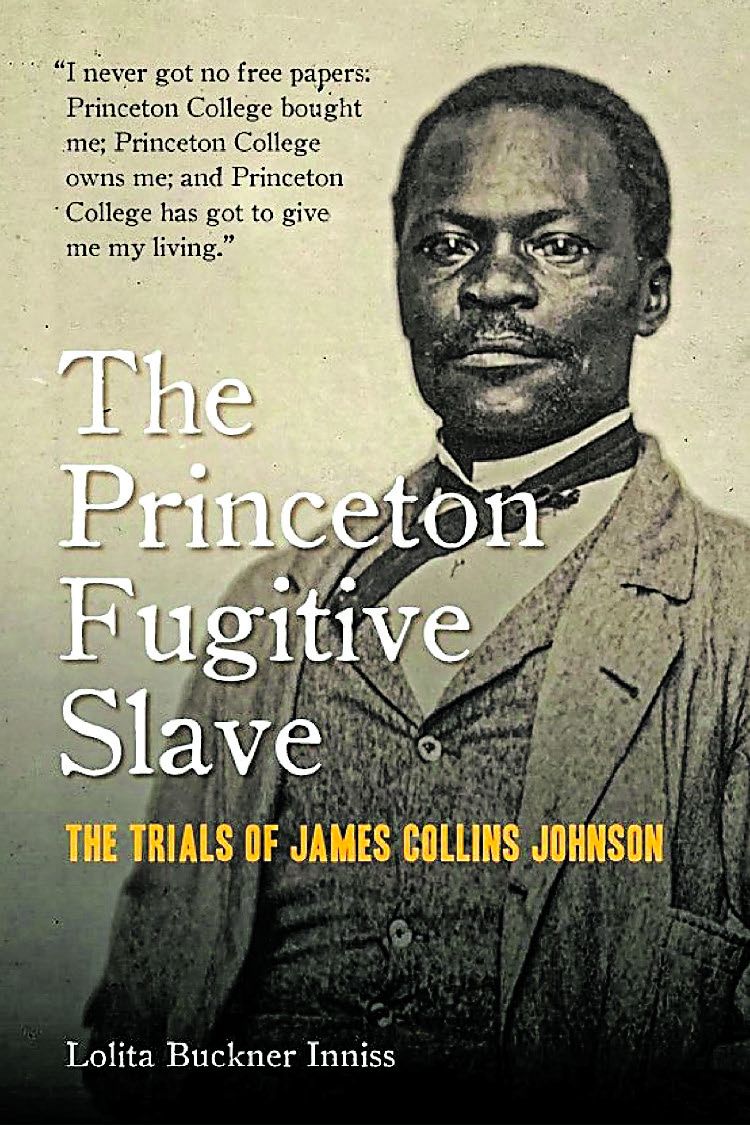
The Princeton Fugitive Slave: The Trials of James Collins Johnson. By Lolita Buckner Inniss. Notes, Bibliography, and Index. 272 pp., 2019. Fordham University Press, www.fordhampress.com, cloth, $29.95. Reviewed by David Marshall
Lolita Inniss tells the story of James Johnson, a runaway slave from Maryland who ended up in Princeton, N.J., in The Princeton Fugitive Slave. In 1839, Johnson found his way to this college town in New Jersey where he obtained a job and became someone well known by many. Working on campus in 1843, he was recognized by a student from Maryland and arrested on suspicion of being a fugitive. Johnson’s owner came to the college and had him taken to jail and kept there until his trial based on the 1793 Fugitive Slave Act. He was convicted and shortly before being returned to his former life, a local white women paid off his former minutiae of Johnson’s move to and makes excellent conclusions titleholder. Princeton and how he succeeded that will cause some readers to In The Trials of James Collins in fitting into the college commu- rethink their own opinions of runJohnson, offers a fascinating nity. The third chapter is the most away slaves and free people. tale of a man who spent sever- complete in detailing the main Disappointing is Inniss’s inal years paying off his debt and character’s experience of disloy- ability to write about Johnson’s how he lived a fascinating life. alty and detention. An excellent life prior to 1839. This would He became an independent en- point this writer addresses are have completed the story and protrepreneur at Princeton who the different people who were in- vided a much greater context to came in contact with many peo- volved with the main character’s what he became. Sadly, Johnson ple throughout a six-decade life arrest. Chapter four analyzes the failed to leave any writing of his on campus. At his death in 1902, fugitive slave trial, who the law- life prior to 1839. However, this students described him as “the yers and jurors were, and how writer does full justice to the unstudents’ friend”. This was a man they arrived at their guilty ver- folding drama in a narrative rich who had freedom, safety, and in- dict. Chapter 5 elucidates how in biographical detail and percepdependence for sixty-three years. Johnson went from a slave to a tive analysis. She was able obtain The author makes an insight- free person. An intriguing point a great deal of information from ful question regarding Johnson brought up concerns the former primary source material in the keeping his feelings to him- slave’s patron and the prominent Princeton College records, cenself throughout his time dealing family she was a member of. sus records, newspapers, family with many students, Princeton Chapter six defines Johnson’s life records, and local histories, that employees, and well-known lo- after the trial and contests the ap- discloses Johnson’s life story. cal citizens. A second intrigu- pearance of this man as a typical One fascinating anecdotal point ing question that the writer cov- free person during Jim Crow but the author found is that Jonson ers is who betrayed Johnson to someone who made a success- was well known on campus but his former owner. In the end, ful independent life as an entre- nicknamed by Princeton students Innis proposes that the Princeton preneur. The concluding chapter as “Jim Stink” which says a great University provost actually was goes over the book’s central ideas deal of the individuals he came in involved in laying out school funds to buy the former slave’s freedom. As he often indicated to people, the college owned him. This man’s life is one of being a slave in the Mid-Atlantic, the challenges of living at a university during the Antebellum Era in contact with. This book is highly recommended for a short but insightful look at the life of James Johnson, a runaway slave, whose freedom during the antebellum period and the Jim Crow era is threatened by lack of opportunity and a local interpretation of several disputed laws. It is a thought-provoking study that should be required reading for students and enthusiasts of an often-neglected topic.
David Marshall is a high school American history teacher in the Miami-Dade School district for the past thirty-three years. A lifelong Civil War enthusiast, David is president of the Miami Civil War Roundtable Book Club. In addition to numerous reviews in Civil War News and other publications, he has given presentations to Civil War Round Tables on Joshua Chamberlain, Ulysses S. Grant, Abraham Lincoln, and the Battle of Gettysburg.
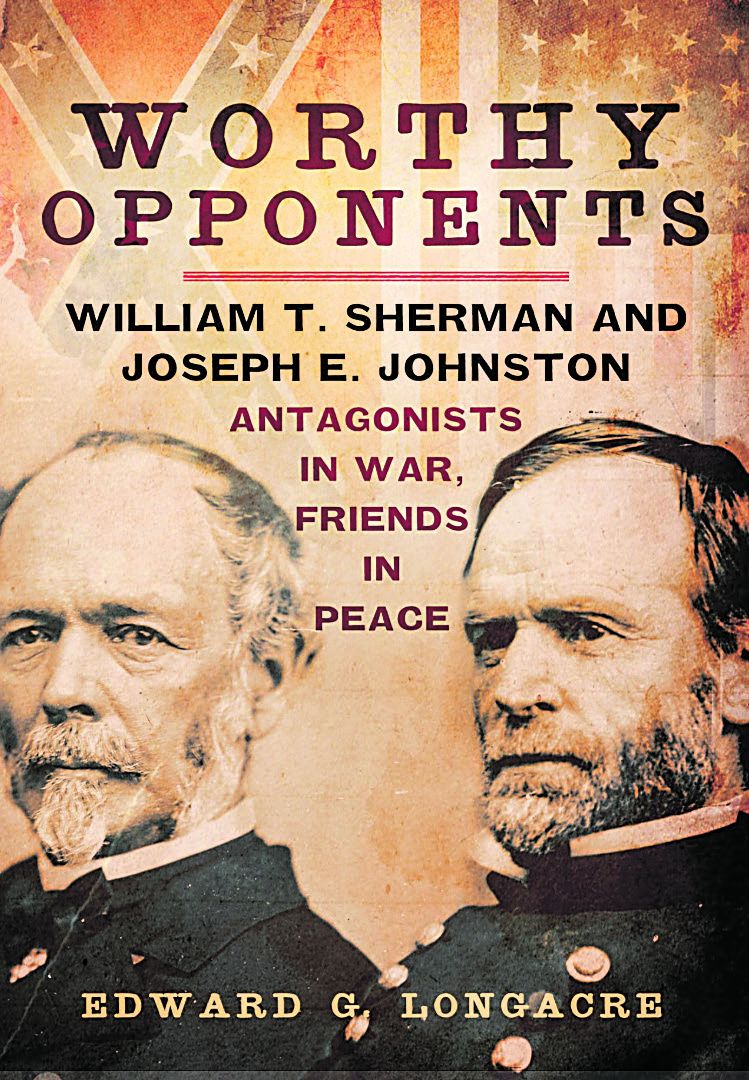
A Tale of Two Generals The Case That Elected Abraham Lincoln Worthy Opponents: William T. Sherman and Joseph E. Johnston – Antagonists in War, Friends in Peace. By Edward G. Longacre. Maps, photos, notes, index, 392 pp., 2017. University of Oklahoma Press, www.oupress.com. $24.95. Reviewed by John D. Fowler
William Tecumseh Sherman is generally considered by Civil War historians as one of the best generals of the American Civil War, while his most famous opponent, Joseph E. Johnston, is often considered among the worst. The Atlanta Campaign of 1864 cemented the reputations, good and bad, of both men and created a bond they continued after the war. Through their post-war letters and memoirs, Sherman explained his success while Johnston explained his defeat. Interestingly, both men needed the other to substantiate their accounts and their generalships. Historian Edward G. Longacre’s Worthy Opponents examines this interesting story. Longacre is a prolific scholar, having written 24 books and some 100 journal and magazine articles on the Civil War. His The Cavalry at Gettysburg: A Tactical Study of Mounted Operations during the Civil War’s Pivotal Campaign, 9 June-14 July 1863 (1993) won the prestigious Fletcher Pratt Award as the best book of Civil War nonfiction; his Pickett: Leader of the Charge – A Biography of General George E. Pickett (1995) was a finalist for the Douglas Southall Freeman Award; and his Gentleman and Soldier: The Extraordinary Life of General Wade Hampton won that award in 2004. He also served as a historical advisor to the 1993 motion picture Gettysburg. Worthy Opponents is organized into 18 chapters that present parallel biographies of both Sherman and Johnston. The final chapter is an epilogue that discusses the men in the post-Civil War period until the death of
Sherman. Longacre writes well, and he weaves an interesting story. He does not, however, offer anything new on Sherman’s and Johnston’s military histories or their battlefield encounters during the Vicksburg, Atlanta, or Carolinas’ Campaigns. Indeed, sections covering the battles are mere summaries without much depth or detail. While the narrative does examine their generalship to a degree, the reader is left wanting more. Moreover, the most disappointing aspect of the book is the short epilogue that chronicles the generals’ post-war relationship. The title appears to promise more than the ten pages give. In sum, Longacre has written a basic biography of both generals that would come in handy for someone who only needs a brief overview with limited detail of these men and their Civil War careers. Despite its brevity, this volume is more effective than the ultra-slim, 94-page attempt at a co-biography of the generals entitled Civil War Enemies, PostWar Friends: William Tecumseh Sherman and Joseph E. Johnston (Charles Rivers Editors, 2013). Those wanting a more detailed account of the lives of both men must consult other biographies. Currently, perhaps the best biographies of William T. Sherman are James Lee McDonough’s William Tecumseh Sherman: In Service to My Country – A Life (2016), Robert L. O’Connell’s Fierce Patriot: The Tangled Lives of William Tecumseh Sherman (2014), and John F. Marszalek’s Sherman: A Soldier’s Passion for Order (1993). Additionally, while not a biography as such, Burke Davis’s Sherman’s March: The First Full-Length Narrative of General William T. Sherman’s Devastating March through Georgia and the Carolinas (1980) offers great insight into the man and his generalship. Perhaps the best modern biographies of Johnston include Gilbert Govan’s and James Livingwood’s Joseph E. Johnston: A Different Valor (1994) and Craig L. Symonds’s Joseph E. Johnston: A Civil War Biography (1992). Historians have not delved into Johnston’s life as much as Sherman’s, and there is a need for a new monograph on the general. John D. Fowler, Ph.D, holds the B.J. and Dicksie Bandy Chair of American History at Dalton State College. He is co-editor, with David B. Parker, of Breaking the Heartland: The Civil War in Georgia (2011).
Dred Scott: The Inside Story. By David T. Hardy. Illustrated, notes, self-published, 2019, 68 pp. Softcover, $9.00. Reviewed by Wayne L. Wolf
The 1857 case of Dred Scott vs. John P.A. Sandford was contrived by pro-slavery forces to once and for all end the sectional debate over slavery and preserve the Union. It had, according to the author, just the opposite effect. While the case originated in Missouri as a freedom suit, it was seized by a conniving President Buchanan, pro-slavery Chief Justice Roger Taney, and former Attorney General Reverdy Johnson to declare the Missouri Compromise unconstitutional, reject the doctrine of popular sovereignty, and deny citizenship to all blacks. To do this the brother of the real slave owner, Mrs. Irene Chaffee, the wife of anti-slavery Rep. Dr. Calvin Chaffee, was named as the owner of Etheldred (Dred) Scott and his wife Harriet. The case thus proceeded with a surrogate defendant and for ten years worked its way through the judicial system until finally coming before the Supreme Court in 1857. The result of the case relegated the Scotts back to slavery and propelled Abraham Lincoln to the presidency. It, along with the Kansas-Nebraska Act, gave Lincoln a roadmap to oppose slavery, divided the Democratic Party, rallied Northern anti-slavery sentiment, and created the 1860 Republican platform. Thus, the case designed to put the issue of slavery to rest once and for all, stirred it instead to divide the Union, cause a Civil War, and led to the ratification of the 13th, 14th, and 15th Amendments to the Constitution. David T. Hardy’s short book is an excellent synopsis of the case for those readers who enjoy the nuances of trials. A much more extensive review of this case and its participants can be found in Don Fehrenbacher’s The Dred Scott Case, and Lea Vandervelde’s Mrs. Dred Scott: A Life on Slavery’s Frontier. This book, however, is recommended for anyone interested in conspiracy theories and conniving politicians, topics as pertinent today as in antebellum America. Wayne L. Wolf is Professor Emeritus at South Suburban College and Past President of the Lincoln-Davis Civil War Roundtable. He is the author of numerous books and articles on Civil War history, particularly the life of the common soldier.
A Long Road to Disunion No Greater Calamity For The Country: North-South Conflict, Secession, and the Onset of Civil War. By Leon Reed. Illustrated, bibliography, Little Falls Press, 2019, softcover, $13.95. Reviewed by Wayne L. Wolf
Using the photographs, letters, and patriotic covers from the scrapbook of ancestor Hiram Roosa, Corresponding Secretary of the New York Military Association, the author catalogues events leading to Civil War. Starting with the election of Abraham Lincoln and ending in mid-1862, Reed not only highlights major political personages, e.g. Lincoln, Seward, Fremont, and Douglas, but also military leaders including Grant, Lee, Jackson, Butler, and McClellan. He weaves their roles into a summary of the war’s causes, early attempts at reconciliation, the journey to ultimate disunion, and the use of printed media to sway the weary public. This book uses over 300 images of patriotic envelopes, the comic medium of the day, as a way to present the basics of the road to secession. Each patriotic envelope is placed in the context of its historical event and why it was chosen to influence public opinion. A great deal of emphasis is placed on Lincoln’s call for 75,000 volunteers to suppress the rebellion and how this singular event galvanized Southern Unionists to support secession, the loss of four Border States, and the destruction of compromise. Likewise, the attack on Fort Sumter caused Northern opinion to support the war effort to preserve the Union. While the nation had been drifting apart philosophically for decades, these two events crystallized public opinion and led to rejecting a peaceful resolution of their sectional differences. There are two historical errors in the text. James Mason and
John Slidell were not British diplomats but rather Southern diplomats captured on their way to Great Britain; the Confederate government never issued $25 bills. The illustrated note is actually a 25 cent note issued by countless municipalities during the war. Despite these minor lapses, the book includes many previously neglected events, e.g. The French Lady Affair, the Enchantress Affair, etc., which add much needed humanity to the endless battle reports. These comic events add readability to any recounting of the horrors of Civil War. This book is well written, readable, and provides a snippet of information on all major aspects of the war and the road to disunion. Including the patriotic covers is a welcome addition that any historian ought to consider for how public opinion was molded. For these reasons, as well as its modest cost, a copy of this book would provide a heartening addition to any Civil War buffs library. Wayne L. Wolf is Professor Emeritus at South Suburban College and the author of numerous Civil War books and articles. His current research involves bringing to light previously unpublished letters of the common soldier.