
Through The Lens
A Terrible Blunder
By Stephanie Hagiwara · Originally published April 2020 · p. 22
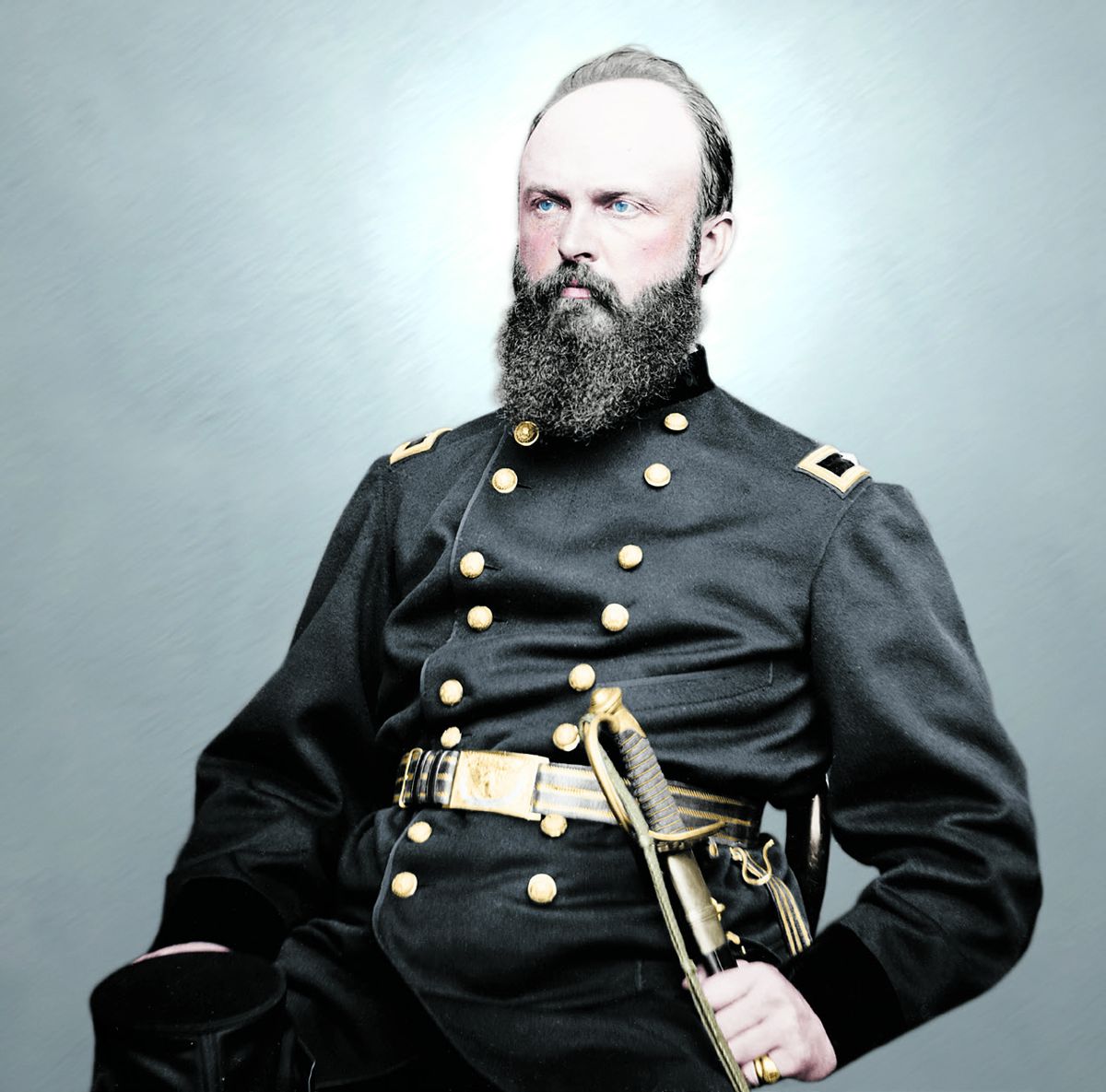
“… You had better get away from here quick. The Texans are whipping our men in the canyon like hell, have driven them nearly through the canyon and pretty soon will have them out on the prairie.” – Federal prisoner Seizing Federal supplies was a crucial element to the Confederate plan to capture the New Mexico Territory. The March 26-28, 1862, Battle of Glorieta Pass was fought along the Santa Fe Trail as the Confederates traveled from Santa Fe to plunder the Fort Union supply depot. The route took them through an 11mile area of canyons and valleys known as Glorieta Pass. The first clash came at Apache Canyon. In his first battle, Maj. John Chivington and his raw Colorado recruits opposed Confederate Maj. Charles L. Pyron and his two 6-pdr. guns. At nightfall, Pyron had kept his guns but the Federals had captured 71 Texan prisoners, the highest capture rate during the far western battles. Both sides retreated to opposite ends of the pass, reported the need for reinforcements to their superiors, gathered their wounded, and buried their dead. On March 28, tired of waiting for the enemy to attack, both sides went on the offensive. U.S. Col. John P. Slough had never fought a battle but had studied Napoleonic maneuvers. He decided to split his 1,340 men. He sent Chivington on a complicated flanking maneuver through the mountains. Slough’s attack force included U.S. Capt. John Ritter, commanding two 12-pdr. howitzers and two 6-pdr. guns, and Capt. Ira Claflin commanding four smaller 12-pdr. mountain howitzers. To the frustration of Quartermaster Capt. Herbert M. Enos, Claflin also commanded the 100-wagon supply train. Enos had argued to leave the wagons safely in the rear. The Confederate opposition under Col. William Scurry had 1,285 soldiers, two 12-pdr. howitzers, and Pyron’s two 6-pdrs. Unlike Slough, Scurry parked his eighty-wagon supply train “in a secure position,” under guard. About 11 a.m., the advance pickets of both sides were surprised to discover their enemy approaching near the center of the Pass, a half mile from Pigeon’s Ranch. A Federal shouted, “Get out of our way, we are going to take dinner in Santa Fe.” C.S. Pvt. Bill Kirk yelled back, “You’ll take your dinner in hell.” Instead of fighting, all rushed back to alert their brethren. The Confederates brought three of their guns to the front line. Pyron was assigned to the far right, Maj. Henry Raquet in the center, and Scurry on the left. The Federals unlimbered eight canon. Enos’s ammunition wagon had to be pried from the mud after supplying the artillery. Company I, 1st Colorado, jumped into a gully using it to flank the enemy, but the Confederates quickly turned their guns on them. This fire fight lasted half an hour before the surviving Federals retreated. By noon the “fog of battle” hung over the field. By 2 p.m. Slough knew he was being outflanked by a superior force. He ordered a retreat to Pigeon’s Ranch. The Federals took the high ground on both sides of the trail, hidden by trees and larger boulders. Ritter and his guns were placed on the road. Scurry ordered his men forward. “Pyron was galloping from the right down our line … when a cannon ball from the enemy cut his horse’s head off.” Pyron survived and continued his rush to join Scurry. C.S. Maj. Shropshire, leading his men forward on the right, was shot dead, stalling the advance. C.S. Sgt. Alfred Peticolas continued moving forward through a gap in the Federal line. Suddenly, Peticolas realized he was among the Federals. “You had better look out, Captain, or those fellows will shoot you,” said U.S. Lt. Col. Tappan. “Who will?” replied
Peticolas. “Why those fellows yonder,” said Tappan pointing at the Texans. Peticolas, wearing a confiscated Federal coat, appreciated his luck. Peticolas declared that he would “go over that way and take a shot at them,” then walked cautiously away as he returned to his side. Scurry renewed his frontal assault on the Federals about 4 p.m. The fight raged until nightfall. Slough returned to where he began the day, Kozlowski’s Ranch. Scurry camped at Pigeon’s Ranch. Both sides collected their dead and wounded. Meanwhile, Chivington and his 488 men had left the Santa Fe Trail to climb the mountains, getting above and around the pass, and reaching its mouth. As they trekked across the mesa above, due to the sheer canyon cliffs, Chivington could not hear the battle raging below. About 2 p.m., Chivington reached his designated position, 700 feet above Johnson’s Ranch, the main Confederate camp. Slough planned on driving the Texans back into Chivington’s waiting Federals. As he waited for Slough, Chivington could see the supply wagons, 500 horses and mules penned in a natural corral, a field hospital, and a 6-pdr. gun pointed towards Apache Canyon, and “the unconscious Texans, jumping, running foot races, etc.” Neither Slough nor the main Confederates force could be seen. Was it a trap? After an hour, Chivington ordered an attack. Suddenly, the Texans realized the enemy were slipping and sliding down the 700-foot precipice towards them. More Federals were hurrying down mule trails while howling the “Injun” yell. The Texas artillerists ran to their gun and Sgt. Timothy Nettles fired two shots from the 6-pdr. before being forced to abandon it. Others fled by foot or on horseback. The fight was over fast. Before his men had a chance to plunder the wagons, Chivington ordered them burned and the livestock released. Freed Federal prisoners warned that the Confederates could arrive at any minute and, since he didn’t want to fight them in the pass, Chivington had to return the way he came. The men made the perilous journey up the mountain, in the dark and through a snowstorm. The men on both sides thought they won and wanted to continue in the morning. For Slough, the battle was over. He had more than accomplished his objective to harass the Confederates. Scurry knew that by losing his supplies, they had lost their ability to remain in the field. The opportunity to capture New Mexico Territory was gone. As C.S. Pvt. Bill Davidson wrote, “… leaving our train without a heavy guard was a terrible blunder.” Sources: •
•
Alberts, Don E. The Battle of Glorieta: Union victory in the West: Texas A&M University Press, June 1, 2000 Edrington, Thomas S. and Taylor, John. The Battle of Glorieta Pass: a Gettysburg in the West, March 26-28, 1862: University of New Mexico Press, August 1, 2000
Stephanie Hagiwara is the editor for Civil War in Color.com and Civil War in 3D.com. She also writes a column for History in Full Color. com that covers stories of photographs of historical interest from the 1850’s to the present. Her articles can be found on Facebook, Tumblr and Pinterest.