
Inspection, ARMS!
The Oldenburg “Cyclops” – The “One Eyed” Musket of the Civil War
By Tim Prince · Originally published September 2019 · pp. 22–24
The American Civil War provided an opportunity for European arsenals to divest themselves of a wide array of obsolete and unwanted small arms in a very short period. While some arms were relatively high quality, some equal to the American U.S. M1855 and M1861 rifle muskets, others were practically useless; either due to their age and obsolescence or due to their poor condition. Confederate purchasing agents concentrated their efforts in obtaining first quality arms like the Pattern 1853 Enfield from Great Britain, with secondary arms being sourced from Austria in the form of the M1854 Lorenz. U.S. agents pursued the same sources as well, but also bought practically anything for sale on the continent. The reasons for the U.S. acquisitions were two-fold; first to arm their rapidly growing army of Union volunteers, but secondly to keep these arms from potentially falling into the hands of Confederate purchasing agents. Some of the most varied, and in many cases most obsolete, arms acquired by United States purchasing agents came from various German states. During this period there was no unified German nation, but rather a loose confederacy of Germanic states, including kingdoms, duchies, and smaller principalities, with militaristic Prussia as the largest and most powerful. In 1841, the Prussians had adopted what was the most advanced infantry rifle in the world the, Leichte PerscussionsGewehr M-1841 or the “Light Percussion Rifle M-1841.” Johann Nikolaus von Dreyse’s invention would be known as the Zündnadelgewehr in the German speaking countries, and as the “Needle Gun” around the world. This bolt action breechloading rifle was so technologically advanced that it made all percussion ignition muzzleloading long arms obsolete. The Prussians initially treated the invention as a state secret. Thus, it was the early 1850s before the technology was widely known outside Prussian military circles. Due to the major technological advance of the needle rifle, Prussia and its allies found themselves with huge quantities of obsolete arms they were only too glad to offer to U.S. purchasing agents. The models ranged from the ubiquitous Prussian Model 1809 “Potsdam” musket, a percussion converted smoothbore flint musket imported in quantities that exceeded 100,000 units, to guns purchased in relatively small quantities including the Prussian M1849 Naval Rifle, the Saxon (Dresden) M1851 and M1857 Rifles, the Bavarian M1842/51 Rifles and Suhl made copies of the British Pattern 1853 Enfield and the U.S. Model 1861 Springfield. Some of the rarest and least often encountered of these scarce Germanic arms were those used by the Grand Duchy of Oldenburg prior to their acquiring the very modern Prussian Model 1841 needle rifle. The Grand Duchy of Oldenburg was one of the smaller Germanic states. Of the thirty-nine member German Confederation, most sources rank Oldenburg tenth in size. While larger than many other members, some of which were little more than glorified city-states, the small territory of Oldenburg appears to be little more than a tiny subsection of the much larger Kingdom of Hanover that surrounds it on period maps. The Duchy was located in the northwest corner of the German Confederacy on the North Sea, and had been a major part of the old Hanseatic League. With the rise of the German Confederation (1815–1866), Oldenburg, in association with the Hanseatic cities of Bremen, Lübeck, and Hamburg, formed the Hanseatic
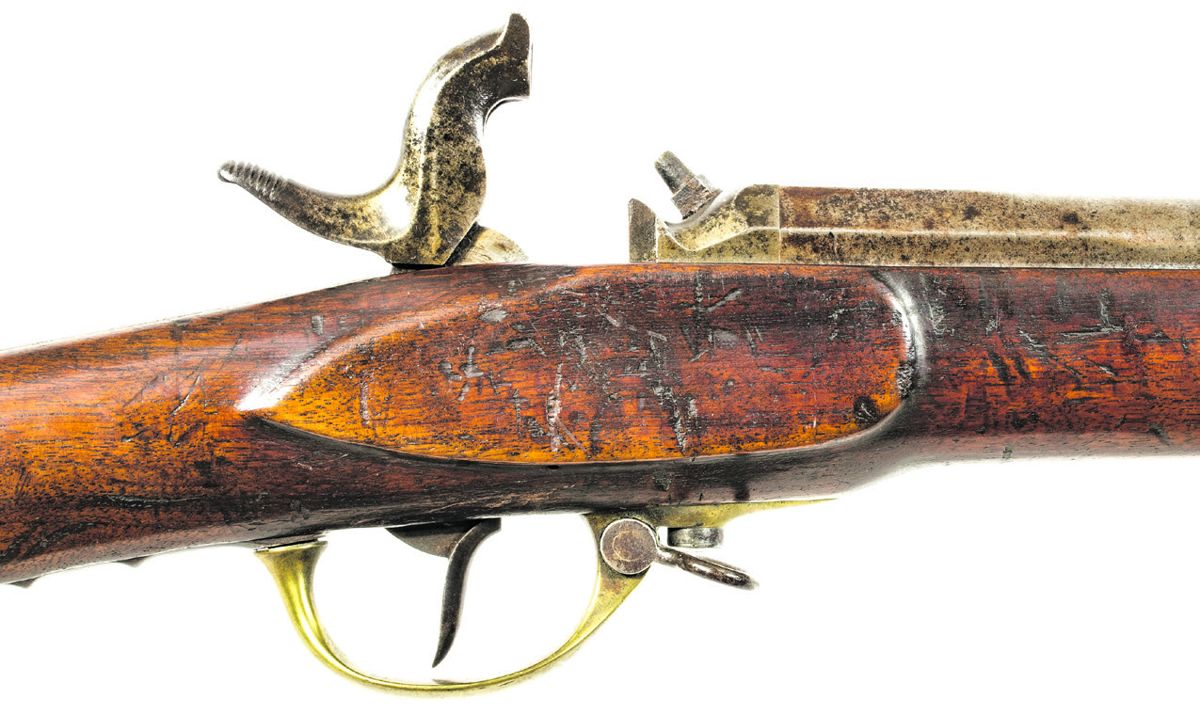
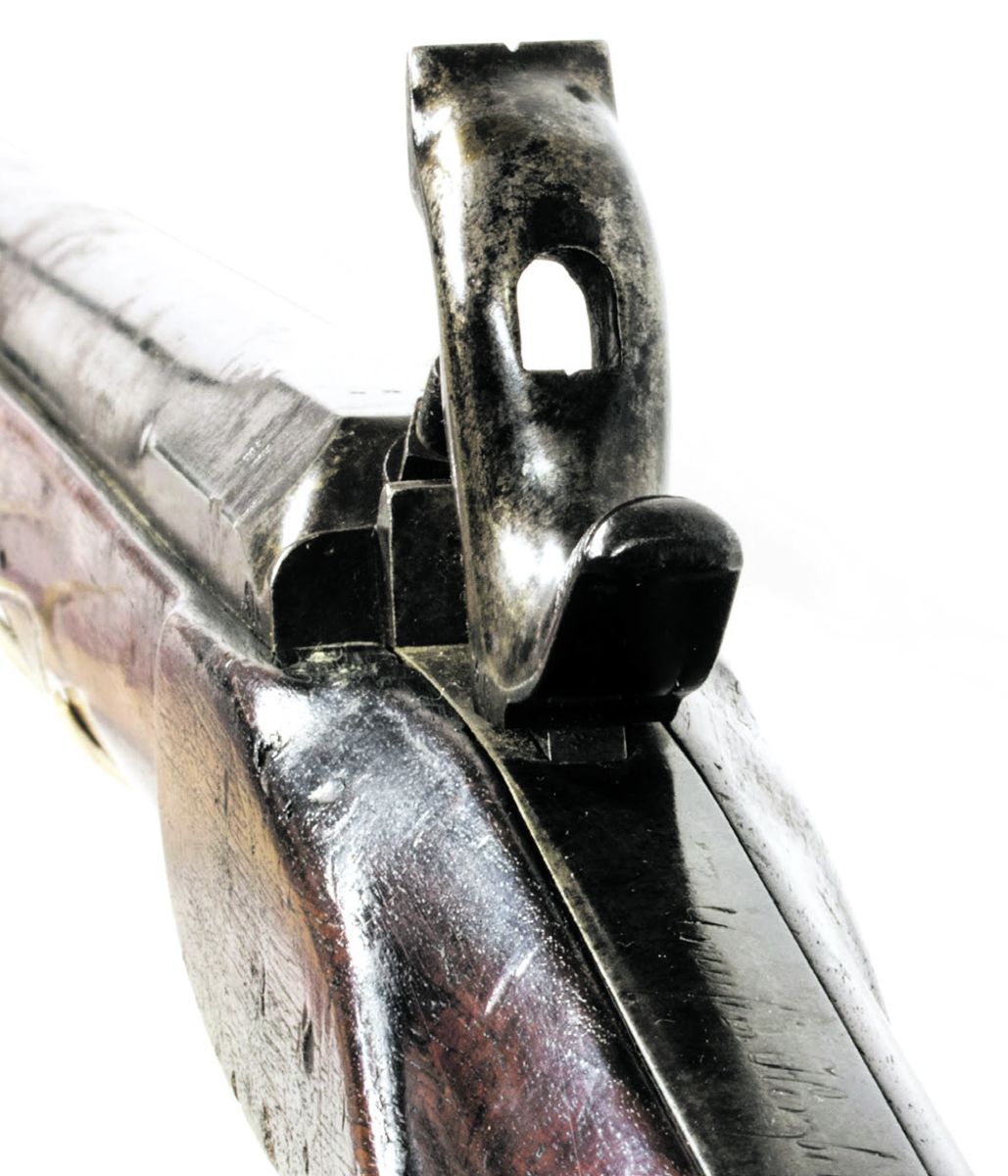
Brigade, whose troops served in the 10th Corps of the German Confederation’s army. Oldenburg had adopted a revolutionary oval bore percussion musket in 1839, with early models rifled with two grooves and later models rifled with four. These guns were conventional side lock percussion rifle muskets with 17.2 mm bores (about .68 caliber) that fired either a patched .66 caliber ball, for accurate fire or a quicker loading .65 caliber ball for more rapid, sustained volley fire. In 1843, Oldenburg adopted a new pattern of percussion muzzleloading long arms, known as the Mittelschlossgewehr (Center Lock Rifle), that has been given the nickname Cyclops by American collectors. The guns used an unconventional, internal lock mechanism with no external lock plate and a centrally mounted hammer. For collectors of Civil War arms, the design somewhat resembles the Reed & Watson muzzleloading alterations done by the Confederacy to Hall Rifles. As the hammer was centrally mounted and obscured the front sight, a sighting “window” was cut into the hammer between the spur and the nose that allowed the shooter to align this notch with the front sight, when the hammer was cocked. This unique sighting feature provided the source for the gun’s nickname as the Cyclops, a reference to the oneeyed giants of Greek mythology. The design was the brain child of Lt. von Weltzien of Oldenburg, who championed the theory that a straight, central line of ignition directly from the breech was the most efficient method of getting reliable detonation of the powder charge. Oldenburg adopted two models of Weltzien’s design in 1845, a non-commissioned officer’s rifle and a longer infantry rifle musket. References in English are somewhat limited, and these guns are given several different model year designations based upon the interpretations of various authors. Firearms from Europe by Whisker, Hartzler, Yantz, and Noe uses the designation Model 1849 for both variants. This is the most commonly used name for these guns in America but is likely the least accurate. In European Bayonets of the American Civil War by Noe & Serbaroli, the authors use the designations of Model 1844 and Model 1845 for the infantry rifle musket and NCO rifle, respectively. In the most recent work on the subject, European Arms in the Civil War by Schwalm & Hofmann, the authors use the designation of Model 1843 for the NCO rifle and do not apply a model designation for the infantry rifle musket, leaving one to assume that they also consider that gun to be a M1843. As the authors are German, have access to information on German arms that is not typically available to English language researchers, and have been studying the subject in their own country for many years, I will defer to their designation for the NCO rifle and will use the Noe & Serbaroli designation for the infantry musket. It should be noted that Schwalm & Hoffman also identify the Model 1843/48 as being those arms that were modified by adding a Tige pillar breech circa 1848. Like much of Europe during the late 1840s, the Duchy of Oldenburg modified many muzzleloading guns in their inventory by adopting the French Thouvenin tige (pillar breech) system to adapt the guns from round ball to elongated, expanding base ammunition. Regardless of pattern designation, both models of “Cyclops” used the central lock and hammer mechanism and had 17.2 mm caliber bores (about .677 inch) rifled with four narrow grooves. The central patent breech and chamber area was octagonal, becoming round about 3 inches from the breech end. The NCO rifle had a nominally 33 inch barrel, while the infantry rifle musket had a nominal 39 inch barrel. The guns used wedges to retain the barrels, two wedges for the rifle and three for the rifle musket, giving the appearance of older pattern flintlock arms. The guns were mounted with a combination of both iron and brass furniture with iron for the buttplate and finger-grooved trigger plate and brass for the triggerguard, nose cap, and ramrod pipes. Sling swivels were attached to the forward bow of the triggerguard and the upper ramrod pipe. The heavy iron ramrod was secured by the brass pipes. As previously mentioned, a sighting “window” in the arc of the hammer nose provided a rear sight; the front sight was a brass blade dovetailed into an iron base. A stud to accept a socket bayonet was located under the barrel, about .875 inch from the muzzle. Schwalm & Hofmann indicate that the French/Belgian M1822 pattern bayonet was the correct one for these muskets, while Noe & Serbaroli say that the correct pattern of bayonet has yet to be identified. Stocks were walnut, with a typical Europeanstyle raised cheek rest on the reverse. Like most Germanic arms of the period, the guns were serial
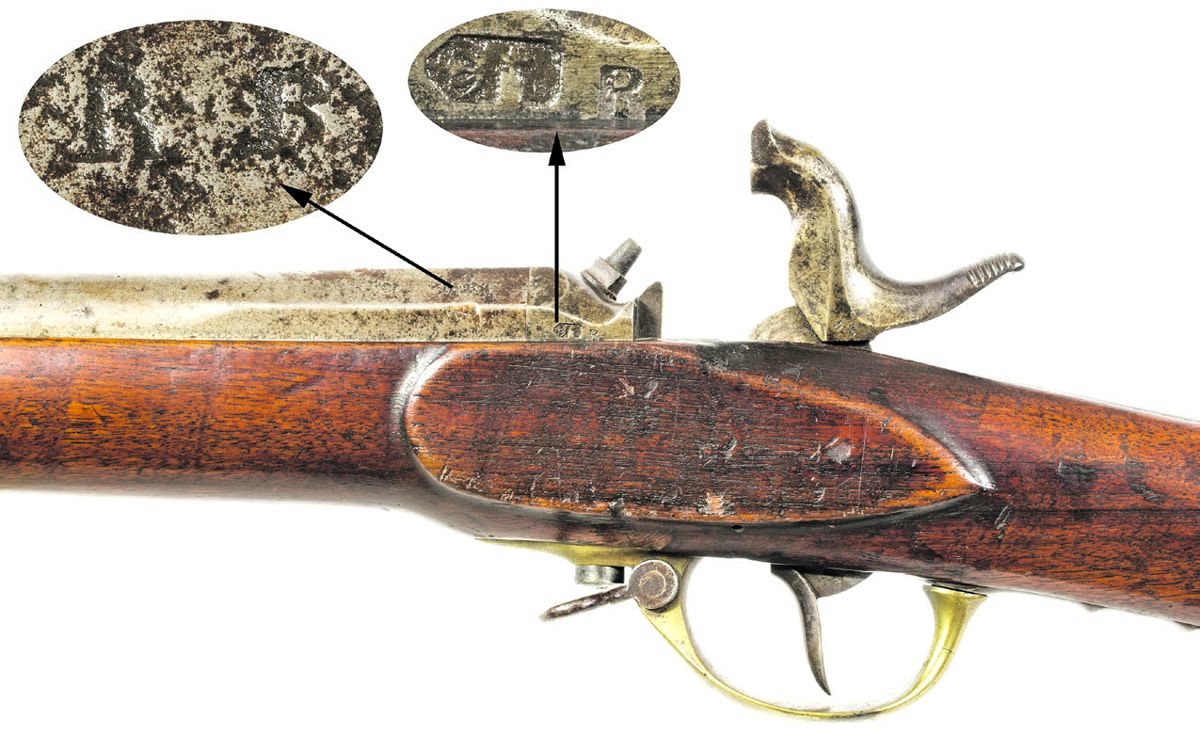
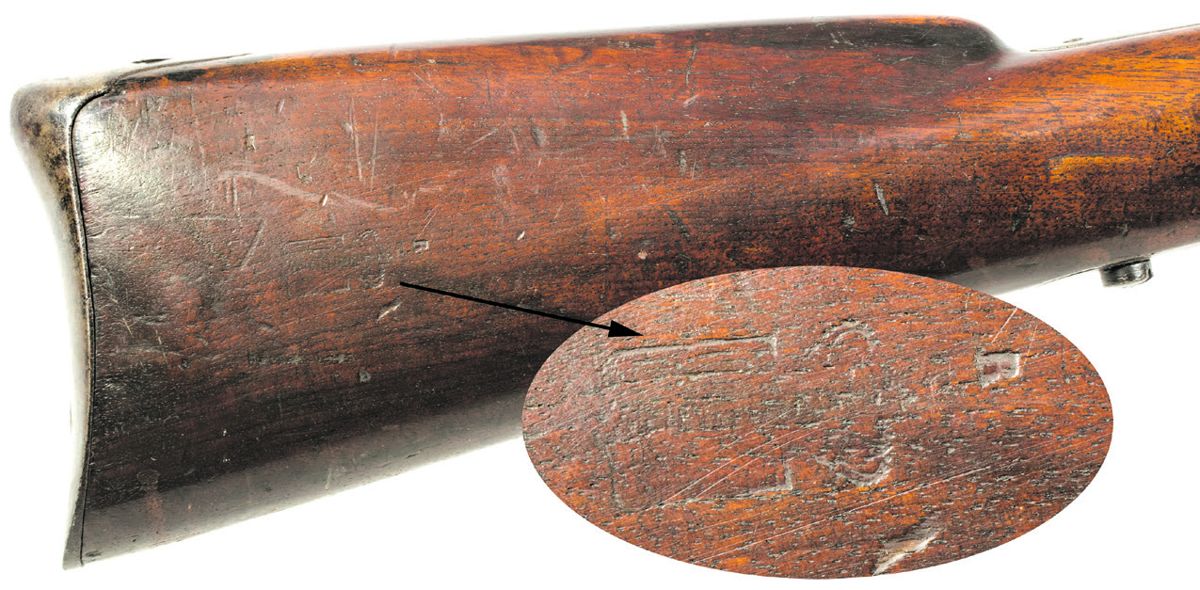
(assembly) numbered throughout, with the full serial number on larger components and the last two digits on smaller components like screw heads. The guns were marked by their maker, “Craufe in Herzberg,” in script on the upper tang, with the “s” in Crause written in the archaic fashion as an “f.” Additional markings include Oldenburg inspection or proof marks on the breech, sub-inspection marks on many small parts, and an Oldenburg cartouche on the obverse buttstock. The guns were produced on contract by the Hanoverian firm of Carl Phillip Crause located in Herzberg. The old Hanoverian state armory had been located in Herzberg and when the Kingdom of Hanover fell to Napoleon in 1807, it had been put back into service to make arms for the French military and Napoleon’s allies. After Napoleon’s defeat in 1814, the armory again fell into a period of disuse. Crause took over the Herzberg armory circa 1820 and began to produce small arms for Hanover and other small Germanic states, including the Hanseatic League. Crause produced Oldenburg’s earlier oval bore long arms and also received the contract for the new Oldenburg Mittelschlossgewehr long arms. He produced a total of three hundred of the shorter NCO rifles and nine hundred of the infantry rifle muskets, although it had been intended to produce fifteen hundred of the longer guns. In 1848, as the transformation to Tige breech arms took place, the older pattern sidelock, oval bore arms were found to be more adaptable to the new elongated ammunition, as new rear sights could be added to take advantage of the new ballistic capabilities of the ammunition. The center lock “Cyclops” rifles could not be so modified because the hammer location prevented mounting a new long-range rear sight on the barrel; so there was little advantage to be gained from the modification. As a result, the guns were soon withdrawn from front line service, and by 1854 were being issued for garrison duty only. By 1860, the guns were simply in storage; Oldenburg was looking for buyers for their obsolete guns to help finance an order for Prussian M1841 needle rifles. According to research by Schwalm & Hofmann, the Cyclops guns, along with some 4,100 other “Herzberg” muskets and some 2,500 guns from Wurttemberg were sold to the firm of Friedrich Wipperfuerth, located at Beneisstrasse 61 in Cologne, one of the larger Prussian cities. Wipperfuerth subsequently offered these guns for sale to any willing buyers. The association of the Cyclops rifle with the American Civil War was first mentioned in William B. Edwards’ ground breaking book Civil War Guns. This was one of the first serious books to look not only at domestically produced small arms used during the conflict, but to also look at imported arms used during the war. Edwards was little more than speculating about their acquisition, but he did note that extant examples were known, most prominently one in the collection of the U.S. military museum at West Point. It was not until much more complete research during the last few years was published that the actual source for the guns was determined along with their concrete association with the American Civil War. Author and researcher Joe Serbaroli Jr. discovered this link while going through the correspondence of Henry Sanford, the
Overall obverse view of Oldenburg “Cyclops” infantry rifle musket #658.
Overall reverse view of “Cyclops” #658. U.S. Minister to Belgium during the Civil War. Sanford had been given access to one million dollars in U.S. funds, held in a London bank, for acquiring small arms in Europe. Sanford was one of the purchasers who was very clear that his intent was aimed more at depriving the Confederacy of arms, rather than obtaining them for Union use. As such, he seems to have concentrated on acquiring guns that today we would consider marginally useful at best. Mr. Serbaroli reprints part of a May 18, 1861 letter from Sanford in his book, which is quoted in part below: There are yet here 4,000 exceedingly fine Herzberger Infantry Rifles partly used partly quite new, 1,400 of them are twice rifled and remainder 4 times all of the same caliber and same shooting qualities (900 of them are extra tirailleur rifles with the cock in the center line of the gun)….
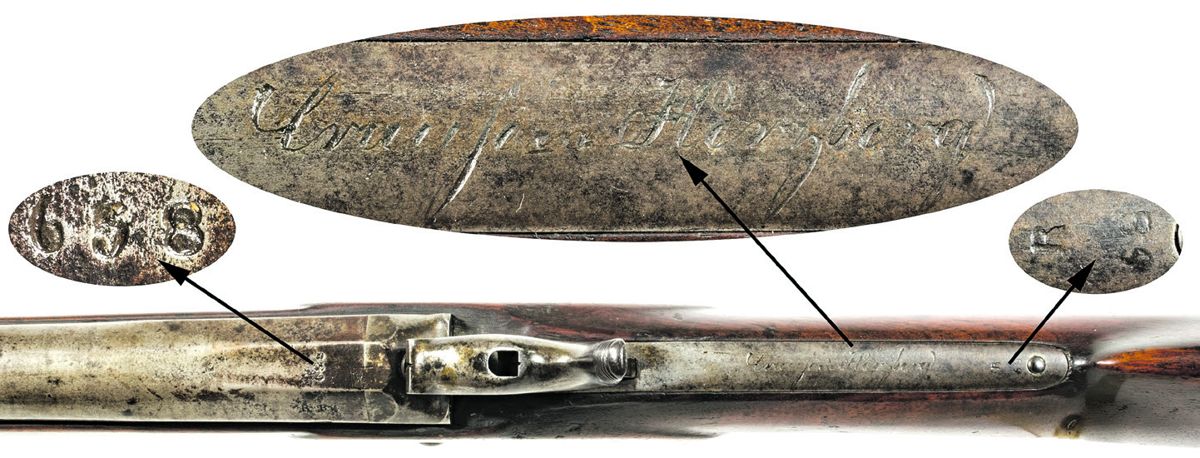
The lowest price would be $6 – (six American dollars) a piece net cash without discount by the average to a buyer of the whole lot. Obviously, Sanford is referring to some surplus guns from Oldenburg and the other Hanseatic League members that were being offered for sale in Cologne by Wipperfuerth. The “twice rifled” guns are clearly the oldest of the two-groove, oval bore guns, but it is the underlined parenthetic comment: 900 of them are extra tirailleur rifles with the cock in the center line of the gun, that pertains here. Clearly, this indicates that nine hundred “Cyclops” guns were being offered for sale. Interestingly Sanford uses the French term tirailleur which means “sharpshooter” to describe the guns. This may be a result of his assuming the center mounted hammer somehow made the guns special and more accurate. More likely, it simply shows his lack of knowledge about small arms, as he also goes on to describe these obsolete arms by saying The fine quality of these arms which can compete with every other gun is guaranteed. While no specific document lists these arms as being purchased by Sanford, he did purchase a total of 27,648 rifled muskets of various patterns. As this group was clearly made up of several different patterns, it is likely that the guns were simply lumped into a category like the “Rifled Muskets, Prussian, .70 caliber” in later reports or correspondence, as the guns originated from an arms dealer in Prussia and did not come directly from Oldenburg. As the guns are practically non-existent in modern Germany and the handful of known examples typically survive in American collections, as well at West Point, it seems almost certain that the majority of the twelve hundred “Cyclops” guns produced (900 infantry rifle muskets and 300 NCO rifles) were acquired by the US government during the early days of the American Civil War. Authors Schwalm & Hofmann refer to additional research noting that some 2,680 Oldenburg / Lübeck / Bremen muskets were provided to the state of Ohio by the U.S. Government and that some saw service with the 56th Ohio Volunteer Infantry. The photos accompanying this article are of an Oldenburg Mittelschlossgewehr infantry rifle musket Model 1844/48. The gun is serial number 658, with the full number found on the top of the barrel and the rear of the trigger plate, while the last two digits, “58,” appear on most small parts. When viewed from the muzzle with bright light, the pillar of the Tige is clearly visible at the bottom of the breech. The gun is complete, with the exception of an old replacement ramrod that appears to have come from a period shotgun and the small stud under the barrel that the socket bayonet locks against. While exact numbers are not known, it is generally believed that only about ten to twelve extant examples of these scarce Civil War import arms have survived to be part of collections, both public and private, in the United States today. Tim Prince is a full-time dealer in fine & collectible military arms from the Colonial Period through WWII. He operates College Hill Arsenal, a web-based antique arms retail site. A long time collector & researcher, Tim has been a contributing author to two major book projects about Civil War era arms including The English Connection and a new book on southern retailer marked and Confederate used shotguns. Tim is also a featured Arms & Militaria appraiser on the PBS Series Antiques Roadshow.