
The Graphic War
Kurz and Allison, Printmakers Antietam
By Salvatore Cilella · Originally published September 2019 · p. 20
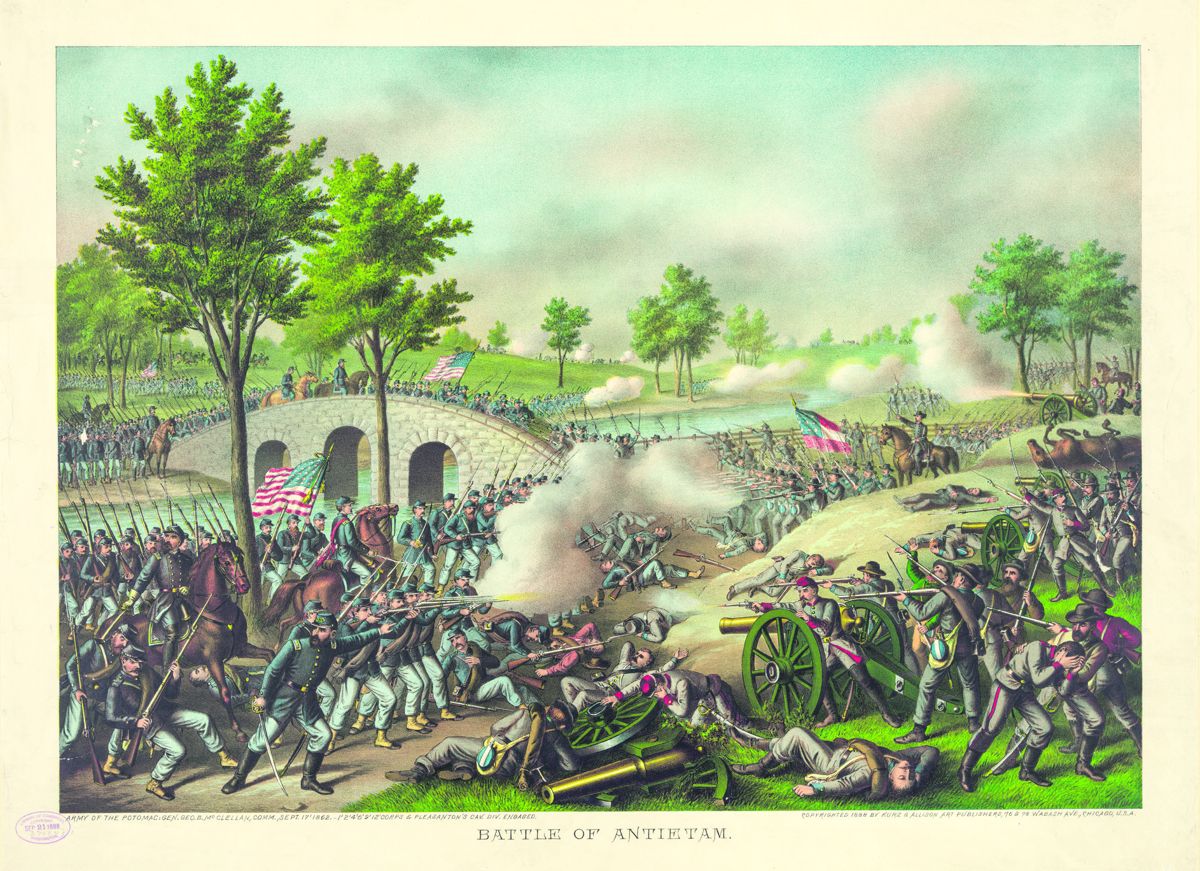
The Graphic War highlights prints and printmakers from the Civil War discussing their meaning and most importantly, the print maker or artist’s goals. During the war, the most prolific producer of battle prints was Currier and Ives, their competitors trailing them by a wide margin. Whereas Currier haphazardly rushed battle prints to market as “breaking news,” firms that produced battle art after the war viewed their work from historical and artistic perspectives. Print collectors uniformly agree that Currier’s battlefield scenes are sub-standard. If it were not for the legend in the title margin, the viewer cannot distinguish the Battle of Shiloh from the Battle of Gettysburg. Identical poses for different battles were used and reused. Some prints appeared to have been executed by two different hands. The same posture of wounded and dead, and grimacing faces can be easily identified from one print to another. As the war progressed, Currier pushed out their prints of recent battles sooner and sooner, often within days. They also became more stridently patriotic and their title margins reflected an unmistakable bias toward Union superiority. In the universe of Civil War prints, especially lithographs, the majority of battle prints we are most familiar with were done well after the war, indeed, after Reconstruction. The two most prominent firms producing them were the Prangs of Boston and the Chicago firm of Kurz and Allison.1 The two “battled” for a market now eager to yield to nostalgia. Their approaches to the art work were entirely different and as a result, their work is easily recognizable and distinguishable. Both operated at the same time, during the 1880’s, and both appealed to the same market. The lost cause was well entrenched and, in the north, there was a nostalgia building for the more romantic aspects of the war. Kurz and Allison were heavily influenced by the Gettysburg Cyclorama. Indeed, some of their foreground figures were direct “copies” of those on the giant canvas. Before his partnership with Alexander Allison, Louis Kurz began his work in America in Milwaukee in June 1848. Milwaukee was the locus for many German artists employed on the Gettysburg and Atlanta Cycloramas. Kurz was born in 1834, in Salzburg, Austria, Ludovicus Ferdinandus Josephus Kurz von Goldenstein. It was in Chicago where he learned the art of lithography as he hired out as a house and sign painter. After a brief stint back in Milwaukee, he returned to Chicago in 1876 where he met Allison, about whom little is known.2 The new partnership, unlike Currier and Ives, Kurz nevertheless named the company in the style of Currier and Ives3; and, much like Currier and Ives, most of Kurz’ battle scenes are interchangeable and indistinguishable save for the title margin telling the viewer what they are seeing. One such exception is the Battle of Antietam. Kurz chose the late afternoon action featuring Burnside’s Bridge, which makes the scene immediately identifiable. It is seen from the Confederate position on a much-truncated ridge, as the Southerners were fending off hordes of well uniformed, precisely marching, accurately firing, and overwhelmingly rigid Yankee attackers. As Harold Holzer, et. al. assert, “Louis Kurz, employing his eye for panoramic inclusion to good effect, focused on the picturesque bridge but surveyed the ranks of both armies and the verdant, late-summer Maryland countryside as well.”4 Between 1884 and 1894, the firm produced thirty-six battle scenes, some of them rare today. In the last century, they were reproduced and marketed during the Centennial. Peter Marzio, who wrote the definitive book on chromolithography, characterized the Kurz and Allison scenes as having a “mural like rigidity, a simplicity in drawing style, and poorly delineated details.” Marzio attributes these qualities to Kurz’s “experience to painting murals, an artform that aims at grand impressions easily perceived.”5 Another scholar, Jay Last, characterized the firm’s output as “hundreds of garish color lithographs” depicting scenes from the Revolutionary War, the War of 1812 (The Battle of New Orleans), the Civil War, the Spanish American War, and even the Johnstown Flood (“The Great Conemaugh Valley Disaster”). “Understatement was not a word in the Kurz and Allison vocabulary.”6 Endnotes: 1. See Harold Holzer, Prang’s Civil
War Pictures: The Complete Battle Chromos of Louis Prang. New York: Fordham University Press, 2001. 2. Thomas Beckman, “Louis Kurz: Early Years.” Imprint. Volume 7, No.1, Spring 1982, 14-25. 3. Harold Holzer, Mark E. Neely, Jr. The Union Image: Popular Prints of the Civil War North, Chapel Hill: The University of North Carolina Press, 2000, 210. 4. Ibid., 219. 5. Peter Marzio, Chromolithography,1840–1900: The Democratic Art, Pictures for a 19th Century America. Boston: David R. Godine, Publisher. 1979, 180-181. 6. Jay T. Last. The Color Explosion: Nineteenth-Century American Lithography. Santa Ana: Hillcrest Press, 2005, 111. Salvatore Cilella is retired after 43 years in the museum field. His last position was President and CEO of the Atlanta History Center. He is the author of several articles and books. His most recent books are Upton’s Regulars: A History of the 121st New York Volunteers in the Civil War (U. Press Kansas, 2009) and The Correspondence of General Emory Upton, 1856–1881 (U. Tennessee Press, 2017) edited. He is editing a manuscript of Upton’s letters to his wife 1868-70 for the Oklahoma University Press due to be published late 2019, or early 2020.