
Impacted Ordnance Found in Historic Bushong Farmhouse
By Lt. Colonel Troy D. Marshall · Originally published September 2019 · pp. 12–13
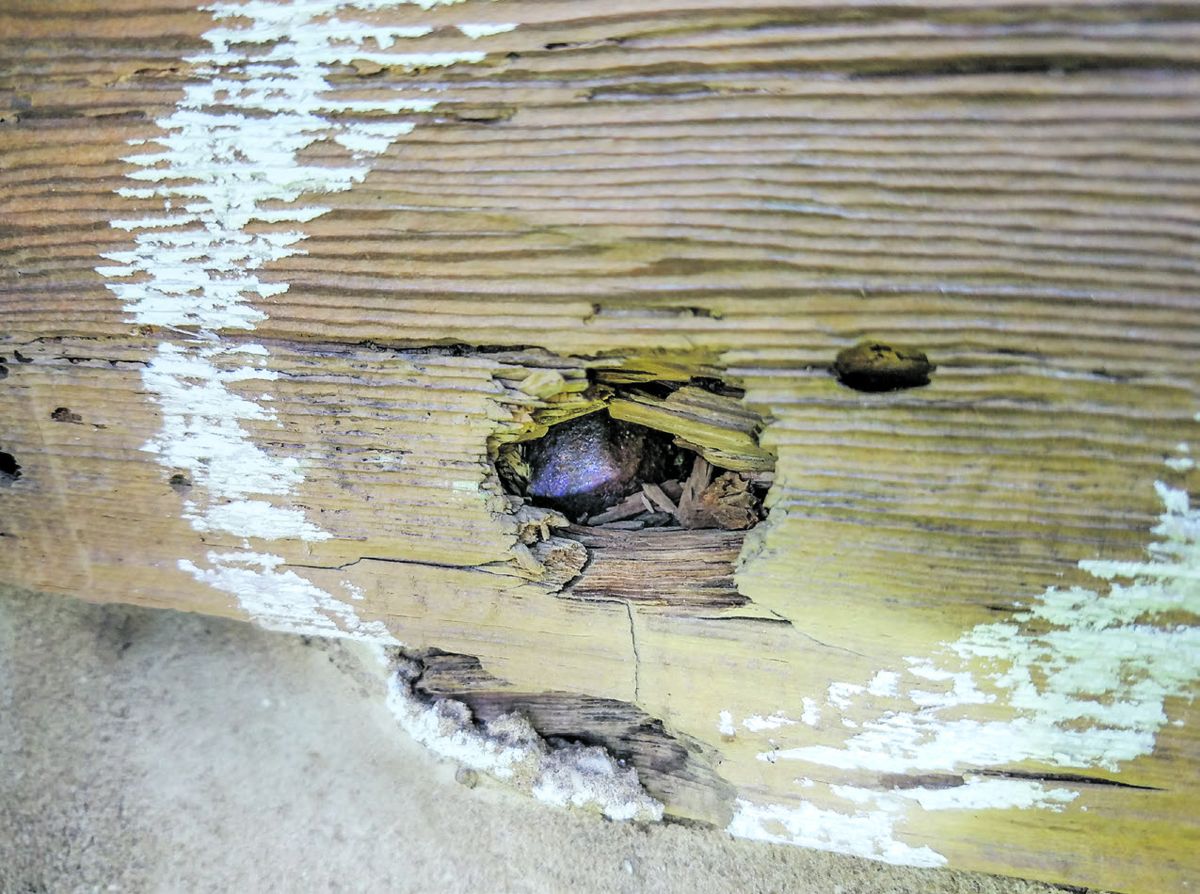
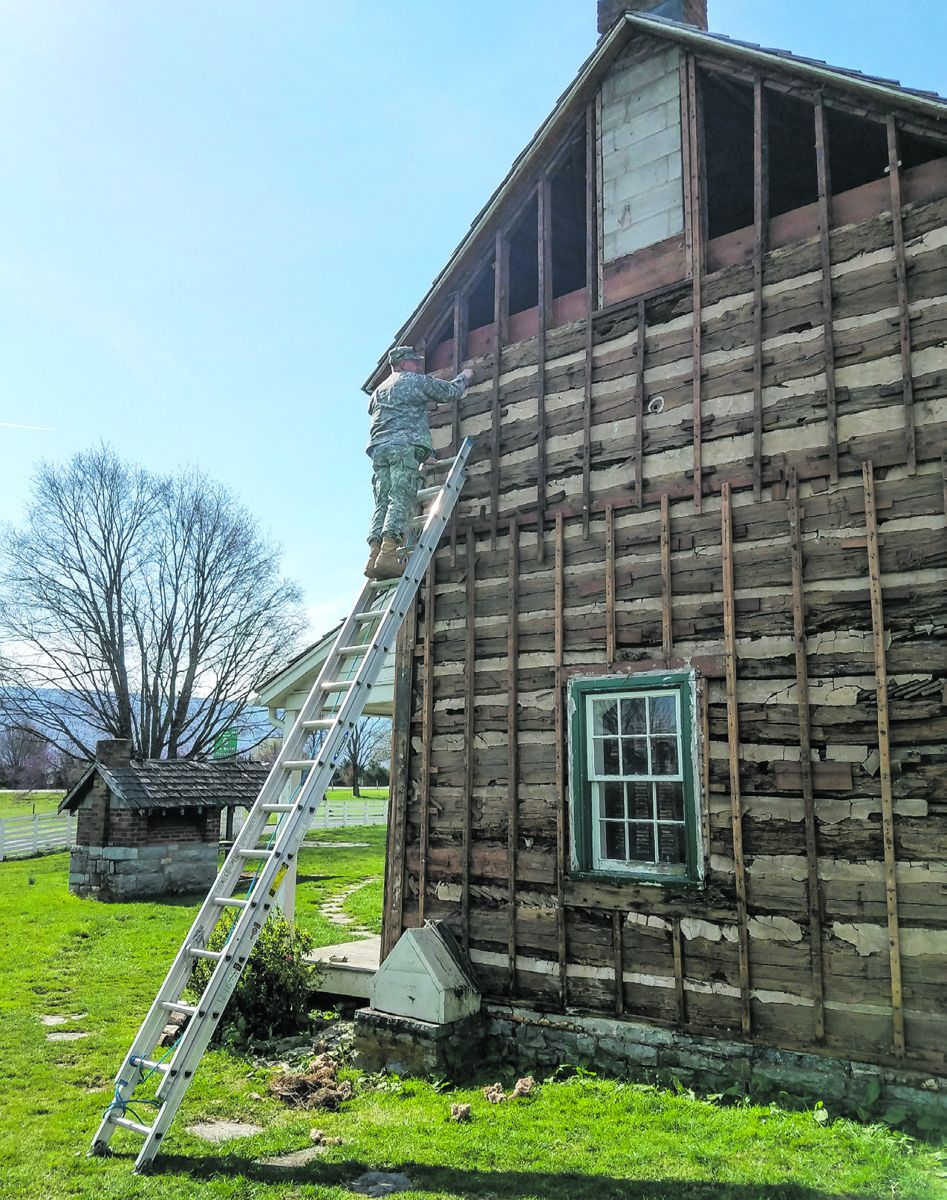
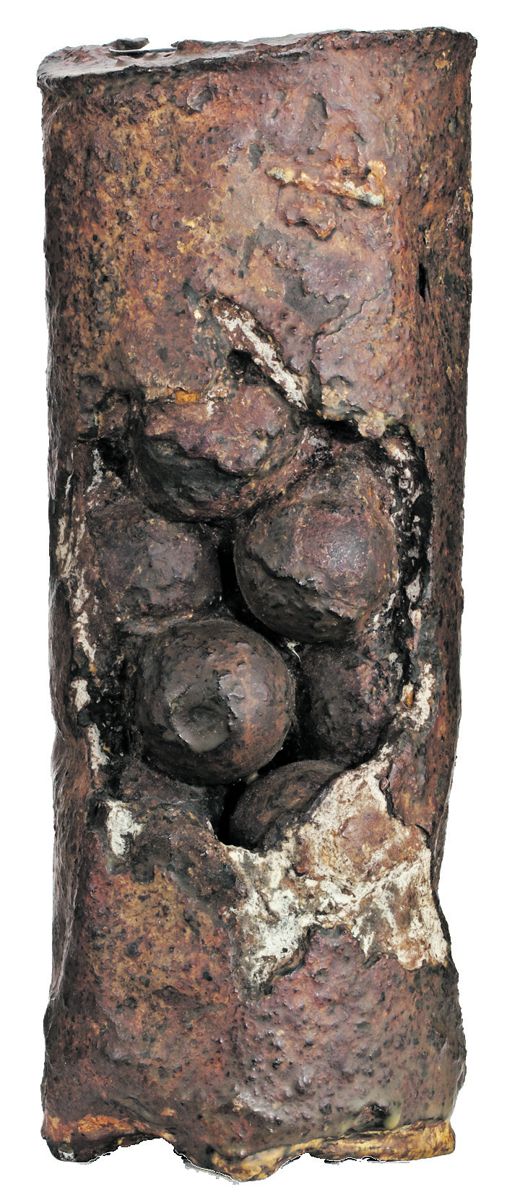
This year as part of a comprehensive rehabilitation of the Bushong Farm, the oldest structure on the farm, the 1818 House, underwent exterior renovations that included clapboarding, window casings, and paint. All the weatherboards from an earlier 1960’s renovation were removed, offering battlefield staff a rare opportunity to examine the exterior walls for construction clues and perhaps even battle damage. On April 11, 2019, the park’s site director, Lieutenant Colonel Troy D. Marshall, carefully examined all four sides of the structure. Something extraordinary was found in the center of the north wall surface, an impacted artillery projectile still there after 155 years. It turned out to be an iron round shot from a 3-inch Hotchkiss canister round. The impact zone is slightly elevated and points north toward the western end of the Union line on Bushong’s Hill. This probably places the round as originating in one of Captain John Carlin’s 3-inch ordnance rifles. Carlin’s Battery D, 1st West Virginia Light Artillery, was heavily engaged during the final phases of the May 15, 1864, battle and lost three guns to the Confederates. On that rainy Sunday afternoon, literally hundreds of deadly iron missiles rent the air over the Bushong farm. Many plowed the ground, into a tree, or hit an unsuspecting soldier. At the time we passed the house the Federals were directing their fire upon us, and the house was made a sounding-board by the striking of the missiles upon its sides. – Captain Frank Preston, Lexington Gazette, May 25, 1864 In the spring of 1864, the newly minted general-in-chief, Ulysses S. Grant declared, My primary mission is to…bring pressure to bear on the Confederacy so no longer could it take advantage of interior lines. Control of the strategically important and troublesome Shenandoah Valley was a key element in General Grant’s plan. While he confronted General Robert E. Lee’s Army of Northern Virginia in the east, Grant ordered Major General Franz Sigel’s army of 10,000 men to secure the Valley, and in so doing, threaten Lee’s left flank. Receiving word that a Union army had entered the Valley, Confederate General John C. Breckinridge pulled together all available forces to repel the threat. The Virginia Military Institute’s Cadet Corps marched from their Lexington classrooms to join Breckinridge and his army of 4,500 veterans. The two armies met at New Market on May 15, 1864. By mid-morning Breckinridge was determined to force the battle. “I shall advance on him,” avowed Breckinridge. We can attack and whip them here and I will do it. After brushing aside Union skirmishers west of town, the rebel infantry line came under fire from Federal troops north of the Bushong farm. Devastating fire on the center of his line forced Breckinridge to put in his reserves, including the 257 VMI cadets. General Breckinridge lamented, Put the boys in…and may God forgive me for the order. Lieutenant
Battle of New Market map.
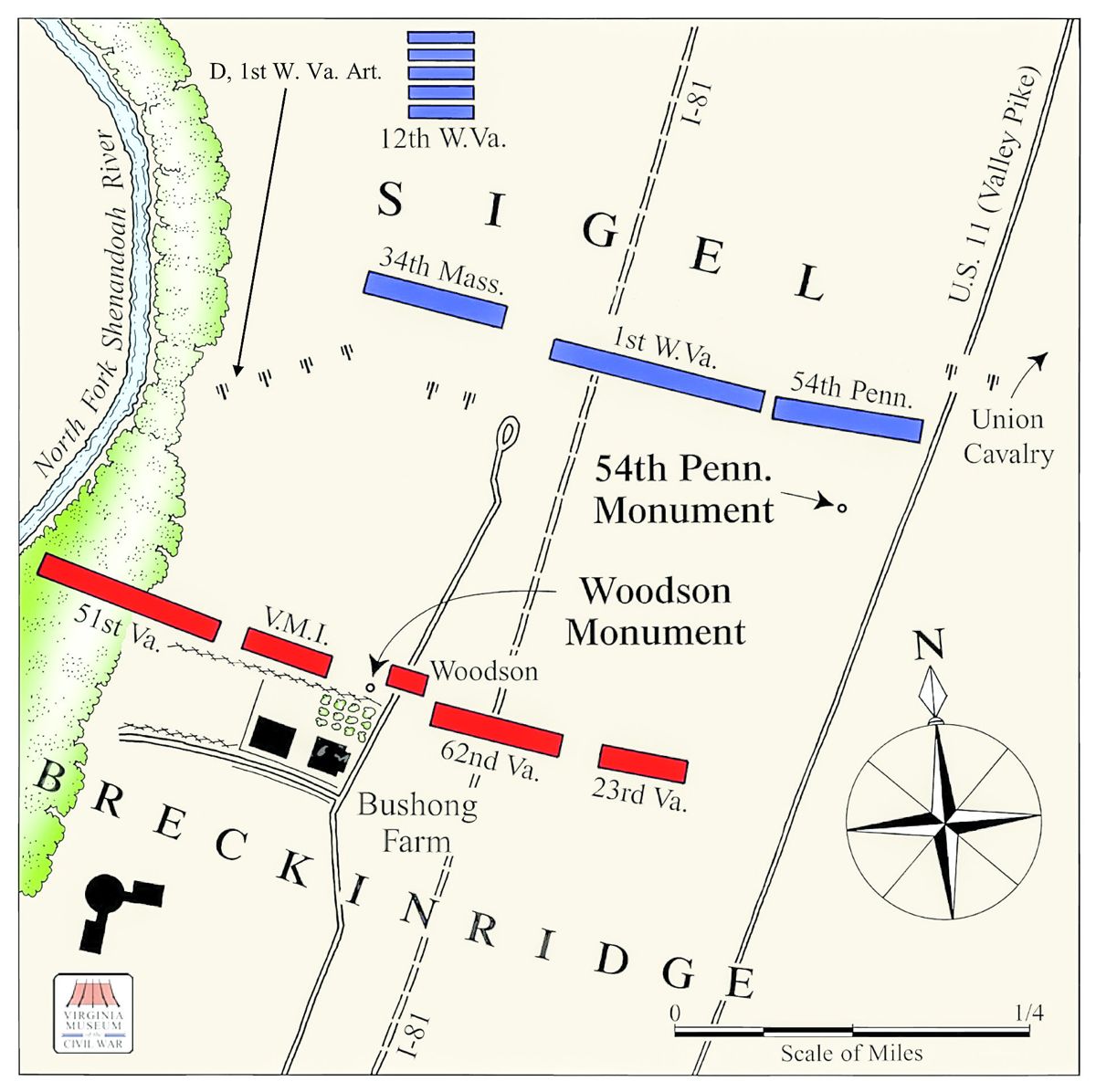
Colonel Scott Shipp directed his battalion of cadets forward and for the first time they saw the full savagery of battle directed right at them. As they advanced, the silhouette of the Bushong Farm came into view and with it, more problems. Shipp quickly devised a solution, dividing the battalion in half to pass on both sides of the Bushong home. Companies A and B went right; C and D to the left. Their destination was a gap in the Confederate center, directly inside Jacob Bushong’s fruit orchard. The march was very costly. A single shell killed
Cadet’s Cabell, Crockett, and Jones; another rent the VMI colors. The Union artillery on Bushong’s Hill poured a devastating fire into the orchard and Bushong Farm precinct. Cadet John Howard recalled the jarring scene he saw from behind a rail fence that afternoon: I look back upon that orchard as the most awful spot on the battle field…as the shot and shell tore over and around us…I saw a cedar tree a yard high or thereabout with a trunk as big as my thumb. Not a very effective defense, but, no matter, anything from a white oak to a wheat straw was better than nothing, and I threw myself down behind it. Cadet R. H. Cousins also remembered the horrific shock of coming under fire after 2:45 p.m. We then went past the house and got into the orchard, where canister and other missiles were raining like hail. It seemed impossible for men to pass through such a storm. Cadet J.B. Baylor echoed Cousins’ sentiments, We were exposed to such a fire…that, if we had long remained in this position, we would have almost been exterminated. Even the cadet’s commander, Lieutenant Colonel Scott
Bushong Farm Orchard ca. 1910.
Excavated U.S. 3-inch Shipp, recorded the fury in his official report, …having passed Bushong’s house, a mile or more beyond New Market, and still to the left of the main road, the enemy’s batteries, at 250 or 300 yards, opened upon us with canister and case shot…the fire was withering. It seemed impossible that any living creature could escape; and here we sustained our heaviest loss, a great many being wounded and numbers knocked down, stunned and temporarily disabled. One of the most interesting accounts of the Union artillery bombardment comes from Cadet N. B. Noland, who was in the orchard that afternoon. He wrote, I noticed just in front of my company an orchard and a dwelling house…it was about here that the enemy’s fire was most destructive[.] We went through the yard very close to the house [and] were ordered to lie down behind the remnant of a worm-fence, about two rails high. The fire was furious at this time…I saw pieces of paper caught up and swept towards us by the currents of air set in motion by the projectiles, and the boughs of a large tree… were all stretched out and swaying towards us. I believed I was bound to get killed[.] Whilst lying here with the air literally filled with Yankee missiles, each one… seemed to miss me by only a scant sixteenth of an inch. Even the soldiers in Sigel’s army were awed by the destructive power of their guns. J. N. Waddell of the 12th West Virginia Infantry wrote, Carlin’s Battery… was just above us on a knoll and was sending shells over our heads with terrible effect into the ranks of these boys. Lieutenant Colonel William Lincoln, an officer with the 34th Massachusetts Infantry, was so impressed by the Union artillery, he later wrote, We poured a rapid and well directed fire into the enemy; which aided by the heavy enfilading fire of our artillery, checked his advance. For a moment he staggered, appeared to give way, and the day seemed ours. Noting the confusion in the Confederate line, Sigel ordered a counterattack. The infantry charge lurched forward, awkwardly and ineffective. Anticipating the result of his failed charge, Sigel began to withdraw his artillery. With his line reinforced and Federal cannon fire reduced, Breckinridge sensed his moment had come. Into the Federal fire marched the gray-clad soldiers. Only a few yards separated the armies when the blue line broke. General Sigel staged a rapid retreat north to Strasburg, leaving the field and the Valley to General Breckinridge’s army and the exuberant VMI Cadets. The VMI cadets had done well in their first engagement, capturing several Union prisoners and a cannon from Von Kleiser’s 30th NY Battery. The cost for that victory was also very high. They lost five students killed and 47 wounded, with five more dying from their wounds in the following days. Six of the fallen cadets
Bushong Farm panoramic photograph. are buried on the campus of the Virginia Military Institute. Life after a storm, whether from a natural source or from battle, takes time and energy to repair. The Bushong buildings were extremely susceptible to battle damage because of their location between the lines and their height. Seven family members survived the scary day in their basement, but now their livelihood was under attack as wounded soldiers were placed in their home, outbuildings and large bank barn served as makeshift Confederate hospitals. Medical supplies not waggoned north by the retreating Federals were seized from locals, subject to the needs of the service. Foodstuffs, yards of cloth, and lint were always in very short supply at the front where the VMI surgical team was furiously at work in the house.
1818 House. The family survived unscathed but the two farmhouses were undoubtedly struck numerous times by small arms and artillery fire. The earliest images of the farm date to around 1880, some 16 years after the battle. In the panoramic image, the large 1825 farm house is seen in the center. To the right of the main structure is a smaller house built around 1818 and later modernized with clapboarding to match the new house. For the family whose farm had been at the storm’s center, The Bushong’s mended fences, went back to work, and eventually opened a tourist home in the 1930’s called Battlefield House to cater to the increasing flood of visitors. Guests stayed in the old house, slept on their beds, and were regaled with stories of the battle over supper in the dining room. This ensured that the battlefield and the historic house survived for another generation, but that future was unsure. On April 27, 1942, the Bushong Farm was sold. This historic property made famous by the battle and the VMI cadets seventy-eight years earlier would need another preservation champion, and he would come from an unlikely place. On August 4, 1944, Mr. George R. Collins, VMI Class of 1911, bought the old Bushong Farm and 120 ¼ acres. His single estate started the New Market Battlefield State Historical Park and enabled significant restoration efforts at the Bushong Farm. When the park and new Hall of Valor Civil War Museum were opened in 1970, the farm houses had new weatherboards, shutters, and a fresh coat of paint. His gift constituted the first major act of battlefield preservation in the Shenandoah Valley. In 2010, VMI changed the museum name to Virginia Museum of the Civil War, to reflect its unique identity as Virginia’s only state-owned signature Civil War museum. One hundred fifty five years later one projectile fired in anger is still suspended high above the farm. It smashed into one of the 1818 House’s log beam where it waited to be discovered. After taking careful measurements and photographs of the impact point, it was determined to leave the shot where it had been since the battle. The location will be marked on the exterior of the new siding for future interpretation. The Virginia Museum of the Civil War and New Market Battlefield State Historical Park are open daily 9-5. The museum and park are located at Exit 264 on Interstate 81. Troy Marshall currently serves as the Site Director of the Virginia Museum of the Civil War and New Market Battlefield State Historical Park, part of the Virginia Military Institute Museum System. He has worked in the museum field for over twenty-five years. A life-long Civil War aficionado, he grew up on the battlefields of Petersburg, Va., and gained a real appreciation for Civil War history and battlefield preservation there.