
The Unfinished Fight
Breakfast
By Craig L. Barry · Originally published September 2019 · pp. 10–11
In his Notes on the State of Virginia, Thomas Jefferson wrote of the ideal democratic republic as a society of self-sufficient agrarians. His plantation estate Monticello that reflected his fascination with Roman architecture was a famous example of what such a place could be like. Jefferson believed so strongly in the model that to this day his home county in Central Virginia does not impose a property tax on any acreage used for grazing animals. The only real property taxed is the main living structure. In his view, everything required should be produced within a thirty-mile radius of home. Jefferson was a naturalist, what we would call a tree-hugger, and went “green” a few hundred years before it was fashionable.
Largely vegetarian, his favorite food was green peas. Breakfast at Monticello was a large meal, because only two meals were served each day. A visitor from Washington noted in 1809 that after the dining room bell rings twice, “Our breakfast table was as large as our dinner table; … we had tea, coffee, excellent muffins, hot wheat and corn bread, cold ham, preserves and butter.” Fifteen years later, Daniel Webster enjoyed an almost identical breakfast at Monticello, partaking of “tea and coffee, with bread always fresh from the oven …, with an accompaniment of cold meat.” It was noteworthy to these visitors because they had grown accustomed to a smaller, simpler morning meal as city dwellers in Washington, D.C. Southerners used to rural life on antebellum plantations noted the lack of meat for breakfast among their personal sacrifices as the Civil War went on. For many city dwellers by the mid-19th century, times were changing from Jefferson’s agrarian model of self-sufficiency to a more specialized economy based around larger communities where such things as shoes, clothing, and tools, as well as food and convenience items were brought in and sold commercially. Co-dependent industries located near each other for convenience and economy; for example, commercial soap and candle maker Proctor & Gamble initially located their business near the meatpacking plants in Cincinnati, Ohio; tallow was a necessary ingredient of both candles and soap. Previously in the South, processing animals for meat, growing vegetables, and making soap/candles were all domestic functions commonly performed at home or on the farm with any leftover byproducts sold locally or bartered. One item we know today that was not served in the antebellum home or as part of a soldier’s ration was oatmeal, steel cut or otherwise. Oatmeal did not gain popularity in America until around 1870. It was a breakfast staple “across the pond” in Victorian England earlier though. A glass of orange juice would not have been common either; oranges were expensive and mostly imported. They were not widely grown domestically in Florida and California until the late 19th century. Likewise, bananas did not become popular until the Philadelphia Exposition of 1876. So what fruit was served with breakfast in the mid-19th century? Apples were a common fruit from Mason & Dixon’s famous line down to the Southern Appalachians, as were peaches (South Carolina and Georgia), berries, watermelons, and grapes. Fresh fruits or preserves were often on the breakfast table. Fruit was also served in the form of pies baked for breakfast in rural communities. Some vegetables like sliced tomatoes were breakfast side dishes in the rural South.
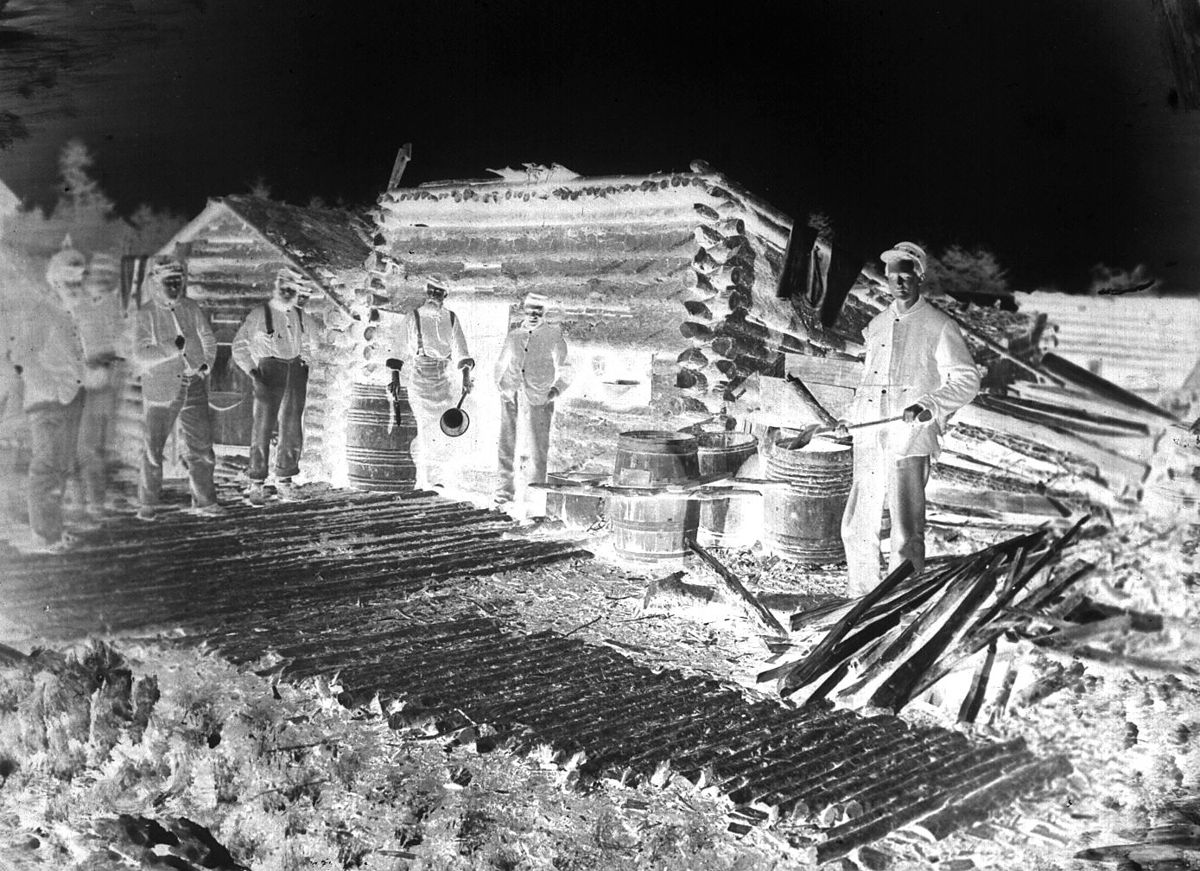
(111-B-252, National Archives Identifier 524671) Unlike breakfast on the farm, in larger cities bacon and eggs were not a common combination before the 1920s. That combination was reintroduced as part of a 1924 public relations campaign by a meatpacker selling pre-sliced bacon. In a sense, the meatpacker was selling the idea of a hearty, rural Southern breakfast of the past to twentieth century urban dwellers long used to toast, coffee, and boxed cereal. On the subject of commercial boxed cereal, it was not widely encountered for breakfast in the 19th century, urban or rural. The first boxed cereal was called granulla, introduced in 1863. The heavy bran nuggets had to be soaked overnight before they could be eaten and as such, failed to catch on in the cities or anywhere else for that matter. Boxed cereal served with milk was not popular as a breakfast food until the late 1870s. For a hot cereal, porridge was often served. What exactly was porridge? Porridge was a mush made from cornmeal, which was ground from dried hominy. There are three basic types of cornmeal. Samp was the coarsest grind and was used to make porridge. Porridge was common to the farmer’s table. It might be sweetened with molasses, maple syrup, or sugar (depending on what you had), and thinned out with a little milk or cream, again if you had it. While a breakfast of porridge would stick to your ribs, and might suffice by itself for a city dweller, there was usually more to the first meal of the day for a working man. Porridge would often be accompanied by wheat or corn bread, fresh or sour milk, coffee/tea, and pork, ham, or other meats. In the South, dairy products were less widely found, so lard substituted for butter. “Hog and hominy” were commonly found on the breakfast table of many Southern households. A visitor to a South Carolina inn during 1861 noted that variations on the “hog and hominy” menu were served every day at almost every meal. The intent of a rural breakfast was to stave off hunger by providing fuel for a hard day’s work, and not necessarily about advancing the culinary arts. Coffee was widely enjoyed in the South, and when Civil War shortages made it scarce, coffee drinkers resorted to parched and ground chicory, peanuts, acorns, sweet potatoes, and other roots for a substitute. Dough-nuts or “nutcakes” were popular with civilians and soldiers at any meal. They were cut into squares and diamonds, not the “O” shape widely known today. One period recipe cautioned that temperature control of the oil/grease needed to be “exacting” because, “if too cool the dough will absorb all the grease, and if too hot the outside will burn while the inside remains uncooked.” How the temperature of the grease would be regulated exactly was not explained. Cooking on a fire is an art largely lost to modern times. For a Civil War soldier in the South, breakfast might include beans soaked overnight and baked in a skillet with salt pork, but more commonly just salt pork, cornbread, and coffee. Sometimes eggs were foraged from a nearby farm and fried in the grease from the salt pork. In the South, corn pone and ‘jonnycakes’ often took the place of hard bread; they were fried in the renderings from the meat ration, if it existed, or otherwise baked on a rock placed on the embers. In other words, a soldier’s breakfast looked an awful lot like lunch and dinner. For civilians, breakfast in the South evolved regionally, but also along urban/rural lines based on the kind of work that was performed during the day. The relationship was a simple one, “more work, more calories.” One account describes a farmer’s breakfast as follows “…besides the buttermilk biscuits, served as four halves (two biscuits) open faced and slathered with white sausage or red-eye gravy, breakfast might also include meat such as country ham or bacon, pork sausage or pork chops, or something called “livermush” that was served on the side but cut up on the plate and mixed with the gravy. And then fried apples or applesauce, eggs, grits, or potatoes, fruit pies made from blackberry, apple, or pumpkin (in the autumn) or fried doughnuts; all accompanied by buttermilk, hot coffee with cream and iced tea, with quartered lemons on the side.” Nineteenth century farmers needed a breakfast like that because the morning meal might need to last until late afternoon if they found themselves at work “on the lower forty.” Two meals a day were quite often the norm. Craig L. Barry was born in Charlottesville, Va. He holds his BA and Masters degrees from the University of North Carolina (Charlotte). Craig served The Watchdog Civil War Quarterly as Associate Editor and Editor from 2003–2017. The Watchdog published books and columns on 19th-century material and donated all funds from publications to battlefield preservation. He is the author of several books including The Civil War Musket: A Handbook for Historical Accuracy (2006, 2011), The Unfinished Fight: Essays on Confederate Material Culture Vol. I and II (2012, 2013) and three books (soon to be four) in the Suppliers to the Confederacy series on English Arms & Accoutrements, Quartermaster stores and other European imports.