
Book Reviews
Book Reviews — September 2019
Originally published September 2019 · pp. 36–44
Civil War News book reviews provide our readers with timely analysis of the latest and most significant Civil War research and scholarship. Contact Stephen Davis, Civil War News Book Review Editor. Email: [email protected].
The Tortured Road to Freedom Illusions of Emancipation: The Pursuit of Freedom and Equality in the Twilight of Slavery. By Joseph P. Reidy. Illustrations, notes, bibliography, index, 506pp., 2019. University of North Carolina Press, www.uncpress.org. $39.95 cloth. Reviewed by Wayne L. Wolf
Emancipation may have become law with the conclusion of the Civil War and the adoption of the 13th Amendment. Yet Joseph Reidy forcefully argues that the process of emancipation and the full enjoyment of citizenship and its rights and privileges did not occur simultaneously. The path to the eradication of the legacy of slavery was long, uneven, filled with successes and failures, and may still be an ongoing process in American society. This volume wraps the struggle for true social, political and economic equality around three themes—time, space and home. Time began long before Abraham Lincoln’s Emancipation Proclamation. For preceding decades slaves took a central part in their own quest for freedom, escaping or purchasing their liberty, engaging in revolts or work stoppages, and pressing for increased aspects of freedom whenever possible. These methods differed depending on the space occupied by the slaves. In border states the Ohio River loomed as the Bible’s River Jordan. Yet the quest for freedom frequently ended in re-enslavement, punishment, or being sold farther South. This frequently involved splitting up families, destroying the sense of home, whether that was defined as relatives or geographically as the plantation, and alienating slaves from their sense of belonging. Within this framework politicians, soldiers, abolitionists and slaves themselves chartered a somewhat tortuous path, frequently imbued with disappointment and destroyed hopes toward the full realization of freedom. During the Civil War the movement of armies frequently dictated temporary freedom or a return to slavery. It likewise destroyed the traditional relationship between owner and slave and caused every American, North and South, to reach for new meaning for society, culture and political control. Joseph Reidy must be complimented on a thoroughly researched analysis of the path toward emancipation in its fullest sense. His use of primary source material conveys not only the facts but the emotions of the participants in the struggle for freedom. This volume will undoubtedly stand as one of the most exhaustive and important looks at emancipation and the road to equality. It is highly recommended for anyone interested in slavery, emancipation and the social, cultural and political changes brought about by freeing three million enslaved people. Wayne L. Wolf is Professor Emeritus at South Suburban College in Illinois and the author or editor of twenty-four books on the Civil War, including Two Years Before the Paddlewheel and Heroes and Rogues of the Civil War. He is currently researching primary source material on the life of the common soldier.
Civil War Congress and the Creation of Modern America: A Revolution on the Home Front. Edited by Paul Finkelman and Donald R. Kennon. 58 illustrations, notes, index, 232 pp., 2019. Ohio University Press, www.ohioswallow.com. $35 hardcover. Reviewed by Paul Taylor
The most common images of the Civil War are ones of grand battles, marching armies, and intense political debates within the United States Congress. Yet often overlooked or even neglected in our study of the war is understanding the long-term impact that Congress’s wartime focus had on the nation’s legal and social fabric. The seven scholarly essays in this volume serve to remind us of the myriad ways that the war’s Congressional legislation fundamentally transformed Northern society and how those laws continue to impact our daily lives to this day. Co-editor Paul Finkelman sets up his authors’ essays by pointing out that the war enlarged our national government beyond anything imaginable in 1861. This was due in large measure to the
Digital Issues of CWN are available by subscription alone or with print plus CWN archives from 2012 at CivilWarNews.com absence of Southern Democrats in Congress, which allowed Northern Republicans to pass legislation that the dominant Democratic Party had steadfastly refused to support prior to the war, believing such laws were harmful to Southern interests. Jennifer Weber’s opening essay on the March 1863 conscription act describes how, for the first time in the country’s history, an average man now had a potential life-or-death interest in national politics. This Federal incursion into what had previously been a local or state matter is a common theme throughout this book: the seismic shift, in only four years, of the relationship between the Federal and state governments, as well as between the country and its citizens. These foundational changes, as this book asserts, all emanated from within the halls of the Congress in Washington. By the end of the rebellion, the nation had been transformed from a primarily agrarian land into a growing industrial behemoth, due in large measure to the North’s need for war supplies. Paying for the war effort cost immense sums and, as Jenny Bourne explains, the war led to the creation of the Internal Revenue Service and a national income tax, paper money known as “Greenbacks,” and massive federal government borrowing with the debt sold directly to the public. The war also changed how society viewed acceptable “women’s work.” With so many men off fighting, the war created marketplace opportunities for women that previously did not exist. Daniel Stowell tells how the federal government employed large numbers of women for the first time ever to count and scissor-cut Treasury notes, thus freeing those men previously employed in such duty to now wield muskets instead of shears. These socalled “Government Girls” led to women becoming an acceptable and permanent part of the Federal government workforce. In addition to its legislative efforts to help suppress the rebellion, the Republican-dominated Congress passed laws that had little or nothing to do with the war effort. The additional essays discuss how the Department of Agriculture, the Homestead Act, the Land Grant College Act, and enhanced civil rights for African Americans all came into being during 1861–65. Illustrations and footnotes (far more user friendly than endnotes in this reviewer’s opinion) abound in this slender yet excellent volume. This work is part of the Ohio University Press’s “Perspectives on the History of Congress, 1801–1877” Series, which is currently a seven-volume series that examines the U.S. Congress during the antebellum and Civil War eras. It rightly reminds us how the Civil War remains to this day the foremost event in U.S. history. Its essays specifically illustrate how the war brought forth a revolution in the size and scope of America’s national government that, along with a consequential change in culture and society, still resonates into the 21st century. Paul Taylor is an award-winning author of seven books pertaining to the Civil War era. His most recent book, “The Most Complete Political Machine Ever Known”: The North’s Union Leagues in the American Civil War, was published by Kent State Univ. Press in 2018. He is currently editing the letters of Union engineer officer Orlando M. Poe to his wife for future publication.
Digital Issues of CWN are available by subscription alone or with print plus CWN archives from 2012 at CivilWarNews.com very capable foreign ministers during the war years. From 1860-1862 it was Edouard Thouvenel, an experienced and energetic diplomatic who was widely respected for his legal knowledge and writing skills. From 1862 until the war’s end, it was Edouard Drouyn de Lhuys who was also an experienced diplomat known for his writing skills. However, the relationship between Napoleon and his ministers was awkward. Both ministers often ignored the orders of Napoleon, almost to the point of insubordination because they found his instructions vague and unrealistic. Consequently, Napoleon often went behind his ministers’ backs to conduct foreign matters. The author argues that Napoleon III early on favored French recognition of the Confederacy, partially because of the way Northern cities had treated him during an 1830s American tour. However, the ministers took a “wait-and-see” approach, believing that the South would only win with outside assistance. They were also worried about potential Confederate expansion into Mexico. Furthermore, both ministers felt that a Confederate victory would be more to England’s advantage than to France’s. Consequently they persuaded Napoleon not to give the Confederacy recognition, though the emperor came close to doing so in 1862 and 1863. However, the blockade that granted the South belligerency status from Europe created diplomatic problems for the Lincoln Administration, which turned down several offers of mediation by the French ruler. Interestingly, Sainlaude argues that the Emancipation Proclamation had virtually no effect on France’s view or approach to the Civil War and that it was the fall of Vicksburg and not Lee’s defeat at Gettysburg that convinced France’s foreign ministry that a Southern military victory was hopeless. The author also examines the relationship between France and England. While their approach to the events in America was similar, that was about it. Relations between the two countries were severely strained, thanks in no small part to England’s concerns about French expansionism in Mexico and the Papal States. In fact, the British Prime Minister, Lord Palmerston, personally despised the French monarch. There are plenty of interesting facts shared in this book, among them that the American Civil War was not a top priority for either England or France and the main reason they gave it what attention it received was because of concerns on how the war affected their respective economies. While the news from America was a hot topic for the British public, in France it received little attention. And for trivia fans, the author points out that it was not until June 8, 1865, that France revoked the Confederacy’s belligerent status. The research is impeccable; much of the material presented comes from the author’s meticulous research in French archives, citing previously unused sources. The writing is fresh, crisp and balanced. Anyone with even a passing interest in the diplomatic side of the war needs to read this book. This is easily one of the best books ever written on the war’s diplomatic front and one of the best Civil War books, period, that this reviewer has read in a long time. Do not be surprised if France and the American Civil War—A Diplomatic History appears on the list of book award-winners at year’s end. Tom Elmore is a Columbia, S.C.based author/historian. He often points out that the only dwelling on the city’s Main Street to survive the fire that destroyed a third of Columbia on February 17, 1865, was the French Consulate.
Lincoln, Seward and US Foreign Relations in the Civil War Era. By Joseph A. Fry. Illustrations, index, bibliography, 244 pp., 2019. University Press of Kentucky, kentuckypress.com. $60 cloth. Reviewed by Wayne L. Wolf
Joseph A. Fry has compiled a comprehensive and thoroughly researched look at the policies of Abraham Lincoln and William Seward that combined threats, caution and compromise that saved the Union. Additionally, these strategies defended republicanism, nationalism and freedom as an example for the world to emulate. Coming from two distinctly different backgrounds— the rural, hardscrabble western frontier of Lincoln and the elitist, wealthy eastern establishment of Seward—these two leaders forged a partnership of respect that aimed to win the Civil War, prevent European intervention in that conflict, and silence domestic critics. Both men suffered through massive political assaults on the home front and from the foreign press, yet never lost sight of their goal of keeping the nation united. Theirs was a vision of an America ever expanding westward, becoming a dominant world power, and enriching Americans as leaders of world production and commerce. From its first foreign policy decision, supplying Fort Sumter and blockading Southern ports, to its last conference aboard the River Queen, the Lincoln administration was consistent in its demands for a reunited country, no retreat on the ultimate goal of emancipation, and no truce before the end of the war. The South would have to submit to these demands or continue to fight for its existence. Lincoln and Seward would concentrate all of their resources to these ends, economically bearing the cost of the war, politically keeping Europe from assisting the Confederacy, and morally taking the high ground against slavery and for freedom. Lincoln would use his political savvy and Seward his diplomatic skills to achieve these three objectives. Unfortunately, just as the fruits of four years of diplomacy were succeeding, John Wilkes Booth destroyed their partnership. But William Seward, barely surviving assassination himself, continued Lincoln’s vision through the Andrew Johnson administration. He never retreated from his quest for the end of slavery and full civil rights for freedmen, westward expansion for America, international dominance in commerce, and the spread of democracy around the world. While Seward’s most notable foreign policy achievement was the purchase of Alaska, his goals of building a Panama Canal, opening trade with Asia and acquiring Hawaii, the Virgin Islands and Puerto Rico became the cornerstone of late 19th- and early 20th-century American foreign policy. As a contemporary interpretation of the unlikely partnership between Lincoln and Seward, this book does an excellent job of not only illuminating the intellectual and diplomatic skills of the President and Secretary of State, but also fully developing their vision of what a united America could become on the world stage. At $60, a bit pricey, Fry’s work is worth the cost for those seeking to better understand the nuances of diplomacy abroad and at home during the Civil War era. Additionally, the bibliographic essay at the conclusion supplies a wealth of avenues for further research. Wayne Wolf is a frequent reviewer for Civil War News.
France and the American Civil War—A Diplomatic History. By Stève Sainlaude, Translated by Jessica Edwards. Photos, notes, chronology, index, bibliography, 285 pages, 2019. University of North Carolina Press, www.uncpress.org. $45 hardcover. Reviewed by Tom Elmore
During the Civil War’s sesquicentennial historians presented long-overdue re-examinations of the diplomatic side of the war. In the process they showed that the war’s impact was not limited to just North America, but was global. Joining this welcomed new scholarship is Sainlaude’s original and unique examination of the role France played in the war. Unlike previous historians who looked at the subject from the American perspective, Sainlaude, a history professor at the University of Paris IV Sorbonne, examines it from the French perspective. The result is a fascinating look at the court of French Emperor Louis Napoleon III. Napoleon Bonaparte’s nephew shared his uncle’s vision of greatness for France, but lacked his intelligence and fortitude. Fortunately, the emperor had two
Decisions of the Atlanta Campaign: The Twenty-One Critical Decisions that Defined the Operation. By Lawrence K. Peterson. Maps, photos, notes, bibliography, index, 242 pages, 2019. University of Tennessee Press, www.utpress.org. $29.95 paper. Reviewed by Gary Ecelbarger
The pivotal, four-month-long 1864 Atlanta Campaign is in the midst of an 11-year renaissance in Civil War book literature. Author Lawrence Peterson has chosen this campaign for the seventh installment of UT Press’s series exploring major decisions made by key commanders on both sides. He presents each case by summarizing the situation, exploring possible options facing the decision-maker, identifying the decision made, evaluating the results and the impact rendered by the decision, and then considering alternate decisions and subsequent scenarios. Although this template repeats 21 times in six chapters for the Atlanta edition, it succeeds as a stimulating read rather than a stale one as it uniquely interprets the campaign. The author’s work is well complemented by period art, photographs, and excellent explanatory maps by cartographer Tim Kissel. The presentation of each decision appears designed to foster debate and discussion among Civil War enthusiasts and military historians. Peterson succeeds for most of his Atlanta Campaign cases, and in some of them—particularly regarding Sherman’s deliberate decision to wreck railroads instead of chasing elusive armies—the author shines at his brightest. Where the book hits its darkest spots is in mischaracterized decisions. This includes two of the three decisions surrounding the Snake Creek Gap and Resaca portion of the campaign. In one particular case, General James B.
McPherson’s “ninth critical decision of the campaign to retreat all the way to Snake Creek Gap” (page 48) was actually not his decision to make at all; it was part of his mission. General Sherman’s orders to McPherson stresse, “It [the railroad at Resaca] once broken to an extent that would take them days to repair, you can withdraw to Snake [Creek] Gap and come to us or await the development…” Additionally, McPherson was never ordered to seize or hold Resaca, as the author claims in his eighth decision, but rather to make a quick and thorough strike before pulling back to the gap. Despite Peterson’s claim that McPherson worried that Johnston would move rapidly to Resaca once he sensed the threat to his flank and rear, Sherman had expected it and specifically ordered McPherson to be as aggressive as possible that day. On May 5, Sherman instructed McPherson that if he met infantry resistance to his railroad mission at Resaca, he was to strike them hard in the flank: “Do not fail in that event to make the most of the opportunity by the most vigorous attack possible,” in an effort (as Sherman later explained) to induce Johnston to quickly abandon the railroad and his supplies altogether and retreat eastward. Peterson’s 19th decision states that “Hood made the critical decision to attack the left flank and rear of … McPherson’s army as it marched west from Decatur to Atlanta.” Only the decision to attack is factual. Hood did not expect the Union army to be “on the march and unentrenched” as the author claims. Already aware that McPherson’s Army of the Tennessee was halted and digging in in front, he intended to surprise attack it from behind. Hood’s initial order was to attack it directly in the center rear from Decatur, but it was Hardee who modified and improved the plan to a simultaneous left flank and rear attack. Nearly two-thirds of the author’s chosen decisions cover the pre-campaign months and the first four weeks of the campaign. It seems unbalanced in that the remaining three months of the campaign are not approached with nearly the same vigor, especially when noting that the final and bloodiest six weeks of the campaign are covered with only three decisions. The author would have enhanced his work had he included other important decisions confronting the commanders from June onward, some more impactful than the ones he chose prior to this. A primary example to include was General Johnston’s controversial decision to abandon the Hell Hole line on June 4 without offering any resistance to Sherman’s reclaiming of the W&A Railroad, and thus sparing Sherman from making a desperate and likely costly attack as the rations for his men were only a week from total consumption. Not to be overlooked is McPherson’s decision not to attack Atlanta from the east on July 20 (arguably more important than the Resaca controversy), Sherman’s endorsement of Stoneman’s desired Macon and Andersonville prison liberations as a distraction from the Stoneman-McCook raid (how would these 30,000 debilitated men make their way to freedom?), and Hood’s endorsement of the impotent Wheeler raid in August (would he have been as surprised as he was about Sherman’s movement to Jonesboro with 5,000 more sets of eyes roaming the region?). These, in my opinion, are but a few examples of decisions that admittedly did not define the operation of the campaign, but would have balanced the campaign study. The author includes a “Driving Tour of the Critical Decisions of the Atlanta Campaign” as one appendix and a Union and Confederate orders of battle for two others. The two campaign orders of battle are inherently problematic due to brigade and regimental reassignments during the latter half of the campaign and successions of regimental and brigade commanders that go unnamed in the appendix, leaving the impression that the officers named are the ones in charge throughout the campaign. The concept of the driving tour to explain the decisions onsite is a sound one, with several good and inspired choices made throughout. However, it must be noted that Hood’s decision to attack McPherson was not at all associated with the Dexter Niles House site and the historic depot at Jonesboro (the author’s final tour stop) was not the site of the Civil War depot—it actually stood half a mile north of it, adjacent to the Patrick Cleburne Cemetery. While I applaud the publisher’s thought-provoking concept, I am disheartened that Decisions of the Atlanta Campaign is the same author’s third campaign-decisions book released in just ten months. How many more campaigns with the same template has he already written but are yet to be published? I endorse the author’s general approach to his chosen campaigns but would prefer that he take much more time to research and test his decision topics with campaign historians to produce books subject to fewer points of criticism while still maintaining enlightening and entertaining points of debate.
Gary Ecelbarger is the author and co-author of ten books and two dozen articles about Civil War topics. He is currently writing his fourth book dedicated to the Atlanta Campaign and its personalities, this one about the May 28, 1864 Battle of Dallas (Ga.)
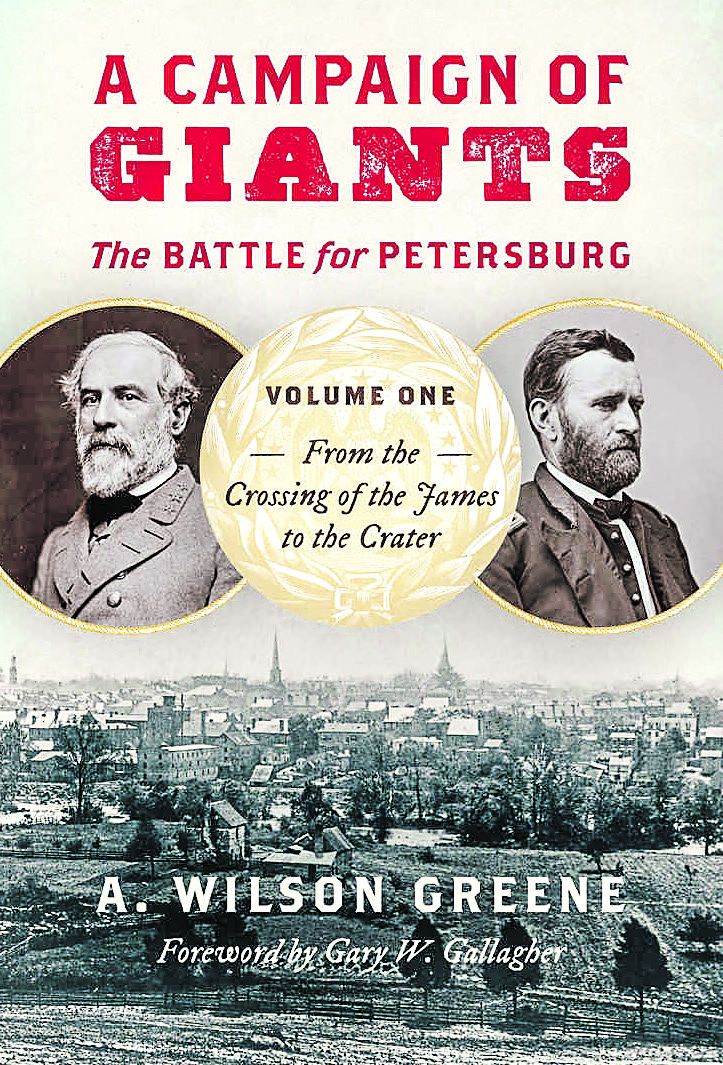
A Campaign of Giants: The Battle for Petersburg, Vol. 1—From the Crossing of the James to the Crater. By A. Wilson Greene. Maps, notes, bibliography, index, 720 pp., 2018. University of North Carolina Press, www.uncpress.org. $45 cloth. Reviewed by Chris Mackowski
The Federal and Confederate armies hunkered down in the trenches around Petersburg for 292 days in 1864, locked in a siege that would lead to final victory for the North and defeat for the South. It has taken me nearly that long to get this review written of A. Wilson Greene’s A Campaign of Giants: The Battle for Petersburg, Vol. 1—From the Crossing of the James to the Crater. The fault rests not with Mr. Greene but with myself—unless one were to blame Greene for writing an epic so extraordinary in its scope, depth, and analysis. This was a book to be pored over, studied, savored, and best of all, enjoyed—military history as it’s meant to be written. I took my time with A Campaign of Giants because the book deserves—demands—it, and I am much richer for it. And this is only part one! A Campaign of Giants is the first of three planned volumes, although Greene says in his introduction that he’s “under no illusion that my work is definitive.” I, for one, think he’s being modest. Greene worked and lived on the Petersburg battlefields for more than twenty-five years. That hands-on, intimate perspective and lived experience have made him the foremost authority on the battle. Admittedly, he says, the company is small because Petersburg gets the short shrift from most students of the war.
“[E]ven the most dedicated students of the American Civil War had an imperfect understanding of those 292 days during which the war’s best-known armies grappled over possession of Virginia’s second-largest city,” he writes. Greene’s book successfully balances the wide strategic context and narrower operational aspects of the campaign with the in-thetrenches perspective of common soldiers on both sides. We spend time with the “giants,” Ulysses S. Grant and Robert E. Lee, but we spend as much time seeing the soldiers’-eye view, usually far more limited but much more illustrative. “The first six weeks of the Petersburg Campaign feature a number of controversies that have intrigued scholars and readers for generations,” Greene adds, specifically laying out “[i]ssues such as Robert E. Lee’s measured response to the Union army’s crossing of the James River, the failure of the Federals to exploit their success on June 15, 1864, the futility of Grant’s First Offensive despite the Federals’ overwhelming numerical superiority, and the preparation for and conduct of the Battle of the Crater…” He tackles each of these in turn, balancing a wealth of information and evidence against his crisp narrative. He never loses the action even as he makes his case, providing readers with a through-thread that brings both the action and the analysis into sharper focus. Adding additional clarity are Edward Alexander’s excellent maps. Alexander formerly worked for Greene at Pamplin Historical Park, allowing them to communicate often about their shared knowledge of the ground—a partnership that resulted in excellent cartography. Like so many others, I’m woefully undereducated about Petersburg beyond the highlights offered in the National Battlefield’s driving tour and the excellent interpretation offered by Pamplin. If I know anything about the battle beyond that, it’s the experience of the 1st Maine Heavy Artillery. The men of the regiment came from areas back in Maine I know well, and the regiment had its baptism of fire at Harris Farm in Spotsylvania on May 18. At Petersburg, the Heavies had the unfortunate distinction of being the regiment with the highest single-loss of any unit on any battlefield during the entire war: 632 of the 900 men fell as casualties during their June 18 assault. “You aught to have seen us kill them,” one Alabamian boasted. Greene’s account of the attack lets us do just that, or as nearly so as a book can. In this one spot where I knew a little bit about the action, I could see Greene’s experienced hand conveying the action deftly, deeply, and in detail. He knew his stuff, and here, in this one spot at least, I knew he knew his stuff. I figured Greene would bring his A-game to this book but, wow, did he bring his A-game. A Campaign of Giants has that same eye for detail, storytelling, and accuracy in its entirety. It is a marvel. Greene has not only helped me better understand events at Petersburg but, more important, better appreciate their importance. It’s a mistake to think of Petersburg as a big, monolithic one-size-fits all thing but, rather, an evolving series of events that leads to the slow unwinding of the Confederacy. Not that we’d know that without the benefit of historical hindsight. At the end of A Campaign of Giants, Grant is vexed by his loss at the Crater, which he called “the saddest affair I have witnessed in the war.” “[T]he question in my mind,” writes a Massachusetts soldier, “is Grant going to raise the siege and fall back a whipped man.” It is a fitting closing thought for Greene to end his book with—because, after all, this is only the end of volume one. In the historical moment, the end of the Petersburg Campaign looks anything but inevitable, and it is a credit to Greene’s storytelling that he leaves us wanting more. Chris Mackowski is the editor in chief of Emerging Civil War (www.emergingcivilwar.com).
The War Criminal’s Son: The Civil War Saga of William A. Winder. By Jane Singer. Illustrations, notes, bibliography, index, 275 pages, 2019. Potomac Books, potomacbooksinc.com. $29.95 hardcover.
Reviewed by Robert S. Davis
Brigadier General John H. Winder, commander of the Confederate prisons east of the Mississippi River and commandant of Camp Sumter (the notorious Andersonville prison), died by natural causes on February 6, 1865. Consequently, Captain Henry Wirz, a mid-level bureaucrat, went to the gallows instead of Winder as a scapegoat for the horrors of Andersonville. According to historian Jane Singer, however, Winder’s death “was only the beginning of the descent of the Winder name into perpetual infamy and irretrievable darkness.” In The War Criminal’s Son, Singer tells the story of Captain William Andrew Winder, John’s son who remained in the Federal army despite his family’s support for the Confederate States of America. Questions about his political sympathies followed him for the rest of his life. The book includes background on such topics as Andersonville, Civil War California, and Allan Pinkerton’s spies. As with Singer’s Confederate Dirty War and Lincoln’s Secret Spy, the author writes in a humanistic style that allows the reader to feel both the times and the
Subscribe at CivilWarNews.com presence of the younger Winder. Singer writes in a complex way that draws the reader along, while avoiding trying to say too much when too little information survives. Some Southerners did remain in the Union, such as John Meck Cuyler, James Moore Wayne, and General George H. Thomas, but that topic does not find a place here. Robert E. Lee had to make that decision and a study of the inclusion of the influence of wives would make interesting reading. (Winder’s wife was the daughter of the Republican governor of New Hampshire.) William A. Winder lived an improbable life. Failing six times to get an appointment to the United States Military Academy, he received a commission of second lieutenant for bravery as a civilian at the battle of Buena Vista in the war with Mexico. In 1853, on the ill-fated San Francisco, he became a hero, saving lives while contending with a hurricane and cholera victims. Winder eventually served across the continent from Maine to Florida and west to Missouri and California. He also became an artist and a physician, as well as having a major role in the classic California novel Ramona. Winder long pleaded for help for the Indians and, despite advanced age and ailments, spent his last years as agent for the Rosebud Reservation in South Dakota. Winder found himself a victim of circumstance. Aside from his father and other close relatives in the Southern army, William’s grandfather William Henry Winder gained notoriety as the scapegoat for the defeat of the
American forces at Bladensburg in 1814, leading to the subsequent British capture of Washington. Lincoln’s Secretary of War Edwin Stanton posed the question of how could the Federal government trust a Southerner who would fight against his home and family. Then Allan Pinkerton’s spy network, searching out Southern sympathizers, caught Winder allegedly voicing support for the South’s cause. Other Winders found themselves in custody on charges of conspiracy and treason against the United States, including even William’s eighty-four-year-old grandmother. William A. Winder returned to California after failing to obtain a position in the war in the east. He found that the fears for state security also followed him back to the military prison at Alcatraz, where he served. Most of the book follows Winder in Civil War California, including his involvement in the C. J. Chapman and the Sutlej affairs. Whatever Winder did, however, always drew suspicions because of his family ties to the Confederacy. After he retired from the army, he struggled financially, tried to salvage his reputation in spite of being a Winder, and promoted San Diego. The War Criminal’s Son thus serves as a history of this prominent Maryland border state family in the Civil War. Professor Davis manages, at Wallace State College, Hanceville, AL, a center for Civil War research. He has authored several books including Ghosts and Shadows of Andersonville.
The Army of the Cumberland: Organization, Strength, Casualties, 1862– 1865. By Darrell L. Collins. Notes, appendices, bibliography, index, 193 pp., 2019. McFarland, www.mcfarlandpub.com. $49.95 softcover.
Reviewed by Christopher L. Kolakowski
The Army of the Cumberland (and its predecessor, the Army of the Ohio) was the second-largest Federal field army in the Civil War, exceeded in size only by the Army of the Potomac. It participated in some of the war’s most crucial battles at Shiloh, Perryville, Stones River, Chickamauga, Chattanooga, the Atlanta Campaign, Franklin and Nashville. It was incubator for leaders such as Don Carlos Buell, William S. Rosecrans, George H. Thomas, John M. Schofield, Philip H. Sheridan and Arthur MacArthur, among many others. Many fine histories have been written about the Army of the Cumberland’s battles, and more are on the way. Darrell Collins takes a different approach, looking at the army from a statistical and organizational standpoint. After a short introduction he starts on the data. The first section charts the army’s evolving order of battle, starting September 30, 1861, and tracking units until the summer of 1865. A second section covers strengths over the same period, while a third and final section outlines casualties for all the major engagements of the army. Readers will also find information on the Department/Army of the Ohio, which the force was called before late 1862. The organization section also demonstrates something often overlooked in histories, namely that the army had garrison responsibilities over wide parts of Tennessee throughout its existence. Collins also follows the Army of the Cumberland units (XIV and XX Corps) that formed the Army of Georgia, which with the Army of the Tennessee participated in the March to the Sea and the Carolinas Campaign— something not usually included in discussions of the Army of the Cumberland after September 1864. That said, the book does have some flaws. First, despite the title 1862–1865, there are entries for 1861, which may cause confusion. The author’s coverage of the Army of the Cumberland’s Tennessee-based units in 1865 is quite limited. He appears not to have consulted sources beyond the Official Records. Typographical errors sometimes appear, and the formatting makes the data seem crunched together. But these limitations ultimately do not cancel out the book’s overall usefulness. Collins’ work shines additional light on an army that needs more attention. He has done what he set out to do, which was compile a handy one-volume statistical reference of this army and its organization. It is not recommended as anything more. Chris Kolakowski works as a historian in Norfolk, Virginia. He is the author of four books on the American Civil War and World War II, and is a contributor to the Emerging Civil War blog.
“This Infernal War”: The Civil War Letters of William and Jane Standard. Edited by Timothy Mason Roberts. Endnotes, bibliography, index, photos, 376 pp., 2018. Kent State University Press, www. KentStateUniversityPress.com, $34.95 cloth. Reviewed by Gould Hagler
My dearest Will, Without you life is difficult and we miss you terribly, but we are managing with the help of our family, our neighbors, and our merciful and powerful God. Your fine young sons have cheerfully taken on the duties of men; your daughter too is a constant help; I am now a farmer rather than a farmer’s wife and have managed to harvest the crop, tend to the livestock, and make sure the family is fed, clothed, shod and sheltered. We are proud of you and will continue to get by until you return in victory. I am forever your loving and faithful wife, Jane Dearest Jane, Your letters are a constant source of comfort in this trying time. I look forward to better days when I am with you and the children, but for now I have an even higher duty. Soldiering is not pleasant but my brave comrades and I endure the hardships willingly. Our country has called us in her hour of need; we have answered and will be steadfast til our work is done. Your loving husband, Will P.S. Please thank your dear father for his kind and generous help. I know Pap does not want or expect re-payment, but I intend to do so as soon as I am able. Just what you expect to see in letters between the farm and the front, right? Maybe in an ideal world, but the letters we read in “This Infernal War” contain no lofty words of encouragement, no noble expressions of patriotism, no reticence to voice complaints or to dwell on the hardships of war. Jane and Will did not live in an ideal world; they were not ideal people; and Pap was not an ideal father-in-law. This large collection of letters, capably edited by Western Illinois University’s Timothy Mason Roberts, pulls back a curtain on a very real world, at times a vulgar and grubby one, a world inhabited by an unenthusiastic middle-aged soldier and his weary and troubled wife, a man and a woman who have a little interest in saving the Union but none whatsoever in freeing the slaves. William and Jane Standard were Illinois farmers, both with roots in the South. They were Democrats and Copperheads to boot. They loathed Lincoln and they loathed Lincoln’s war. Why did Will volunteer? At his age, 40, he surely could have avoided service with no dishonor. He was “sensitive to his reputation in the community,” the editor speculates, plus he was in debt and sought to postpone the day of reckoning. From the tone of the letters I judge the second motive to be the stronger one. Will signed up in August 1862, served as a sergeant in the 103rd Illinois Infantry, and at the end of the war was promoted to lieutenant. The regiment saw relatively little action until Missionary Ridge in November 1863, then campaigned with Sherman to Atlanta, on to the sea, and through the Carolinas. Will’s letters are mostly about camp life, foraging, hopes for furloughs, complaints about delinquent pay and constant plans to get out of the army, by one means or another. Will is often ambivalent about his service. Should he try for a promotion and get better pay? Should he seek a commission in a black regiment, and get even better pay? Or should he desert, sell out, and leave Illinois for California? Jane writes in detail about the crops, the livestock, tenants, boarders, high prices and creditors. We learn of her dismay when she discovers that Will left behind some serious debts. He hadn’t told her before he went a-soldiering, and was less than forthcoming when she confronted him via the post.
The letters also paint a portrait of their community in the Little Egypt section of southern Illinois. Will was not the only reluctant soldier. At one point Jane writes of armed resistance to efforts to capture deserters sheltering in Fulton County. In another letter she tells of a vehement argument between her father (a Republican) and another local man, a Democrat whose views are aligned with the Standards’. Pap and his one-time friend nearly came to blows. Jane and Will were not highly educated people, but neither were they unschooled. Will, in fact, had once been a schoolteacher. Both were facile with pen and ink, and were able to write clearly and expressively. The numerous letters are a rich source of information about a soldier’s life, the civilian community he left, the army community he joined, and the attitudes he and others held about the war, politics, Lincoln, blacks, Black Republicans, secessionists and much else besides. The letters are also a very good read. One final item, if the book review editor will permit after this already over-long review. Your English teacher would have been apoplectic had you turned in a paper with the grammar and spelling employed by the Standards. However, for anyone interested in linguistics, their writing provides insights about how people of their class and region used the American language in the middle of the 19th century. In her first letter to Will, the month after he signed up, Jane wrote: I wish you was here to eat supper with us. I am in the parlr a-writing at the big table. Almira is over to the Worley’s. George and Perry is off a-playing somewhere, I do not know where. Freeman is upstairs as usual a-squealing and thumping around. What they had to say makes “This Infernal War” worth reading. So does the way they said it. Gould Hagler is a retired lobbyist living in Dunwoody, Ga. He is a past president of the Civil War Round Table of Atlanta and the author Georgia’s Confederate Monuments: In Honor of a Fallen Nation, published by Mercer University Press in 2014. Hagler speaks frequently on this topic and others related to different aspects of the Civil War and has been a regular contributor to CWN since 2016. He can be reached at [email protected].
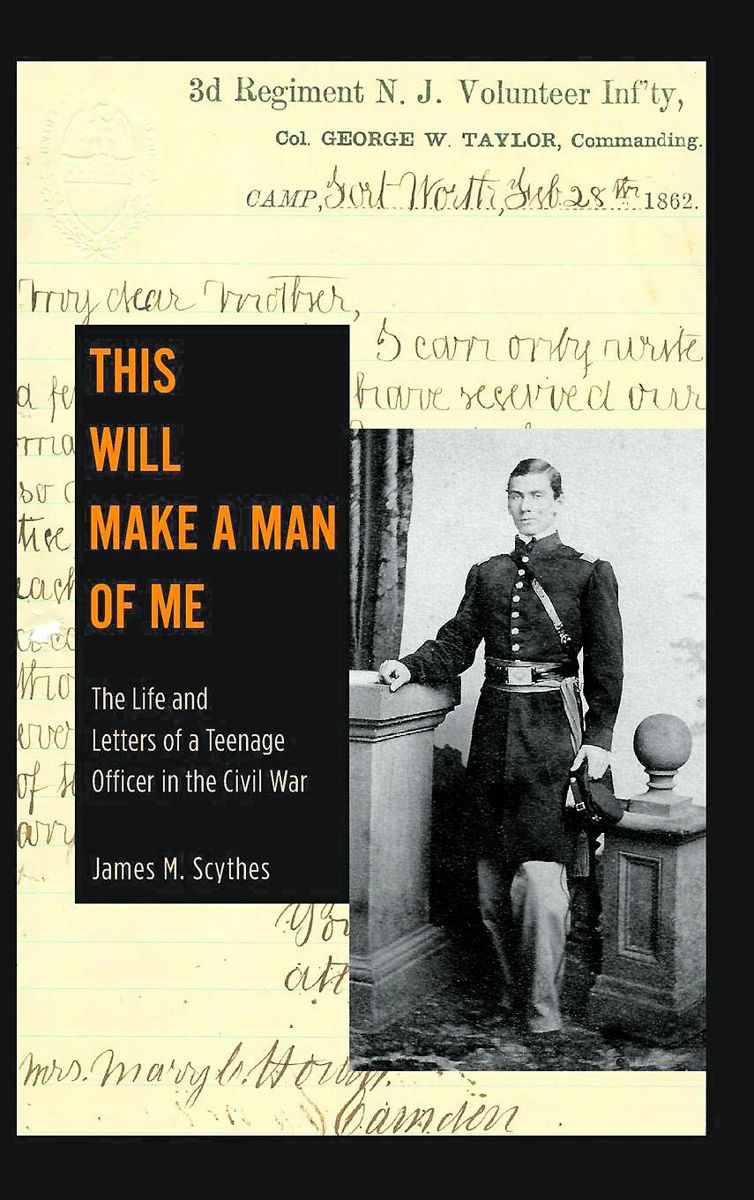
This Will Make a Man of Me: The Life and Letters of a Teenage Officer in the Civil War. Edited by James M. Scythes. Photos, notes, bibliography, index, 2016, 181 pp. Lehigh University Press, www.rowman.com. $90 hardcover, $42.99 paperback. Reviewed by Noah F. Crawford
Although estimates of the number of boys who enlisted in Civil War armies before their eighteenth birthday vary widely, most agree that tens of thousands of these young men filled Union and Confederate regiments. Such youths most frequently fought as enlisted men. Herein lies the value of 2nd Lieutenant Thomas James Howell’s wartime letters. This Will Make a Man of Me presents the sixty-five letters of a seventeen-year-old lieutenant in the 3rd New Jersey Infantry from February through June 1862. Howell’s correspondence, capably edited and annotated by James M. Scythes, provides readers with unique insight into the experiences and motivations of a teenage officer in the Union army. In the book’s introduction, Scythes cites Benjamin Gould’s 1869 study of soldiers’ ages to show that Howell represents one of only perhaps a dozen commissioned officers under the age of eighteen. Howell was born in Camden, N.J., in 1844, into a large and prominent family. His father—an outspoken abolitionist and devout Christian—died in 1859. He was classically educated at a local school, where he achieved proficiency in the Man of Me French language and on the piano.
essay on chivalry and the noble nature of death on a battlefield before the Civil War began. Scythes argues that Howell joined the Union army both from a desire to financially support his family and to pass from boyhood into manhood. Through his family’s political connections, Howell received a commission in February 1862, just four months after his seventeenth birthday. After joining the 3rd New Jersey in Virginia, he began a frequent correspondence with several members of his family. The majority of these letters reveal that Howell fought primarily to prove himself a man to both his family and his comrades. In his effort to live up to the ideals of a “Christian gentleman,” Howell repeatedly expressed disgust with the officers of his regiment who swore, smoked, and drank freely. Such vices, Scythes notes, “were to be avoided by an honorable gentleman.” Howell’s letters reveal a young man’s yearning for approval from both his men and his superiors—but never at the expense of his own morality and honor. Alcohol, he wrote, “is a bad thing. And which prove the ruin of a great number.” Howell described the voyage from northern Virginia down the Chesapeake Bay to the Union lines outside of Yorktown, where he first encountered the brutal realities of combat in the form of wounded men being brought back to hospitals. There he heard rumors of Confederates’ slaves murdering a helpless Federal soldier as he begged for quarter. The “black Rebels called y’all the d—n Northerners, and they shot the Zouave dead on the spot,” he wrote. Howell opined that the only punishment for such an enemy was to “shoot them like dogs.” The 3rd New Jersey participated in the Army of the Potomac’s plodding campaign towards Richmond in the spring of 1862, and Howell’s letters belie the confidence of his youth. He predicted that the Confederates would evacuate Richmond as they had done at Yorktown and optimistically hoped that he would be home for the Fourth of July. General George B. McClellan reviewed Howell’s brigade in May “amid the most tremendous cheering I ever heard… . I could have touched his horse with my hand.” As the campaign dragged on, Howell’s letters began to reflect a yearning for his home and family: “if I am spared through the coming battle,” he wrote, “I shall resign.” Howell penned what would be his final letter on the night of June 26. The following day, he was killed in his very first battle at Gaines’ Mill. Howell is an atypical and fascinating study for his age, rank, beliefs, motivations and education. While his fervency to prove his worth as a man was common among young soldiers during the war, his affluence and eloquence separate his letters from other Northern narratives. This Will Make a Man of Me is a valuable source for any student of the war seeking a new and unique perspective from one of the Union’s youngest commissioned officers.
Noah F. Crawford graduated from Christopher Newport University in 2019 with degrees in American Studies and History. He is currently pursuing an M.A. in history at Virginia Tech.