
Through The Lens
A Delaying Action
By Stephanie Hagiwara · Originally published September 2019 · p. 14
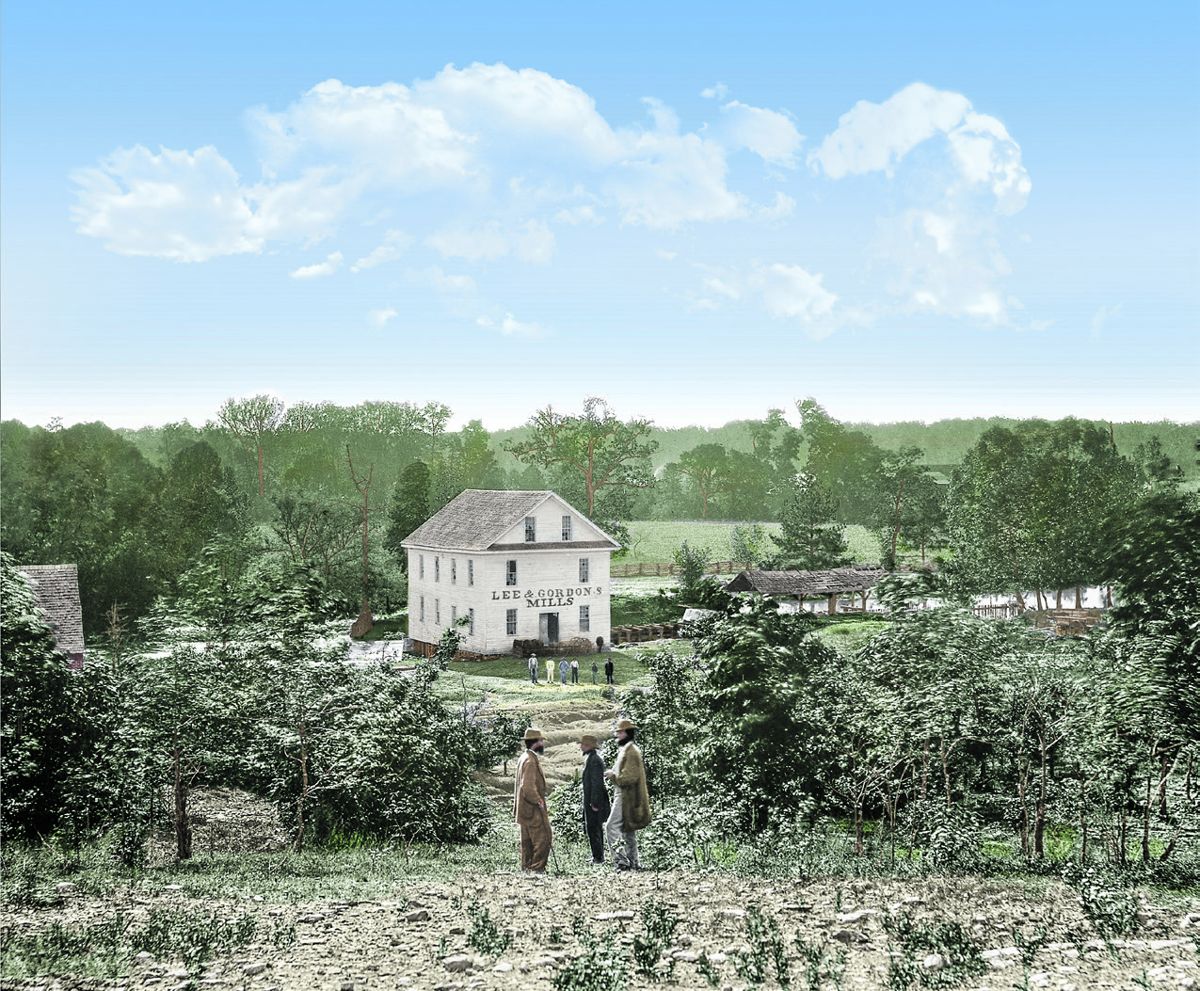
“the rebels are coming in bunches.” – U.S. Cpt. Heber S. Thompson By September 1863, U.S. Gen. William Rosecrans’s Army of the Cumberland had driven C.S. Gen. Braxton Bragg’s Army of Tennessee out of Middle Tennessee and had captured Chattanooga. However, Bragg was not willing to abandon the area. His plan was to destroy Rosecrans’s army by striking U.S. Gen. Thomas Crittenden’s XXI Corps at Lee & Gordon’s Mill, Bragg’s former headquarters. Crittenden’s left flank and front would be attacked simultaneously. Bragg would drive forward and pen in his foes at McLemore’s Cove before obliterating them. Reinforcements poured in by train. He had “deserters” portray the Confederates as demoralized and fleeing the area. Bragg proclaimed, “The movement will be executed with the utmost promptness, vigor and persistence.” On September 18, the initial phases of the Battle of Chickamauga, Tenn., began. C.S. Gen. Bushrod Johnson was ordered to cross the Chickamauga Creek to reach a position on Crittenden’s left flank. Oddly enough, Johnson came from an abolitionist Ohio family and had graduated from West Point. As a descendent later put it, “a rather strange career for a Quaker.” Johnson had spent a decade in the South and accepted a commission in the Tennessee militia at the start of the War. Due to confusing orders,
Johnson’s men had to countermarch an extra six miles before engaging the Federals. U.S. Col. Robert H.G. Minty, 4th Michigan Cavalry, had been assigned to guard Reed’s Bridge. Minty had sent reports to Crittenden’s headquarters that he could hear “train after train” arriving and unloading at Ringgold, Ga. Minty was assured, “… the rebel army is retreating, and are trying to get away some of their abandoned stores; they have nothing but dismounted cavalry in your front.” Minty suspected otherwise. Minty’s father had served in the British military. He had travelled the world as a military dependent, and then served five years as an officer before selling his commission. He was a railroad engineer in Michigan when the War began. In the morning Minty sent patrols to scout for the Confederates as his camp was struck and gear sent to the rear. They found Johnson’s men approaching Peavine Creek. From Peavine Ridge Minty could see what he was up against, Johnson’s 5,000 infantry and 20 cannon vs. Minty’s 973 troopers and two guns. Minty knew Rosecrans army was scattered. Reinforcements would not be coming soon. He decided to use the terrain to delay the Confederate advance with a fighting retreat. Moving against an enemy of undetermined size, Johnson spread his men into lines of battle. They fought their way across the creek and up the ridge. There they caught a glimpse of the enemy concealed in an orchard. C.S. Gen. Nathan Bedford Forrest was unimpressed. He requested and was granted permission to take his cavalry and flank the enemy’s perceived main camp. Another delay came as C.S. Gen. John Bell Hood was warmly welcomed. Hood was back in the field after his left arm was crippled at Gettysburg. He had traveled by train with his men from Richmond, Va., to rapidly reinforce Bragg. Now 10,000 men in grey with 15 regimental colors were overwhelming Minty. His men slowly retreated past the Reed house. The Board of Trade Battery opened their four guns, raking the Confederates who followed, forcing them to redeploy. Minty’s men crossed Reed Bridge, removing the planks, and positioning themselves on the high ground. After two hours, the Rebels found other places to cross and were replanking the bridge with siding from Reed’s barn. The Board of Trade Battery “were entertained by a hand-to hand contest while the guns were limbered to the rear and run across the ford.” Earlier, along with sending reports to headquarters, Minty had sent a request to the other brigade in the area to reinforce the unprotected crossing at Dryer’s Bridge. U.S. Col. John T. Wilder sent seven companies of the 72nd Ind., 123rd Ill., and two sections of Eli Lilly’s artillery, to the crossings. Wilder was determined that his brigade would be the best it could be. Needing cavalry to protect his infantry, he had ordered men to ride the wagon mules. When the mules disagreed, horses were obtained. His mounted infantry was armed with two cannon cast from his own foundry and the best guns he could find, Spencer repeating rifles. Wilder’s “Lightning Brigade” was protecting Alexander’s Bridge, three miles north of Lee & Gordon’s Mill. It was 1,000 men vs. 8,000 infantry, Forrest’s cavalry, and artillery. The steep creek banks forced the Confederates to use the bridge or try elsewhere. Dense woods protected the Federals positioned on each side of the bridge. They built a small fort with planks from the bridge with Lilly’s four guns positioned on a knoll behind them. For almost five hours the combatants traded fire. Then the Confederates began to find places to cross the Chickamauga Creek. Minty sent word that he was being forced to withdraw and Lily’s guns were limbering up. The last defenders knew they couldn’t all leave at once. They decided to slip away, two men at a time. Wilder’s brigade withdrew 1½ miles from Lee and Gordon’s Mill. Minty’s men, “making a circuit round the Confederates who had crossed near Alexander’s Bridge,” joined them. Together they threw up breastworks of “fence rails, rocks, and trees. Minty had galloped over to the Mill to report to U.S. Gen. Thomas Wood. Wood asked, “Well, Minty, what have you been doing all day?” “Fighting the enemy,” came the retort. “What have you been fighting?” “Everything – infantry, artillery and cavalry.” “Where are they?” “Close to your present position, which is now covered by Wilder’s brigade and mine.” “Do you mean on our side of the creek?” “On our side of the creek, General.” “Well, come along, and we’ll drive them back across to their own side.” Minty, Wood, and some orderlies rode out to the Lightning Brigade. Wood asked, “Where are they, Wilder?” “Ride forward about a dozen paces, General, and you will see them.” Just then a roar of musketry blazed in front of Minty’s position, followed by the quavering sound of the Rebel yell. Wood turned to see Hood’s infantrymen charging. With a stunned look on his face, Wood declared, “By God, they are here,” realizing for the first time just how endangered the Army of the Cumberland was. Wood
Bushrod Rust Johnson, 1817-1880. Colorization © 2019 civilwarincolor.com courtesy civilwarincolor.com/cwn. (Library of Congress) wheeled his horse and galloped back to his command to get it ready to give battle. The Confederates continued their attack until 10 p.m., repelled by the Lightening Brigade’s Spencer Rifles. Sources: • •
•
Wittenberg, Eric J. Holding the Line on the River of Death Powell, David. The Chickamauga Campaign: A Mad Irregular Battle: From the Crossing of Tennessee River Through the First Day, August 22 - September 19, 1863 Time Life Books. The Fight for Chattanooga
Stephanie Hagiwara is the editor for Civil War in Color.com and Civil War in 3D.com. She also writes a column for History in Full Color. com that covers stories of photographs of historical interest from the 1850’s to the present. Her articles can be found on Facebook, Tumblr and Pinterest.