
The Graphic War
Prang and Company: Sheridan’s Ride October 19, 1864
By Salvatore Cilella · Originally published October 2019 · p. 20
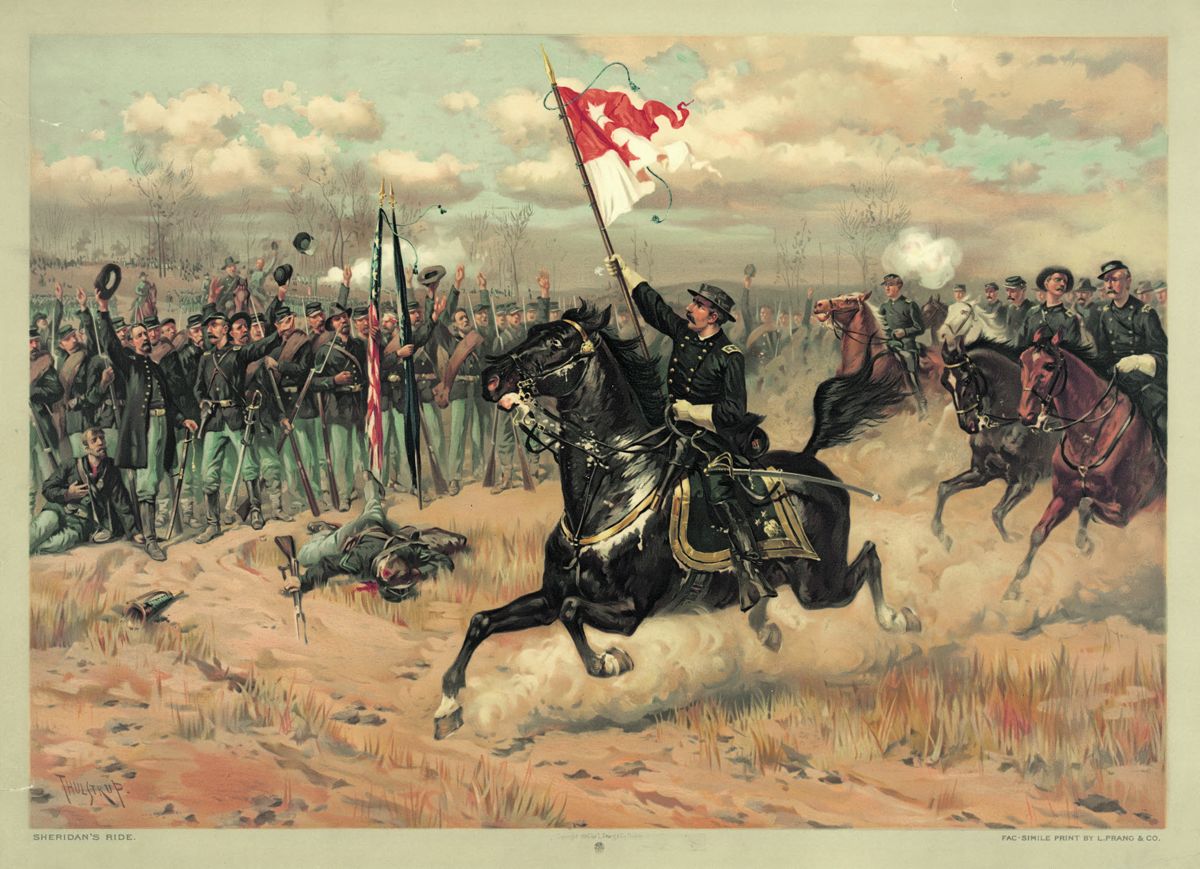
Prang and Company: Sheridan’s Ride October 19, 1864 The Graphic War highlights prints and printmakers from the Civil War discussing their meaning and most importantly, the print maker or artist’s goals. Last month’s column highlighted the lithographic firm of Kurz and Allison. Their head to head competitor was the firm of Louis Prang and Company. Both firms operated through most of the last quarter of the 19th century and produced many subjects beyond the Civil War. Insipid greeting cards, Valentine cards, advertising (where most of the money was), and soppy “sentimentals” were the stock in trade of both firms. But the two approached their subject matter much differently and whether or not their strategies were intentional, their products were so different as to make them unmistakable. Like other lithographic businessmen, Louis Prang was an immigrant. He was born in 1824 in Breslau, Prussian Silesia. With the European revolutions of 1848, he first went to Switzerland, and then in 1850, the United States.1 Six years later he joined Julius Mayer in Boston to form the Prang and Mayer enterprise in 1856. When the war came, the firm continued to produce the usual products for mass consumption and oddly enough, war maps for American newspapers.2 As Currier and Ives continued to print timely, if highly dramatic and inaccurate depictions of the latest battle, Prang did not turn to war subjects until the 1880’s as Kurz and Allison began to compete with them. Like Kurz, Prang was interested in chromolithography as a means to produce and reproduce “art.” Chromolithography, essentially “printing in colors” as opposed to printing in black and white followed by hand coloring, allowed greater freedom to use color, which made “up the picture itself.”3 One major “war” exception was Prang’s collaboration with the iconic American painter, Winslow Homer. The two produced Civil War scenes entitled Campaign Sketches in 1863, “spirited camp scenes sketched on the spot.”4 In the early 1880’s, Kurz and Allison produced their first battle art, “The Battle of Gettysburg,” based on the Gettysburg Cyclorama. According to most sources, this prompted Prang to develop his eighteen Civil War scenes which he called “Prang’s War Pictures: Aquarelle Facsimile Prints.”5 They were equitably depicted, six naval images, six western theater scenes, and six eastern theater clashes. Whereas Kurz printed various images throughout the 1880’s, Prang issued all eighteen in his portfolio in 1885-6. The most famous was Sheridan’s ride during the Battle of Cedar Creek as he rallied Federal troops on October 19, 1864, as they faltered from Jubal Early’s withering surprise attack in the Confederacy’s last major Shenandoah Valley engagement. Sheridan had pushed Early out of Winchester in the 3rd Battle of Winchester or Opequon Creek on September 19, then followed up at Fisher’s Hill four days later. Both armies moved up the Valley and came to rest near the two forks of the Shenandoah River where Massanutten Mountain towered above the valley. On the morning of October 19, 1864, Early launched a dawn assault that scattered the Federal troops. Sheridan was in Winchester at 6 a.m. and when word reached him about the severity of the renewed Confederate initiative. By 10:30, he was up the Valley rallying the Union forces forward, an action which won the day and became the stuff of legend. By virtue of this print, Sheridan’s reputation was sealed as a member of the national trio including Sherman and Grant as saviors of the Union. Sheridan had turned a Yankee route into a Yankee victory. Artist Thure de Thulstrup, a Swedish officer in the French army before immigrating to America in 1873, captured the moment. Although error filled; Sheridan is shown waving a flag not his hat and with a mustache that came later. He got the endorsement of at least one veteran who thought he “attained an exceptional degree of realism.”6 After the release of his portfolio, Prang went on to enjoy a long career expanding the technique of chromolithography. According to author Jay Last, Prang developed many new lithographic production and sales techniques, introduced Christmas cards to America, and became the key American producer of greeting cards.” He retired to Los Angeles where he died in 1909. De Thulstrup passed away in New York during 1930 leaving no survivors or papers. He had a long career at Frank Leslie’s Weekly, Harper’s Weekly, and the Graphic. At Harper’s he worked closely with Thomas Nast. Sheridan went on to an illustrious career fighting Indians in the West. Thanks to both Prang and Thulstrup, he was immortalized artistically.
Endnotes 1.
“Louis Prang,” The New York Times, (Obituary), June 16, 1909. Katherine Morrison McClinton, The Chromolithographs of Louis Prang. New York: Clarkson N. Potter, 1973, 4. Peter Marzio. Chromolithography, 1840– 1900: The Democratic Art, Pictures for a 19th Century America. Boston: David R. Godine, Publisher. 1979, 11. Ibid, 144. Harold Holzer, Mark E. Neely, Jr. The Union Image: Popular Prints of the Civil War North, Chapel Hill: The University of North Carolina Press, 2000, 213. Ibid., 188ff (Caption). Jay T. Last. The Color Explosion: Nineteenth-Century American Lithography. Santa Ana: Hillcrest Press, 2005, 122. “Thulstrup, Artist, Dies in 83d Year,” The New York Times, (Obituary), June 10, 1930.
After 43 years in the museum field, Salvatore Cilella now spends his time writing. He is the author of several articles and books. His most recent books are Upton’s Regulars: A History of the 121st New York Volunteers in the Civil War (U. Press Kansas, 2009) and The Correspondence of General Emory Upton, 1856–1881 (U. Tennessee Press, 2017) edited. He is editing a manuscript of Upton’s letters to his wife 1868-70, which the Oklahoma University Press will publish late 2019, or early 2020. His last professional position was President and CEO of the Atlanta History Center.