
Fort Jefferson Gun Conservation—General Rodman's Cannon
By Joan Wenner, J.D. · Originally published October 2019 · p. 43
Fort Jefferson Gun Conservation—General Rodman’s Cannon By Joan Wenner, J.D. Historical records note some in the Northern leadership had seen the Civil War as a limited fight without going all out onto a war footing, and once certain areas had fallen under Federal control, the Confederate government would realize it would be impossible to win independence by force, negotiation was the path for readmission into the Union. Of course that did not happen as the war changed from being limited into a total war in which one side would have to conquer.
It’s been claimed that before his inauguration Lincoln apparently opted for a strategy of continuing business as usual understanding that the ‘planter aristocracy’ particularly wished to prevent freeing the slaves. Early on Lincoln decided to take no overt step toward war. Indeed in his inaugural address he had said: “In your hands, my dissatisfied countrymen, and not in mine, is the momentous issue of civil war. The government will not assail you. You can have no conflict without being yourselves the aggressors.”
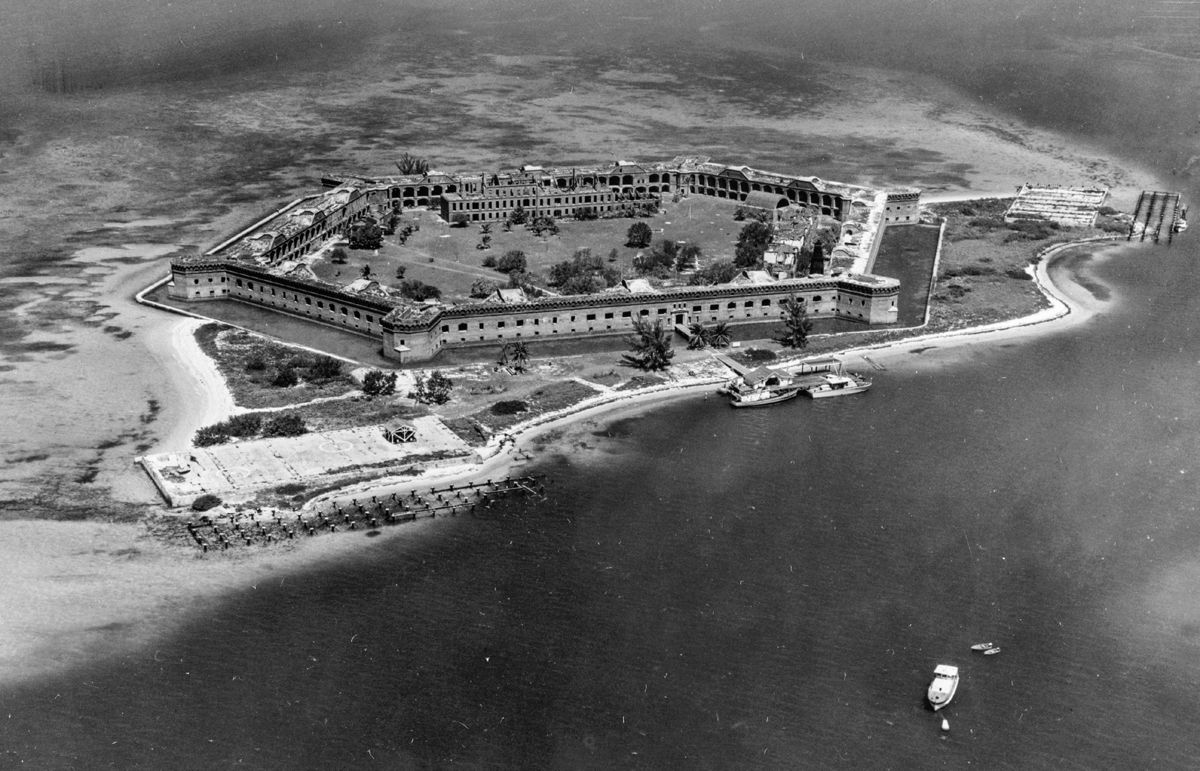
But the President also was determined, and obliged, to hold and occupy Federal property within the seceded states; this included Florida`s Fort Jefferson where construction had begun in 1846. In contrast to Fort Sumter, the apparent unimportance of the Florida forts made Federal retention relatively easy, even after Florida left the Union on January 10, 1861.
Also used as a prison from 1872–1878, it remains a ‘Federal’ outpost where the National Park Service hosts many visitors who combine history with nature, picnics on the beach, and peaceful exploration against a backdrop of silent cannons at Dry Tortugas National Park’s Garden Key.
The national landmark was designed as “an immense gun platform and heavily armed,” according to the Park Service staff. Today, only twenty-five 15-inch smoothbore Rodman cannon, each weighing around 50,000 lbs., are known to exist. They note that among the fort`s various cannon types, in addition to Parrott rifles, one of the largest was the “Rodman Cannon,” with a 15-inch bore, that could fire a 440-pound shell over 3-½ miles. ‘Rodman gun’ refers to a series of Columbiads designed by Union artilleryman Bvt. Brigadier General Thomas Jackson Rodman; these were smoothbore, heavy guns that fired both solid shot and shell. Rodman had developed a new cannon founding process, hollow casting, that resulted in cast iron guns much stronger than those previous made.
Intended for seacoast fortifications and manufactured with 8, 10, 12, 15, and 20-inch bores, “they were all nearly identical in design, with a curving soda bottle shape, and a large flat back with rachets or sockets for the elevating mechanism.”
The Project
The South Florida National Parks Trust says its 25-ton Rodman was mounted on a Maryland-made reproduction carriage in 2015. The undertaking to mount the cannon began five years earlier in 2010, according to museum curator Nancy Russell, who said at the time, “A Rodman cannon hasn’t been seen at Fort Jefferson in over 100 years.” The original gun carriages had been scrapped in 1900 leading to corrosion and deterioration of the cannon at Fort Jefferson.
A team of civilian and government experts from many backgrounds, plus the military from Homestead AFB, were enlisted in 2010 to mount the massive gun. Logistics were a major challenge as the site location was 70 miles west of Key West where accessibility was only possible by boat or seaplane. Mounting the gun and carriage 45 feet above the parade ground posed difficulties. Safety was also daunting because working with such a heavy object with a crane or helicopter was not possible.
The barrel was ultimately raised 7.5 feet with a ‘gun lift’ inspired by a circa 1876 Rodman jack designed by Colonel Theodore T.S. Laidley specifically for the 15-inch Rodman, but with a modification. With the barrel suspended, the carriage was then assembled, one part at a time, underneath the gun. The assembly was complicated because pieces weighed almost 1,000 lbs. and each had to be hauled to the terreplein.
Ongoing Conservation
The NPS contracts for continuing conservation treatment methods and coatings established by the Naval Research Laboratory’s Center for Corrosion Science and Engineering. The goal is long-term sustainability in the harsh marine environment of Garden Key.
A Side Note: Thomas Rodman, an 1841 West Point graduate who designed the gun, began his career in the Ordnance Department at the Allegheny Arsenal. During the Civil War, he served as superintendent of the Watertown Arsenal, in Cambridge, Mass., before taking command of the Rock Island Arsenal in August 1865. In addition to creating an arsenal master plan, he tested gun metal, supervised cannon manufacture, tested guns and gunpowder, and served on ordnance and artillery boards. View the Rock Island Arsenal Museum’s website at www.arsenalhistoricalsociety.org/museum for its history and visitor hours. Arsenal: Exploring Tomorrow Through Yesterday, published in 1996, is available at many university libraries. A story by the author also appeared in the Summer 2014 issue of The Artilleryman.
Joan Wenner, J.D. is a longtime history and maritime writer previously published in The Artilleryman, America’s Civil War, Military Heritage; and others. She also contributes stories and book reviews for the Civil War News. Comments are welcomed at [email protected]