Through The Lens
David vs. Goliath
By Stephanie Hagiwara · Originally published October 2019 · pp. 14–15
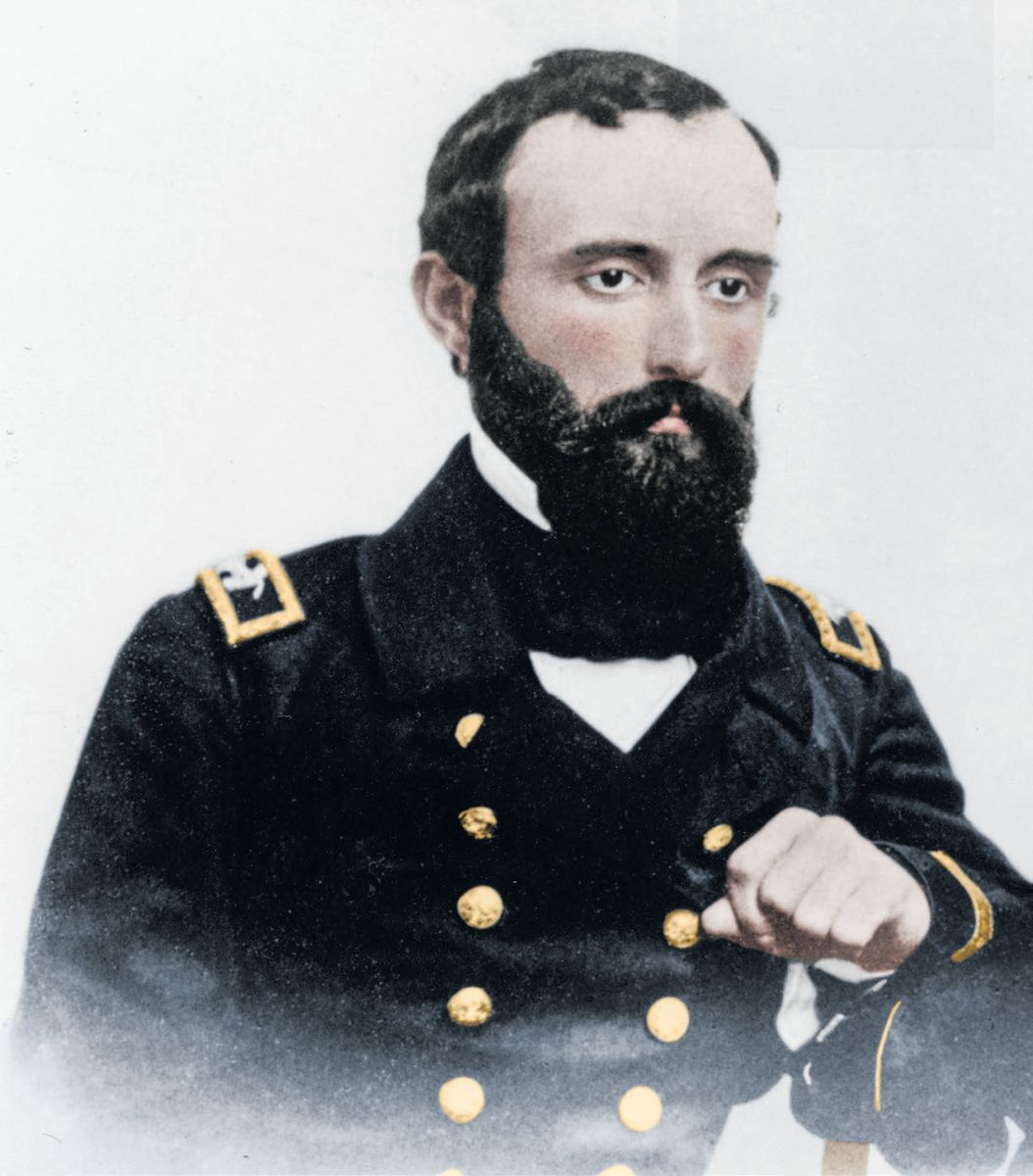
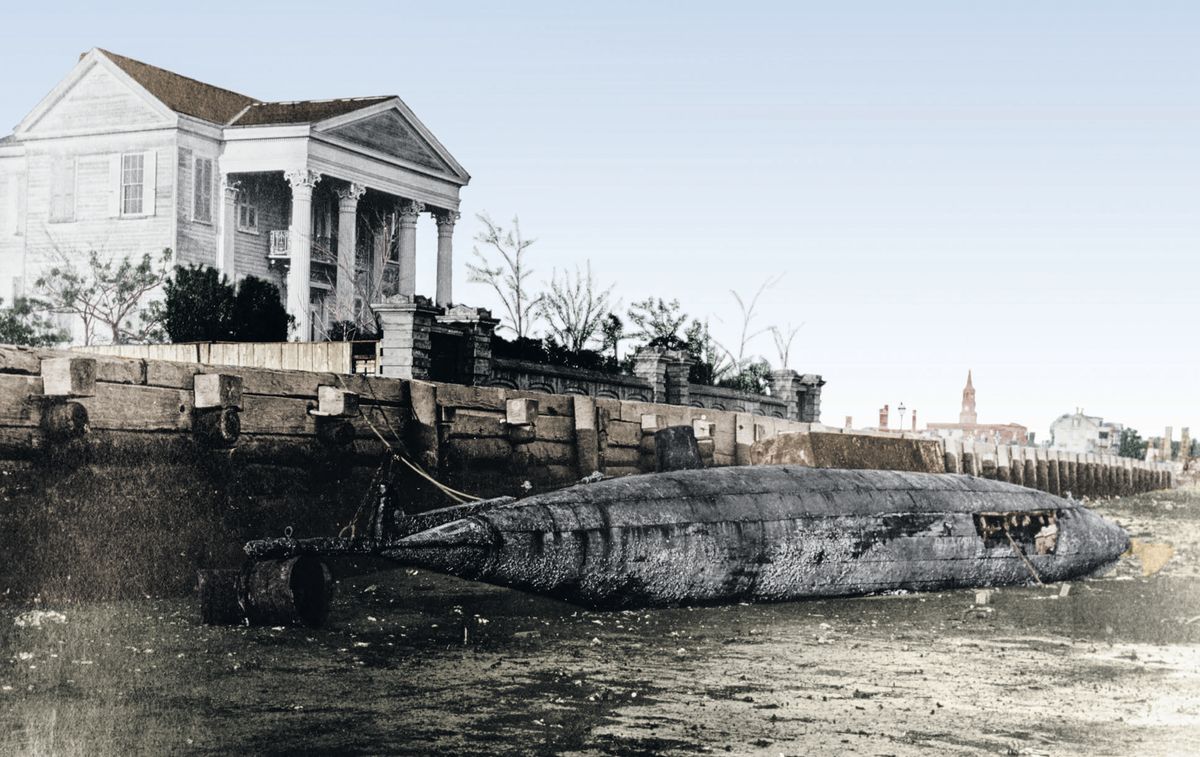
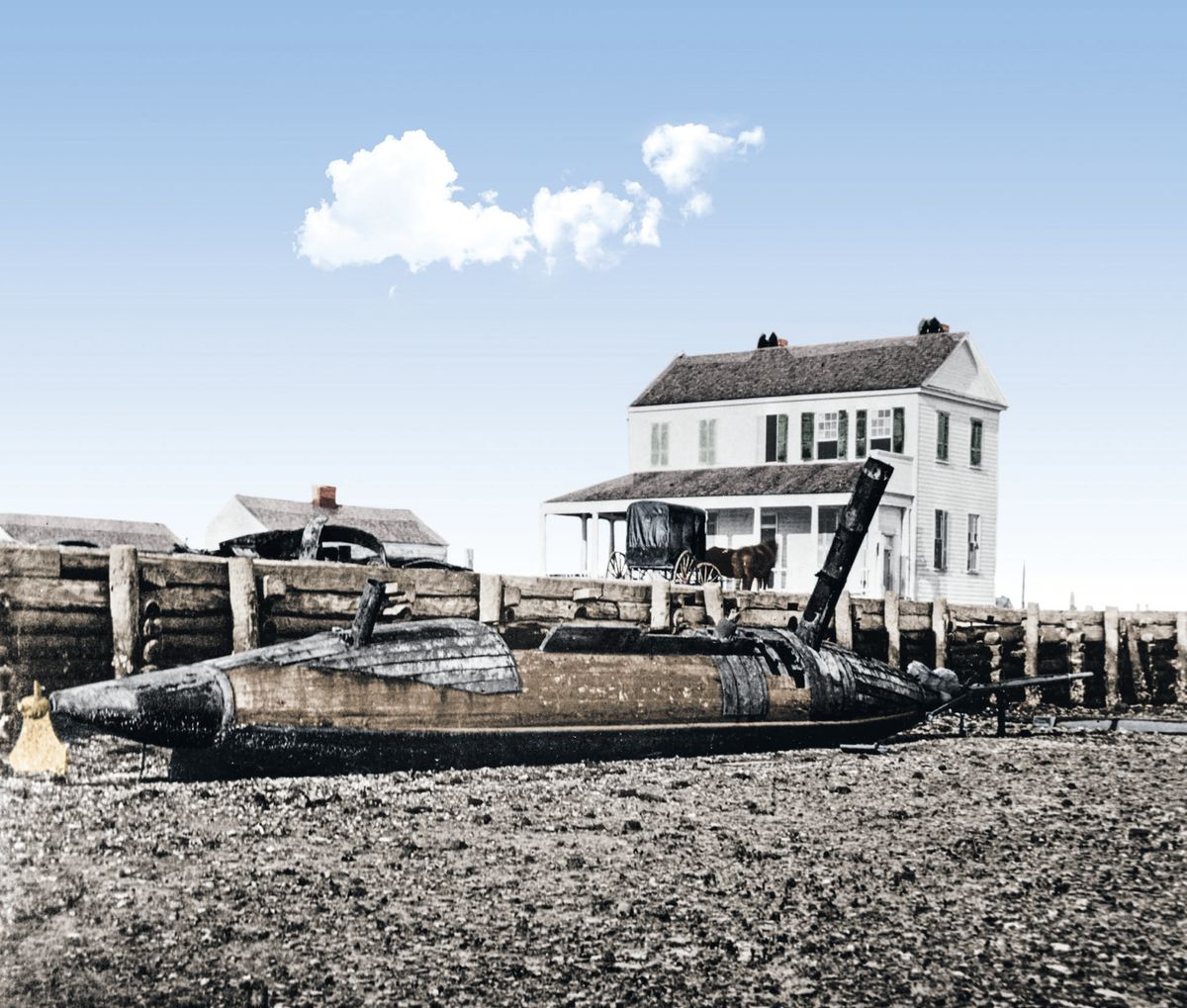
“It [was] my right, if not my duty, to act the part of a belligerent.” – C.S. Lt. William T. Glassell On September 7, 1863, the Federals captured Morris Island, Charleston, S.C., after hardfought battles. Fort Sumter still anchored Confederate control of the harbor. Furthermore, the Rebels had not lost their determination to break the blockade. Instead of competing with the North’s ability to build large vessels, C.S. Capt. Francis D. Lee obtained approval to build the first assault boat in world naval history. Lee, a successful Charleston architect, had been assigned as an engineering officer to the staff of C.S. Gen. Pierre G.T. Beauregard. Intrigued with the concept of attaching underwater explosives to enemy ships, Lee tinkered with fuses and torpedoes. With Beauregard’s encouragement, Lee designed a cooper torpedo containing one hundred pounds of gun powder. It had not one but four separate primers. Each chemical fuse was placed into a glass vial, protected by a three-inch lead tube, capped by a thin piece of metal. Denting the cap ignited the torpedo. A stealth vessel was needed to come alongside the enemy ship to position the torpedo. A 50-footlong, six-foot-wide cigar shaped boat was built. Its tallest feature was an armored iron funnel. A steam engine powered the one propeller to reach 7 knots. A fourteen-foot-long, hollow iron spar to place the torpedo was attached to the bow. Ballast tanks similar to a submarine’s, enabled her to submerge, leaving only part of her deck above the water when stalking prey. Perhaps inspired by the story of David and Goliath, she was named CSS David. William T. Glassell volunteered to serve as the David’s captain. The Virginia native had been serving as a lieutenant on the USS Hartford in the Pacific Ocean near Java when the vessel was ordered to return at the start of the Civil War. On arrival in 1862, Glassell was given the choice of taking a new oath of allegiance or being imprisoned at Fort Warren, Mass. Glassell “refused to take this oath, on the ground that it was inconsistent with one I had already taken to support the Constitution of the United States.” After eight months, he was exchanged as a P.O.W. The David was put through training runs with her crew of Acting First Assistant Engineer James H. Tomb, James Stuart as fireman, and Walker Cannon as pilot. The boat was painted blockade running grey. To make her crew “feel safe,” four double-barreled shotguns, .36 caliber Colt “Navy” revolvers, and cork life-preservers “had been thrown aboard.” Glassell chose October 5, during the change of tide at 9 p.m., for the attack. The water was smooth, the night misty, lit only by starlight. The vessel left Charleston wharf on the ebb-tide. She glided past Fort Sumter, the Federals’ picket-boats, and the campfires of the 20,000 troops on Morris Island. In the dark she waited until the nine o’clock signal to extinguish unnecessary lights had sounded and the responding “music of drum and fife had just ceased” from the surrounding boats. “It is now nine o’clock. Shall we strike her?” Glassell reportedly asked his crew. Cannon replied laconically, “That’s what we came for. I am ready.” Tomb was ready too; “Let’s go at her then, and do our best!” Sullivan agreed: “I’m with you all, and waiting. Go ahead!” The men loaded their firearms, lowered the torpedo spar and the boat raced forward. The target, the USS New Ironsides, had her fires banked and steam up in all four boilers, as part of blockade duty. She had been selected as she “threw a great deal more metal at each broadside than all of the monitors together.” A sentinel spotted the fast-moving, low lying craft (National Archives) on their starboard side. Acting Ensign Charles W. Howard leapt to the gangway hailing, “Boat ahoy! Boat ahoy!” Not receiving a response Howard warned, “Keep off or I will fire into you.” Now in range, Glassell responded with his shotgun, mortally wounding Howard. The David rushed forward, slamming the torpedo into the wrought iron hull at the waterline. The torpedo exploded with a deafening roar. “The huge ship trembled in every plate and spar throughout her length; rigging crashed to the deck; cannon leaped from their moorings; shot and shell scattered across the decks, rolling as the vessel heeled violently to port.” The blast threw an enormous plume of water into the air, falling on both boats and down the David’s smokestack extinguishing her engine fire. Both sides thought their vessel might sink. Glassell ordered his men to abandon ship. The crew leapt overboard wearing their cork vests. The Ironsides’ Marines rushed to fire their rifles and pistols at their fleeing foe. Glassell and Tomb swam away. Sullivan would be captured while clinging to the Ironsides’ rudder chains. Cannon, unable to swim, climbed back into the David as it drifted away. The Ironsides fired two 11-inch shells at the vanishing craft. Cannon plucked Tomb out of the water. Tomb restarted the engine and the David steamed back to Charleston. Glassell, swiftly swimming out of firing range, found himself alone in the cold water. He was picked up by a schooner and transferred to the guard ship USS Ottawa. Glassell and the Ottawa’s captain, Lt. William D. Whiting, knew each other from the “old” Navy. Glassell would be grateful for the connection. Whiting arranged for him to give his word not to escape instead of transporting him in chains. U.S. Adm. John Dahlgren considered, “It is desirable that this Officer should not be allowed to return here until some time has elapsed, as he could not fail to be of great service to the enemy in future operations of the same kind.” P.O.W. Glassell was returned to Fort Warren and promoted by the Confederates for “gallant and meritorious service.” Dahlgren joined the Ironsides’ crew to inspect the damage. The torpedo had struck under number six starboard gun where the coal bunker gave her additional support. Aside from the “stores thrown in confusion,” the ship suffered minor damage overall. Her assistant engineer, William S. Wells, speculated that, “If the torpedo had struck the ship on the port side we would certainly have gone down,” since the main condenser overboard discharge was “just on a line with the point where the torpedo struck on the starboard side.” Dahlgren, the inventor of the Dahlgren gun, was impressed. “Among the many inventions with which I have been familiar, I have seen none which have acted so perfectly at first trial. The secrecy, rapidity of movement, control of direction, and precise explosion indicate, I think, the introduction of the torpedo element as a means of certain warfare. It can be ignored no longer. If 60 pounds of powder, why not 600 pounds?” • • • • •
Sources: Tomb, James H. Engineer in Gray: Memoirs of Chief Engineer James H. Tomb, CSN Glassell, William T. “Reminiscences of Torpedo Service in Charleston Harbor”, Southern Historical Society Papers Luraghi, Raimondo. A History of the Confederate Navy Roberts, William H. USS New Ironsides in the Civil War Perry, Milton F., Infernal Machines: The Story of Confederate Submarine and Mine Warfare
Stephanie Hagiwara is the editor for Civil War in Color.com and Civil War in 3D.com. She also writes a column for History in Full Color. com that covers stories of photographs of historical interest from the 1850’s to the present. Her articles can be found on Facebook, Tumblr and Pinterest.